
After nearly twenty years of intercollegiate committees, the Royal College of Anaesthetists and six other colleges founded a faculty for intensive care medicine, which within two years offered the first UK training programme in the specialty alone.
Reading Library · Anesthesia Epochs · 中文版
Watch the education video (for clinicians)
2010: The Faculty of Intensive Care Medicine — Seven Colleges · Anesthesia Epochs Education Series
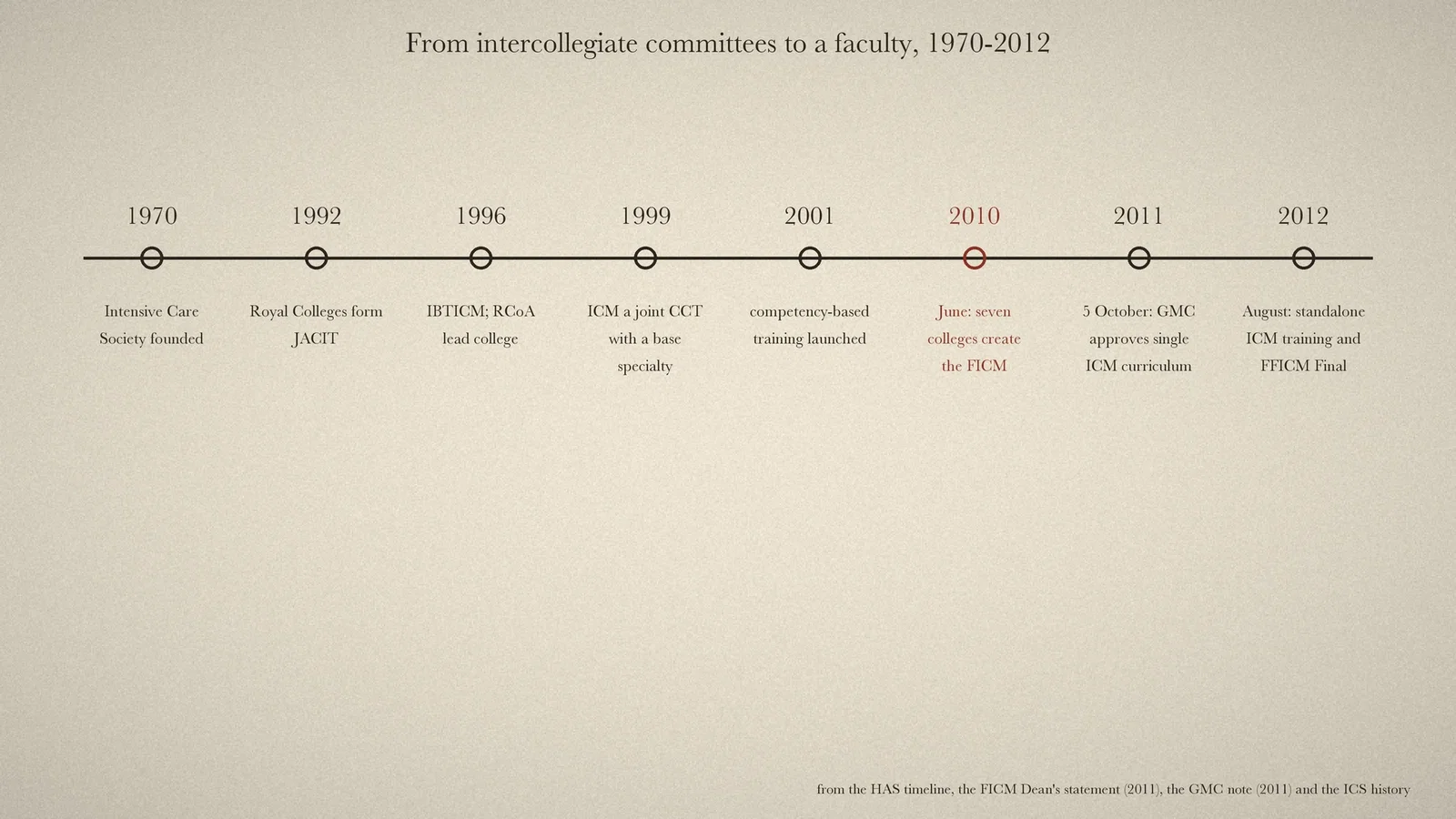
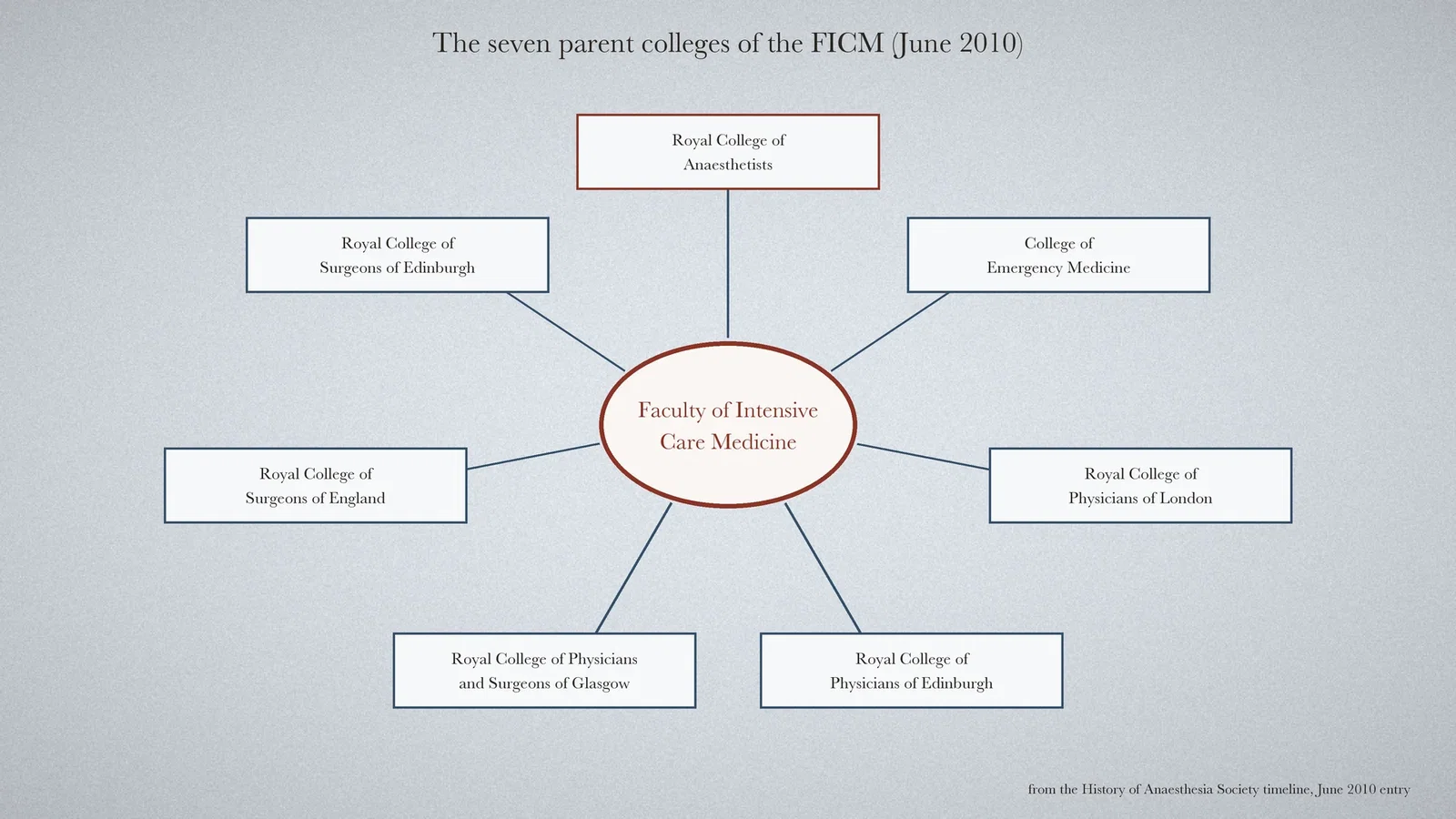
The History of Anaesthesia Society (HAS) timeline gives this entry for June 2010: the "Faculty of Intensive Care Medicine is founded by seven parent colleges". It names them as the Royal College of Anaesthetists, the College of Emergency Medicine, the Royal College of Physicians of London, the Royal College of Physicians of Edinburgh, the Royal College of Physicians and Surgeons of Glasgow, the Royal College of Surgeons of England and the Royal College of Surgeons of Edinburgh, and adds that the Faculty oversees the FFICM examinations. [1] This article is about how British intensive care medicine got a professional home of its own, and what that changed for trainees.
Before the Faculty
Intensive care in Britain long predates the Faculty. The Intensive Care Society (ICS) dates the first British intensive care unit to Mead Ward at St Thomas' Hospital, London, in 1966, and its own foundation to 8 June 1970. [8] Training, though, belonged to other specialties. The HAS timeline records that in 1992 the Royal Colleges formed the Joint Advisory Committee for Intensive Therapy (JACIT), and that in 1996 the Intercollegiate Board for Training in Intensive Care Medicine (IBTICM) superseded it, with the Royal College of Anaesthetists as lead institution. [1]
The Dean's account
The fullest contemporary account is a statement by the Dean, Professor Julian Bion, on the Faculty's early website, which survives in Internet Archive copies from 2011 and 2012. [2] It calls the foundation "an important milestone in our development of a multidisciplinary professional identity", one that took "nearly twenty years". The steps it lists match the HAS timeline and add two more: in 1999 the Minister of Health changed the Specialist Medical Order so that intensive care medicine (ICM) became a joint certificate of completion of training (CCT) taken with a base specialty, and in 2001 a competency-based training programme was launched. [2]
"In June 2010, in their role as trustees, the parent Colleges approved the creation of the Faculty of ICM," Bion wrote. The General Medical Council (GMC) then required the Faculty to develop, by January 2011, a primary specialty training programme in ICM, to run alongside dual certification. Bion called the change a "quiet revolution" and ended: "The new Faculty is not a destination. It is a starting point." [2]
First members
From January 2011 the Faculty accepted applications for Foundation Fellowship, open to NHS or Defence Medical Services consultants with a contracted commitment to ICM who were Fellows or Members of one of the trustee colleges. Trainees appointed to an ICM CCT programme had to register as Members. [2,4]
A specialty on its own
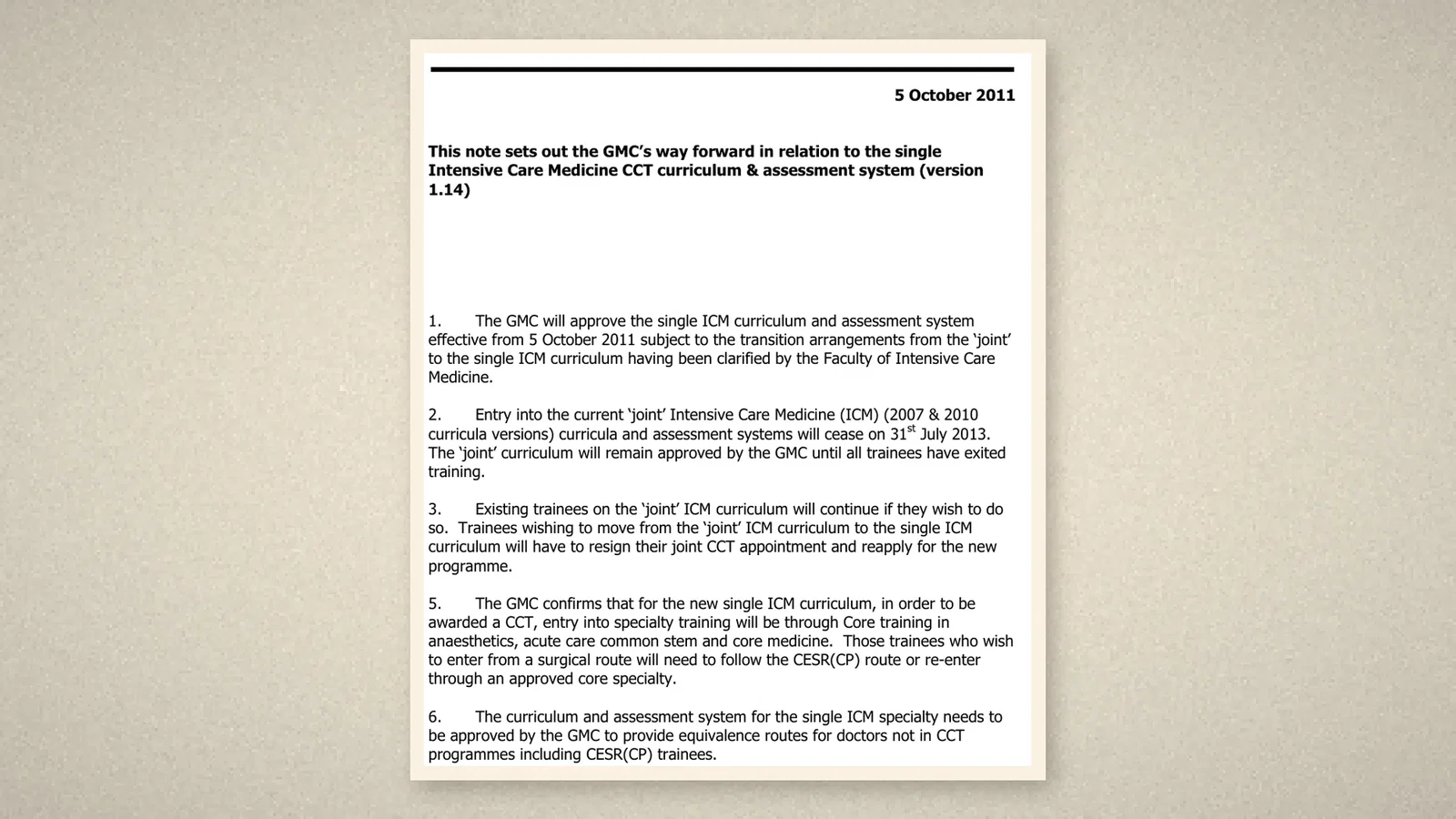
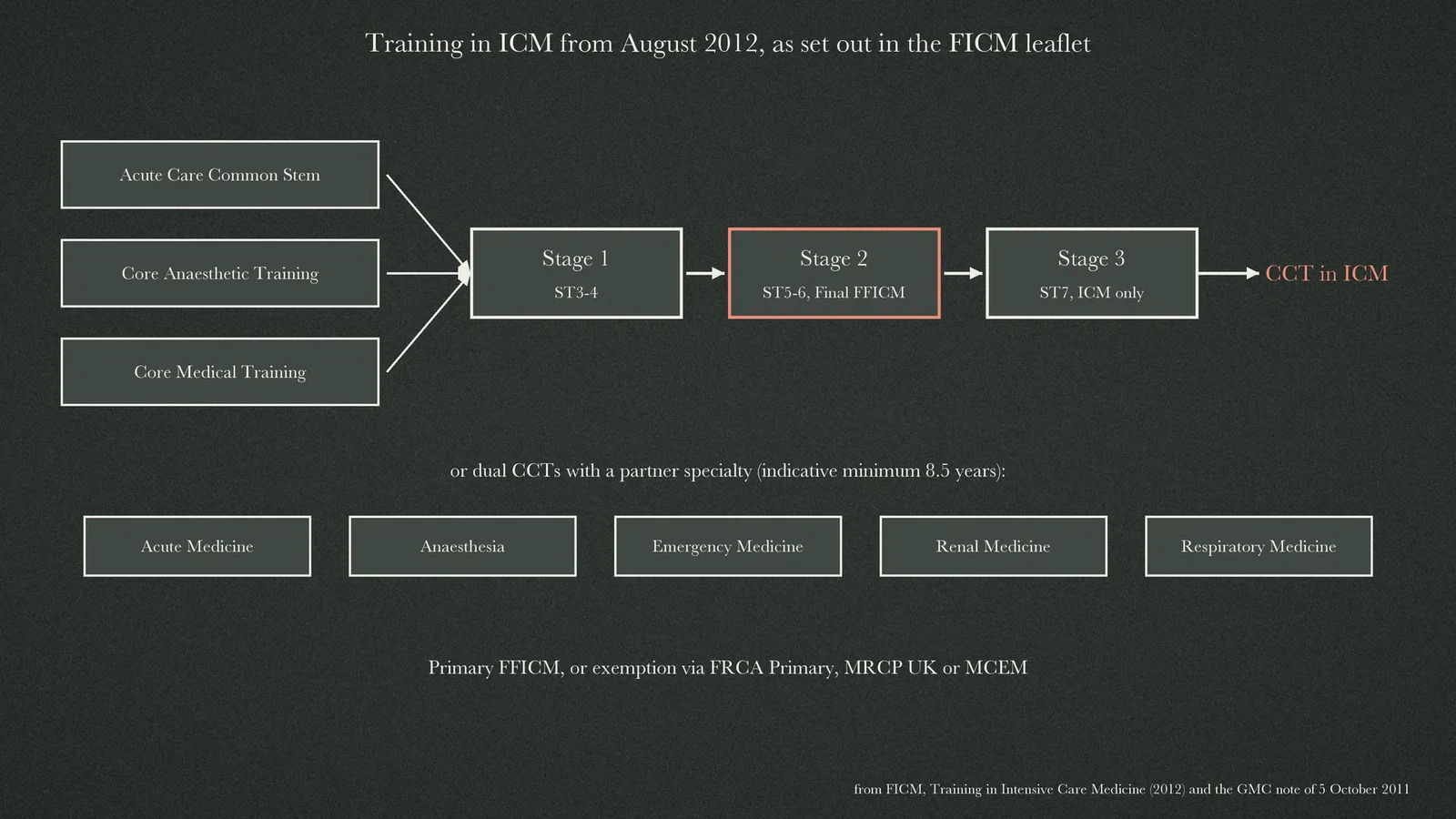
The new curriculum came quickly. The Faculty's curriculum page from early 2012 says that in 2010 it had been "tasked by the GMC to develop a new, standalone curriculum in Intensive Care Medicine". [3] A GMC note dated 5 October 2011 approved the single ICM curriculum and assessment system from that day and closed entry to the old joint programmes on 31 July 2013. Entry to the new specialty was to be through core training in anaesthetics, the acute care common stem or core medicine. [6]
The Faculty's 2012 leaflet for trainees put it simply: "For the first time it is now possible to train exclusively in ICM", although doctors could still combine it with acute medicine, anaesthesia, emergency medicine, renal medicine or respiratory medicine in dual programmes, for which 8.5 years was given as an indicative minimum. [7] The standalone programme ran from ST3 to ST7, and the new FFICM Final examination became mandatory for trainees entering from August 2012; the Faculty said the examination would draw on the Australasian FCICM. [5,7] The ICS history page also marks 2012 as the year a stand-alone UK training programme began. [8]
What the record shows
Until 2012, as the Faculty's leaflet puts it, doctors wanting to train in ICM did so "in conjunction with a 'parent' specialty". [7] In 2010 the colleges that had shared the training created a faculty to own it, and the GMC asked the Faculty for a programme that could stand alone. Anaesthesia, through the Royal College of Anaesthetists, had led the intercollegiate board and remained one of the routes into the new specialty.
Sources and reading limits
Read: Internet Archive copies of the FICM website from March 2011 to July 2012 (home page, Dean's statement in two versions, curriculum, examination and membership pages); the GMC note of 5 October 2011 (PDF, with p. 1 as a page image); the FICM 2012 training leaflet (PDF); the HAS timeline; the ICS history page.
Not covered: the current FICM website, which refused automated requests (403) and was not bypassed; the colleges' resolutions of June 2010; the Faculty's first regulations, which were not archived; any journal article on the founding (none was found in PubMed). The sources read do not give the exact day in June 2010. Most of the path from 1992 rests on the Dean's own statement, checked where possible against the HAS and ICS timelines.
One illustration is a crop of the GMC note; three are drawn from the sources.
- History of Anaesthesia Society. Timeline. Website
- Bion J. Dean's statement. Faculty of Intensive Care Medicine; 2011. Archived copy
- Faculty of Intensive Care Medicine. ICM CCT curriculum. 2012. Archived copy
- Faculty of Intensive Care Medicine. Membership. 2011. Archived copy
- Faculty of Intensive Care Medicine. FFICM examination. 2012. Archived copy
- General Medical Council. Delivery of the single Intensive Care Medicine curriculum & assessment system. 5 October 2011.
- Faculty of Intensive Care Medicine. Training in Intensive Care Medicine: a guide to the UK CCT programme. 2012.
- Intensive Care Society. A history of intensive care. Website
Continue exploring
Related reading connects shared questions and contexts; it does not by itself establish historical influence.
- 1970: Alan Gilston Drafts the Rules of an Intensive Care Society
- 1988: The Faculty of Anaesthetists Becomes a College
Anesthesia Epochs · The Source Room · About & Editorial Method
Published November 2, 2026. Sources and reading limits are stated above. Illustrations are labelled as original source images or AI-made. Historical accounts are educational; they are not current treatment instructions.