Virginia Thatcher's 1953 history records that Sister Mary Bernard entered St. Vincent's Hospital in Erie to study nursing in 1877 and within the year took on anesthetic duties, citing a personal communication from the Wichita congregation.
Reading Library · Anesthesia Epochs · 中文版
Watch the education video (for clinicians)
1877: Sister Mary Bernard — One Sentence, One Footnote · Anesthesia Epochs Education Series
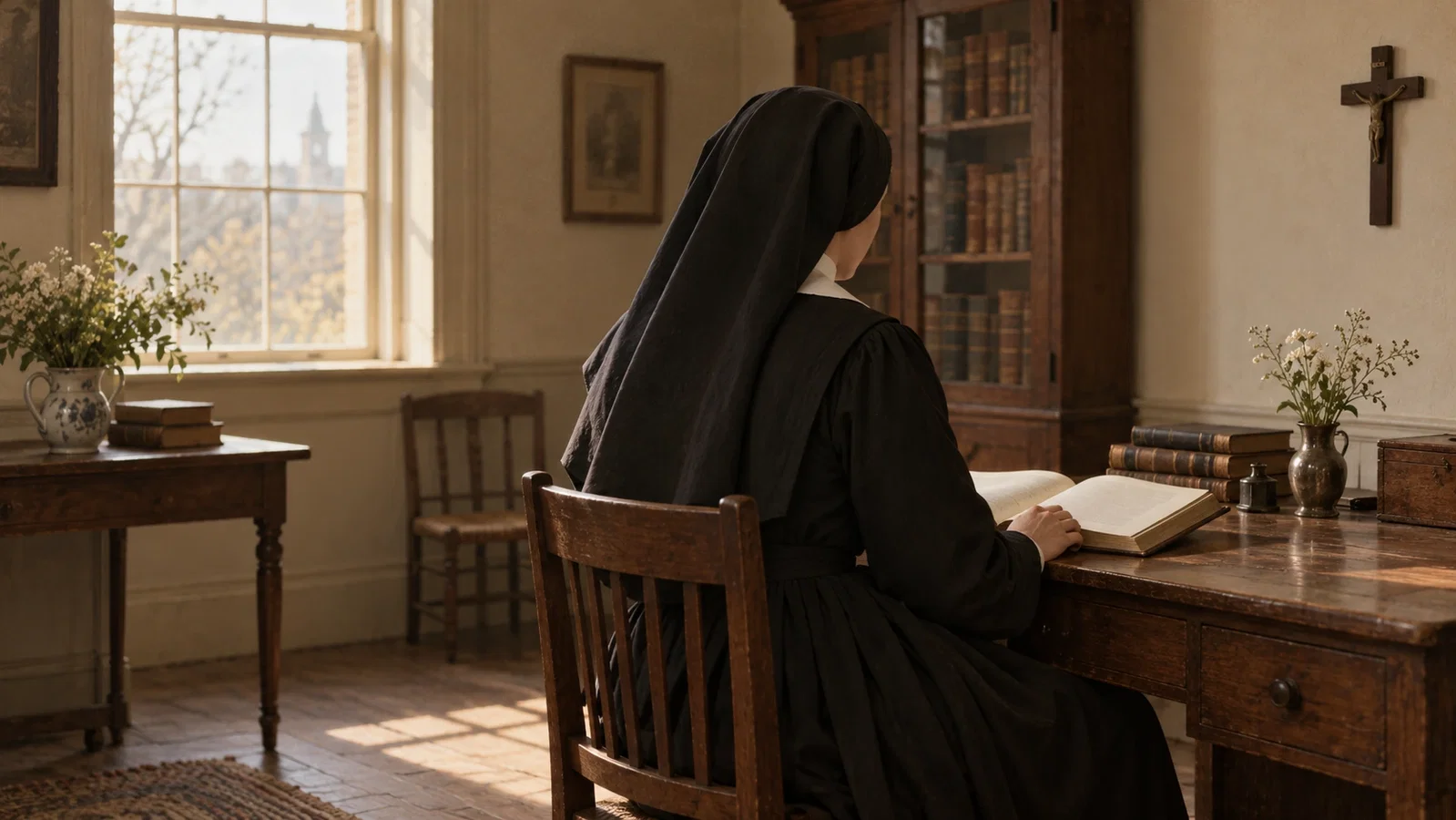
An original imagining of nursing study in the 1870s: an unnamed sister reading at a wooden desk. The person, clothing details and room are editorial elements, not a portrait of Mary Bernard or a documented lesson.
Sister Mary Bernard occupies only a short paragraph on page 54 of Virginia S. Thatcher’s 1953 history of anesthesia. In 1877, the account says, Mary Bernard entered St. Vincent’s Hospital in Erie, Pennsylvania, to study nursing, and within the year was called upon to take on anesthetic duties. [1, p. 54]
A small reference number follows the sentence. Footnote 17 leads to a personal communication from the Mother Superior of the Sisters of St. Joseph of Wichita. [1, p. 54, note 17]
A name that later entered professional timelines thus has a specific place in this history, preserved through a religious community’s correspondence. That connection matters. So does the kind of record we are reading.
Hospital entry and anesthetic work were separate steps
Thatcher’s sentence contains two actions: entering the hospital to learn nursing, then assuming anesthetic duties. The year 1877 directly dates the first. The second follows with the words “within the year.” No month, day, patient or operation identifies a first anesthetic in that paragraph. [1, p. 54]
This article therefore uses 1877 as its chronological entry and identifies it as the year of entry into nursing. It supplies no invented inaugural operation and does not force the relative wording into a definite event in 1878.
The paragraph also associates Mary Bernard with the founding of the Wichita community in 1888. That helps identify the person and makes the origin of the footnote intelligible. [1, p. 54] The communication itself is not covered here. Its date, individual signatory and underlying earlier records cannot be reconstructed from the short citation alone.
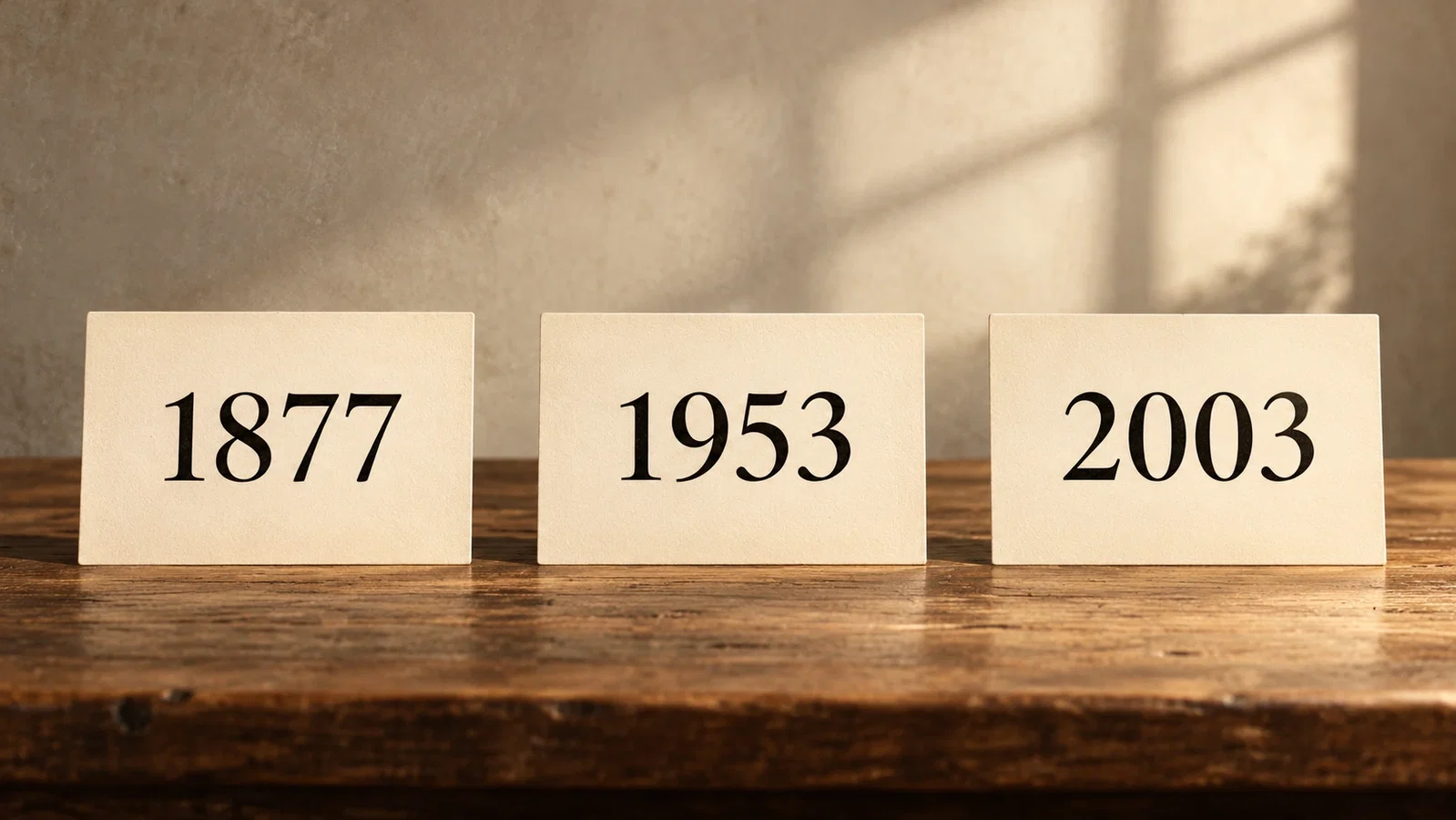
Modern editorial cards distinguish 1877, 1953 and 2003: entry into nursing, publication of the historical book, and later commemoration. They do not represent stages in one training program or three original case records.
Attention developed within a division of work
On the preceding page, Thatcher considered what surgical services had expected of an anesthetist. Thatcher placed sustained attention to anesthesia and freedom from distraction by learning surgery alongside acceptance of a subordinate position and comparatively low pay. [1, p. 53]
That account gives professional development a social setting. A need for someone to concentrate on anesthesia did not itself create an independent position, a complete curriculum or a uniform qualification. Skilled attention to patients operated within arrangements about authority, remuneration and responsibility.
This remains a historian’s interpretation, published in 1953. It is not treated here as a rule followed by every hospital. Nor are historical expectations of subordination and low pay endorsed as present-day standards. Attention to a task does not establish an innate advantage associated with sex or profession.
The surrounding pages record the work of other nursing sisters. Thatcher acknowledged that the evidence remained fragmentary, and considered the record of nurses administering anesthetics in lay hospitals even less complete. [1, pp. 54–56]
Those other women’s experiences cannot become Mary Bernard’s technique. How one sister decided when to give more anesthetic, or how another watched patients, must remain attached to the person described. No case series, anesthetic notebook or teaching manual written by Mary Bernard is known to this article.

A blank envelope and closed book represent correspondence entering a historical account. These are original editorial objects, with no fabricated message, handwriting or addressee.
A marker preserved the starting point as learning
In a photograph published by the Women Religious Archives Collaborative, a marker identifies Sr. Bernard Sheridan, 1860–1924. It describes entry into Saint Vincent Hospital to study nursing in 1877, followed by developing expertise in anesthesiology. The bottom bears the Pennsylvania Historical and Museum Commission’s name and the year 2003. [2, marker image]
The congregation’s own short commemorative article dates the unveiling to 26 September 2003. Its webpage date, 27 March 2025, belongs to the later web publication. [3, opening paragraph]
That article honors Mary Bernard as America’s first formally educated nurse anesthetist. The phrase does not supply an 1877 curriculum, examination or certificate, and cannot be converted directly into a present-day credential. The photographed marker celebrates learning and expertise without claiming a worldwide first. [2–3]
The accompanying portrait was also inspected, but its photographic date was not verified. It cannot simply supply the appearance of the learner in 1877.
A person survives, with gaps still visible
An unnamed sister passing a quiet ward doorway, imagined in period. The scene represents hospital learning and work, not an authenticated anesthetic, building or patient.
The year 1877 need not become a fully reconstructed “first” to deserve a place in the timeline. A paragraph and its footnote preserve a particular person’s place in professional history. They also show why recovering a name and recovering every detail of the work are different achievements.
Sources and reading limits
Read: Thatcher’s History of Anesthesia (1953), pp. 53–56, with note 17; the Women Religious Archives Collaborative page on Sister Mary Bernard Sheridan and its photograph of the 2003 marker; the congregation’s short article on the unveiling.
Not covered: the personal communication cited in note 17; any 1877 case book, training record or record of a first anaesthetic; the rest of the 1953 book. The marker and the later institutional accounts are not contemporary clinical records, and the congregation’s pages are not treated as independent evidence of the work. The 2003 web wording about a discovery is not taken to mean the career was unknown before then, since the 1953 book already names Mary Bernard. Priority, a complete curriculum and patient outcomes are not judged here. The four illustrations are AI-made interpretive images, not historical evidence.
- Thatcher VS. History of anesthesia, with emphasis on the nurse specialist. Philadelphia: Lippincott; 1953. HathiTrust
- Women Religious Archives Collaborative. Sr. Mary Bernard Sheridan. Web page
- Sisters of St. Joseph of Northwestern Pennsylvania. Sister Mary Bernard makes history. 2025. Web page
Continue exploring
Related reading connects shared questions and contexts; it does not by itself establish historical influence.
- 1899: Alice Magaw Makes Time for Anesthesia
- 1931: Hodgins Organizes NANA Around an Educational Program
Anesthesia Epochs · The Source Room · About & Editorial Method
Updated October 30, 2026. Sources and reading limits are stated above. Illustrations are labelled as original source images or AI-made. Historical accounts are educational; they are not current treatment instructions.