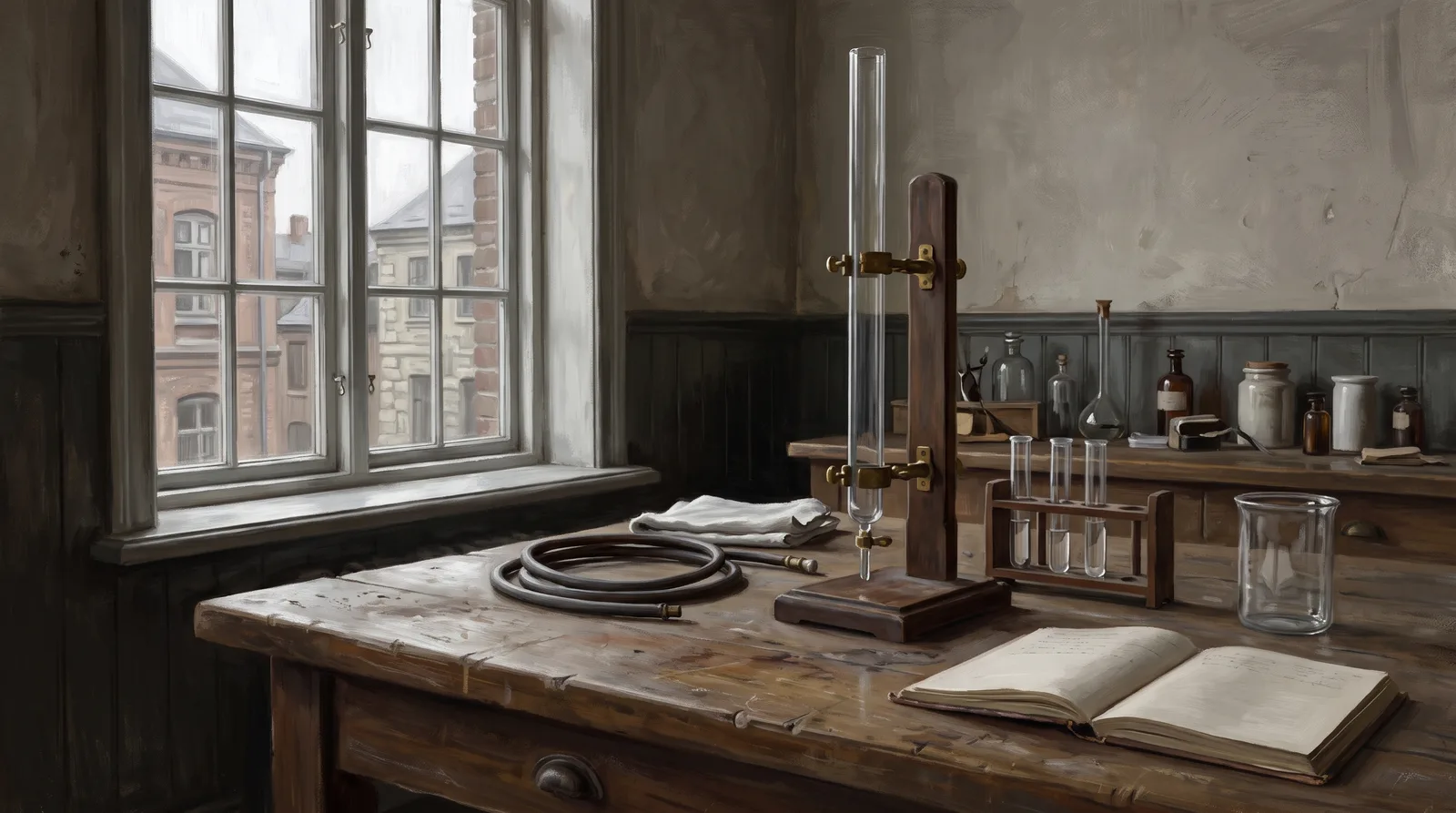
In September 1891 Heinrich Quincke reported 22 lumbar punctures in ten patients, measuring the pressure of the cerebrospinal fluid and recording mostly short-lived responses, and proposed that the fluid might also help diagnosis.
Reading Library · Anesthesia Epochs · 中文版
Watch the education video (for clinicians)
1891: Quincke's Lumbar Puncture — After Measuring Pressure · Anesthesia Epochs Education Series
After six punctures, seven-year-old Gretchen went home on 18 August 1891. Gretchen’s family had sometimes thought that Gretchen walked better for a few days after a procedure. The improvement did not last, and similar fluctuations had occurred beforehand. Quincke did not record a cure: there had been no substantial change in the child’s general condition or ability to move. [1, p. 931]
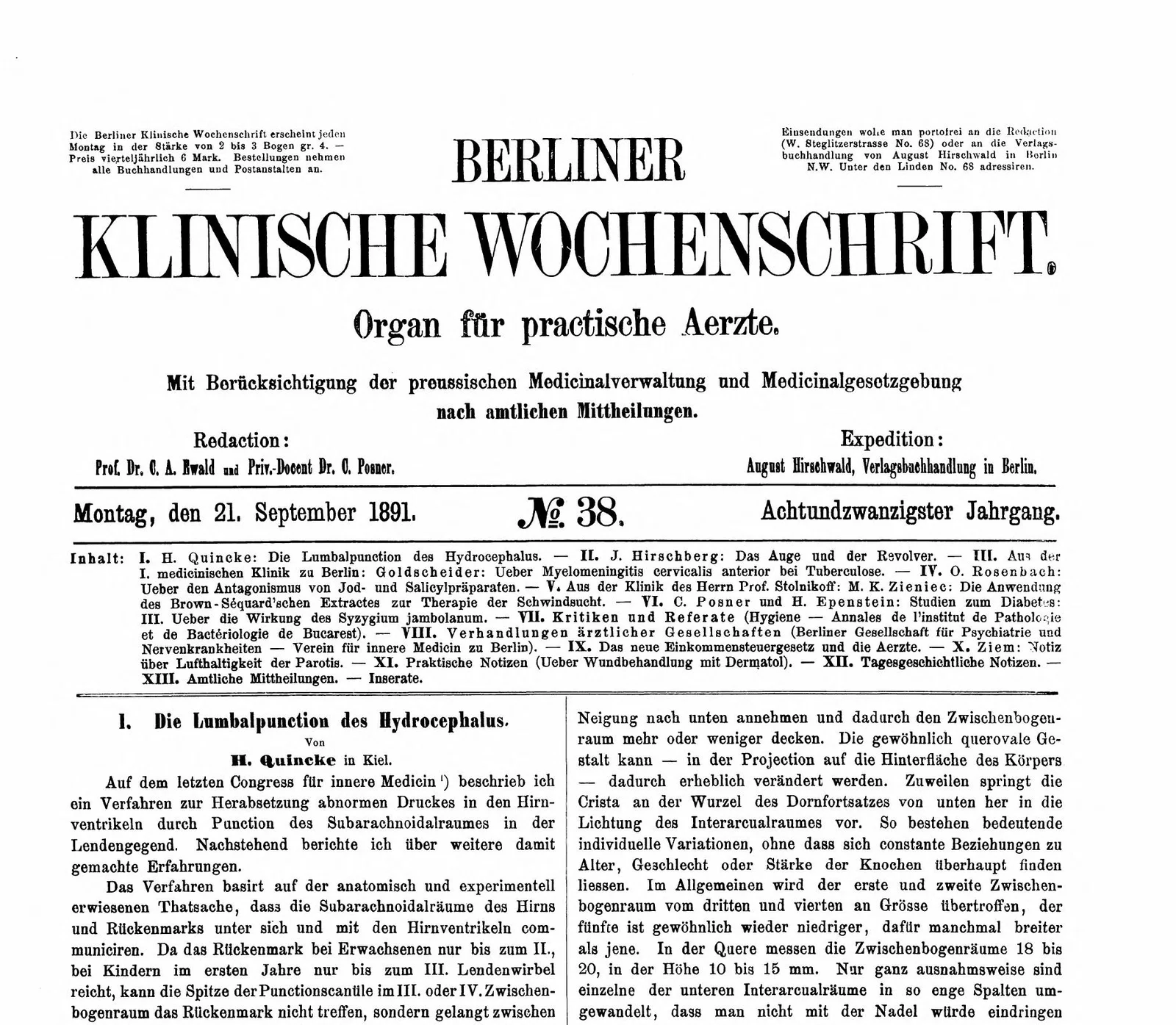
Gretchen’s case separates two questions in the early history of lumbar puncture. Reaching cerebrospinal fluid and measuring its pressure did not necessarily mean knowing how to alter the course of disease. Quincke’s report, published in two installments on 21 and 28 September 1891, described a route for observation while preserving instances in which therapeutic hopes were disappointed. [1, pp. 929–933, 965–968]
A question of pressure
The opening recalled a method Quincke had presented at an earlier congress of internal medicine: approaching the subarachnoid space in the lumbar region to reduce abnormally elevated fluid pressure. The article added further experience. [1, p. 929]
Quincke described an arrangement involving a hollow needle, rubber connections and a glass tube. The fluid column moved with respiration and the pulse; changes in position or straining could alter the reading. A cessation of flow might reflect an obstructed needle opening rather than resolution of the pressure problem. [1, pp. 929–930]
Nor was the technique uniform across the report. In attempts to maintain drainage, some cases included incising the dura with lancet-type instruments. [1, pp. 930–932]
Twenty-two procedures, ten patients
The author’s summary counted 22 punctures in ten patients: five adults and five children. [1, p. 967] Procedures and patients are different denominators. Conditions, stages of illness, numbers of interventions and techniques varied. They do not support a tidy overall success rate.
Gretchen was not the only case requiring a distinction between a response and a durable benefit. In Bertha’s account, drainage was followed by temporary reductions in fontanelle tension and neck stiffness, which then returned. Bertha’s condition deteriorated, the child died on 1 September, and the autopsy recorded widespread tuberculosis. [1, pp. 932–933] Temporary decompression was far from a cure of the underlying illness. These observations alone also do not establish that puncture caused the death.
At the end of the paper, Quincke set out the outcomes case by case. [1, p. 968]
Case numbers | The author’s assessment of puncture |
1 | The only cure Quincke attributed to puncture |
8 and 9 | Probably no substantial effect; recovery attributed to other treatment |
5, 6 and 7 | Temporary improvement in pressure-related symptoms |
2, 3, 4 and 10 | No clear effect |
These are the author’s judgments, not controlled estimates of efficacy. Patients marked as recovered in the table cannot all be recounted as cures produced by lumbar puncture.
A number still needed interpretation
On page 967, Quincke acknowledged lacking a reliable reference for normal pressure in adults. The absolute pressure in these cases was not proportional to the severity of symptoms. Quincke considered possible contributions from the speed of pressure increase and the state of the circulation, rather than treating a reading as a complete account of illness. [1, p. 967]
Quincke also argued that cranial and spinal fluid spaces might not communicate freely in every pathological condition. Pressure in one therefore need not represent pressure in the other. Meanwhile, the withdrawn fluid offered observations of color, protein and blood. The closing passage proposed diagnostic uses for puncture. [1, pp. 967–968]
The report thus went beyond removing fluid. Observation extended from outward symptoms to pressure changes and fluid characteristics. Its physiological explanations and diagnostic possibilities nevertheless belong to the evidence available in 1891. They are not substitutes for modern reference ranges, diagnostic criteria or indications.
Quincke expressly considered the case series too small to define indications precisely. The paper discussed possible dangers, including hemorrhage and nerve-root injury, while stating that these adverse events had not yet occurred in Quincke’s own cases. [1, p. 968] That statement about personal experience cannot establish general safety.
Reading alongside Wynter and Bier
On page 930, Quincke directly cited Wynter’s report of 2 May 1891 and compared its drainage methods. [1, p. 930; 2, pp. 981–982] This establishes a documentary connection at the time of writing. It does not show that Wynter supplied Quincke’s original idea or settle every question of priority.
On page 361 of an 1899 paper, Bier explicitly named Quincke’s lumbar puncture and described introducing cocaine through that route. [3, p. 361] A specific change of purpose can be identified: the 1891 paper concerned decompression, measurement and possible diagnosis, whereas Bier’s passage concerned drug-induced analgesia. The connection can be described without turning the two reports into one discovery or claiming that the later spinal-anaesthesia work had already been accomplished in 1891.
Quincke’s paper deserves its own place partly because it did not preserve only successes. A fluid column could be seen and a sample examined, yet therapeutic responses remained uneven, and measured pressure did not straightforwardly match symptoms. Those discrepancies are part of the history of the technique too.
Sources and reading limits
Read: the complete Quincke contribution, printed pages 929–933 and 965–968, in the public Internet Archive scan of the 1891 volume; Wynter’s two-page article; and page 361 of Bier’s 1899 paper. [1–3]
Not covered: Quincke’s earlier congress paper, the original case charts and questions of worldwide priority. Dates and ages sometimes differ between Quincke’s table and case narratives: for case 6, the table gives 5 April for the first puncture and 9 May for the terminal puncture, while the narrative gives 3 April and 10 May; both are left as printed.
- Quincke H. Die Lumbalpunction des Hydrocephalus. Berliner klinische Wochenschrift. 1891;28:929–933 (21 September);965–968 (28 September). Original volume scan.
- Wynter WE. Four cases of tubercular meningitis in which paracentesis of the theca vertebralis was performed for the relief of fluid pressure. Lancet. 1891 May 2;I:981–982. Original two pages.
- Bier A. Versuche über Cocainisirung des Rückenmarkes. Deutsche Zeitschrift für Chirurgie. 1899;51:361–369. Zenodo.
Continue exploring
Related reading connects shared questions and contexts; it does not by itself establish historical influence.
Anesthesia Epochs · The Source Room · About & Editorial Method
Published November 2, 2026. Sources and reading limits are stated above. Illustrations are labelled as original source images or AI-made. Historical accounts are educational; they are not current treatment instructions.