In May 1832 Latta reported that saline injected into a vein brought back a dying cholera patient's pulse, but she relapsed and died hours later.
Reading Library · Anesthesia Epochs · 中文版
Watch the education video (for clinicians)
1832: Thomas Latta's Cholera Letter — After the Pulse Returned · Anesthesia Epochs Education Series

On 23 May 1832, Thomas Latta wrote from Leith to the secretary of the Central Board of Health in London. His friend Lewins had conveyed the board’s wish for a detailed account of his treatment of cholera by intravenous saline injections. Latta acknowledged that his observations were limited, while already expressing considerable confidence in the method.[1, p. 5]
The letter’s most memorable scene concerns an older woman. The usual remedies had failed, and Latta thought her near death. At first he saw no change during the injection. Then breathing appeared easier, a pulse returned at the wrist, her extremities grew warm and her voice regained strength.[1, pp. 5–6]
The account continues beyond that transformation.
The moment he thought she was safe
This was his first case. Believing his patient secure, Latta left her in the hospital surgeon’s care while he went to rest. Vomiting and diarrhea returned, followed by renewed collapse. She died five and a half hours after he left.[1, p. 6]
Latta believed that repeating the intervention would have produced a better outcome. That was his judgment about an unrealized possibility. The recorded outcome remained death; a returning pulse cannot turn this into a story of the first patient being cured.[1, p. 6]

Later on the same page, Latta warns that changes gratifying to both patient and physician must not lead the physician to relax his care. His account moves from an arresting bedside impression to concern about the subsequent course. Preserving that transition reveals more than stopping at the return of the pulse.[1, p. 6]
A reading that suggested an intervention
Latta identified his inspiration: a review in The Lancet of O’Shaughnessy’s report on the chemical pathology of cholera. He understood the illness as involving a deficiency of water and salts in the blood. He first tried oral and rectal fluids, reported no lasting benefit, and then decided to introduce fluid directly into the circulation.[1, p. 5]
This establishes the reading and reasoning Latta described. O’Shaughnessy’s original report is not covered here. These nineteenth-century attempts are not a comparison of modern fluid treatments, and the historical salt mixture cannot simply be called today’s 0.9% normal saline.[1, pp. 5–6]
Another patient, a woman aged 50, also experienced improvement followed by renewed illness and further injections. Latta reported her convalescent when he wrote. Other passages describe deaths and offer explanations for failure. Hope and disappointment coexist in the letter; the author’s explanations are not themselves comparative evidence establishing causation.[1, p. 7]
A letter, two dates and a reprint across the Atlantic
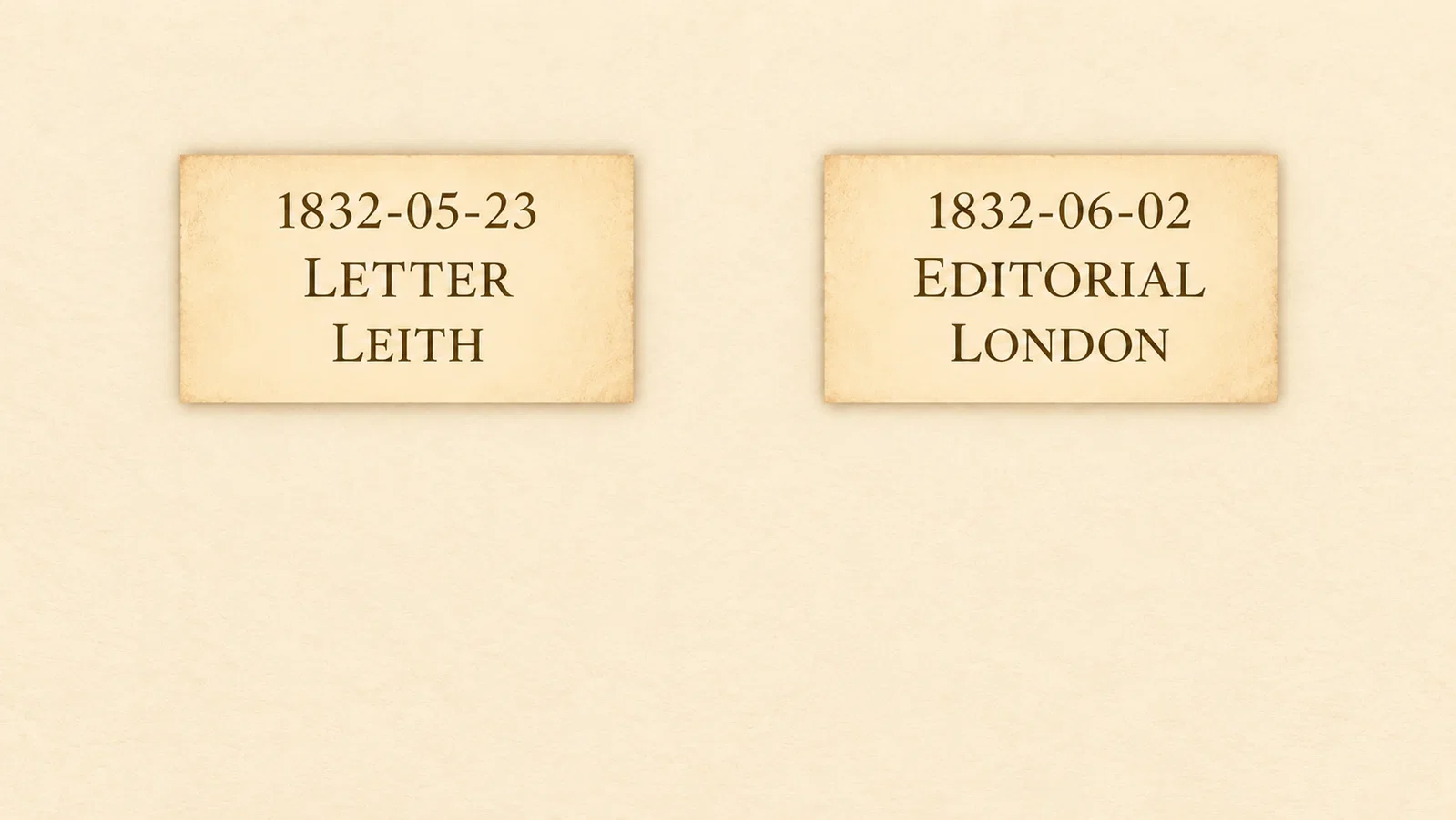
The source used here is an 1832 New York pamphlet held by the US National Library of Medicine. Its title page identifies the contents as coming from the London Lancet. The June 2 editorial welcomes the reports enthusiastically and places them beside earlier discussions of intravenous remedies and transfusion.[1, title page, pp. 3–4] That enthusiasm is part of the historical evidence. It cannot supply the follow-up or independent evidence of safety that the cases lack.
Near the end of his letter, Latta also mentions the hazards of introducing air and causing phlebitis.[1, p. 8] His confidence, awareness of risk and unfavorable outcomes all belong in the reading. Historical recipes and procedural details are not reproduced as instructions here.

The Major 1664 article offers a comparison of documentary forms. Major presented an infusion proposal still within the bounds of conjecture, awaiting experiments. Latta supplied patient narratives together with his interpretation of them.[2, title page, p. 12; 1, pp. 5–8] This comparison does not establish direct influence between the authors.
Latta’s letter has a place on the timeline that depends on the whole course: he witnessed striking improvement and recorded deaths that followed it.
Sources and reading limits
- A Full Account of the Operation of Injecting the Veins with Aqueous and Saline Liquids, for the Cure of Malignant Cholera, in the Most Hopeless Cases. New-York: Peter Hill; 1832. Read: the title page, the editorial (pp. 3–4) and Latta’s complete letter (pp. 5–8). Citations use this reprint’s printed pagination. It was not compared with the original London issue, and the later reports in the pamphlet are not covered.
- Major JD. Prodromus inventae a se chirurgiae infusoriae. Leipzig; 1664. Only the title page and p. 12 are used here.
Material limits: This article uses a contemporary reprint for a bounded account. It does not adjudicate global priority, long-term safety or every case outcome. All four images are original historical imaginings or modern editorial illustrations.
Continue exploring
Related reading connects shared questions and contexts; it does not by itself establish historical influence.
Anesthesia Epochs · The Source Room · About & Editorial Method
Updated October 30, 2026. Sources and reading limits are stated above. Illustrations are labelled as original source images or AI-made. Historical accounts are educational; they are not current treatment instructions.