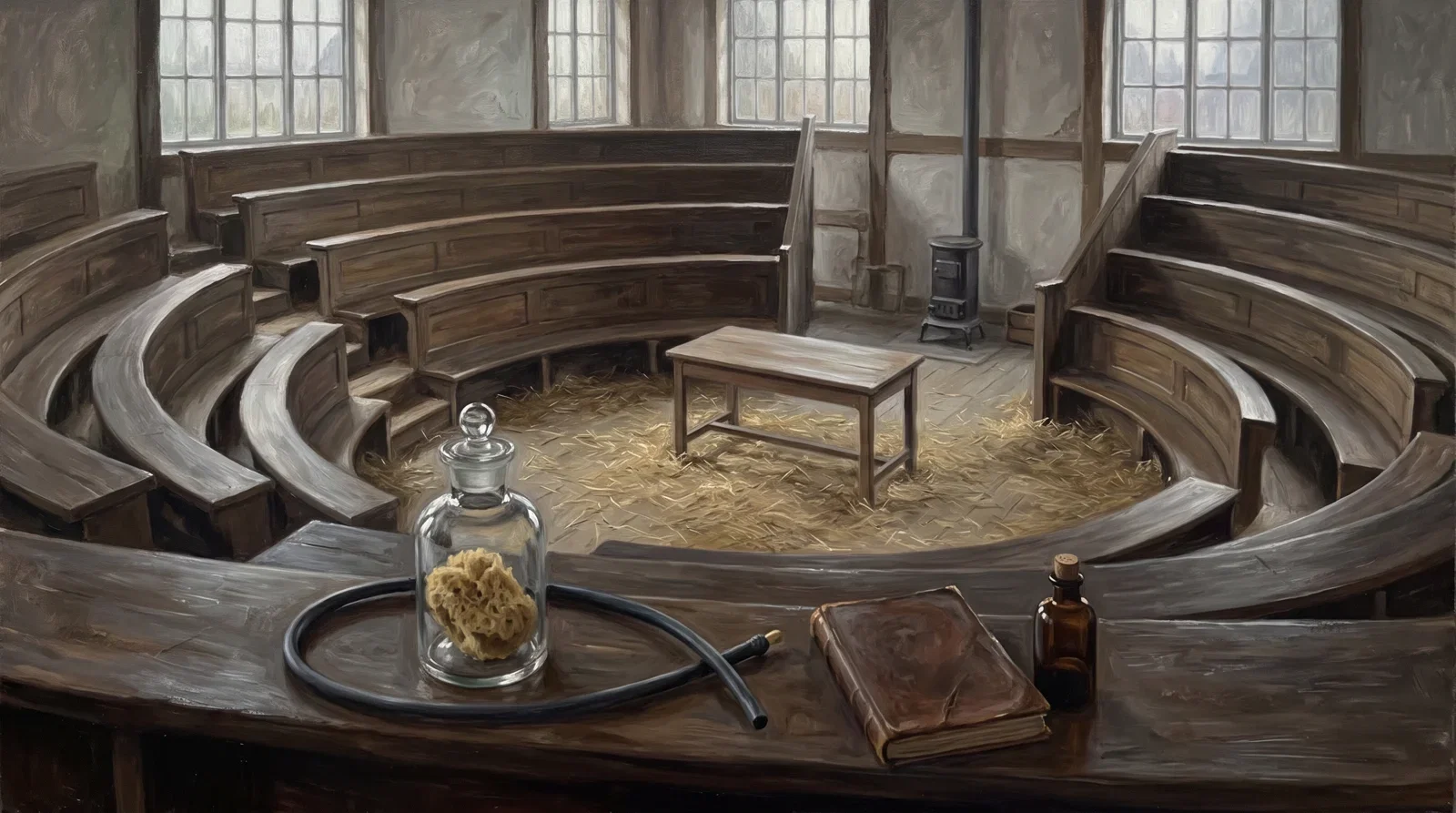
In March 1847 The Veterinarian reprinted reports of a horse given ether for neurotomy and a sheep given ether for amputation at the Royal Veterinary College.
Reading Library · Anesthesia Epochs · 中文版
Watch the education video (for clinicians)
1847: Ether in Animal Patients — A Horse and a Sheep · Anesthesia Epochs Education Series
The sheep could scarcely put her foot to the ground without pain. According to an account published in 1847, a disease of the hock had troubled her for months and was considered incurable. She was brought into an operating theatre, given ether by inhalation, and underwent amputation.[1, p. 148]
In this passage, the animal had a disease of her own and an operation intended to address it. Her presence in the history of anaesthesia was more than that of an experimental subject used to discover what a substance could do.
A horse with chronic lameness appears on the same page. Together, the accounts give substance to a timeline entry about veterinary anaesthesia: particular animals, indications for intervention, observations, and limits to what the record can establish.
Two patients on a page of collected reports
The March 1847 issue of The Veterinarian carried “Additional Observations on the Effects of the Inhalation of Æther on Animals,” signed “Ed. Vet.” It was a compilation of communications, experiments and newspaper reports. The horse and sheep passages were explicitly taken from Bell’s Life in London.[1, pp. 145–149]
At the Royal Veterinary College, Spooner had performed neurotomy on a horse whose chronic forefoot lameness was attributed to navicular disease. The report describes about thirteen minutes of inhalation before the animal fell forward. It judges the division of the nerves to have produced no manifestation of pain, while also recording a slight convulsive movement of the limb.[1, p. 148]
Both observations belong in the account. The movement did not disappear from the report, and the observer did not treat it as overturning the judgement about pain. We can read how a response was seen and interpreted without pretending that the paragraph directly measures the horse’s subjective experience.
The same passage records recovery from ether’s effects within twenty-three minutes, but the starting point for that interval is not sufficiently clear in the excerpt. Subtracting thirteen from twenty-three would invent a precise ten-minute recovery period. Nor does immediate recovery establish the eventual result for the original lameness.[1, p. 148]
Simonds, at the same institution, performed the sheep’s amputation. The account says that ether’s influence was evident after about five minutes, that the operation occupied about six, and that within twenty minutes of the commencement the animal had regained sensation and consciousness and was removed from the theatre.[1, p. 148]
Those numbers show how the reporter described the sequence. They are not a transferable schedule for administering an anaesthetic. The passage does not tell us how long the sheep subsequently lived or how the wound healed.
Treatment was one purpose among several
Other passages in the article served different purposes. Barrow, a veterinary surgeon at Newmarket, supplied five experiments. One included an additional incision in a donkey for which the text provided no therapeutic indication. A separate item, taken from John Bull, described using ether to permit the shoeing of a difficult horse.[1, pp. 146–149]
Calling every animal in the compilation a patient receiving treatment would flatten these distinctions. An operation for disease, an experiment exploring a drug’s effects and an intervention to make routine handling possible could appear together without constituting the same activity or a single modern study.
The editor was hopeful, but the closing paragraph acknowledged that much remained to be learned about ether’s action and administration. Failures and unexpected results had already occurred.[1, p. 149] Hope for a useful practice should not become a retrospective declaration that its safety had been established.
How the reports reached us
The complete five-page compilation, the volume title and the March issue heading were read. The original issues of Bell’s Life in London and John Bull are not covered here. The journal preserves contemporary reports through a visible act of quotation; it does not turn the newspaper, journal scan and a modern timeline into independent clinical witnesses.
The New Zealand Society of Anaesthetists’ historical timeline labels veterinary treatment at the London college in 1847 as a first.[3] That is a useful lead for research, but the materials read here do not establish worldwide priority. This article is filed under 1847-03, the compilation’s publication month. It is not an exact date for either operation.
The horse passage also mentions apparatus temporarily adjusted by “Mr. Morton.” A surname alone does not identify him with the participant in the Boston ether demonstration, and the passage does not establish the equipment’s precise form.[1, p. 148] The illustrations therefore do not supply an apparently exact inhaler that the evidence cannot support.

A specific connection with Snow’s 1847 book
The article on John Snow’s ether book offers a related problem of observation. In an appendix, Snow argued that a patient’s later denial of pain did not prove its absence when there had been unequivocal signs of it. Conversely, every slight movement or moan did not by itself establish pain.[2, pp. 86–87]
The veterinary report’s combination of a limb movement and a judgement of no pain makes the problem especially visible. An animal could not later describe the experience in the words of a human patient. The connection lies in how the two texts interpret movement and sensation. It does not show that the veterinary editor had read Snow or applied his classifications to these animals.

The compilation preserves animal patients within early practice and shows how observers used bodily responses, elapsed time and recovery to support their judgements. Those observations deserve attention. So do the questions they left unanswered.
Sources and reading limits
- Ed. Vet. Additional Observations on the Effects of the Inhalation of Æther on Animals. The Veterinarian. 1847;20(231):145–149, March issue. Internet Archive. Read: the volume title, the March issue heading and printed pp. 144–149 (pp. 145–149 are the complete compilation; p. 144 belongs to the preceding article). Not covered: the rest of the volume and the two original newspapers.
- Snow J. On the Inhalation of the Vapour of Ether in Surgical Operations. London: John Churchill; 1847. Wellcome Collection. Read: printed pp. 86–87 (Appendix Note 5).
- New Zealand Society of Anaesthetists. History of Anaesthesia, 1847 entry read, accessed 30 October 2026. A modern institutional timeline used as a research lead, not independent proof of global priority.
Historical narrative, not current veterinary instructions. The two images are modern editorial works.
Continue exploring
Related reading connects shared questions and contexts; it does not by itself establish historical influence.
- 1847: Snow Makes Ether a Question of Observation and Control
- 1846: Fisher's Ether Fails in Paris Before a Boston Inhaler Succeeds
Anesthesia Epochs · The Source Room · About & Editorial Method
Updated October 30, 2026. Sources and reading limits are stated above. Illustrations are labelled as original source images or AI-made. Historical accounts are educational; they are not current treatment instructions.