From McLean's 1916 promise to 'report upon later' to Chargaff and Olson's finding in 1937 that protamine stops it.
Reading Library · Anesthesia Epochs · 中文版
Watch the education video (for clinicians)
1918: Howell and Holt Name Heparin — and Protamine Reverses It · Anesthesia Epochs Education Series
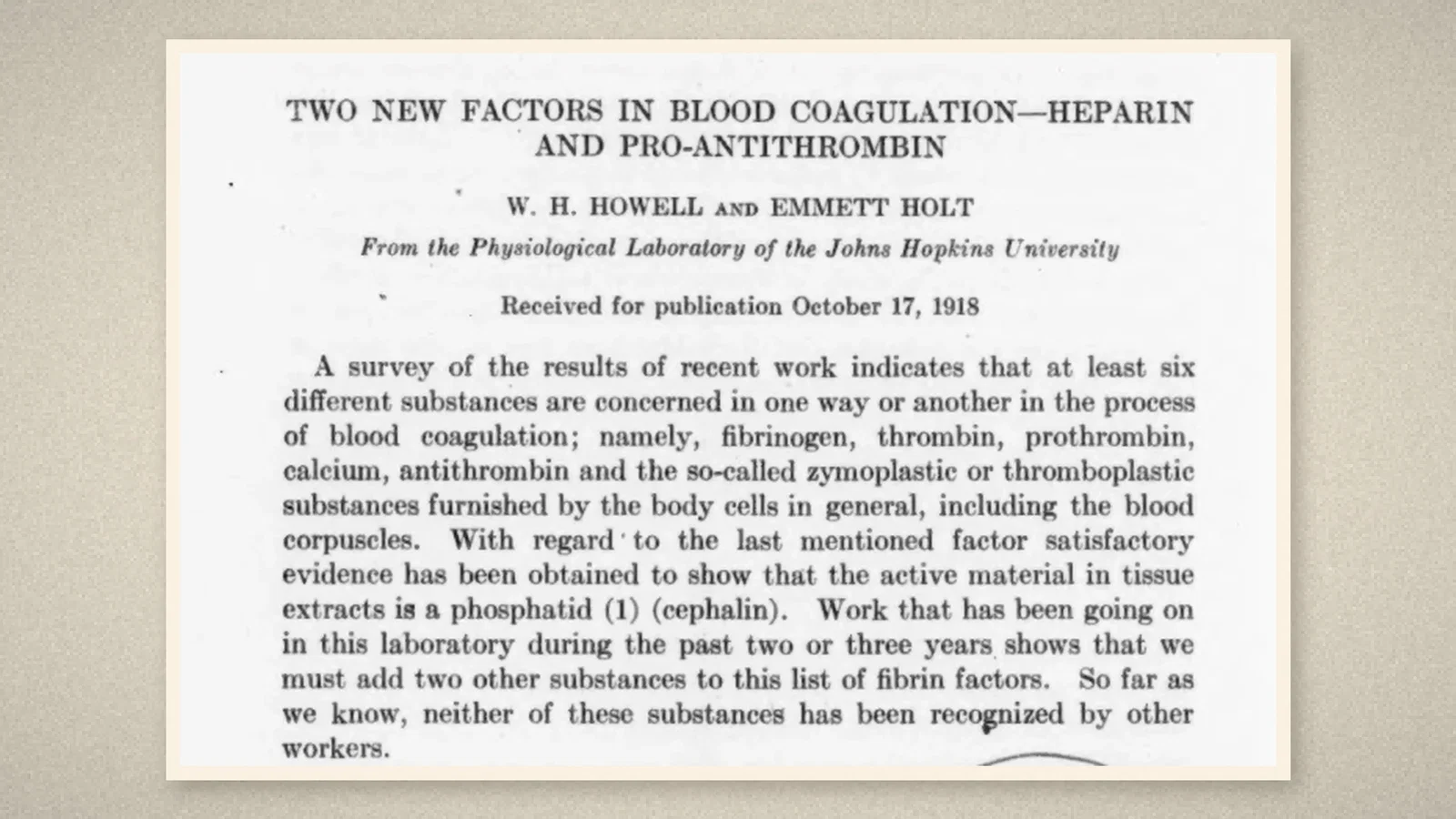
Every cardiac anaesthetist gives heparin before bypass and protamine after it. The first of these two drugs got its name in a paper from the Physiological Laboratory of the Johns Hopkins University, "Two New Factors in Blood Coagulation—Heparin and Pro-Antithrombin", by W. H. Howell and Emmett Holt, received for publication on 17 October 1918. [2, p. 328] The second was found to undo the first nineteen years later, by accident.
A sentence in 1916
The story starts with a paper that was not about anticoagulants at all. In 1912 Howell had shown that the substance in tissues that speeds clotting was a phosphatid with the properties of cephalin. Jay McLean, in the same laboratory, took up the question again "at the suggestion of Dr. Howell": was the clotting effect due to cephalin itself or to an impurity, and did other related phosphatids share it? [1, p. 250] McLean tested cephalin, lecithin, sphingomyelin, cuorin from heart muscle and heparphosphatid from liver. [1, p. 250]
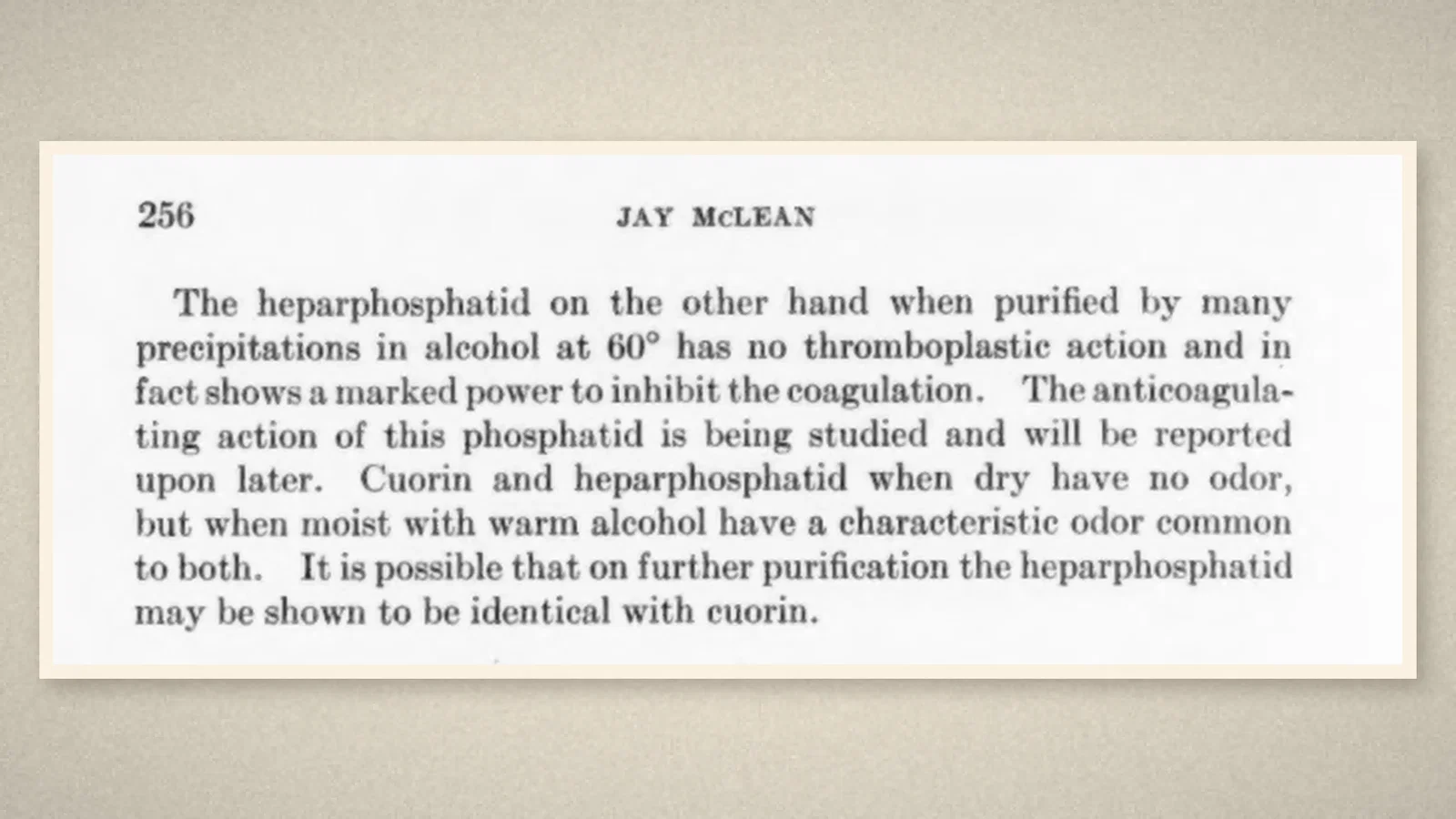
Cephalin, McLean concluded, did promote clotting. [1, p. 257] But two of the others behaved the opposite way. Purified cuorin "possesses an anticoagulating power". [1, p. 255] And the heparphosphatid, purified by many precipitations in alcohol at 60°, had no thromboplastic action and "in fact shows a marked power to inhibit the coagulation". McLean added only that its anticoagulating action "is being studied and will be reported upon later". [1, p. 256]
The name, 1918
The report came from Howell and Holt. Work in the laboratory during the past two or three years, they wrote, showed that two substances had to be added to the list of clotting factors, and "so far as we know, neither of these substances has been recognized by other workers". [2, p. 328] The first was a phosphatid found in greatest abundance in the liver, "designated as heparin to indicate its origin from liver"; it inhibits coagulation partially or completely according to its concentration. The second was a substance in plasma that heparin converts into antithrombin, which they called pro-antithrombin. [2, p. 328]
They were careful about credit. "Attention was first called to this substance during some work done in this laboratory by Jay McLean", and the liver phosphatid McLean prepared had an inhibiting effect "much stronger than that of cuorin". [2, p. 328–329] A footnote adds that the substance had been described earlier, in a Harvey Lecture, under the name antiprothrombin. [2, p. 328]
The method was not easy. It yielded a reliable preparation but was "time-consuming and expensive in material", because heparin and cephalin dissolve so similarly that separating them was the main obstacle. [2, p. 329] In their summary, heparin is a phosphatid "obtained most readily from the liver (dog)", which retards or prevents clotting in the body and in shed blood and "causes a marked increase in antithrombin". It acts, they concluded, "as an antiprothrombin rather than as an antithrombin". [2, p. 340] On the theoretical side they suggested that heparin and pro-antithrombin together served for "safeguarding the fluidity of the blood". [2, p. 341]
Nineteen years later: protamine
By 1937 heparin had changed its chemical identity. Erwin Chargaff and Kenneth B. Olson of the College of Physicians and Surgeons, Columbia University, opened their paper: "Heparin, which was discovered in liver by Howell and Holt", was now considered, according to recent work, a mucoitin polysulfuric acid, no longer a phosphatid. Through the work of Charles and Scott it had become available "in sufficient purity and quantity" for physiological and clinical experiments. [3, p. 153]
In dogs, heparin's effect wore off fairly quickly. Following the example of insulin combined with protamine, they "attempted to protract the short lived activity of heparin" by combining it with the protamine salmine. The result was unexpected: "the anticoagulant action of heparin in vivo was entirely stopped by protamine". [3, p. 154] The heparin, a highly purified preparation from beef lungs, came from Hoffmann-La Roche. [3, p. 154]
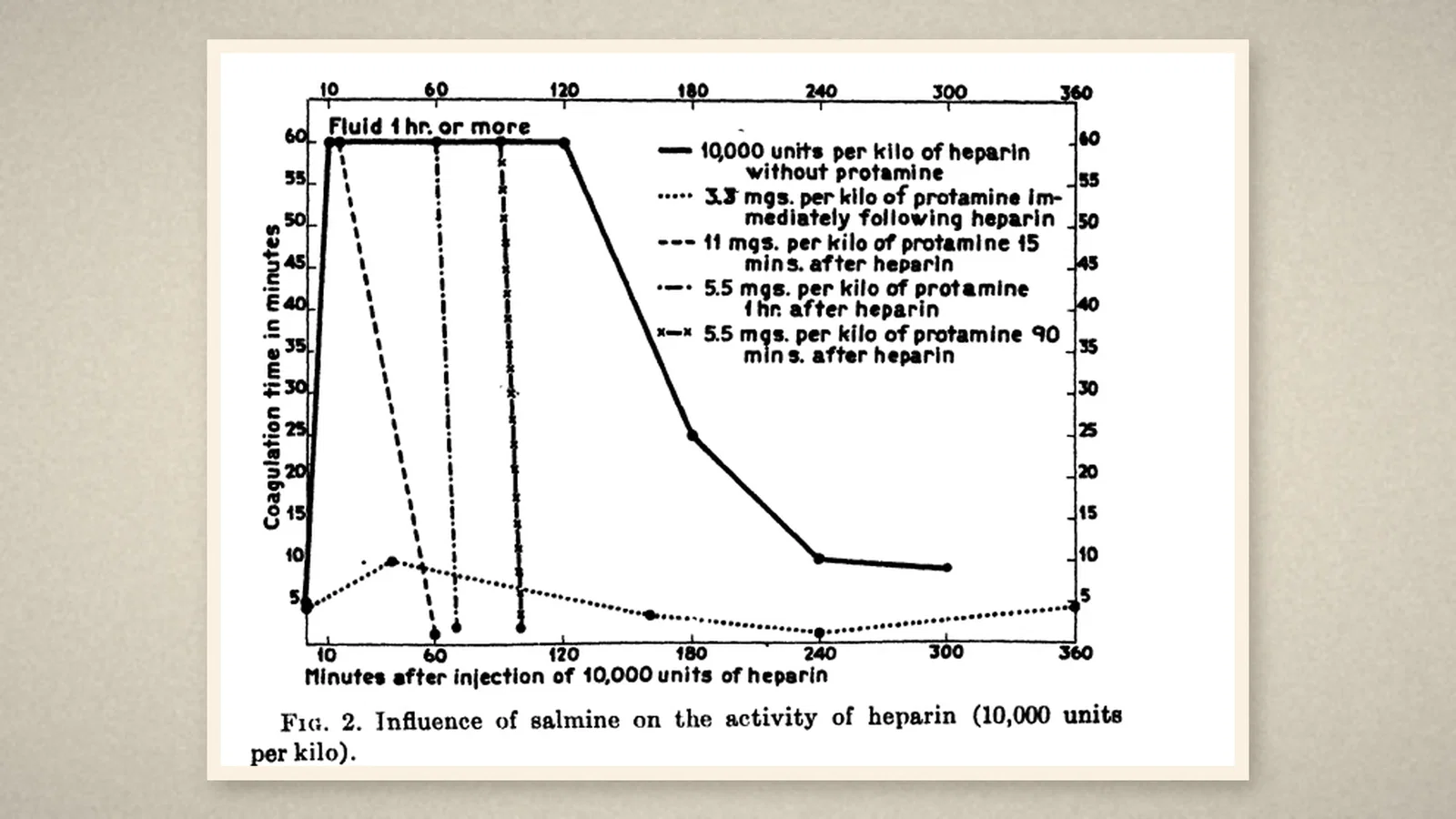
Salmine given just before or after heparin left no anticoagulant effect; given later, it brought the prolonged clotting time "immediately" back to the usual level. In more than twenty experiments, "only one slightly divergent result was observed". [3, p. 161] About 3 mg of salmine seemed enough for 10,000 units of heparin; subcutaneous protamine did not work. [3, p. 162] They explained it by "the formation of insoluble complexes which remove the anticoagulants from the blood clotting system". [3, p. 164] Large doses of protamine sometimes caused weakness, inability to stand and, rarely, a convulsion. [3, p. 165]
They saw uses at once. In a transfusion experiment, heparinized blood stored 96 hours was given back to a dog, and after salmine the clotting time "almost immediately fell to 5 minutes". [3, p. 165] Once heparin was in clinical use, they wrote, the reaction would make it possible "to interrupt the heparin action at any desired time". [3, p. 166]
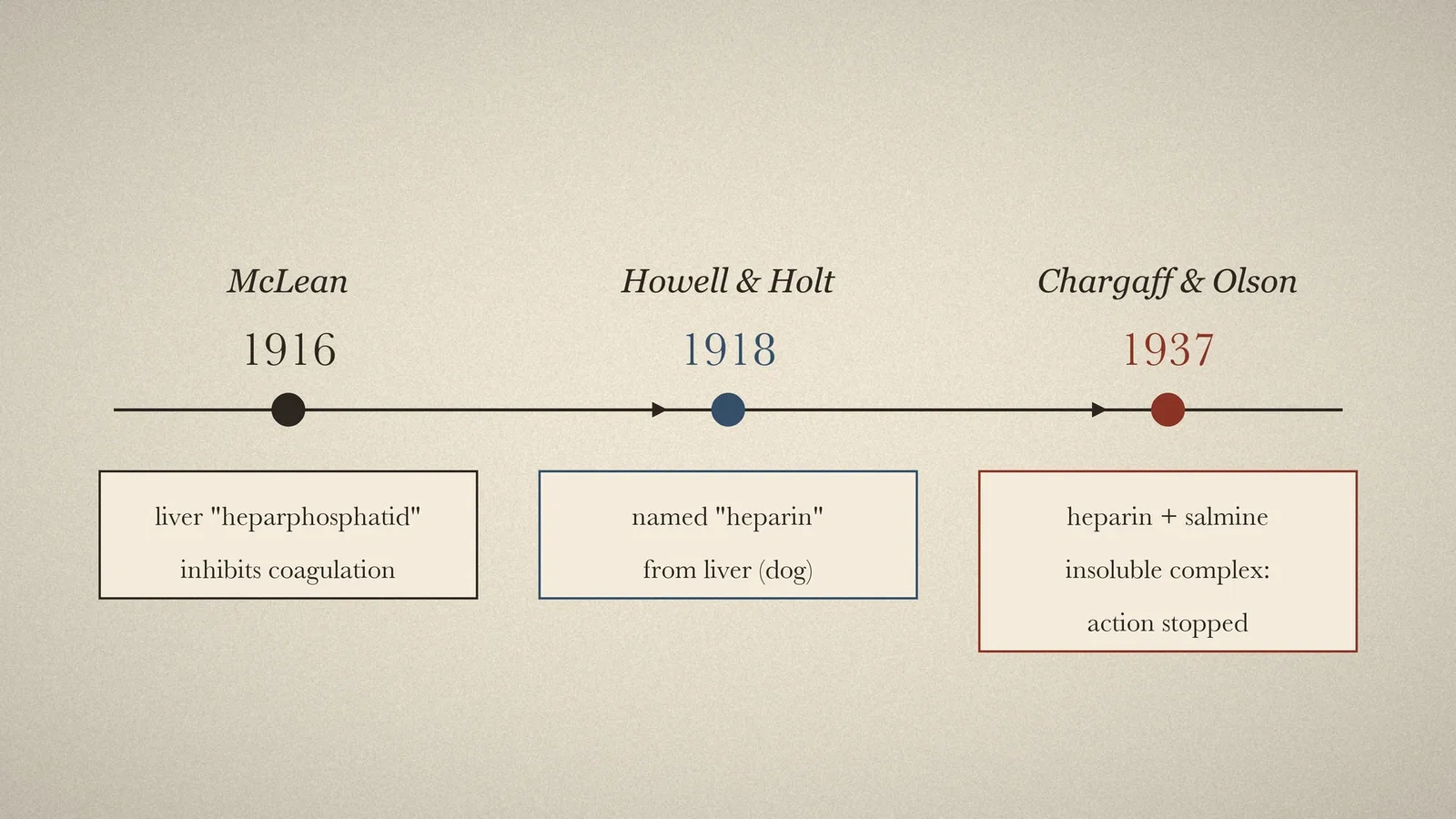
What the record shows
Three papers, read in order, show how a drug is made. In 1916 a worker notes an unwanted result and promises to report on it. In 1918 the same laboratory names it, credits the worker and admits the method is slow and costly. In 1937 two others, trying to make it last longer, find the way to switch it off. The chemistry in the first two papers was later revised, but the name and the antidote stayed.
Sources and reading limits
Read: McLean's 1916 paper (Am J Physiol 41, pp. 250–257), Howell and Holt's 1918 paper (Am J Physiol 47, pp. 328–341) and Chargaff and Olson's 1937 paper (J Biol Chem 122, pp. 153–167), each in full.
Not covered: Chargaff and Olson's paper was received on 6 October 1937, so the protamine finding is dated 1937. In 1916 and 1918 McLean's substance was described as a phosphatid, not a carbohydrate. That McLean was a medical student is not stated in what was read and is not used. "Stoichiometric" is not the authors' word. The later history through Connaught, Gordon Murray, cardiopulmonary bypass and ACT monitoring is not documented in what was read and is not told here. The Harvey Lecture where the name antiprothrombin was used is not covered.
Of the four illustrations, three are crops of pages from the three papers and one is a timeline drawn for this article.
- McLean J. The thromboplastic action of cephalin. Am J Physiol. 1916;41(2):250-7. Internet Archive
- Howell WH, Holt E. Two new factors in blood coagulation—heparin and pro-antithrombin. Am J Physiol. 1918;47(3):328-41. Internet Archive
- Chargaff E, Olson KB. Studies on the chemistry of blood coagulation. VI. Studies on the action of heparin and other anticoagulants. The influence of protamine on the anticoagulant effect in vivo. J Biol Chem. 1937;122(1):153-67. doi:10.1016/S0021-9258(18)74257-9. Internet Archive
Continue exploring
Related reading connects shared questions and contexts; it does not by itself establish historical influence.
- 1917: The Boyle Machine, Adaptation Behind an Eponym
- 1915: Pohl's N-Allylnorcodeine Pushes Morphine Back
Anesthesia Epochs · The Source Room · About & Editorial Method
Published November 2, 2026. Sources and reading limits are stated above. Illustrations are labelled as original source images or AI-made. Historical accounts are educational; they are not current treatment instructions.