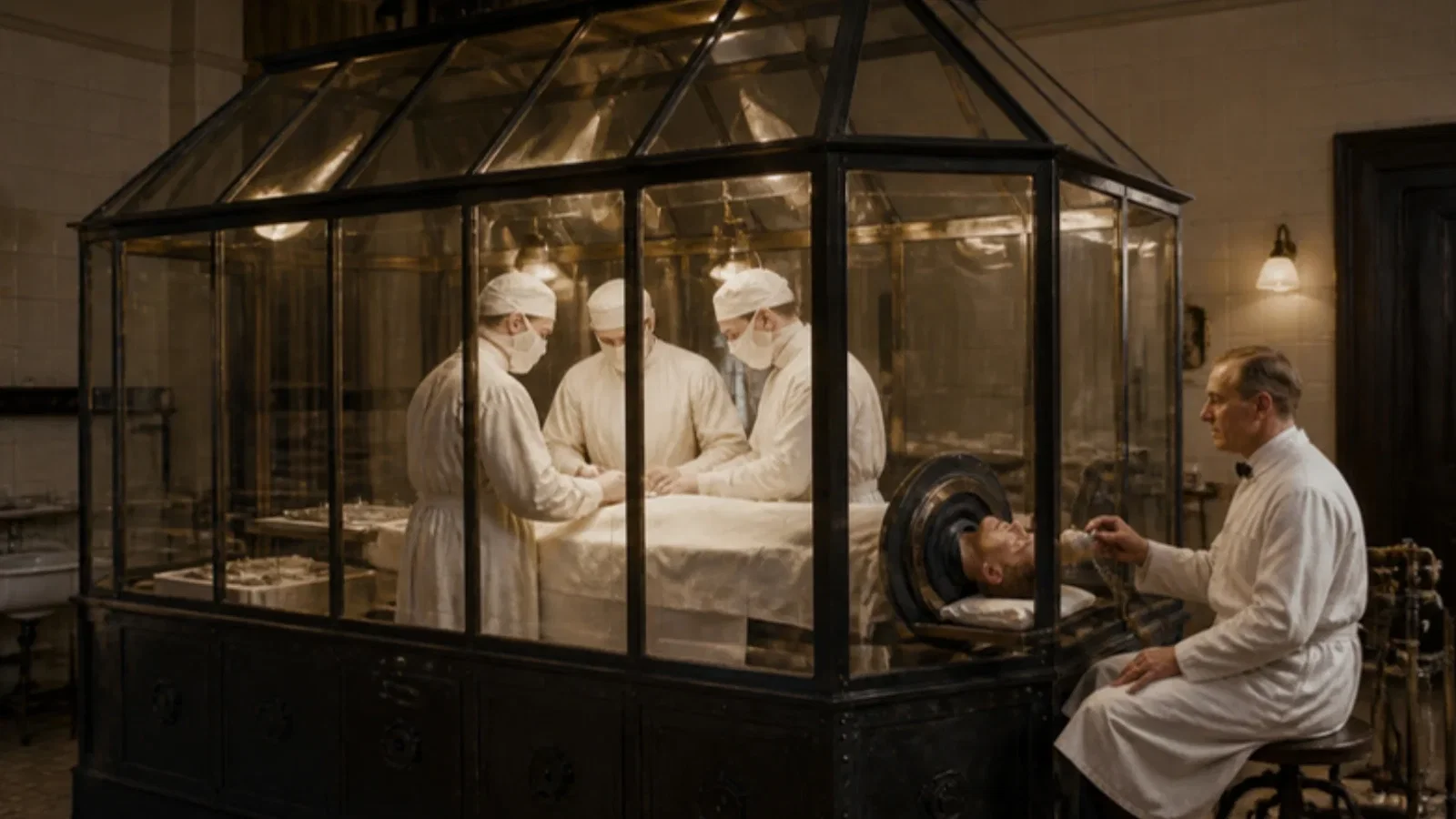
In 1904 Ferdinand Sauerbruch in Breslau kept the lungs inflated during open-chest operations by putting the trunk and the surgeons in a low-pressure chamber, leaving the patient's head, and the anaesthetist, outside the wall.
Reading Library · Anesthesia Epochs · 中文版
Watch the education video (for clinicians)
1904: Sauerbruch's Negative-Pressure Chamber — Two Pressure Zones · Anesthesia Epochs Education Series
The issue of the Zentralblatt für Chirurgie dated 13 February 1904 (No. 6) opened with an original note of just over three pages. Its author was Ferdinand Sauerbruch, a research assistant in the surgical clinic at Breslau; its subject was how to eliminate the harmful effect of pneumothorax in intrathoracic operations. It was signed "Breslau, 25 January 1904". [1, p. 149]
The problem had been set by the head of the clinic, Johann von Mikulicz. In October of the previous year, Sauerbruch wrote, Mikulicz had suggested an experimental study of whether this could be done; what Mikulicz had chiefly in mind was transpleural resection of the oesophagus, which so far had given "the saddest results" both in patients and in animal experiments. [1, p. 146] Once the pleura was opened, the lung collapsed under atmospheric pressure, and that was one of the main reasons for failure.
The physiologists' method and its costs
There was already a remedy of sorts. Physiologists operating in the chest had long kept the collapsed lungs working by rhythmically pumping air in through an airtight tracheal cannula. [1, p. 146] Mikulicz had tried this for a series of oesophageal resections in dogs the year before, but "the results were not satisfactory". [1, p. 146]
Sauerbruch listed eight harms of pneumothorax and artificial respiration: the altered pattern of breathing; interstitial emphysema from pumping air into the lungs; a large loss of heat, up to 3 degrees in half an hour; effects on the circulation; pneumothorax remaining after insufflation stopped; the need for tracheotomy, with the pneumonia it might bring; the difficulties of anaesthesia; and a greater risk of pleural infection. [1, p. 147] Two of the eight fall squarely on the anaesthetist: the tracheotomy and "the difficulties of anaesthesia".
A glass cylinder
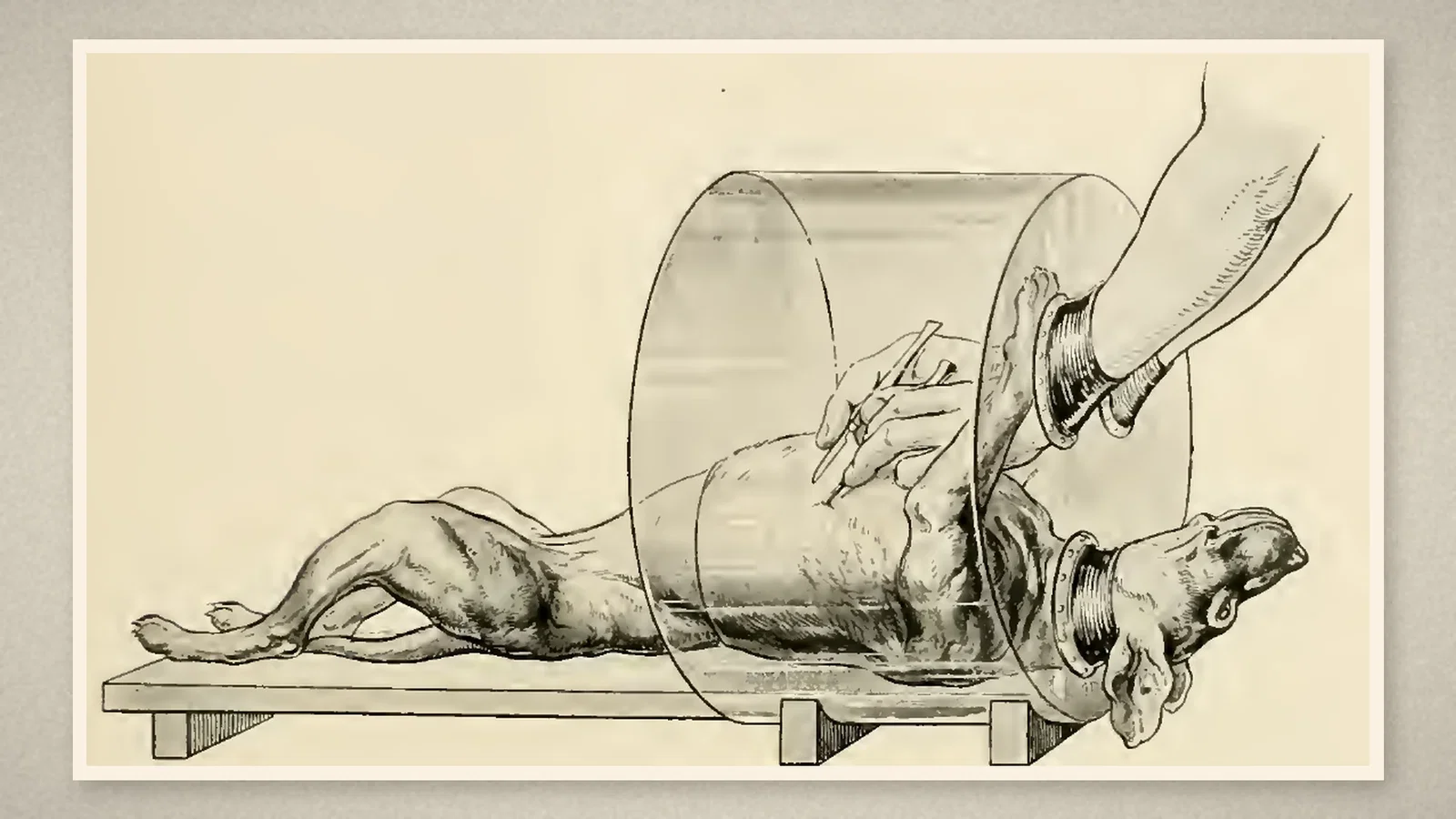
Sauerbruch's idea was to work the other way round: not to raise the pressure inside the lung but to lower it outside the lung's surface. The first apparatus was crude. A glass cylinder open at both ends was closed with guttapercha paper; the animal's chest and upper abdomen lay inside, its head and hind parts outside. Sauerbruch put both hands in through small holes, all openings were sealed with rubber bandages and adhesive, and an assistant drew air out through a rubber tube until the negative pressure inside equalled a mercury column of about 10 mm. [1, p. 147]
Sauerbruch then opened both sides of the chest: "The lungs did not collapse, and the animal's breathing went on undisturbed." After about 3 minutes the sealing membrane tore at one point, the lungs collapsed and the animal died. [1, p. 147]
A room for two
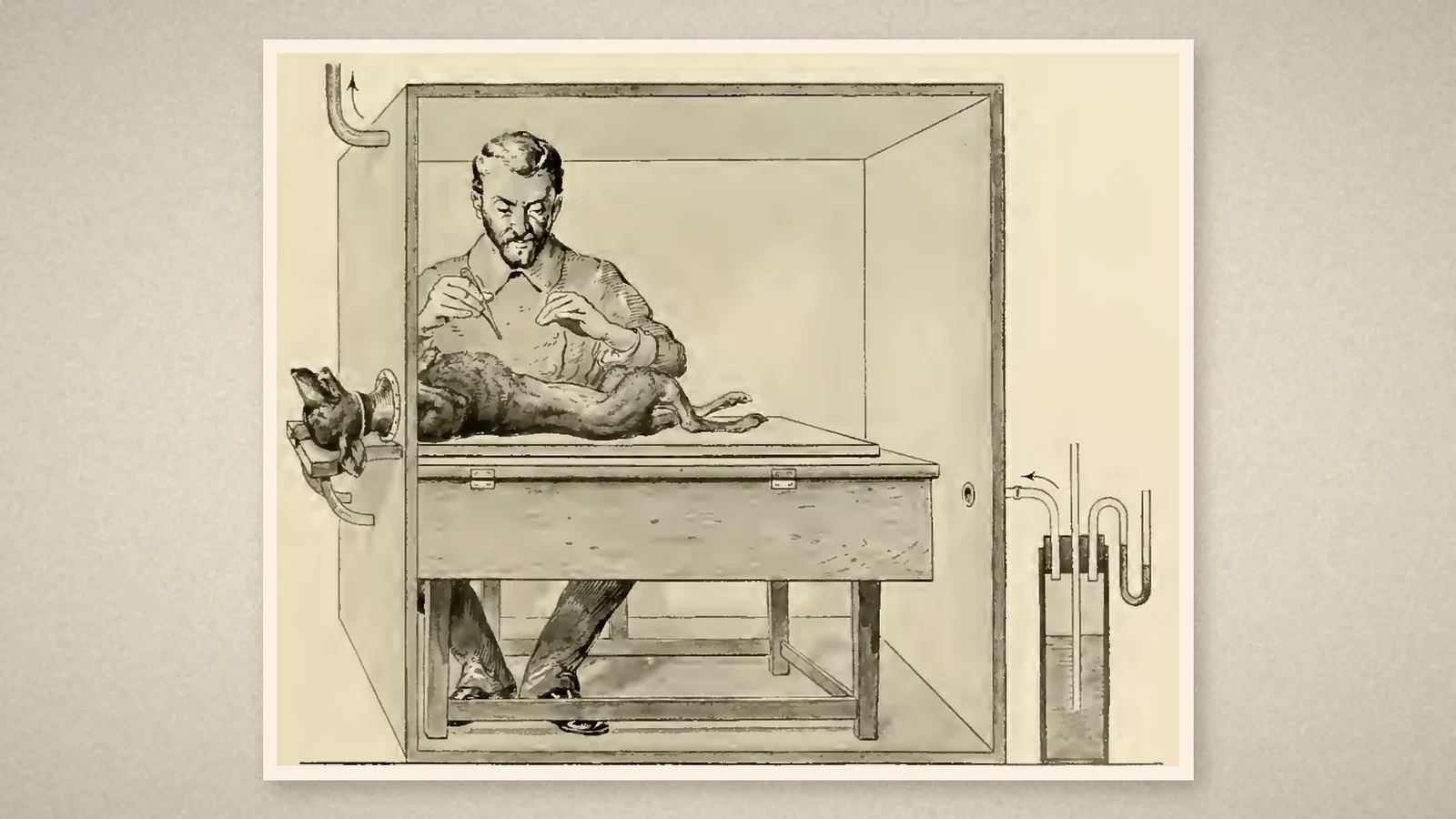
A mechanic built an improved apparatus sealed with rubber pads, and from there Sauerbruch went to a small operating room: 1.5 m long, 1.0 m wide and 1.30 m high, made of boards lined with soldered tin, closed at the top by a thick glass plate, with a door sealed by rubber strips. In the wall opposite the door was a round window 55 cm across, closed by a rubber cap with a central opening; the animal's head went through it, and a rubber cuff closed tightly round its shaved neck. [1, p. 148] There was room for the table and a seat on each side for operator and assistant; one opening led to a suction pump, the other to a valve that kept the negative pressure steady and adjustable. For medium-sized dogs Sauerbruch found the best value to be 12–16 mm Hg. [1, p. 148]
The people inside were not comfortable. Two of them had stayed in the room for more than two hours, which Sauerbruch said they tolerated well, and Mikulicz had operated there for over an hour; but the temperature always rose by several degrees, once to 29 °C. [1, p. 148] The paper's example was a dog under chloroform: large flaps were resected from both sides of the chest, the oesophagus was opened, the pericardium and mediastinum were opened; after closure the animal woke from the anaesthetic and ran about for a few minutes. It died on the second day, which Sauerbruch put down to the lack of aseptic precautions and of rib suture. [1, p. 149]
Lower or raise the pressure: the March dispute
Soon afterwards Brauer and Petersen published a "substantial simplification" of Sauerbruch's method: instead of lowering the pressure outside the chest, raise it in the airway. On 26 March Sauerbruch replied in No. 14 that the principle was the same, with the pressure difference produced by lowering pleural pressure in Sauerbruch's case and by raising intrabronchial pressure in theirs. [2, p. 442] Breslau, Sauerbruch said, had already tried the reversal. On 17 January Mikulicz had opened a dog's chest under overpressure, with its head in the box and its body outside, at 10 mm Hg above atmospheric, and the dog breathed on; but Dr Heile, who gave the anaesthetic inside the box, felt the effects of the chloroform after only 20 minutes, the smell of chloroform met them when the box was opened, and they set the method aside for the time being. [2, p. 442] Brauer answered in the same issue that the modification had been reached independently. [2, p. 445]
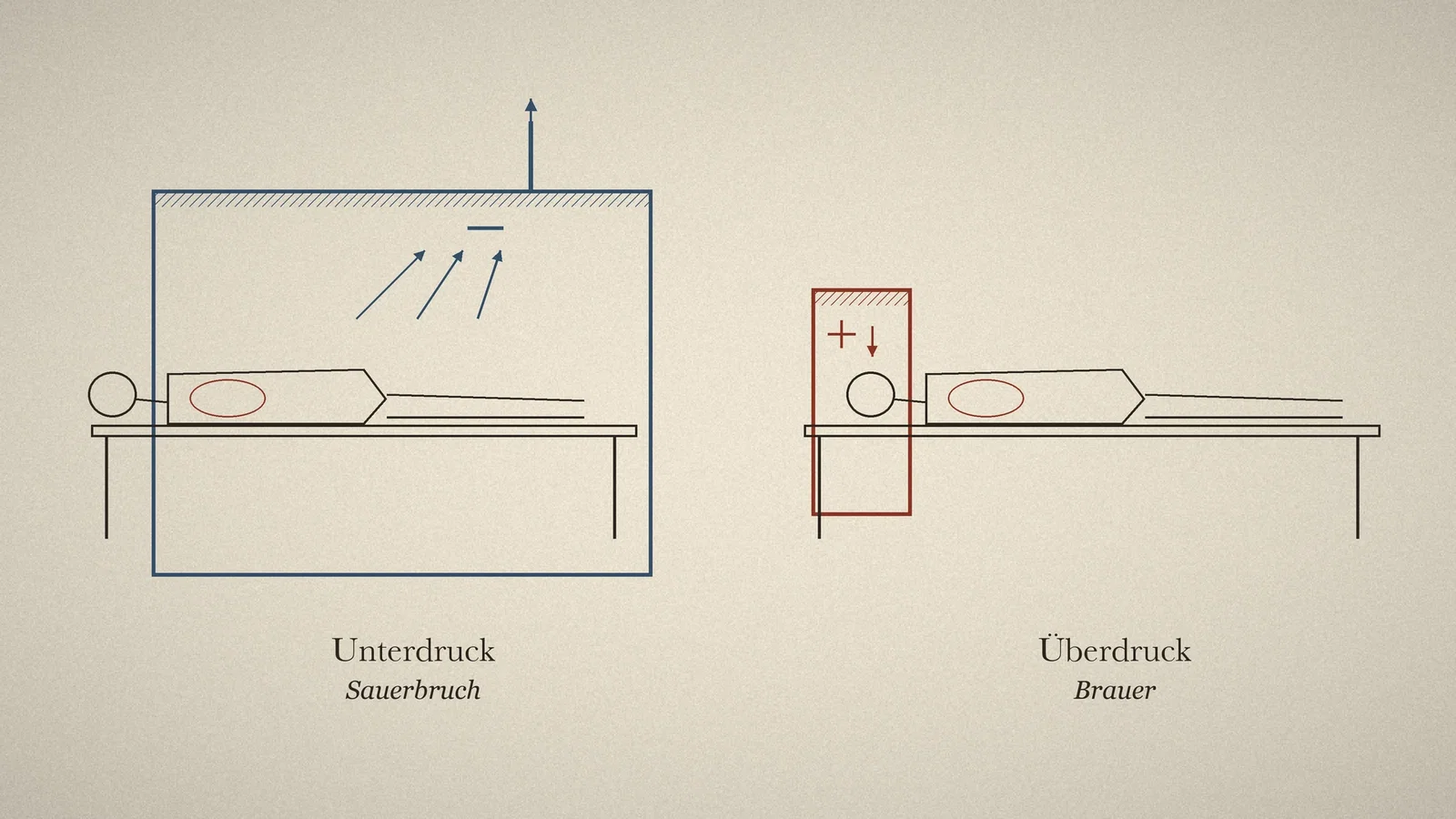
For the history of anaesthesia the dispute matters. With negative pressure the patient's head stayed at atmospheric pressure and the anaesthetic could be given in the usual way; with overpressure the head, and the anaesthetic, went into the box. As late as 1920 Sauerbruch wrote that, in their experience with both kinds of apparatus, anaesthesia was "undoubtedly easier" with the chamber. [4, p. 387] The same book grants that Petersen and especially Brauer developed the overpressure method and brought it into practice. [4, p. 384]
From dogs to patients: the anaesthetist outside the wall
The 33rd congress of the German Society of Surgery met in Berlin from 6 to 9 April 1904. [5, p. 183] Mikulicz's assistant Bernhard Hahn later recalled that Sauerbruch and Mikulicz presented the method there. [3, p. 43] The clinic then built a large chamber that could be run at either over- or underpressure; Sauerbruch gives its volume as 14 cubic metres, Hahn as forty. [2, p. 443; 3, p. 44]
In a talk given in October 1905, Hahn described how a patient was operated on. Not yet fully anaesthetised, the patient was brought into the chamber; the head went through the rubber cuff and rested outside on a small table, beside which the anaesthetist sat, and Hahn thought chloroform preferable to ether. [3, p. 44] Operator and anaesthetist could use sign language and were also linked by a telephone. Hahn was frank that the patient's body was in effect divided in two: the anaesthetist outside could not reach the trunk, and those inside could not reach the head, so that in an emergency such as asphyxia it was harder than usual to act energetically. [3, p. 45]
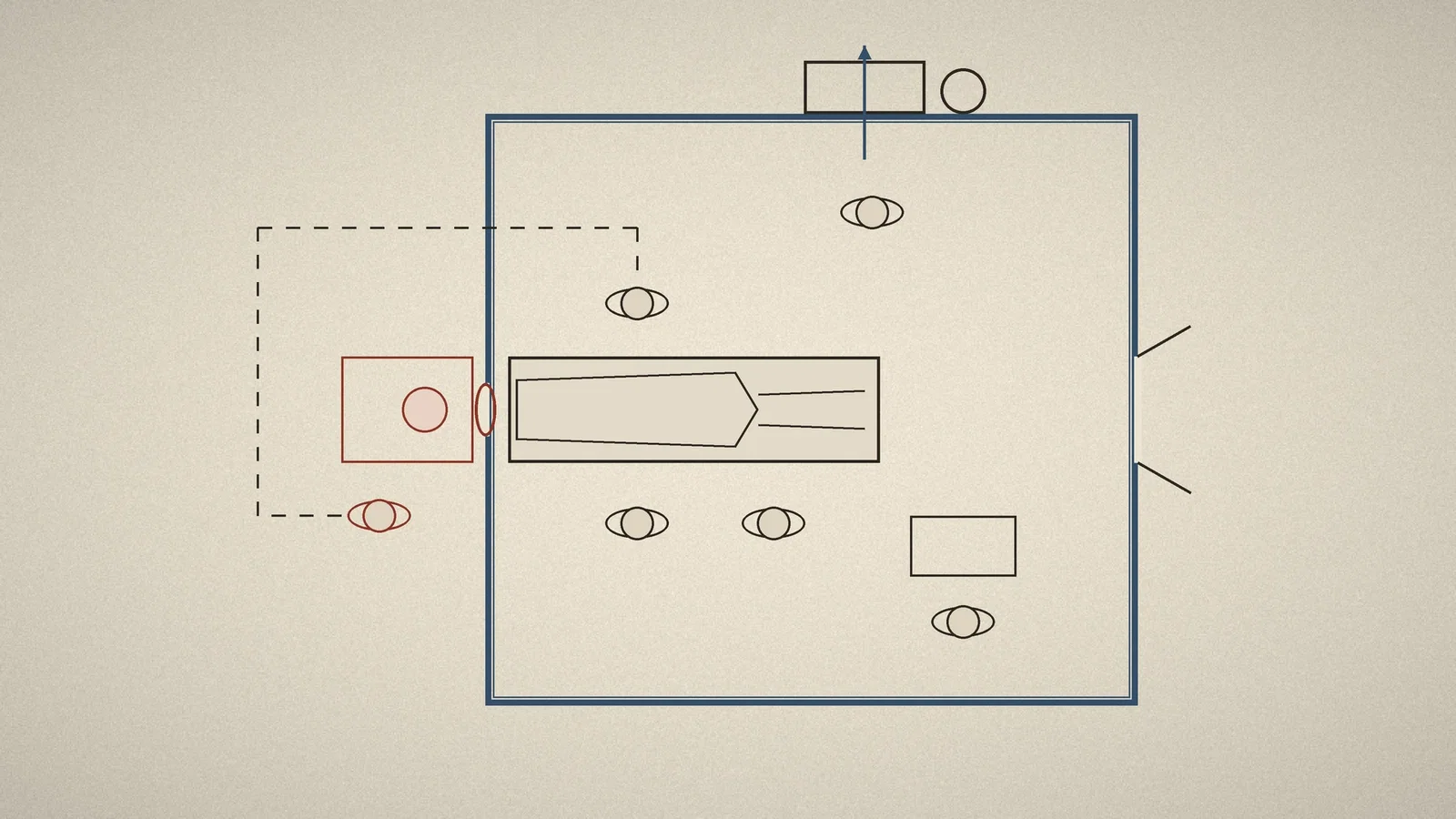
By Hahn's count, at least a dozen operations were done in the chamber in May, June and July 1904, including 5 on the oesophagus and 1 on the heart; the oesophageal results were poor, while a patient with a sarcoma of the chest wall went home on the ninth day. [3, p. 45–48]
What the record shows
The negative-pressure chamber was later displaced by methods that raised pressure in the airway, but it put a question on the table: when the chest is open, who keeps the lung inflated and how, and where does the anaesthetist stand in relation to the patient? In Breslau in 1904 the answer was to put the anaesthetist outside the wall, with a telephone in between.
Sources and reading limits
Read: Sauerbruch's note in the Zentralblatt für Chirurgie No. 6 of 13 February 1904 (pp. 146–149); Sauerbruch's reply and Brauer's rejoinder in No. 14 (pp. 441–445); the congress notice in No. 6, p. 183; the full text of Hahn's 1906 paper in the American Journal of the Medical Sciences; Sauerbruch's Die Chirurgie der Brustorgane of 1920, pp. 381–394 with figures 332–335 and 341.
Not covered: the 1904 congress proceedings; Sauerbruch's long paper in the Mitteilungen aus den Grenzgebieten; Mikulicz's 1904 article in the Deutsche Medizinische Wochenschrift. The sources read do not support a "first successful human thoracotomy on 6 June 1904". The pressures differ between sources: about 10 mm Hg in the glass cylinder, an optimum of 12–16 mm Hg for dogs (1904), 10–15 mm and later 6–12 mm in Hahn, 7 mm in the 1920 book; each is kept as stated. The two figures for the chamber's volume are both given. Hahn dates a first visit to "January, 1903", which conflicts with the October 1903 start of the work and is probably a slip.
Of the four illustrations, two are period figures from Sauerbruch's 1920 book (captions cropped) and two are diagrams drawn for this article from the sources; none is a portrait or a reconstruction of the actual scene.
- Sauerbruch F. Über die Ausschaltung der schädlichen Wirkung des Pneumothorax bei intrathorakalen Operationen. Zentralbl Chir. 1904;31(6):146-9. Internet Archive
- Sauerbruch F. Bemerkungen zum Artikel der Herren Prof. Brauer und Prof. Petersen; Brauer L. Entgegnung. Zentralbl Chir. 1904;31(14 Beilage):441-5. Internet Archive
- Hahn B. Sauerbruch's operative chamber: history, experiments, and experiences. Am J Med Sci. 1906;132(1):41-9. Internet Archive
- Sauerbruch F. Die Chirurgie der Brustorgane. Bd. 1. Berlin: Springer; 1920. p. 381-94. Internet Archive
- XXXIII. Kongreß der Deutschen Gesellschaft für Chirurgie 1904 [notice]. Zentralbl Chir. 1904;31(6):183. Internet Archive
Continue exploring
Related reading connects shared questions and contexts; it does not by itself establish historical influence.
- 1902: Hewitt's Emergency Anaesthetic for King Edward VII
- 1893: London's Society of Anaesthetists Brings Experience Before Peers
Anesthesia Epochs · The Source Room · About & Editorial Method
Published November 2, 2026. Sources and reading limits are stated above. Illustrations are labelled as original source images or AI-made. Historical accounts are educational; they are not current treatment instructions.