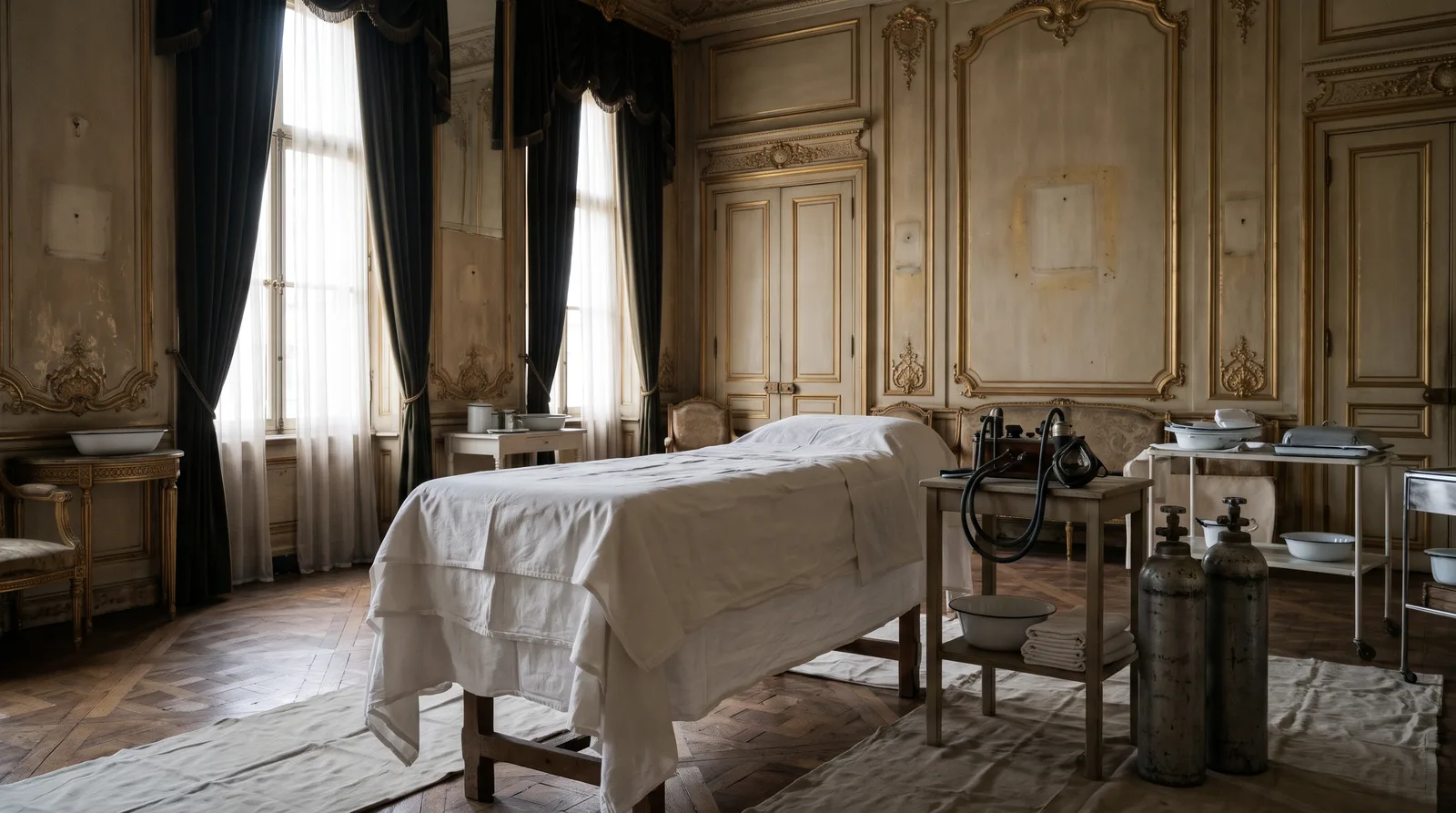
On 24 June 1902, two days before the planned coronation, Sir Frederick Treves drained an abdominal abscess in King Edward VII under an anaesthetic given by Frederic Hewitt, and the Lancet told its readers that the anaesthetic had been borne well.
Reading Library · Anesthesia Epochs · 中文版
Watch the education video (for clinicians)
1902: Hewitt's Anaesthetic for King Edward VII · Anesthesia Epochs Education Series
On Tuesday 24 June 1902 London was making its last preparations for a coronation two days away. At 12.30 that day Sir Frederick Treves operated on King Edward VII's abdomen and opened a large abscess; the anaesthetic was given by Dr Frederic Hewitt, "anaesthetist to His Majesty". [2]
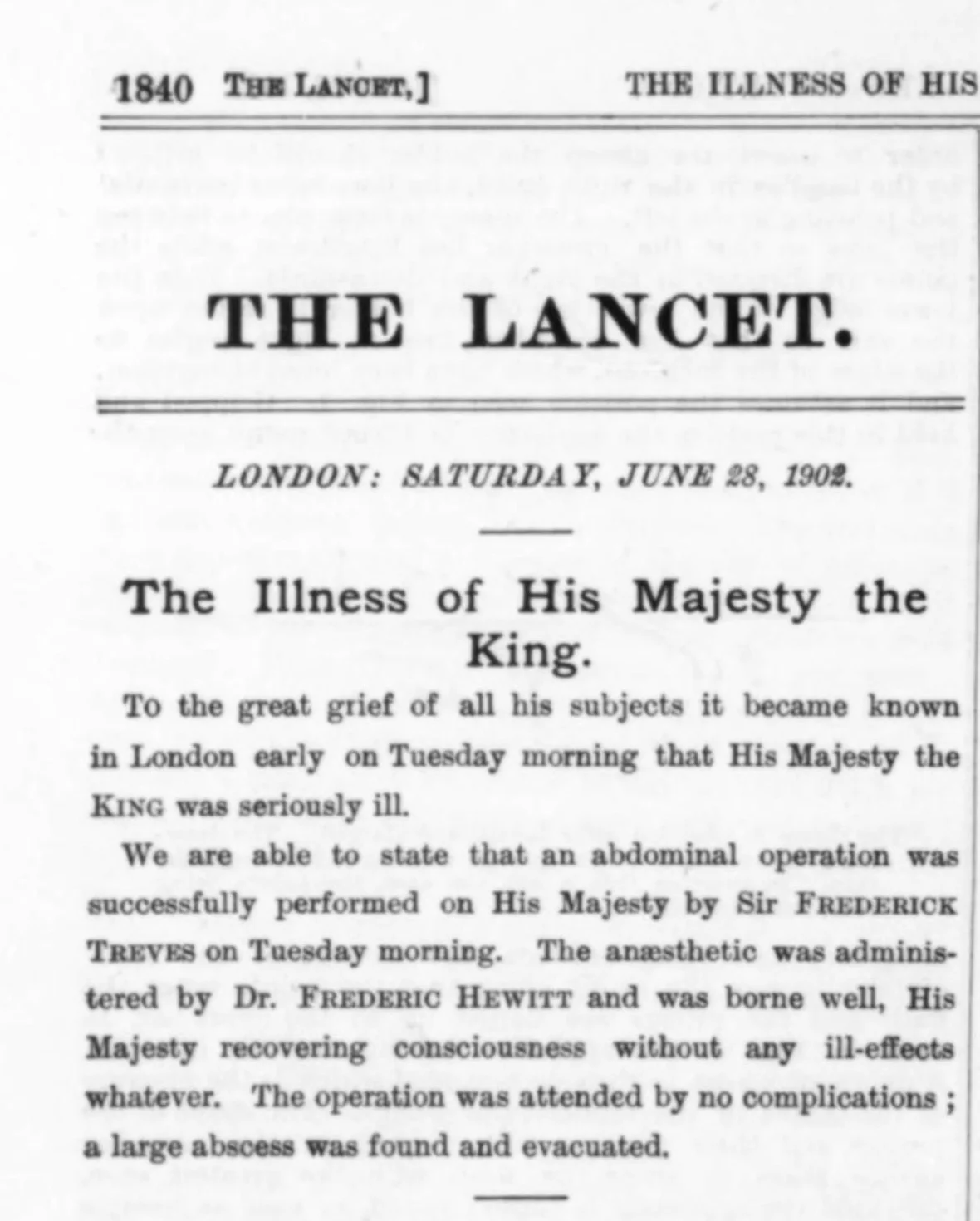
The Lancet reported the event in its next two issues. The first notice was brief: the operation had been performed by Treves on Tuesday morning, the anaesthetic was administered by Dr Hewitt and "was borne well", and the King recovered consciousness "without any ill-effects whatever"; there were no complications, and a large abscess was found and evacuated. [1, p. 1840] That a medical journal's leading notice named the anaesthetist and the quality of the anaesthetic is itself a detail worth noting.
From "much better" to "operation unavoidable"
The Lancet of 5 July reprinted the account of the illness from its second edition of 25 June. [2] On Wednesday 18 June Treves saw the King: the King's temperature was raised and there was swelling and tenderness in the right iliac fossa — in the editors' words, the symptoms of perityphlitis. [2] On the following Thursday and Friday these signs disappeared; by Saturday the 21st the temperature had been normal for two and a half days and the swelling had nearly gone, and it was believed the King would be able to go through the coronation. [2]
On Monday the 23rd the King travelled by railway from Windsor to London. When Treves saw the King on arrival, the medical advisers began to suspect pus in the right iliac region. [2] At 10 o'clock the next morning the urgency of an operation was explained to the King, who, the report says, accepted it although it meant upsetting the coronation arrangements. [2]
A decision taken by several senior physicians
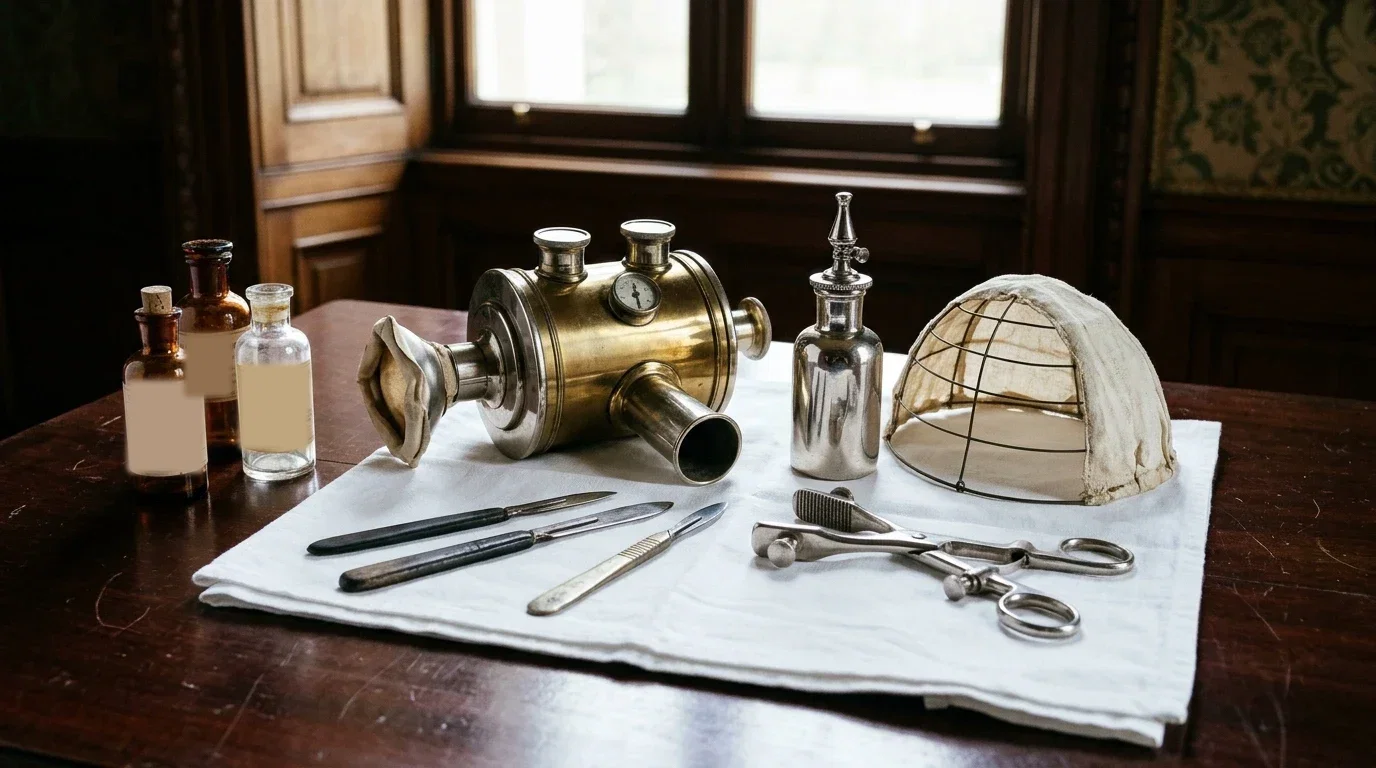
The report records how the decision was made. Treves, Serjeant-Surgeon to the King, took the advice of the two other Serjeant-Surgeons, Lord Lister and Sir Thomas Smith; they, with Sir Thomas Barlow and Sir Francis Laking, unanimously concluded that no course but operation was possible, and that delay would risk the King's life. [2] The King was then placed under an anaesthetic by Hewitt, "anaesthetist to His Majesty", and Treves made an incision in the usual place and opened a large abscess. [2]
The reports do not name the anaesthetic agent or method, nor give its duration. Two things are certain: the anaesthetic was entrusted to a specialist holding a formal title, and the journal thought the public should be told that it had been "borne well" with recovery "without any ill-effects". [1, p. 1840; 2]
Why "the briefest and plainest terms"
The Lancet explained its approach: although the account was written mainly for medical readers, it was certain to reach the public, and with rumours everywhere the editors judged it highly important that the public should know the real state of the case; so they wrote in the briefest and plainest terms and flatly contradicted some of the sinister rumours of the previous 48 hours. [2] The issue dated 28 June added that it would reach readers about three days early, having been arranged for publication before the coronation ceremonies, which had now been indefinitely postponed. [1, p. 1840]
The editors also gave a prognosis: once an appendix abscess had been successfully drained, recurrence or further operation was rare. [2]
What the record shows
For anaesthesia history the operation matters not for a new technique but for a title: in the most watched case of the day, the reports named "the anaesthetist to His Majesty" and treated the safety of the anaesthetic and the patient's waking as matters of public concern. [1, p. 1840; 2] By 1902 anaesthesia in Britain was being treated as a task with a named, accountable specialist.
Sources and reading limits
Read: the Lancet leader of 28 June 1902, "The Illness of His Majesty the King", p. 1840; the Lancet of 5 July 1902, which reprints the account of 25 June.
Not covered: Treves's later account in the BMJ of 1903; the rest of the two Lancet issues. 23 June was the day suppuration was first suspected; the operation was on 24 June.
- The illness of His Majesty the King. Lancet. 1902 Jun 28;159(4113):1840. Internet Archive
- The illness of the King [with the account of 25 June]. Lancet. 1902 Jul 5;160(4114):28 ff. Internet Archive
Continue exploring
Related reading connects shared questions and contexts; it does not by itself establish historical influence.
- 1893: London's Society of Anaesthetists Brings Experience Before Peers
- 1908: Hewitt Describes an Artificial Air-Way
Anesthesia Epochs · The Source Room · About & Editorial Method
Published November 2, 2026. Sources and reading limits are stated above. Illustrations are labelled as original source images or AI-made. Historical accounts are educational; they are not current treatment instructions.