
From study committees in 1934 to certification without examination in 1944: how specialist certification began in Canada, with anaesthesia among the first specialties approved.
Reading Library · Anesthesia Epochs · 中文版
Watch the education video (for clinicians)
1942: Canada's Royal College Certifies Anaesthesia Specialists · Anesthesia Epochs Education Series
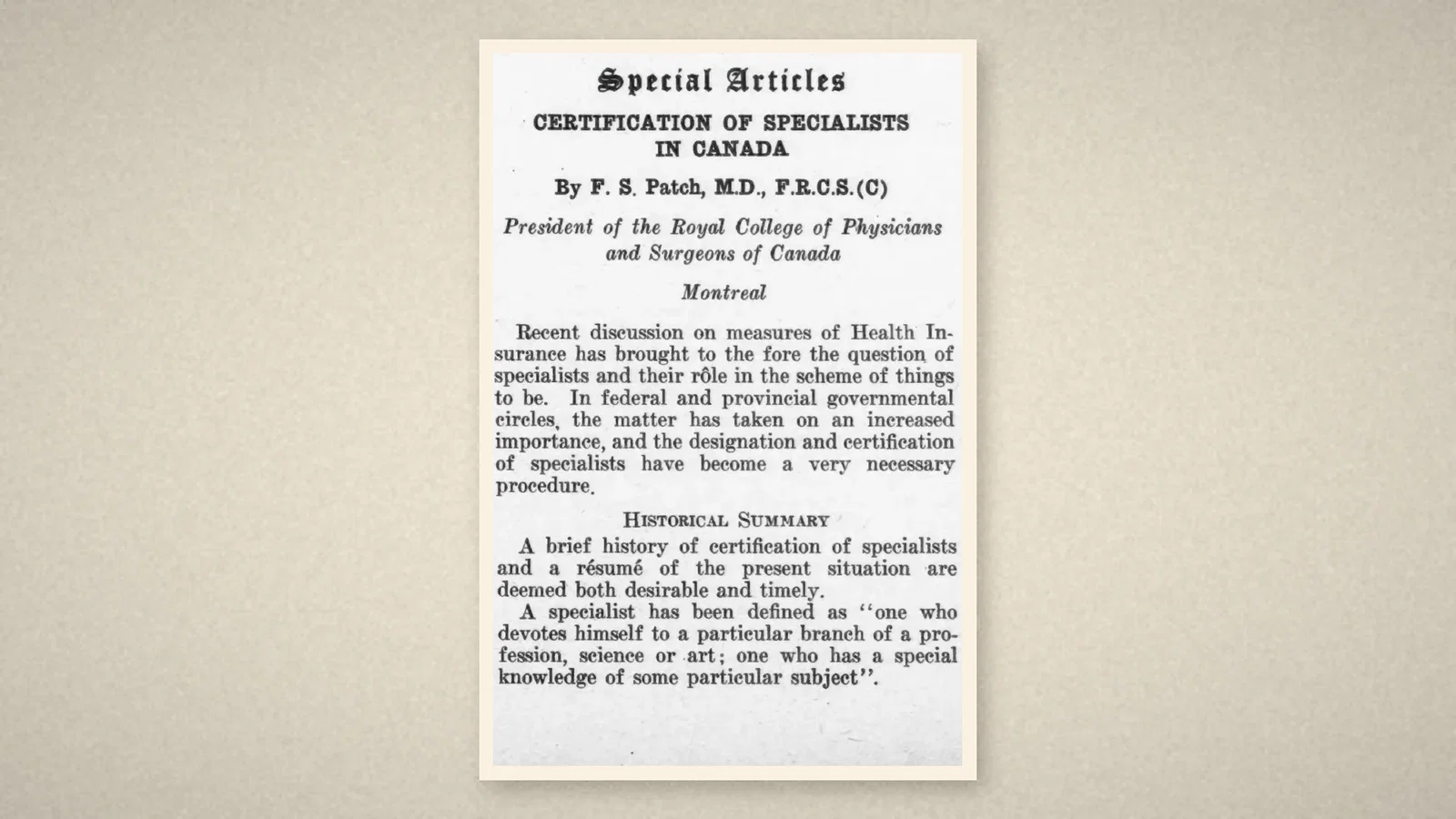
A Canadian anaesthetist today becomes a specialist through the training and examinations of the Royal College of Physicians and Surgeons of Canada. That system of certification was built in the years just before and during the Second World War, and anaesthesia was among the first specialties approved for it. This article draws on three items in the Canadian Medical Association Journal of 1943 and 1944, above all the 1944 article by the College's President, F. S. Patch, to show how it began.
One line: anaesthesia on the list
In February 1943 the journal's "Medical Economics" pages reported on discussions about health insurance. Under "6. Certification of Specialists", the President of the Royal College, Dr A. T. Mathers, "explained at a conference on December 10th" that the College had been "working on certification since" 1937 at the request of the Canadian Medical Association. Up to then a limited "number of specialties (anesthesia, dermatology" and syphilology, otolaryngology, paediatrics, radiology and urology) had been approved. "Certification is quite apart" from Fellowship or Membership, and the report recommended that "lists of specialists as" prepared by the College be recognised for health insurance, subject to approval by the profession in each province. [1] In July 1943 the journal drew readers' attention to the College's notice on certification. [2]
Why certify
In September 1944 Patch, as President of the College, published "Certification of specialists in Canada". "Recent discussion on measures of Health Insurance", Patch began, had brought the question of specialists to the fore, and governments now needed specialists designated and certified. [3, p. 261] The lure of higher rewards had made the pendulum swing too far; too many took the title without adequate training, so a mechanism was needed to tell the competent specialist "from the self-styled variety". [3, p. 262]
Patch traced the American example: the "American Board of Ophthalmology, organized in 1916", then board after board, including "Surgery, 1937, Anesthesiology, 1938"; by 20 March 1944, "23,277 certificates" had been issued. [3, p. 262]
The Canadian route
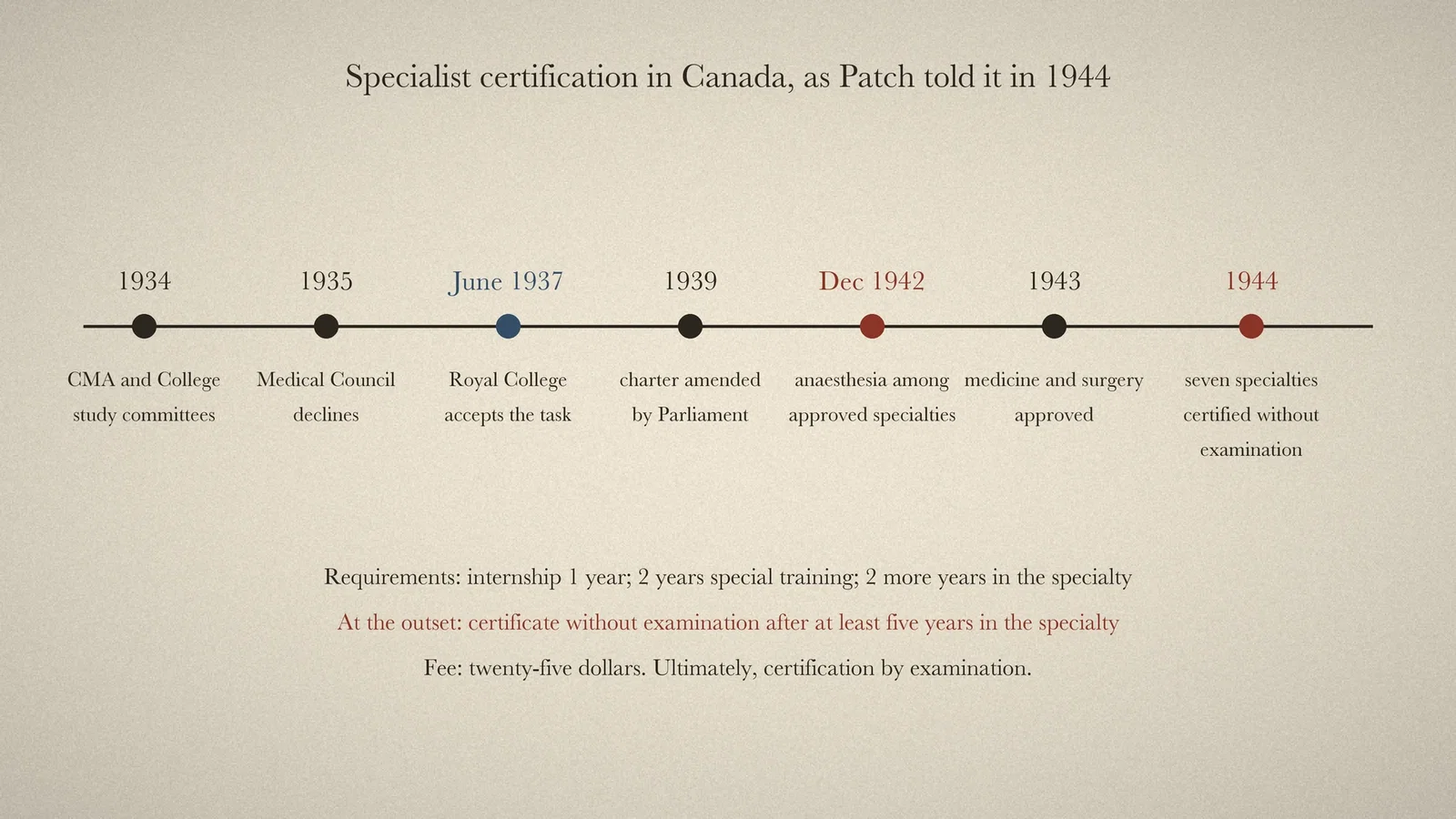
The movement did not pass unnoticed in Canada. In 1934 the Council of the Canadian Medical Association "appointed a committee to" study the question, as did the Royal College; both concluded that certification should be controlled nationally, and thought the Medical Council of Canada the logical body. Asked in 1935, the Medical Council said it "could not undertake" the responsibility. In October 1936 the Canadian Medical Association invited the Royal College to supervise certification, "and in June, 1937, the Royal College formally" accepted; the necessary amendment to its charter "was obtained in 1939". [3, p. 262]
The College moved cautiously and at first "approved only six specialties". Internal medicine and general surgery, for which the Fellowship had been thought the proper qualification, were approved in 1943, when the "Royal College Council formally approved these" branches; obstetrics and gynaecology followed, then neurology and psychiatry and orthopaedic surgery. [3, p. 262] Certification ran through committees in each specialty, and where a national specialist organisation existed, the College gave it the right to nominate the committee. [3, p. 263]
Without examination first, examination in the end
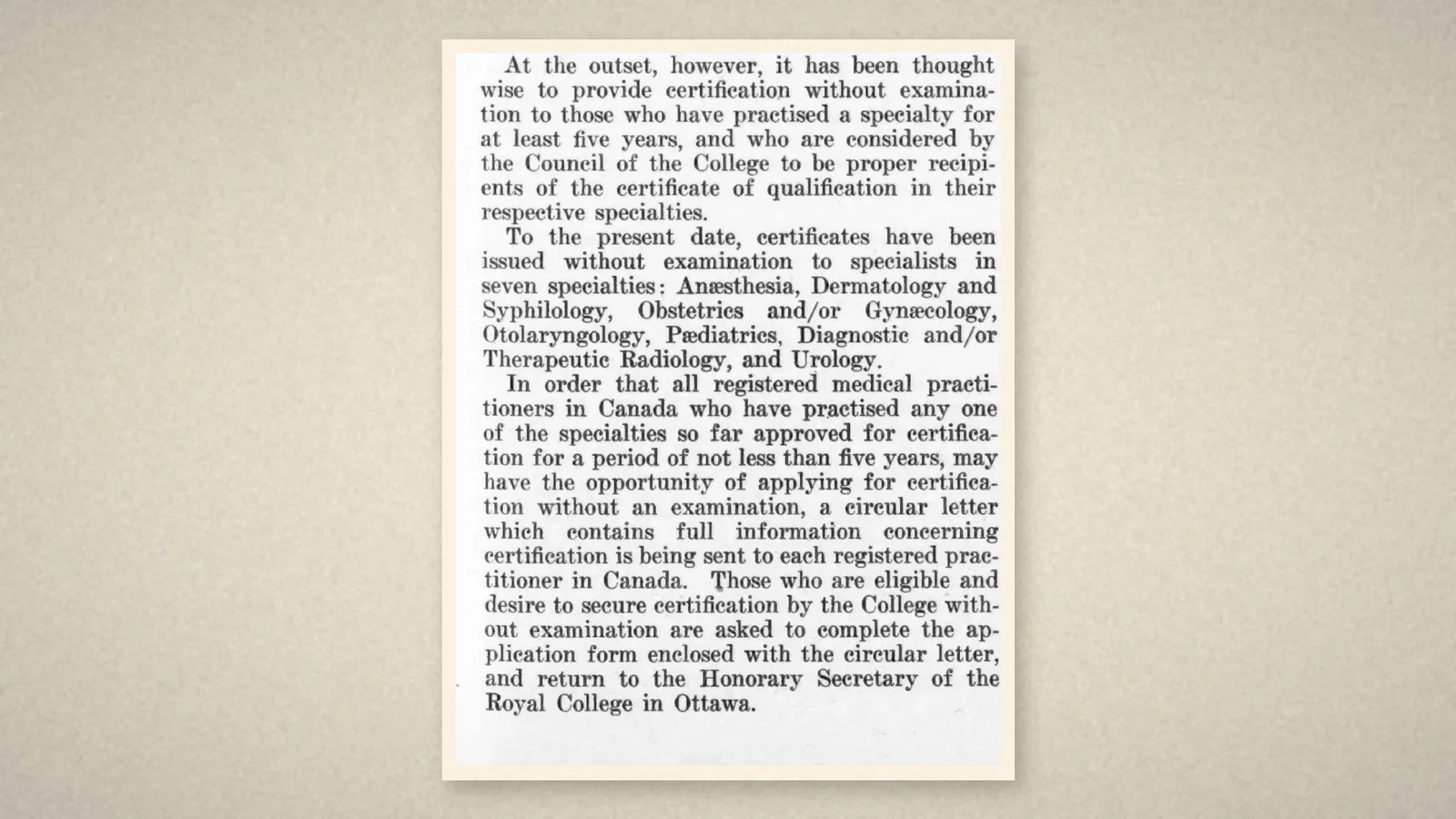
"Ultimately, certification will be by examination", Patch wrote. A candidate needed a year's internship, "not less than two years in a hospital approved by" the Council in special training, basic science, and two further years in the specialty. [3, p. 263] But at the outset it was thought "wise to provide certification without examination" to those who had practised a specialty for at least five years. "To the present date, certificates have been issued without examination to specialists in seven specialties: Anaesthesia, Dermatology and Syphilology, Obstetrics and/or Gynaecology, Otolaryngology, Paediatrics, Diagnostic and/or Therapeutic Radiology, and Urology." A circular letter "is being sent to each registered practitioner" in Canada. [3, p. 263]
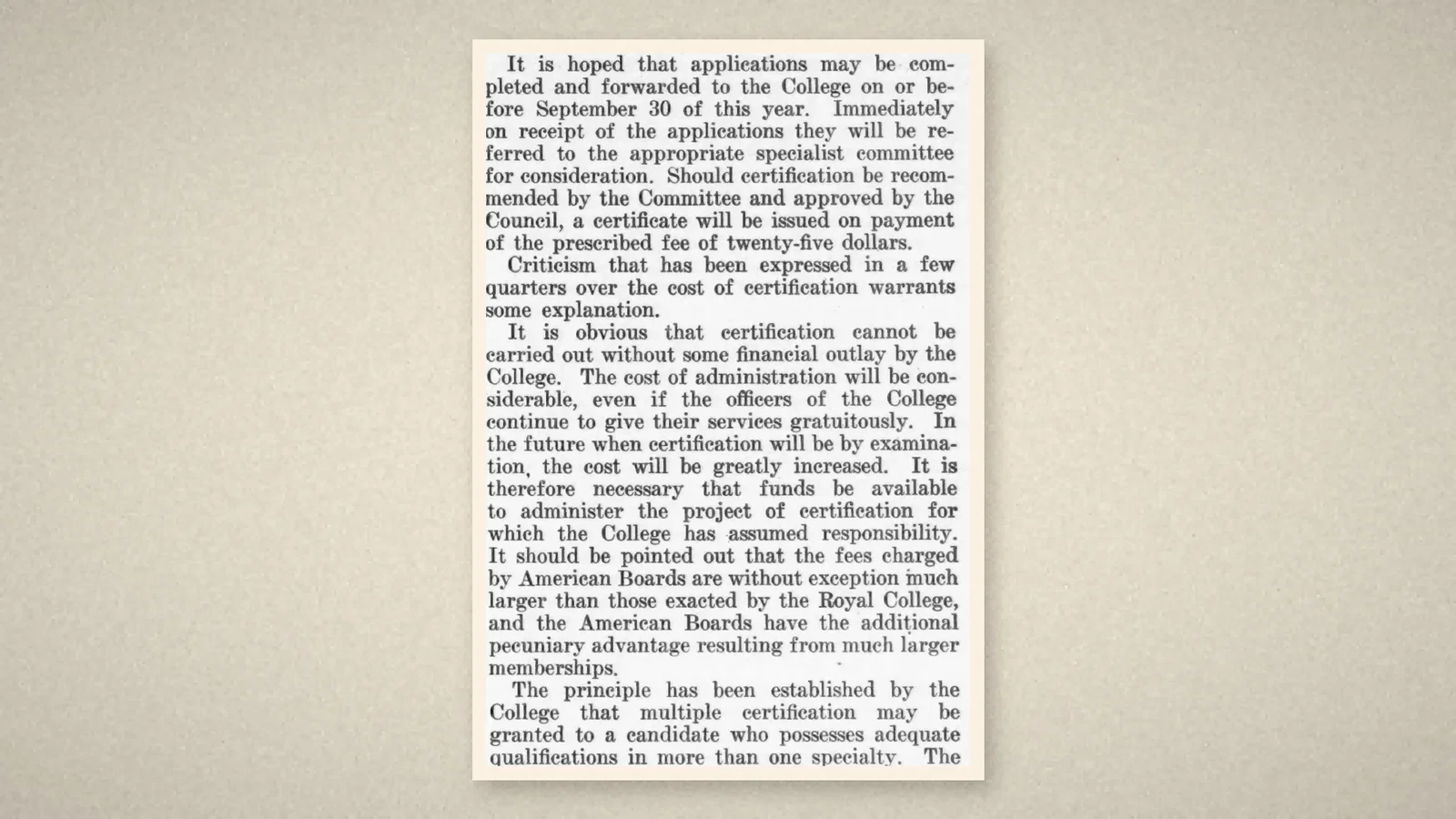
The certificate cost "the prescribed fee of twenty-five dollars"; certification needed funds, and examination would cost more, but the fees charged "by American Boards are without exception much" larger. Nor had the College required certified specialists to limit their practice to the specialty, as some American boards did; it "has not insisted upon a" limitation. [3, p. 263] The issue's supplement on graduate training set out the American anesthesiology board's demands for comparison: a year's internship, "three years of specialized training" in the specialty and basic sciences, the duty to "administer 500 anesthetics a year", 400 of them general surgical, and three years of further practice. [3, supplement]
What the record shows
Specialist certification in Canada was not built by the specialty societies themselves. The Canadian Medical Association pressed for it, the Royal College took it on, and it was tied closely to wartime planning for health insurance. Anaesthesia was among the few specialties approved by December 1942, and by 1944 anaesthetists had been certified without examination; examination was left for "ultimately".
Sources and reading limits
Read: CMAJ February 1943, the "Certification of Specialists" section of the Medical Economics report, in full; CMAJ July 1943, the note on the College's notice; CMAJ September 1944, Patch, "Certification of specialists in Canada", pp. 261–263, in full, and sections 99A and 100B of the issue's graduate-training supplement.
Not covered: the College's minutes, its 1943 notice and application form, and records of the founding of the Canadian Anaesthetists' Society in 1943 were not found in these sources, so the Society's founding is not described. The first anaesthetists certified are not named in what was read. The sources show anaesthesia approved for certification by December 1942 and certificates issued without examination by September 1944.
Three illustrations are crops of the 1944 journal pages; one is a timeline drawn from the article.
- Medical economics: 6. Certification of specialists. Can Med Assoc J. 1943 Feb;48(2). Internet Archive
- Certification of specialists [editorial note]. Can Med Assoc J. 1943 Jul;49(1). Internet Archive
- Patch FS. Certification of specialists in Canada. Can Med Assoc J. 1944;51(3):261-3; with the issue's supplement on graduate training, sections 99A and 100B. Internet Archive
Continue exploring
Related reading connects shared questions and contexts; it does not by itself establish historical influence.
- 1941: The American Board of Anesthesiology Becomes a Separate Board
- 1945: McGill's Department of Anaesthesia and Its Diploma Course
Anesthesia Epochs · The Source Room · About & Editorial Method
Published November 2, 2026. Sources and reading limits are stated above. Illustrations are labelled as original source images or AI-made. Historical accounts are educational; they are not current treatment instructions.