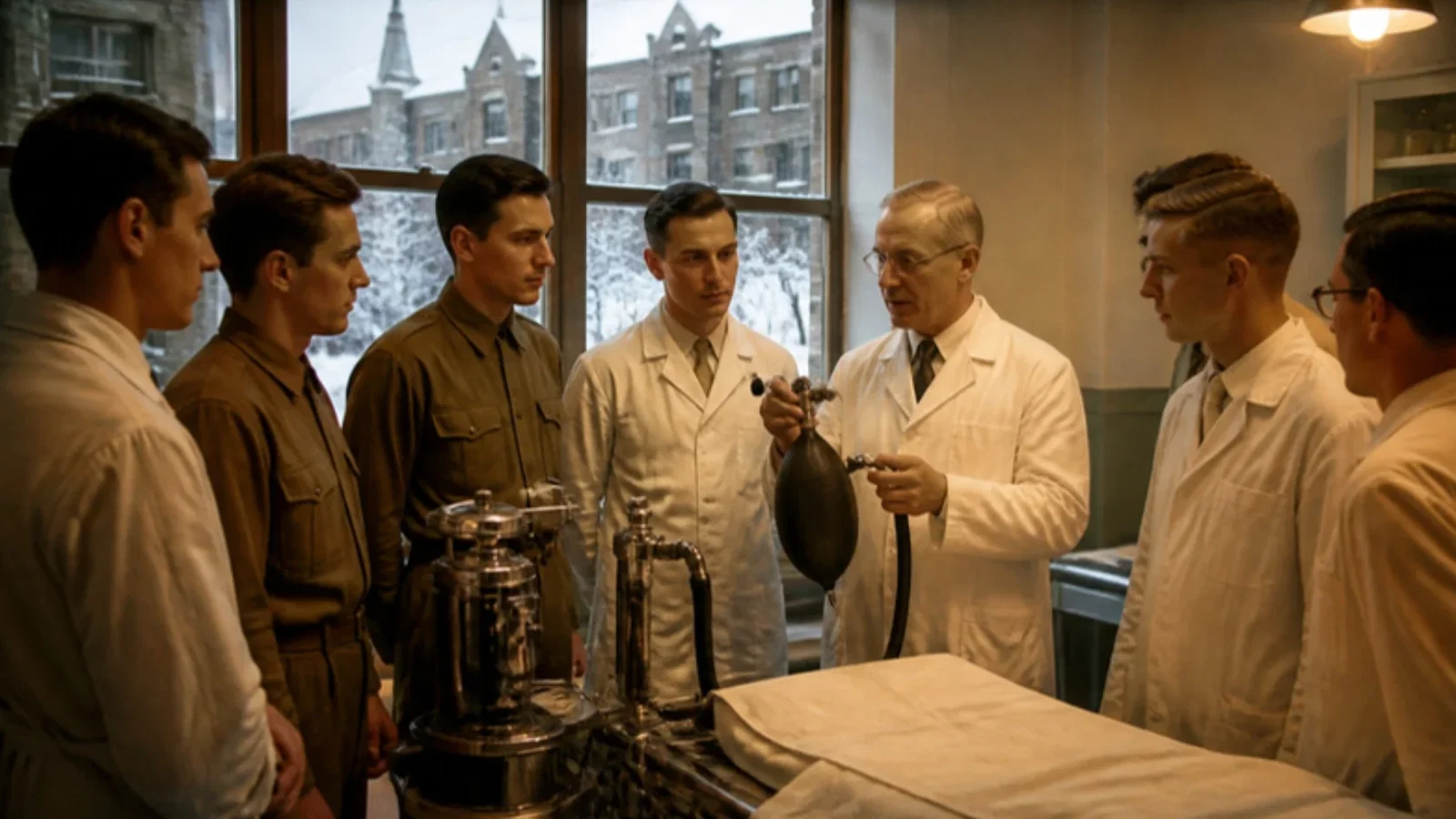
From a four-month course for the armed forces in 1941 to an independent university department in 1945: the systematic teaching Wesley Bourne built at McGill.
Reading Library · Anesthesia Epochs · 中文版
Watch the education video (for clinicians)
1945: Wesley Bourne at McGill — A Three-Year Diploma Course · Anesthesia Epochs Education Series
Anaesthesia residency today usually means rotating among several hospitals under one university department, with basic science courses and regular seminars. In Canada an early version of that model was the Department of Anaesthesia and three-year diploma course set up at McGill University in Montreal just after the war. This article rests on two items: a notice in the British Medical Journal in March 1946, and Harold R. Griffith's 1951 profile of Griffith's teacher, Wesley Bourne.
A notice
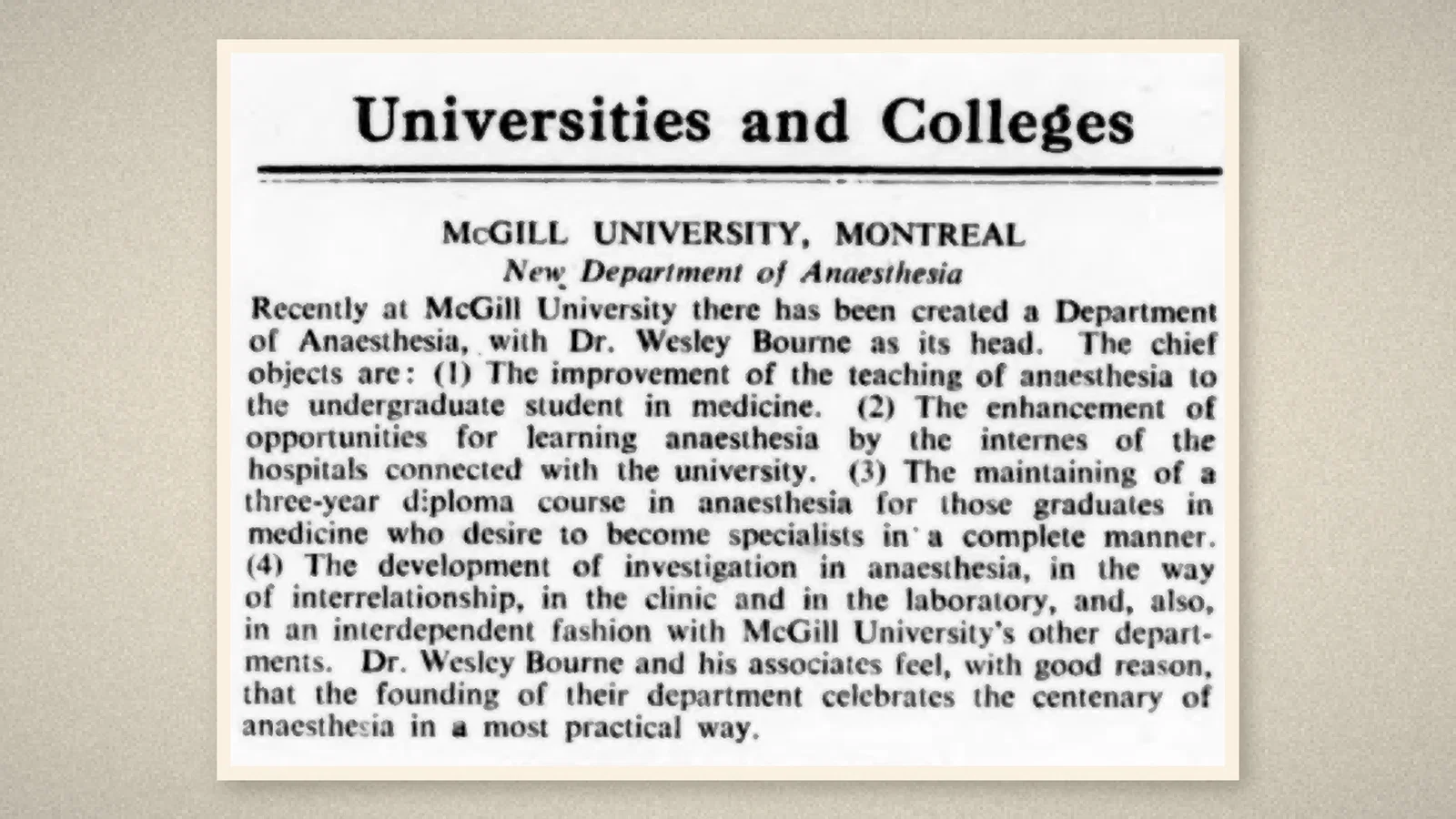
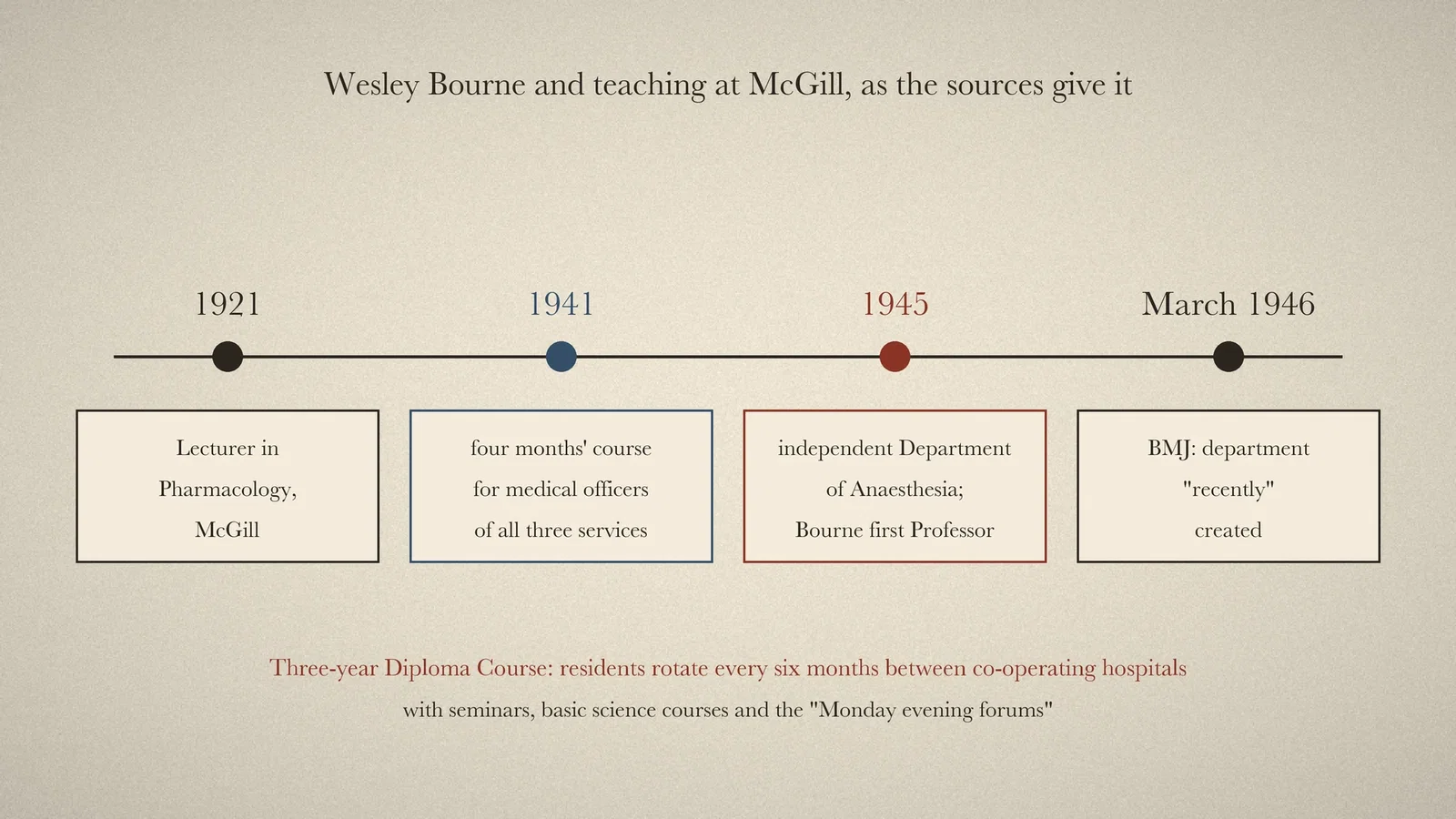
On 2 March 1946, under "Universities and Colleges", the BMJ reported that "recently at McGill University there has been created a Department" of Anaesthesia, "with Dr. Wesley Bourne as its head". Its objects were four: (1) "the improvement of the teaching of anaesthesia to" undergraduate medical students; (2) the enhancement of "opportunities for learning anaesthesia by the internes" of the university hospitals; (3) the maintaining of a "three-year diploma course in anaesthesia for those graduates" who wished to become specialists "in a complete manner"; and (4) "the development of investigation in anaesthesia", in clinic and laboratory and with the university's other departments. Bourne and associates felt that the founding "celebrates the centenary of" anaesthesia in a most practical way. [1, p. 338]
The writer of the profile
In July 1951 the British Journal of Anaesthesia's series "Eminent Anaesthetists" reached No. 6, Wesley Bourne, "by Harold R. Griffith". Griffith said at the outset that the subject was a mentor, "my teacher and my academic predecessor", and Griffith's closest friend, so the profile could not be wholly dispassionate. [2, p. 186] It is a tribute by a participant, and is read here as one.
According to Griffith, Bourne was born in Barbados, "came via New York to Montreal" to study medicine at McGill, "graduated in 1911", and began to train as a surgeon. At the Royal Victoria Hospital anaesthesia was given single-handed by Dr. F. W. Nagle; the surgeon Edward Archibald asked young Bourne "to try his hand at" dropping ether, and the die was cast. [2, p. 186–187] Bourne's connection with McGill's teaching staff dated from 1921, on being "appointed Lecturer in Pharmacology", a post Bourne held for nearly twenty-five years until the Department of Anaesthesia was established. [2, p. 187]
1941: a four-month course for the forces
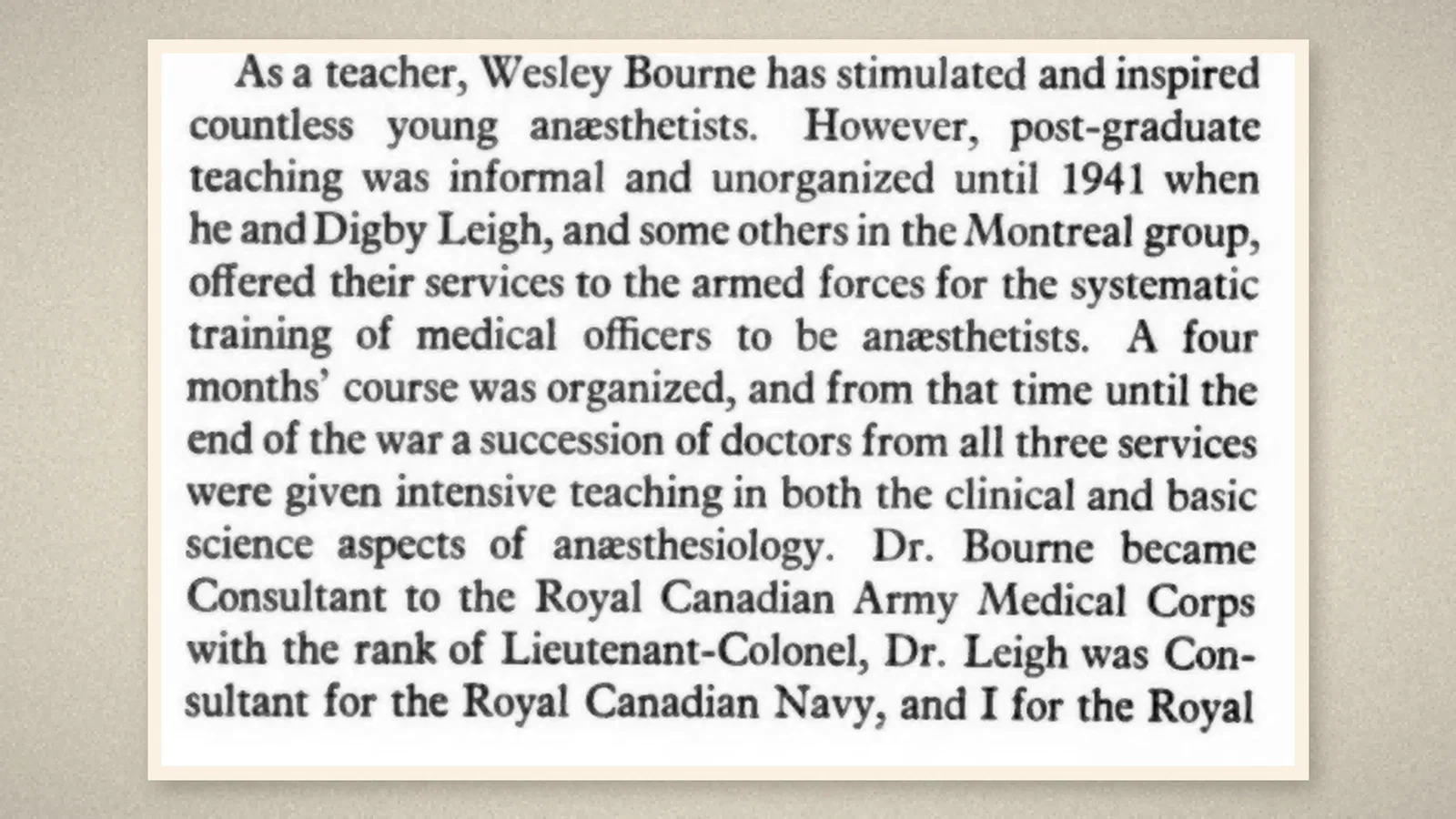
Bourne had inspired countless young anaesthetists, Griffith wrote, "however, post-graduate teaching was informal and unorganized until 1941", when "he and Digby Leigh", and others of the Montreal group, offered the armed forces systematic training of medical officers as anaesthetists. A four months' course was organized, "and from that time until the" end of the war doctors from all three services received "intensive teaching in both the clinical and basic science" aspects of anaesthesiology. Bourne became "Consultant to the Royal Canadian Army Medical Corps" as a lieutenant-colonel, Leigh consultant to the Navy, and Griffith to the Air Force. [2, p. 192] Bourne designed and directed the whole programme as a patriotic duty, "without any personal remuneration". [2, p. 193]
1945: an independent department and a three-year diploma
"In 1945 the pattern of this course was followed" in organising McGill's Department of Anaesthesia. The Principal and Governors decided to establish anaesthesia "as an independent Department in the Faculty of Medicine", with Bourne its first Professor. Bourne organised systematic teaching for graduates and undergraduates. "A three-year Diploma Course for specialist training" was started, with the advantage that "students rotate as residents every six months" between co-operating hospitals and meet regularly for seminars, basic science courses and lectures. The "Monday evening forums" drew French- and English-speaking anaesthetists and many visitors. [2, p. 193]
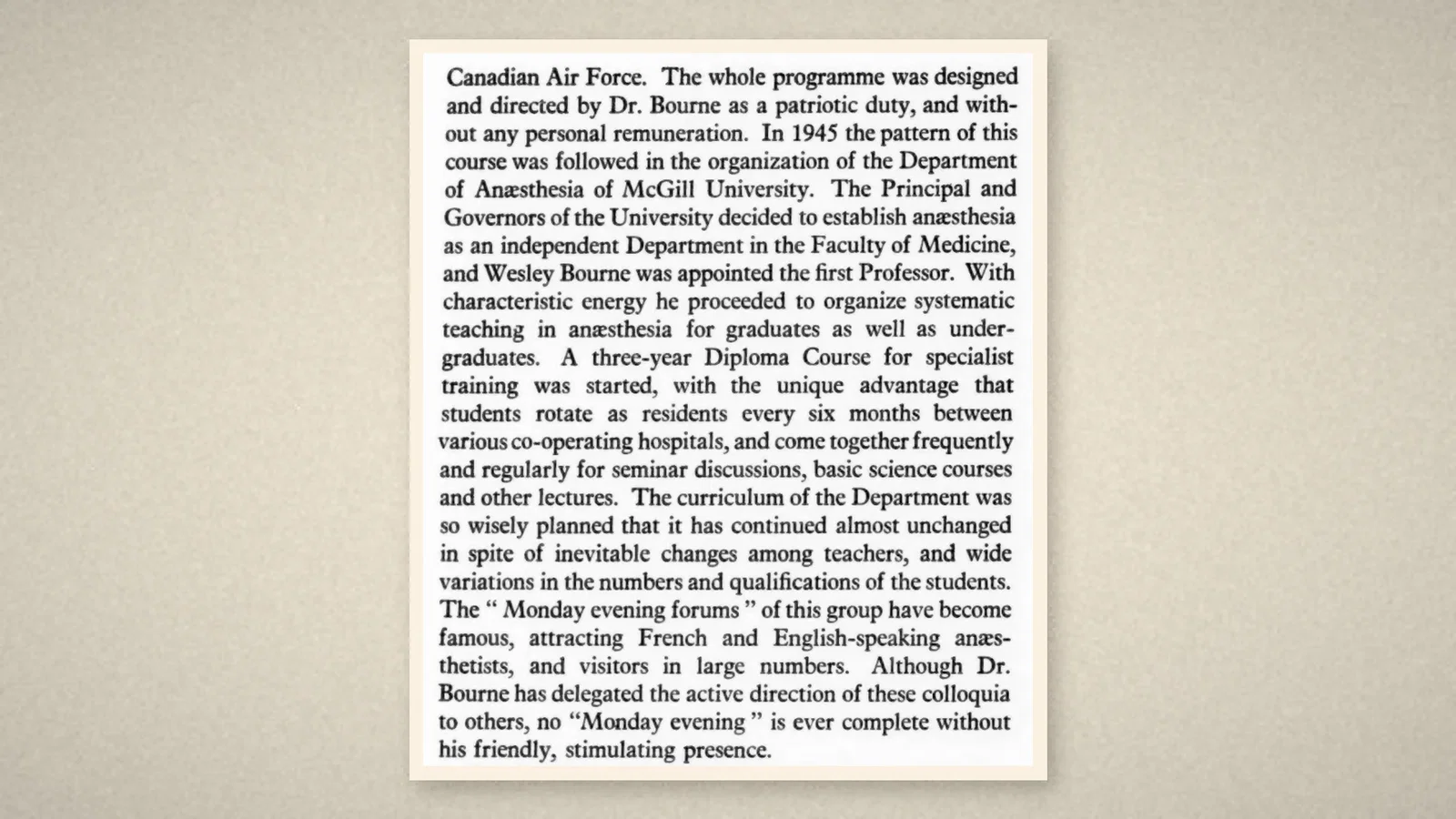
By the time Griffith wrote, the chairmanship had passed to other hands. If nothing else remained of Bourne's work, Griffith said, the Diploma Course alone would be a worthy memorial; "dozens of its graduates have gone to" leading posts in hospitals, practice and other medical schools around the world. [2, p. 193]
What the record shows
McGill's department did not begin as a plan on paper but as a wartime crash course: the four-month course for the services in 1941 became the template for an independent department in 1945. The four objects in the 1946 notice (undergraduate teaching, learning for interns, a three-year specialist diploma, clinical and laboratory investigation), together with the rotations, seminars and basic science courses Griffith described, already outline a university training programme in anaesthesia.
Sources and reading limits
Read: BMJ 2 March 1946, p. 338, the notice of McGill's new Department of Anaesthesia, in full; Griffith, "Eminent Anaesthetists, No. 6: Wesley Bourne", BJA July 1951, pp. 186–195, in full.
Not covered: McGill's Faculty of Medicine and Board of Governors records for 1941–46, the Canadian services' records of the wartime course, and Bourne's own essays on teaching are not covered. The wartime course, the 1945 decision and the diploma's structure rest on Griffith's 1951 account; Griffith was Bourne's pupil, wartime colleague and successor as chairman, and the profile is a tribute, read as such. Griffith gives only the year 1945 for the department; the BMJ in March 1946 calls it "recent".
Three illustrations are crops of the two journal pages; one is a timeline drawn from them.
- McGill University, Montreal: New Department of Anaesthesia. Br Med J. 1946;1(4443):338. Internet Archive
- Griffith HR. Eminent anaesthetists, No. 6: Wesley Bourne. Br J Anaesth. 1951;23(3):186-95. Internet Archive
Continue exploring
Related reading connects shared questions and contexts; it does not by itself establish historical influence.
- 1945: Sydney Opens a Diploma Course in Anaesthesia
- 1937: Oxford Creates the Nuffield Chair of Anaesthetics
- 1940: The First Number of Anesthesiology
Anesthesia Epochs · The Source Room · About & Editorial Method
Published November 2, 2026. Sources and reading limits are stated above. Illustrations are labelled as original source images or AI-made. Historical accounts are educational; they are not current treatment instructions.