
In November 1893 the Philadelphia ophthalmologist C. A. Veasey reported that a 3% solution of tropacocaine numbed the cornea in about two minutes for about eight, and judged it better than cocaine only for foreign bodies, caustic applications and keratitis, since at about forty cents a grain it was unlikely to come into general use.
Reading Library · Anesthesia Epochs · 中文版
Watch the education video (for clinicians)
1893: Veasey's Tropacocaine Trial — Forty Cents a Grain · Anesthesia Epochs Education Series
When a new local anesthetic crossed the Atlantic from European pharmacological laboratories to American eye clinics in the early 1890s, its practical survival depended on more than whether it numbed the cornea. Clinicians wanted to know whether patients could still read after leaving the chair, whether corneal blood vessels constricted, and what the druggist charged per grain. On November 25, 1893, C. A. Veasey, M.D.—Clinical Assistant to the Ophthalmological Department of the Jefferson Medical College Hospital and Consulting Ophthalmic Surgeon to the Philadelphia Lying-in Charity and Nurse-Training School—published a concise three-page clinical evaluation in The New York Medical Journal titled "Tropacocaine, The New Local Anæsthetic, and its Use in Diseases of the Eye." [1, wrapper and p. 1]
Having substituted a 3% tropacocaine hydrochloride solution for the customary 4% cocaine hydrochloride across "several weeks" of clinical work in Philadelphia, Veasey delivered a candid, divided verdict. For minor eye operations in general, Veasey wrote, "I... do not like it any better than the ordinary cocaine solutions; and as the price of the preparation is so high—being about forty cents a grain wholesale—it is hardly probable that it will come into general use." Yet for three specific clinical tasks—removing corneal foreign bodies, applying strong astringents or caustics, and treating keratitis—Veasey judged tropacocaine distinctly preferable to cocaine. [1, pp. 2–3]
From Berlin Reports to a Philadelphia Clinic Trial
Veasey opened by tracing the alkaloid's recent European literature: its isolation from a Java coca plant by F. Giesel (citing Pharmaceutische Zeitung, vol. xxxvi, July 4, 1891) and its physiological investigation by Arthur P. Chadbourne (citing the British Medical Journal of 1892, p. 402, though the reprint's footnote misprinted the volume numeral as vii instead of ii). [1, p. 1; 2, p. 402]
Echoing Chadbourne's pharmacological framing, Veasey noted that chemically tropacocaine was benzo-pseudo-tropeine and occupied a middle ground—a "physiological connecting link"—between the "true anæsthetics" that produce marked ischemia (such as cocaine) and the "anæsthetica dolorosa" of Liebreich (printed "Liebriech" in the pamphlet) that provoke irritation and hyperemia. Veasey also cited the Berlin ophthalmic reports of Schweigger, who claimed to have performed painless iridectomy in under two minutes after instilling one or two drops of a 3% solution, and Silex, who reported painless tenotomy in less than half a minute. [1, pp. 1–2; 2, p. 406]
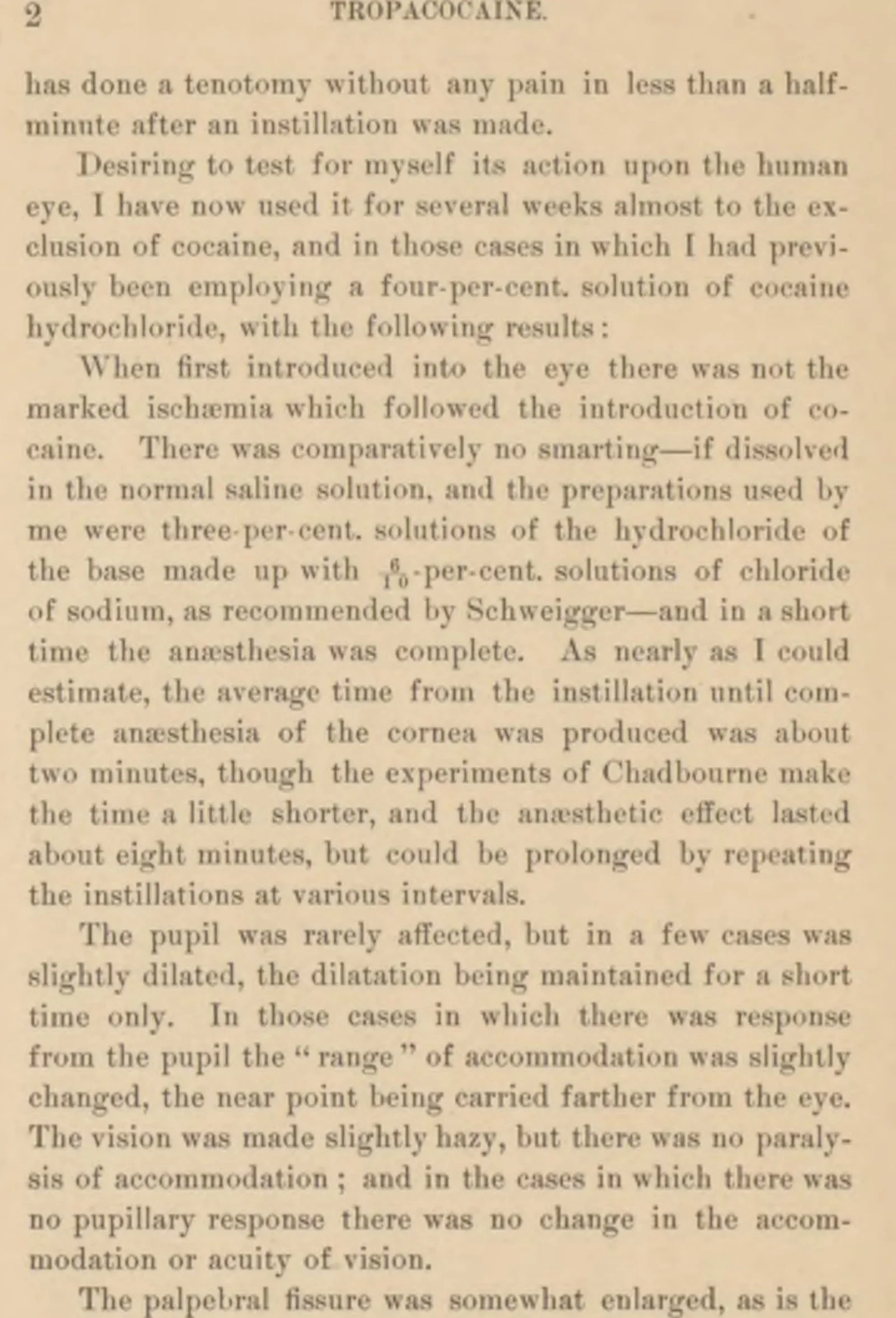
To test the drug on human eyes first-hand, Veasey replaced the usual 4% cocaine hydrochloride with a 3% solution of tropacocaine hydrochloride dissolved in a 6/10% (0.6%) aqueous solution of sodium chloride, following Schweigger's recommendation to eliminate initial stinging. [1, p. 2]
Two Minutes to Onset, Eight Minutes of Anesthesia, and Spared Accommodation
Across several weeks of ophthalmic use, Veasey documented four clinical properties that differentiated 3% tropacocaine in 0.6% saline from 4% cocaine:
- Absence of Marked Ischemia and Smarting: Instillation did not produce the pronounced conjunctival and corneal ischemia characteristic of cocaine, and when prepared in 0.6% sodium chloride solution there was "comparatively no smarting." [1, p. 2]
- Estimated Onset and Duration: "As nearly as I could estimate," Veasey reported, complete corneal anesthesia required an average of about two minutes—which Veasey noted was slightly longer than in Chadbourne's report—and lasted about eight minutes, though anesthesia could be prolonged by repeating instillations at intervals. [1, p. 2]
- Conditional Pupil and Accommodation Effects: The pupil was rarely affected, showing only slight, brief dilation in a few cases. Where pupillary dilation did occur, the "range" of accommodation shifted slightly—carrying the near point farther from the eye and making vision slightly hazy, yet producing no paralysis of accommodation. Where the pupil did not respond, neither accommodation nor visual acuity changed at all. [1, p. 2]
- Palpebral Fissure Without Ptosis: Like cocaine, tropacocaine slightly widened the palpebral fissure, and in no instance did Veasey observe ptosis. [1, p. 2]
Where Tropacocaine Beat Cocaine—and Why Price Blocked General Adoption
Rather than treating tropacocaine as a universal replacement for cocaine, Veasey used its physiological profile and wholesale cost to draw a sharp practical boundary on pages 2 and 3 of the reprint (signed from an office at 125 North Seventeenth Street, Philadelphia): [1, pp. 2–3]
Clinical Dimension | Veasey's 1893 Observation (3% Tropacocaine in 0.6% NaCl) | Practical Verdict vs. 4% Cocaine Hydrochloride |
General Minor Eye Operations | Complete corneal anesthesia in ~2 min, lasting ~8 min (extendable by repeat drops) | Not preferred: "do not like it any better than the ordinary cocaine solutions" |
Corneal Foreign Bodies & Strong Astringent / Caustic Applications | Feeble, infrequent action on accommodation; no paralysis of accommodation | Preferable to cocaine: spares outpatient cases "the annoyance of a hazy vision for a time" |
Keratitis Requiring Local Anesthesia | Lacks marked vasoconstriction; does not strongly diminish blood supply | Preferable to cocaine: preserves corneal vascular supply when inflammation is present |
Wholesale Cost & General Adoption | About 40 cents a grain wholesale | Unlikely to become routine: "hardly probable that it will come into general use" |
Reading Veasey (1893) Alongside Chadbourne (1892)
Chadbourne's paper in the BMJ of 20 August 1892 reported animal experiments done at the Pharmacological Institute of the University of Berlin with Liebreich's support. [2, p. 403] Comparing the two drugs in frogs, Chadbourne concluded among other things that cocaine was at least twice as poisonous as tropacocaine. [2, p. 403] Chadbourne described the alkaloid's source as the leaves of a "small-leaved coca-plant" of Java. [2, p. 402]
Read together, the two texts show a common route for a new local anaesthetic into practice: the laboratory compares toxicity and action, and a specialist then tests the drug against concrete tasks in the clinic. Veasey did not adopt the Berlin claim of painless iridectomy in under two minutes; Veasey recorded a personal estimate of about two minutes to onset and about eight minutes of effect. Nor did Veasey dismiss the drug: spared accommodation, spared blood supply and a wholesale price of about forty cents a grain defined where it belonged in an eye clinic of the 1890s. [1, pp. 2–3]
Sources and reading limits
Read: all of Veasey’s 1893 author reprint in the National Library of Medicine Digital Collections (wrapper, printed pages 1–3 and the publisher’s pages), including the page image of printed page 2 for the “6/10-per-cent.” saline strength; pages 402–403 of Chadbourne’s 1892 BMJ article.
Not covered: the bound New York Medical Journal issue of 25 November 1893 (the reprint has only its own pagination, 1–3); Giesel’s 1891 isolation note; the original Berlin reports of Schweigger and Silex, which are cited only as Veasey reports them. Veasey gives no patient count for the “several weeks” of use, and the authors are named as printed.
- Veasey CA. Tropacocaine, The New Local Anæsthetic, and its Use in Diseases of the Eye. Reprinted from The New York Medical Journal for November 25, 1893. New York: D. Appleton and Company; 1893:1–3. NLM Digital Collections PDF; Wikimedia Commons copy.
- Chadbourne AP. On the Value of a New Coca Base: Benzoyl, ψ Tropeïn (Tropacocaine), as a Local Anæsthetic. BMJ. 1892 Aug 20;2(1651):402–406. Internet Archive volume.
Continue exploring
Related reading connects shared questions and contexts; it does not by itself establish historical influence.
Anesthesia Epochs · The Source Room · About & Editorial Method
Published November 2, 2026. Sources and reading limits are stated above. Illustrations are labelled as original source images or AI-made. Historical accounts are educational; they are not current treatment instructions.