Detecting a signal through tissue left questions about its source and path.
Reading Library · Anesthesia Epochs · 中文版
Watch the companion film
1977: Jöbsis — Near-Infrared Spectroscopy · Watch on YouTube
Historical anchor: 1977. Date details and source qualifications are explained below.
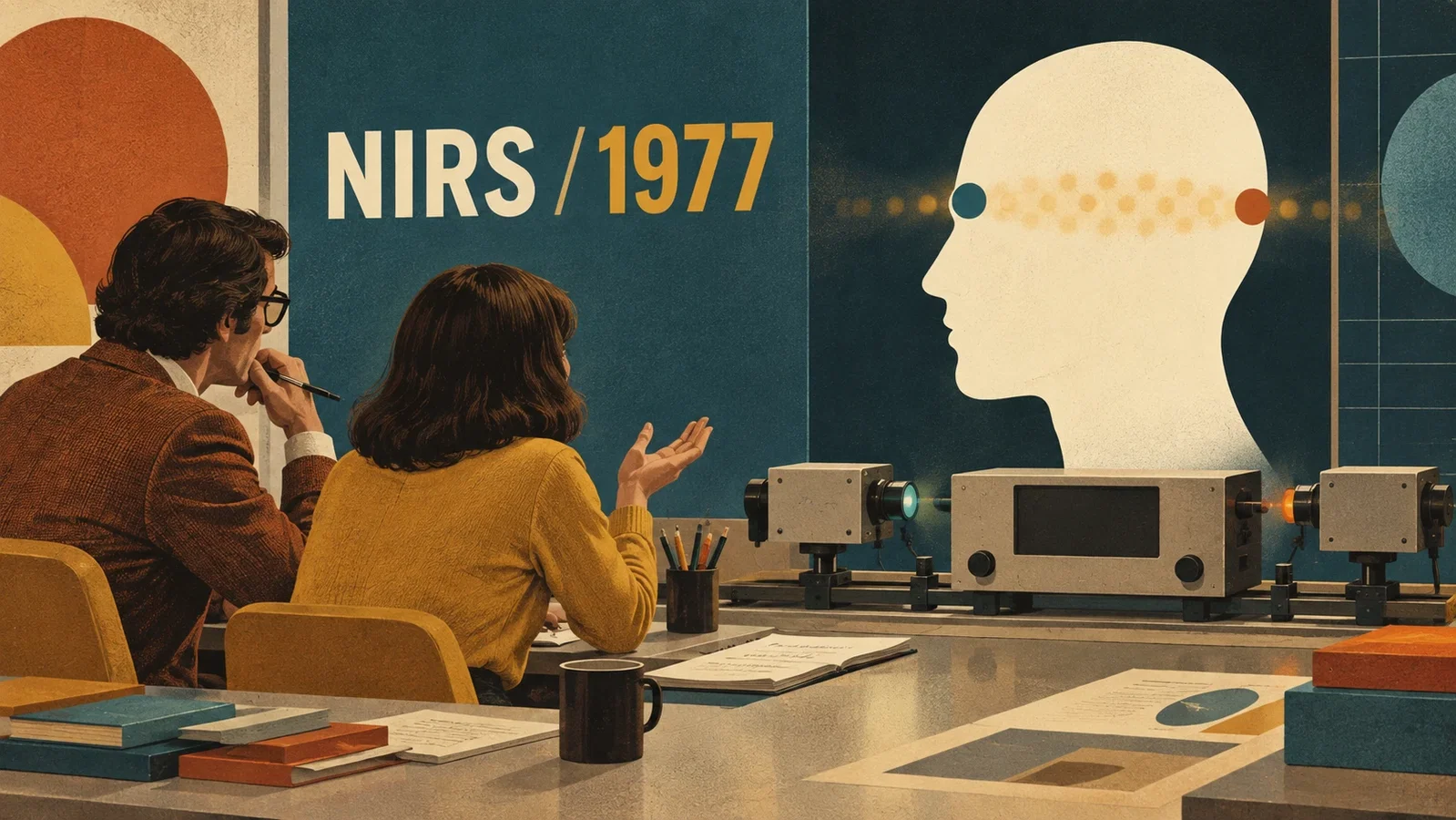
A pulse oximeter and an early near-infrared tissue experiment ask different questions of transmitted light. Aoyagi’s method compared the pulsatile component with total intensity at each of two wavelengths, then compared those ratios to obtain information about arterial oxygen saturation.[3, p.673] Frans F. Jöbsis was interested in observing cytochrome oxidase inside living tissue. His later account describes the difficulty of separating its absorption from that of hemoglobin.[1, pp.392–394]
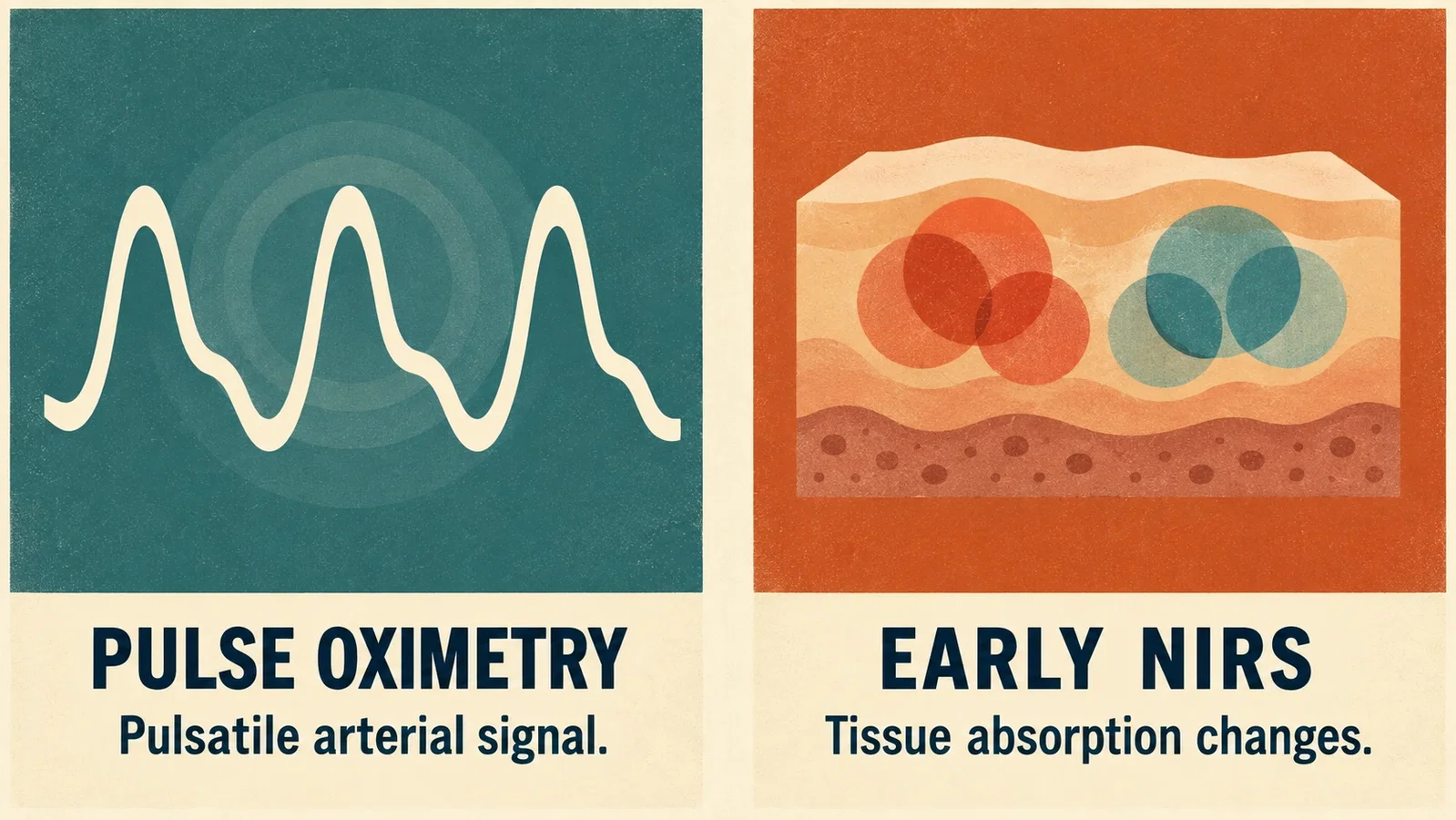
This is a comparison of measurement strategies. It does not establish that one investigator adopted the other’s technique. Both accounts involve extracting physiological information from overlapping optical contributions, but the intended signals differ.
In his 1999 retrospective, Jöbsis recalled assembling equipment with Ben Comfort, Hans Keizer and Ron Overaker in early 1977. He placed successful transmission through a cat’s head in late January and through his own head in mid-February.[1, p.393] Those dates come from a participant writing more than twenty years later. They describe exploratory measurements, with no basis here for turning them into a clinical outcomes trial.
His four-page Science report appeared on December 23, 1977. Its title addressed cerebral and myocardial oxygen sufficiency and circulatory parameters.[2] The publication record is verified; the development history in this essay is drawn from the fully read 1999 account.
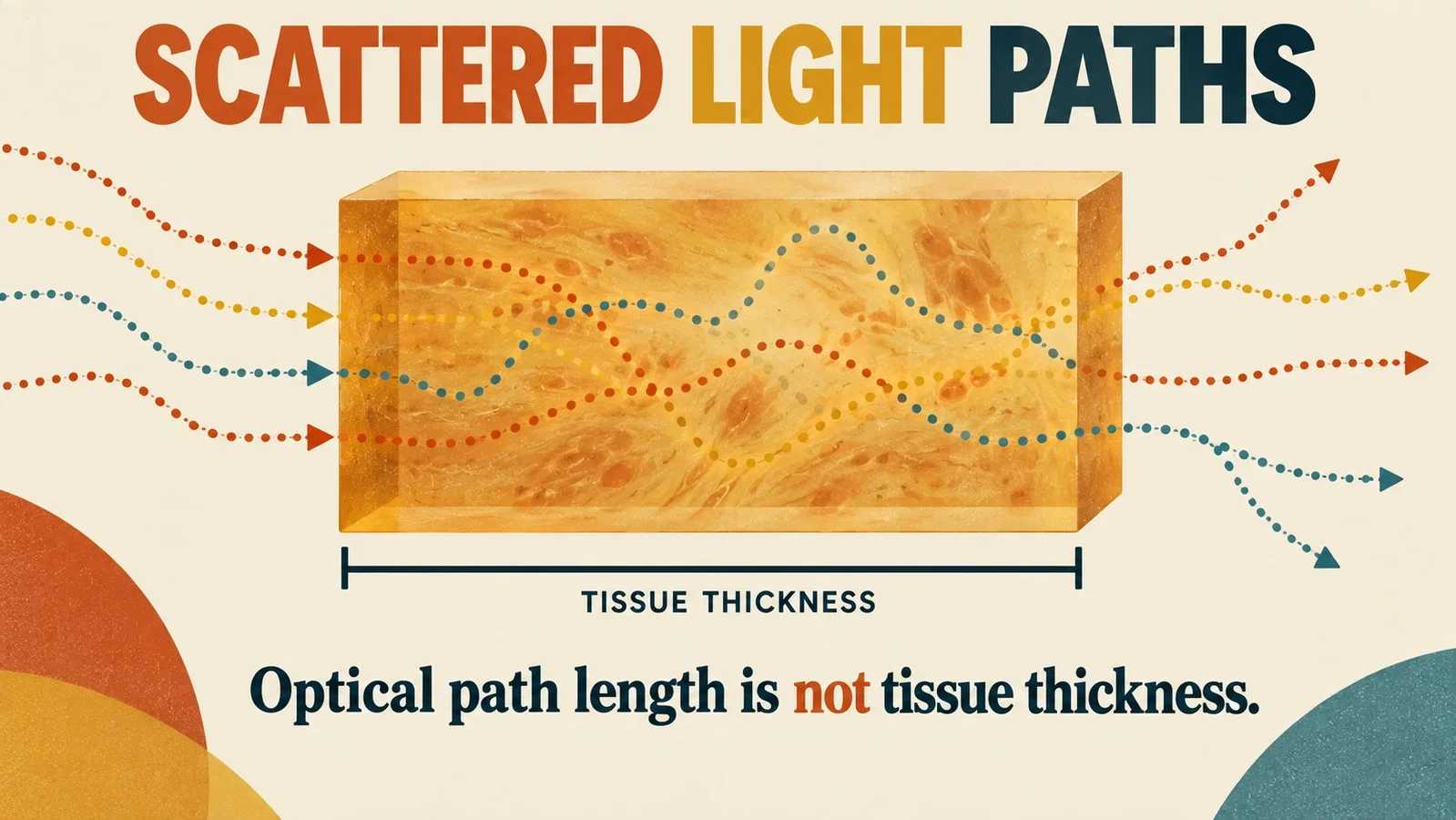
Interpretation remained difficult. Multiple scattering lengthened the photons’ path through tissue by an unknown amount. Jöbsis explained that his algorithms expressed relative changes in the component signals rather than absolute concentrations.[1, p.394] A drawing of a light path can help explain that distinction, but cannot supply the missing path length or reconstruct an experimental trace.
He dated completion of a bedside prototype to autumn 1980. His account separates early digital photon counting and transillumination from subsequent analog and reflectance work, and credits anesthesiologist Elisabeth Fox and neonatologist Jane Brazy with clinical exploration and improvements at the patient–instrument interface.[1, pp.394–395]
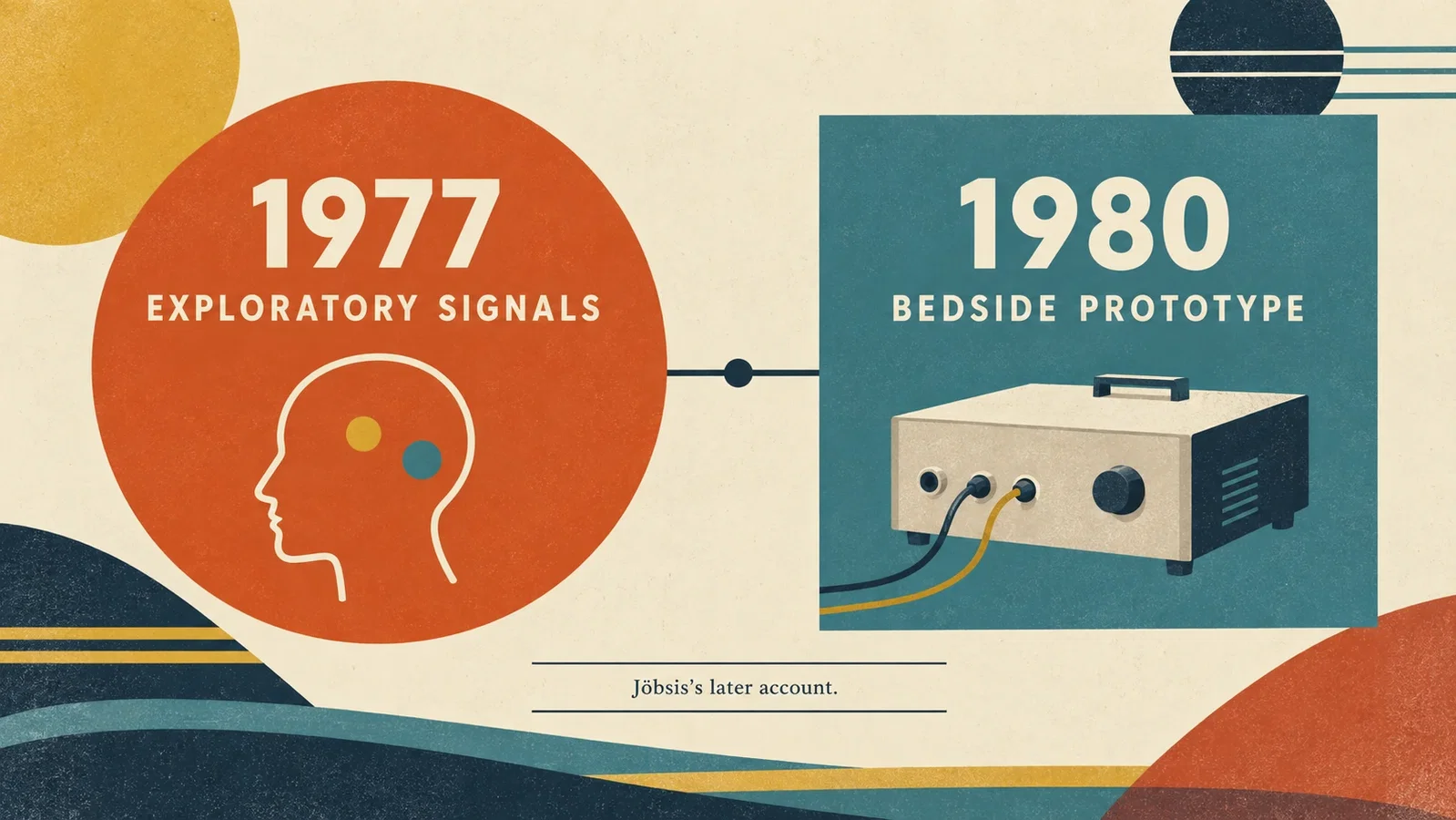
The 1977 publication provides a firm anchor without compressing those later stages into a finished clinical product. The questions left visible in this history concern which signal was measured, how it was separated, and what the instrument could reasonably say about living tissue.
Image note: the four images are modern editorial illustrations. People, instruments, head contours and optical paths are conceptual, without reconstruction of a particular historical apparatus, experimental dataset or current clinical display. The 1980 date refers to the prototype described in Jöbsis’s retrospective.
Sources and reading limits
- Jöbsis-vanderVliet FF. Discovery of the near-infrared window into the body and the early development of near-infrared spectroscopy. J Biomed Opt. 1999;4(4):392–396. DOI. Full five-page original read; a firsthand retrospective based on a 1998 presentation.
- Jöbsis FF. Noninvasive, infrared monitoring of cerebral and myocardial oxygen sufficiency and circulatory parameters. Science. 1977;198(4323):1264–1267. Publisher record; PMID 929199. Publication identity and date checked; full text not covered, so no unique experimental detail is drawn from its abstract.
- Miyasaka K, Shelley K, Takahashi S, et al. Tribute to Dr. Takuo Aoyagi, inventor of pulse oximetry. J Anesth. 2021;35:671–709. DOI. Selected original pages 671–673 read, especially Shelley’s account of the two-wavelength AC/DC ratio on p.673; the full 39-page collection was not reread.
All five original pages of the 1999 article were read. The 1977 Science full text is not covered; its abstract is not treated as verification of experimental details. Only pp.671–673 of the 2021 collection were newly read. Retrospective accounts remain attributed to their authors. The comparison concerns historical measurement principles and supplies no current clinical threshold or treatment instruction.
Continue exploring
Related reading connects shared questions and contexts; it does not by itself establish historical influence.
The Source Room · About & Editorial Method
Sources and reading limits are stated above. Illustrations are labelled as original source images or AI-made. Historical accounts are educational; they are not current treatment instructions.