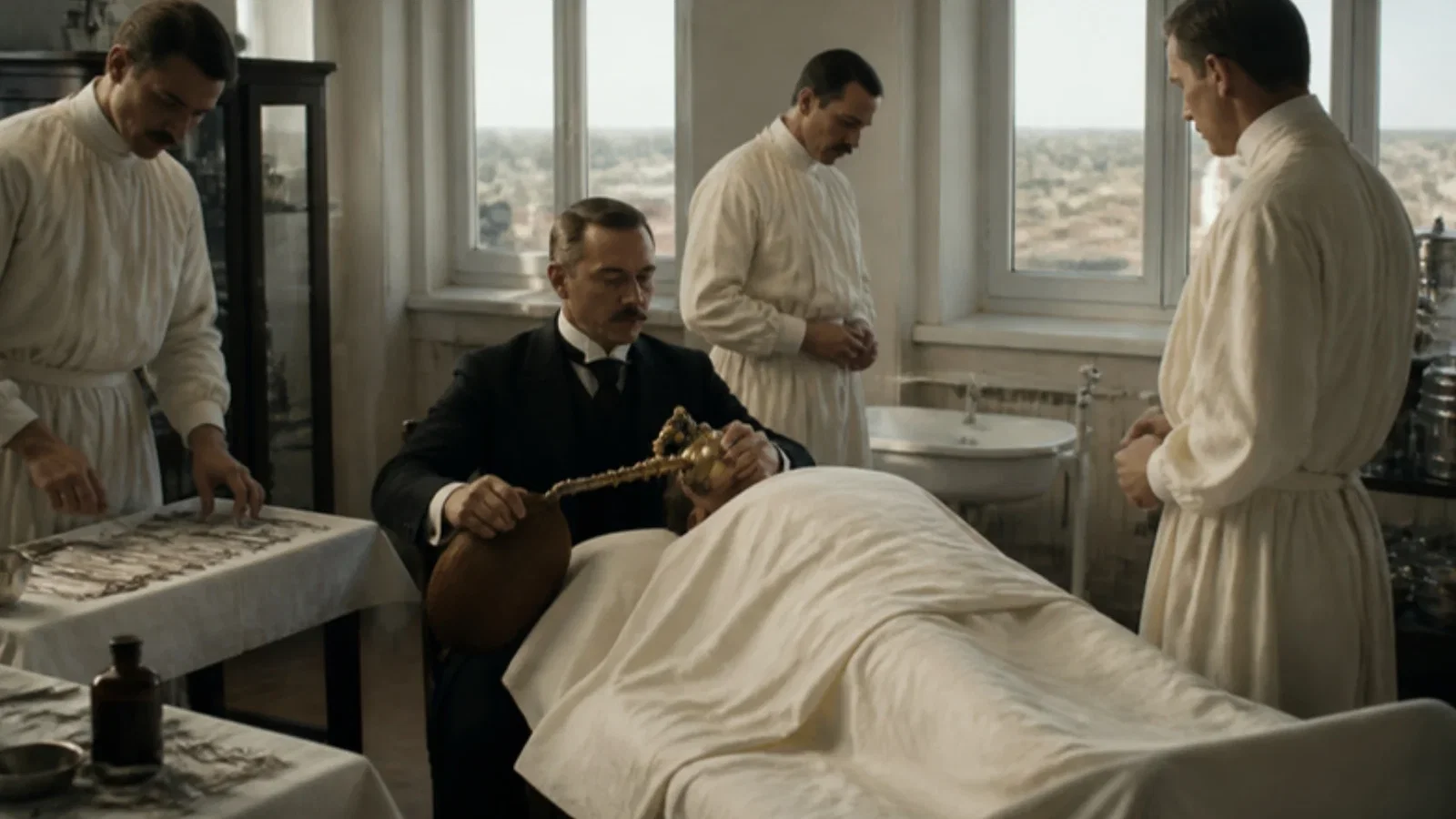
An anaesthetist who had given ethyl chloride two thousand times, and an appointment known only from later accounts.
Reading Library · Anesthesia Epochs · 中文版
Watch the education video (for clinicians)
1907: George Daniell — South Africa's First Specialist Anaesthetist · Anesthesia Epochs Education Series
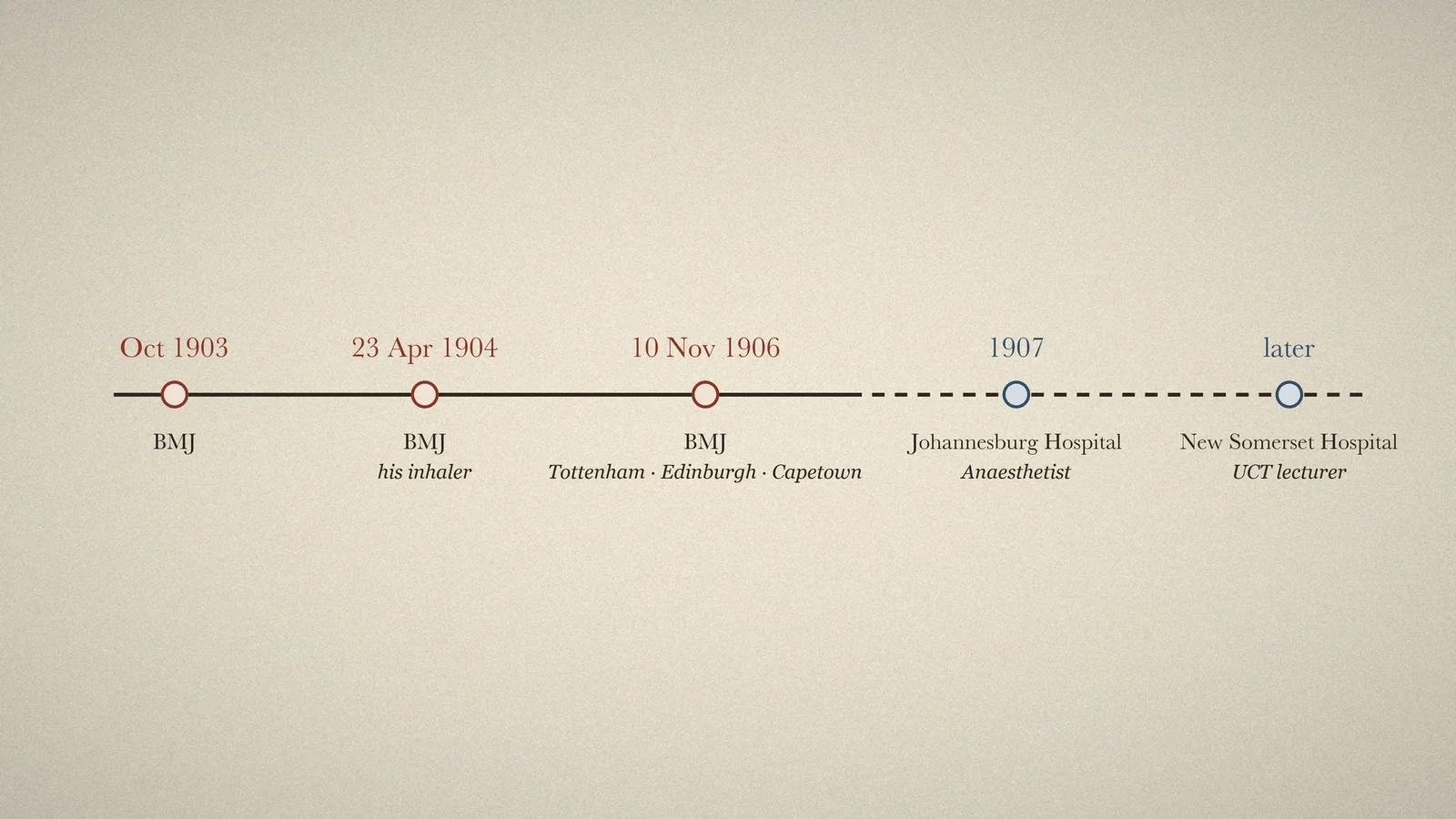
South African anaesthesia history has a much-quoted starting point. Reviewing the country's history in 2023, Gordon and James of the University of Cape Town wrote that Dr George Warwick Bampfylde Daniell came out to South Africa as a doctor in the Anglo-Boer War, bringing a state-of-the-art Clover inhaler; Daniell stayed, was appointed Anaesthetist to the Johannesburg Hospital in 1907 and so became South Africa's first "specialist anaesthetist"; Daniell later moved to Cape Town and became the first lecturer in anaesthesia to University of Cape Town students at the New Somerset Hospital. [2]
That account gives no primary source for the 1907 appointment, and no contemporary record of it was found for this article. What can be read is a paper Daniell published the year before. It gives the name some substance.
What anaesthesia in South Africa looked like
Gordon and James set the scene. Both sides used anaesthesia in the Anglo-Boer War; British medical services kept chloroform and ether at every base hospital, and mounted doctors carried chloroform in their saddlebags. [2] Afterwards most anaesthetics were given by general practitioners in patients' homes, by "rag and bottle" methods with ether or chloroform dropped onto a Schimmelbusch mask; anaesthetists in private practice were not paid for work in State hospitals, were paid by the surgeon they worked for in private practice, and had to carry all their equipment except oxygen. [2] Against that background, a hospital naming an "anaesthetist" was something worth recording.
1906: a paper on ethyl chloride
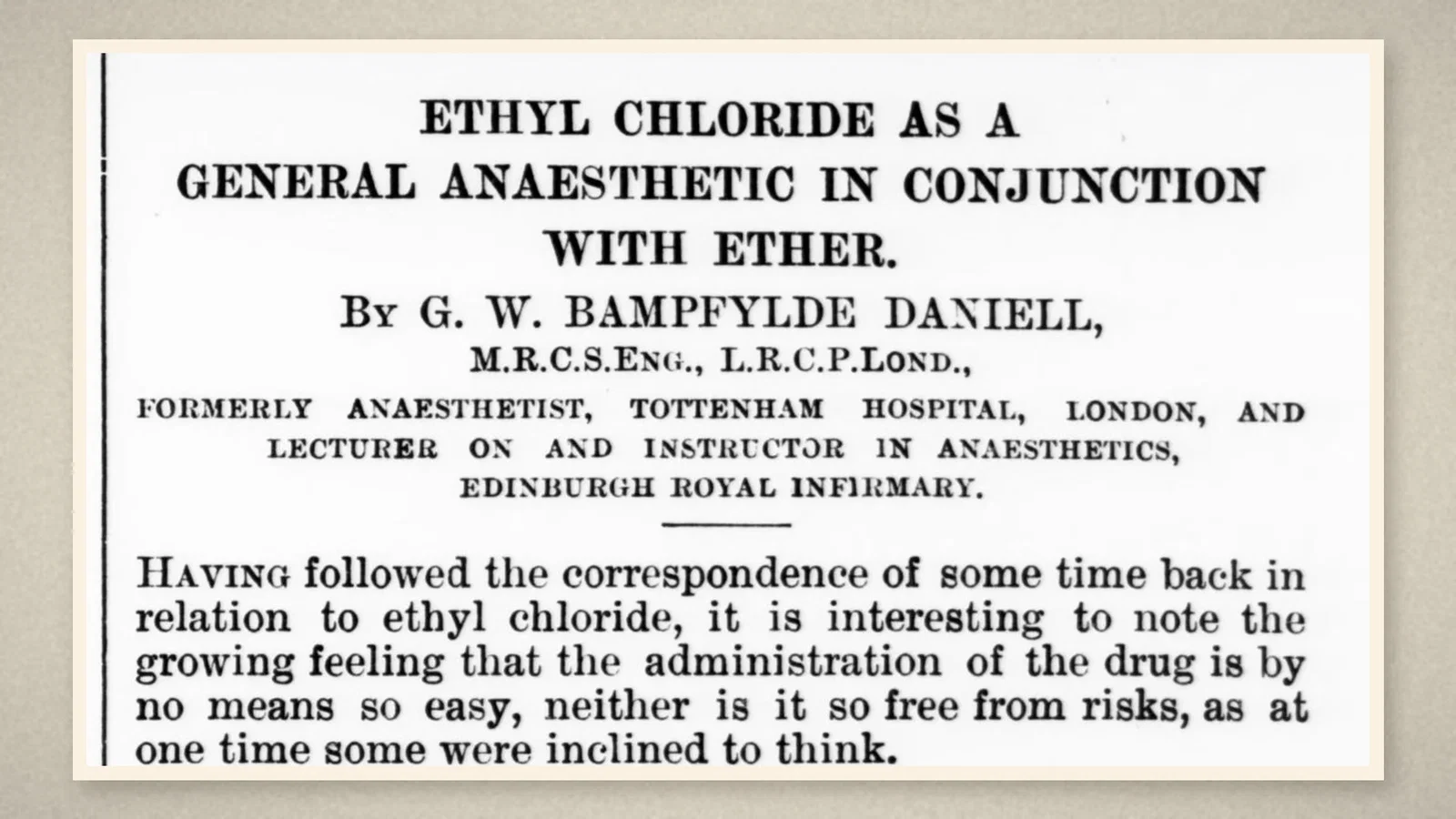
On 10 November 1906 the British Medical Journal published Daniell's "Ethyl chloride as a general anaesthetic in conjunction with ether". The byline gave Daniell's standing: formerly anaesthetist, Tottenham Hospital, London, and lecturer on and instructor in anaesthetics, Edinburgh Royal Infirmary. [1, p. 1257] It did not mention South Africa.
Daniell began by noting the growing feeling that ethyl chloride was "by no means so easy" to give, nor "so free from risks", as some had once thought. Daniell had given the drug about two thousand times and had one case that caused a moment's anxiety: a man of about 20, about to have teeth extracted, suddenly turned pale as he went under, his eyelids lost their tone and his pulse and breathing became feeble; the mask was withdrawn at once and he recovered quickly. [1, p. 1257] Vomiting afterwards revealed that he had eaten a hearty breakfast.
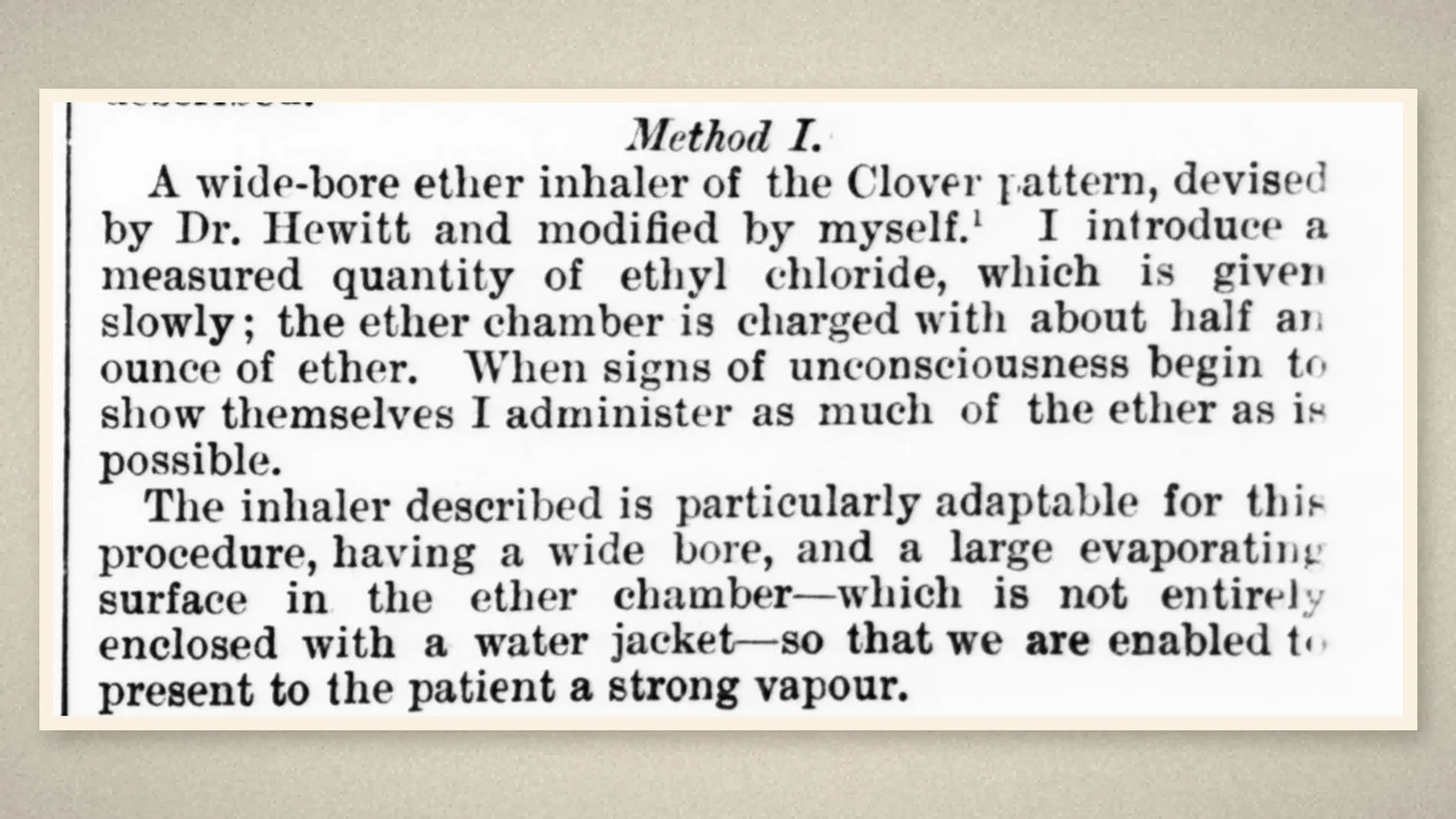
The conclusion was plain. As with other anaesthetics, ethyl chloride needed caution and experience; Daniell strongly advised anyone intending to use it to see it given by an experienced anaesthetist and to give it under that guidance several times, to several types of patient, before using it on their own. [1, p. 1257] Daniell had used ethyl chloride followed as soon as possible by ether extensively since 1902. [1, p. 1257] The first method used a wide-bore ether inhaler of the Clover pattern, devised by Hewitt and modified by Daniell. [1, p. 1257] Daniell had described the apparatus in the BMJ of 23 April 1904, and the references also cite a Daniell paper from October 1903 in the same journal. [1, p. 1257–1258]
"When in Capetown"
The second method opens: "When in Capetown it was reported to me by the makers of my inhaler..." Some practitioners complained that the glass tube was occasionally blown from the tap. That had never happened to Daniell, who had found, however, that at a temperature of about 90 °F some of the drug was lost by evaporation while filling the tube; so Daniell first put a few drops of ether in the tube to cool it, and eventually gave a mixture of 2½ c. cm. each of ether and ethyl chloride. [1, p. 1258]
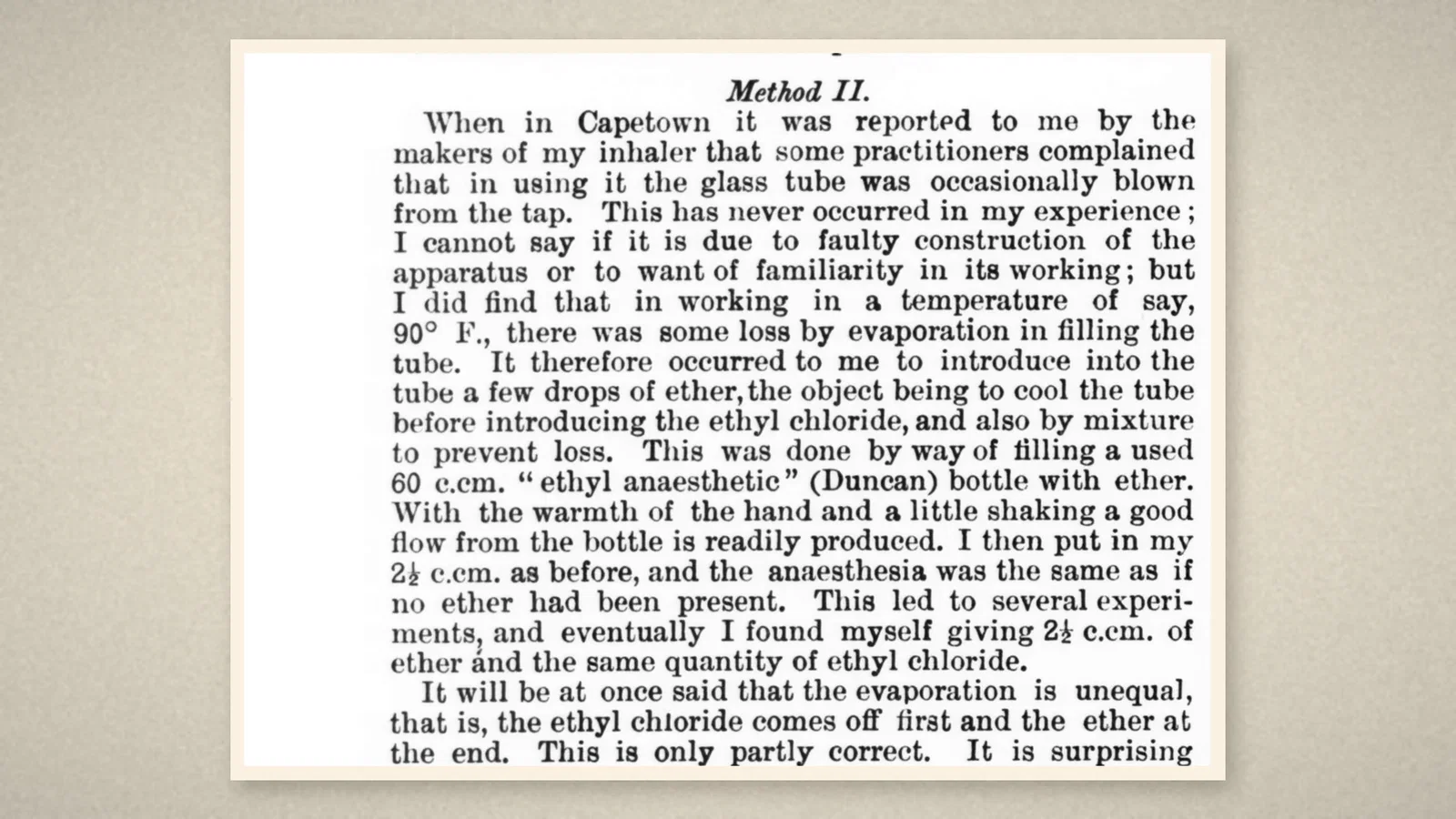
That sentence puts Daniell back in South Africa: adjusting apparatus and technique to the heat is a trace of practice there. Why Daniell signed in 1906 with British posts, and how Daniell came to the Johannesburg Hospital in 1907, the paper does not say, and this article does not fill the gap.
What the record shows
"South Africa's first specialist anaesthetist" is a title given by later historians. The Daniell who can be read here gave ethyl chloride two thousand times, recorded a personal near-miss, kept modifying the inhaler and told colleagues to learn from someone experienced first. A hospital post could enter the national history of anaesthesia because most anaesthetics were still given by general practitioners at the kitchen table, with a rag and a bottle.
Sources and reading limits
Read: Daniell's paper in the BMJ of 10 November 1906, pp. 1257–1258; the "Early anaesthetists" section of Gordon and James's 2023 brief history of anaesthesia in South Africa.
Not covered: a contemporary record of the 1907 Johannesburg Hospital appointment; the appointment, the "first specialist anaesthetist" description and the later UCT lectureship rest on Gordon and James, who give no primary source for them. Daniell's BMJ papers of 1903 and 1904 and the biography of Daniell by Parbhoo NP in S Afr Med J 1987;71:712–5 are not covered, so Daniell's dates of birth and death are not given.
Of the four illustrations, three are crops of the 1906 BMJ pages and one is a diagram drawn for this article from the sources.
- Daniell GWB. Ethyl chloride as a general anaesthetic in conjunction with ether. Br Med J. 1906;2(2393):1257-8. doi:10.1136/bmj.2.2393.1257. Internet Archive
- Gordon PC, James MFM. A brief history of anaesthesia in South Africa. J Coll Med S Afr. 2023;1(1):a53. doi:10.4102/jcmsa.v1i1.53. DOI
Continue exploring
Related reading connects shared questions and contexts; it does not by itself establish historical influence.
- 1893: London's Society of Anaesthetists Brings Experience Before Peers
- 1900: Janet Greig Becomes an Honorary Anaesthetist in Melbourne
Anesthesia Epochs · The Source Room · About & Editorial Method
Published November 2, 2026. Sources and reading limits are stated above. Illustrations are labelled as original source images or AI-made. Historical accounts are educational; they are not current treatment instructions.