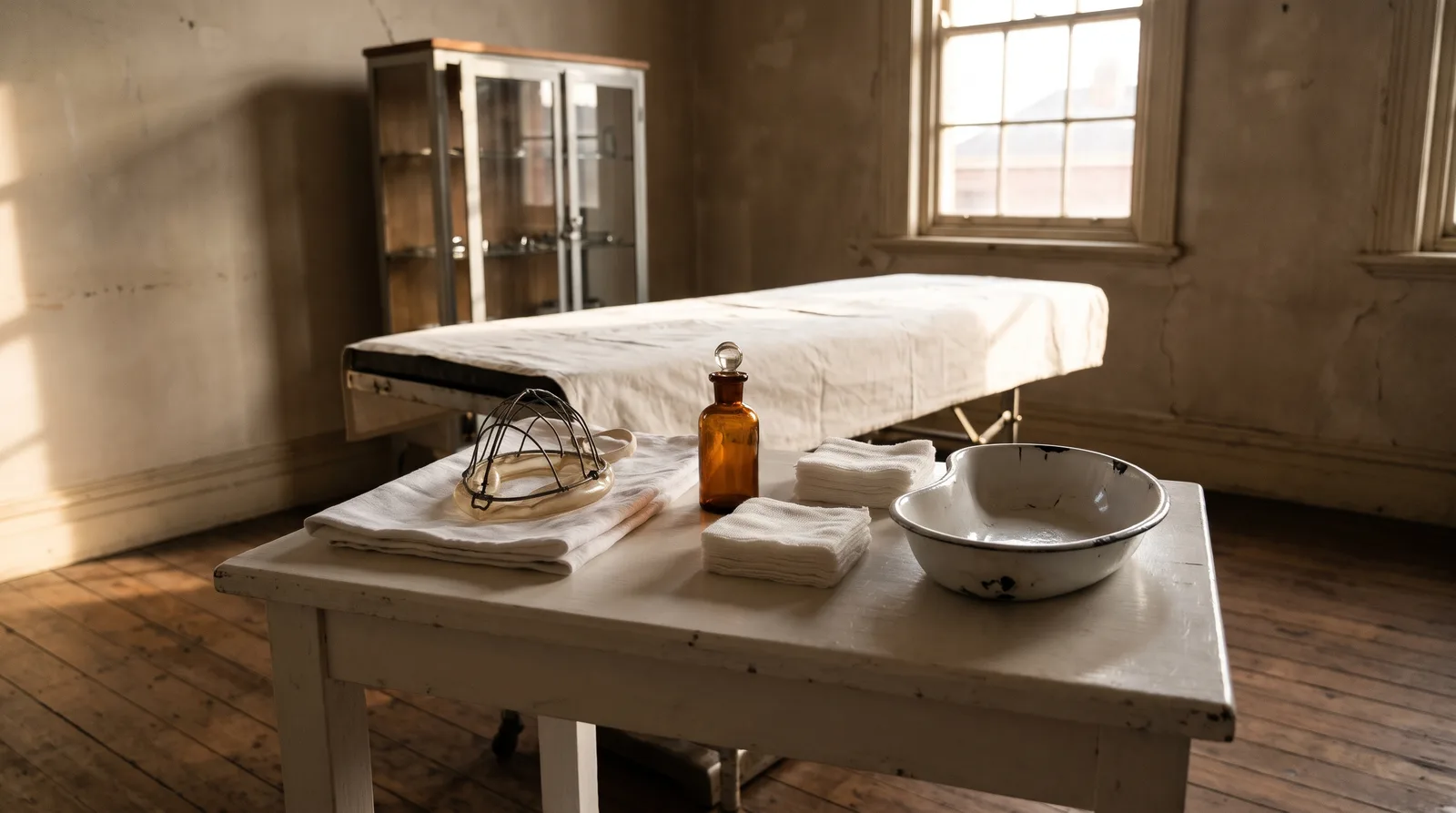
In 1900 Janet Lindsay Greig, who had trained under Edward Embley at the Melbourne Hospital, was appointed Honorary Anaesthetist at the newly founded Queen Victoria Hospital in Melbourne, one of the earliest women in Australia to hold such a post.
Reading Library · Anesthesia Epochs · 中文版
Watch the education video (for clinicians)
1900: Janet Greig — An Honorary Anaesthetist in Melbourne · Anesthesia Epochs Education Series
In 1900 the newly formed Queen Victoria Hospital in Melbourne advertised for an Honorary Anaesthetist. According to the Geoffrey Kaye Museum of Anaesthetic History, the post went to Janet Lindsay Greig, who had trained under Edward Henry Embley at the Melbourne Hospital, and the museum calls Greig the first woman in Australia appointed to the position of Honorary Anaesthetist. [1]
The sentence is often shortened to "Australia's first woman anaesthetist". The accounts used here are the museum’s biography, the entry in the Encyclopedia of Australian Science and Innovation (EOAS) and the abstract of Gwen Wilson’s 1985 article. [1–4] These broadly agree, but they differ on which hospital and which years.
A family that moved so its daughters could study medicine
The museum records that Greig was born on 8 August 1874 at Broughty Ferry, Scotland. [1] Greig’s father, Robert Greig, an advocate of women's education, moved the family to Melbourne in 1889 on learning that the University of Melbourne would admit women to medicine. [1] Janet graduated in 1896 in the top six of the class, along with another woman, Ælfreda Gamble. [1]
The top six graduates were customarily offered residencies at the Melbourne Hospital, but nobody had expected women among them. In 1891 the hospital had refused to let Margaret Whyte, top of the year, take up a residency. [1] Citing the hospital's 1896 minute books, the museum reports that the committee of management finally voted 13 to six to take on the "Lady Graduates". [1] When the residencies ended, a short item in the Adelaide Advertiser of 5 May 1897 quoted the committee chairman conceding that the women had been subjected to "very unfair, ungentlemanly, and almost brutal conduct". [1]
From a meeting to a hospital
In 1895 Constance Stone, who had studied medicine in Pennsylvania, invited ten medical women to discuss founding a hospital run by women; the sisters Janet and Jane Greig were among them. [1] Both Wilson's abstract and EOAS name Greig as one of the founders of the Queen Victoria Hospital. [3, 4] The museum says Greig worked at the new hospital on Fridays, and that in 1900, when it advertised for an Honorary Anaesthetist, Greig received the appointment. [1]
"Honorary" in hospitals of the period usually meant an unpaid hospital appointment held alongside private practice; EOAS records Greig in private practice in Fitzroy from 1897 to 1915. [4] The significance of the appointment lay in the post and the standing it conferred, not in a salaried job.
Two records
The museum writes that in 1903 Greig also became Honorary Assistant Anaesthetist at the Melbourne Hospital, giving anaesthetics at both hospitals and working again with Embley, and that in 1917 Greig gave up the anaesthetic posts to become Honorary Physician at the Queen Victoria Hospital. [1]
The EOAS career list instead gives Honorary Anaesthetist at the Women's Hospital, Melbourne, from 1900 to 1917, and Honorary Anaesthetist at the Melbourne Hospital from 1902 to 1905. [4] The institution and the dates both differ. The two records are given here side by side.
The claim of being "first" also comes in degrees. The museum calls Greig the first woman in Australia appointed Honorary Anaesthetist; [1] another museum page calls Greig the first female anaesthetist in Victoria; [2] Wilson's 1985 abstract says the first woman anaesthetist in Australia; [3] and EOAS says, more cautiously, one of the first woman anaesthetists in Victoria. [4] The narrowest statement the sources share is that in 1900 Greig was appointed an honorary anaesthetist, among the earliest women in Australia to hold such a post.
A long career
The museum records that Greig retired in 1948 after a career of 52 years, and that Greig died while visiting London in 1950. [1] From being questioned in 1896 over whether Greig could hold a residency at all, to an anaesthetic appointment in 1900, the path shows that early women in anaesthesia often found their posts in hospitals that women themselves had founded.
Sources and reading limits
Read: the Geoffrey Kaye Museum’s 2017 biography of Greig and its Australia and New Zealand history page; the EOAS entry for Greig; the PubMed abstract of Wilson 1985.
Not covered: the original records of the 1900 appointment, such as hospital minutes, the advertisement and contemporary newspapers; the full text of Wilson’s 1985 article; the 1951 Medical Journal of Australia obituary; the Australian Dictionary of Biography entry. The account rests on these secondary sources.
- Geoffrey Kaye Museum of Anaesthetic History. The great women of anaesthesia: Janet Lindsay Greig. 2017. Museum page.
- Geoffrey Kaye Museum of Anaesthetic History. Australia and New Zealand. Museum page.
- Wilson G. Janet Lindsay Greig: a pioneer. Anaesth Intensive Care. 1985;13(4):420–428. PubMed.
- Encyclopedia of Australian Science and Innovation. Greig, Janet Lindsay (1874–1950). EOAS entry.
Continue exploring
Related reading connects shared questions and contexts; it does not by itself establish historical influence.
- 1906: A Melbourne Certificate for Six Anaesthetics
- 1891: Rupa Bai in the Record of Chloroform Anesthesia
Anesthesia Epochs · The Source Room · About & Editorial Method
Published November 2, 2026. Sources and reading limits are stated above. Illustrations are labelled as original source images or AI-made. Historical accounts are educational; they are not current treatment instructions.