
From the 1936 commission on anaesthetic mortality and the specialist register to the society of 1 August 1943 and the Witwatersrand diploma of 1947, as told at the time by the Durban anaesthetist H. Grant Whyte.
Reading Library · Anesthesia Epochs · 中文版
Watch the education video (for clinicians)
1943: The South African Society of Anaesthetists — Founded in Wartime · Anesthesia Epochs Education Series
The South African Society of Anaesthesiologists is today the main professional body of its specialty in the country. It was founded during the Second World War. This article rests mainly on an account by someone who was there: the Durban anaesthetist H. Grant Whyte's address "The development of anesthesia in South Africa", given at the McMechan memorial session of the joint congress of the International Anesthesia Research Society and the International College of Anesthetists in New York in September 1948. It is checked against the short history by Gordon and James (2023).
The narrator
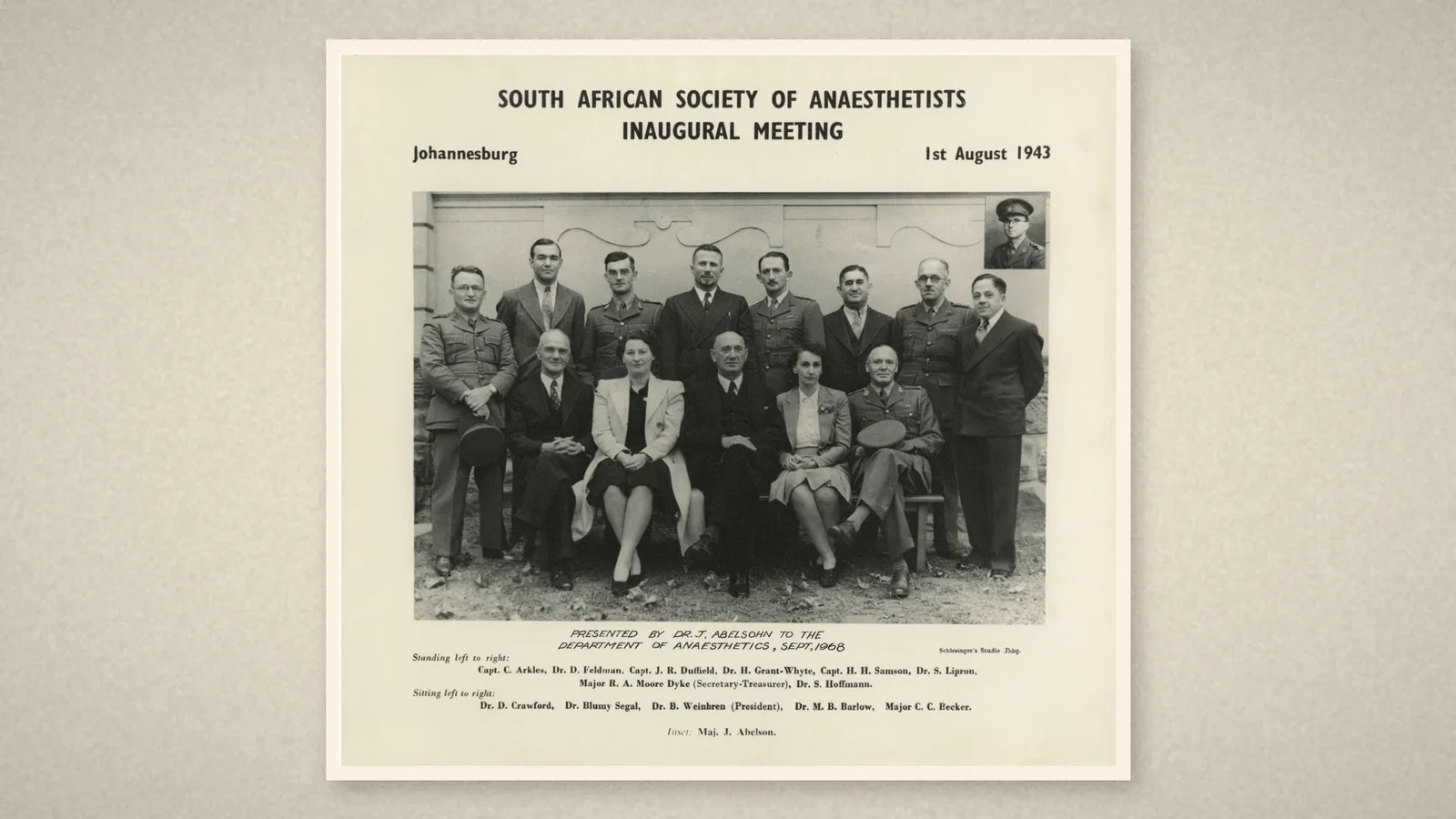
Grant Whyte, a Cape Town graduate with the English Diploma in Anaesthetics, was senior visiting anaesthetist at the Government Hospital in Durban. About ten years earlier, "after meeting Dr. McMechan of" Cleveland, Grant Whyte said, the turn from anaesthetic technician to anaesthesiologist came; McMechan arranged a tour of American and Canadian clinics, and on returning Grant Whyte and colleagues similarly guided put what they had learned into practice. [1, scan p. 20] Grant Whyte appears in the photograph of the Society's inaugural meeting. [2, p. 2]
Background: mortality and the register
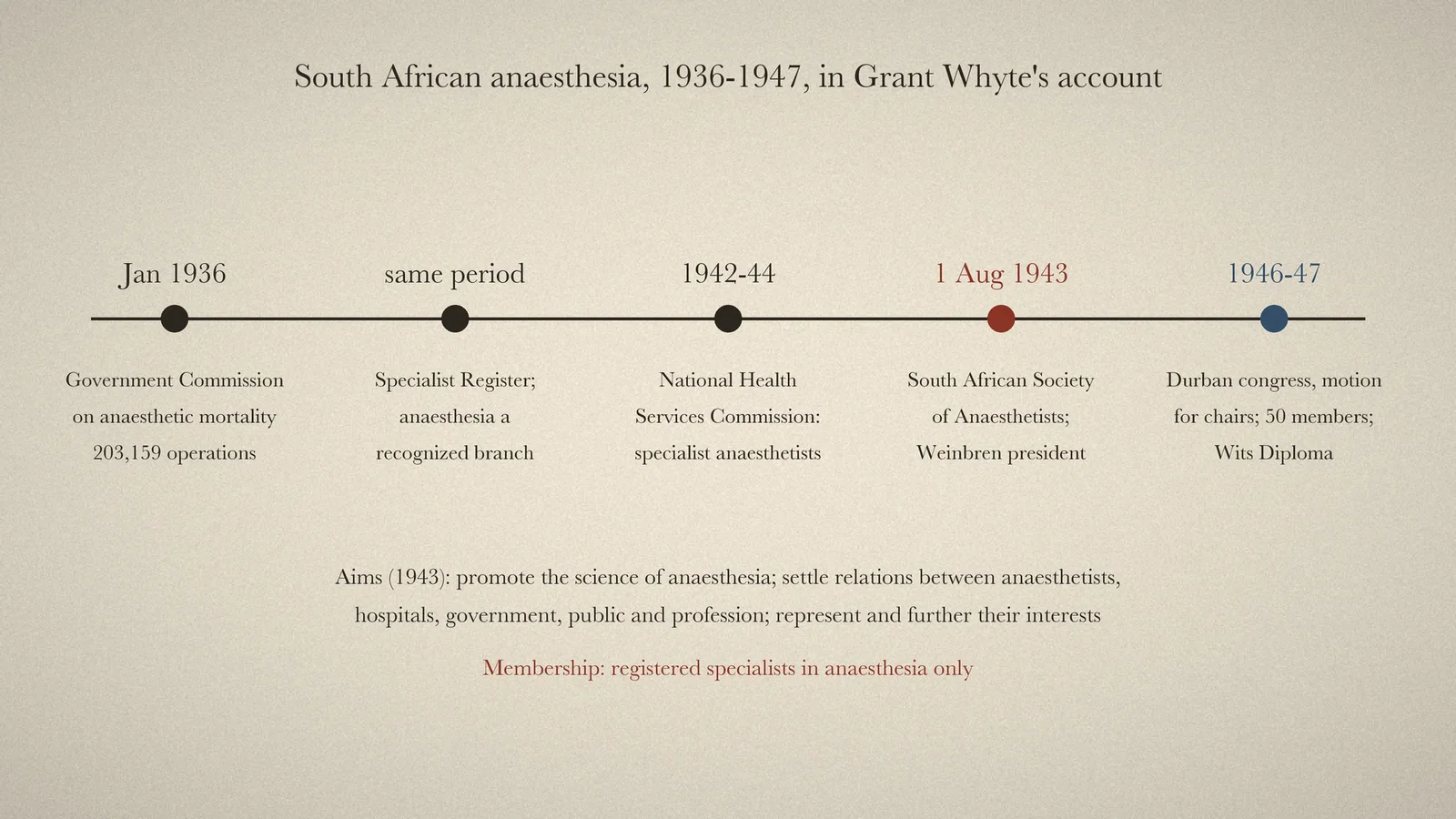
The first two South Africans to devote themselves wholly to anaesthesia, Grant Whyte wrote, were Bampfylde-Daniell of Cape Town and Benjamin Weinbren of Johannesburg; Bampfylde-Daniell "was the first practicing specialist in Anesthesia in South Africa". [1, scan p. 22] For the next fifteen years, though, most anaesthetics were given "by doctors in general practice" holding honorary posts, and anaesthetic mortality rose by leaps and bounds. In January 1936, "because of grave public disquiet", the government appointed a commission, which had "records of 203,159" operations; its chief recommendation was that "medical students, and resident medical officers have every opportunity" of gaining practical experience, and that hospitals employ trained anaesthetists to teach residents. Weinbren sat on the commission into "Anaesthetic Mortality in the Union". [1, scan p. 23]
About the same time the South African Medical Council created a "Specialist Register" to protect the public from pseudo-specialists, and "anesthesia was recognized as one of the" specialised branches. [1, scan p. 24] Those who wished to register often had to go to England for the London diploma, which few could afford, and "during the war years as far as South" Africans were concerned it was out of the question. [1, scan p. 24] The "National Health Services Commission was appointed" in 1942, and its final report said that the administration of anaesthetics "should as far as possible be regarded as the work of an Anaesthetic" specialist. [1, scan p. 25]
1 August 1943
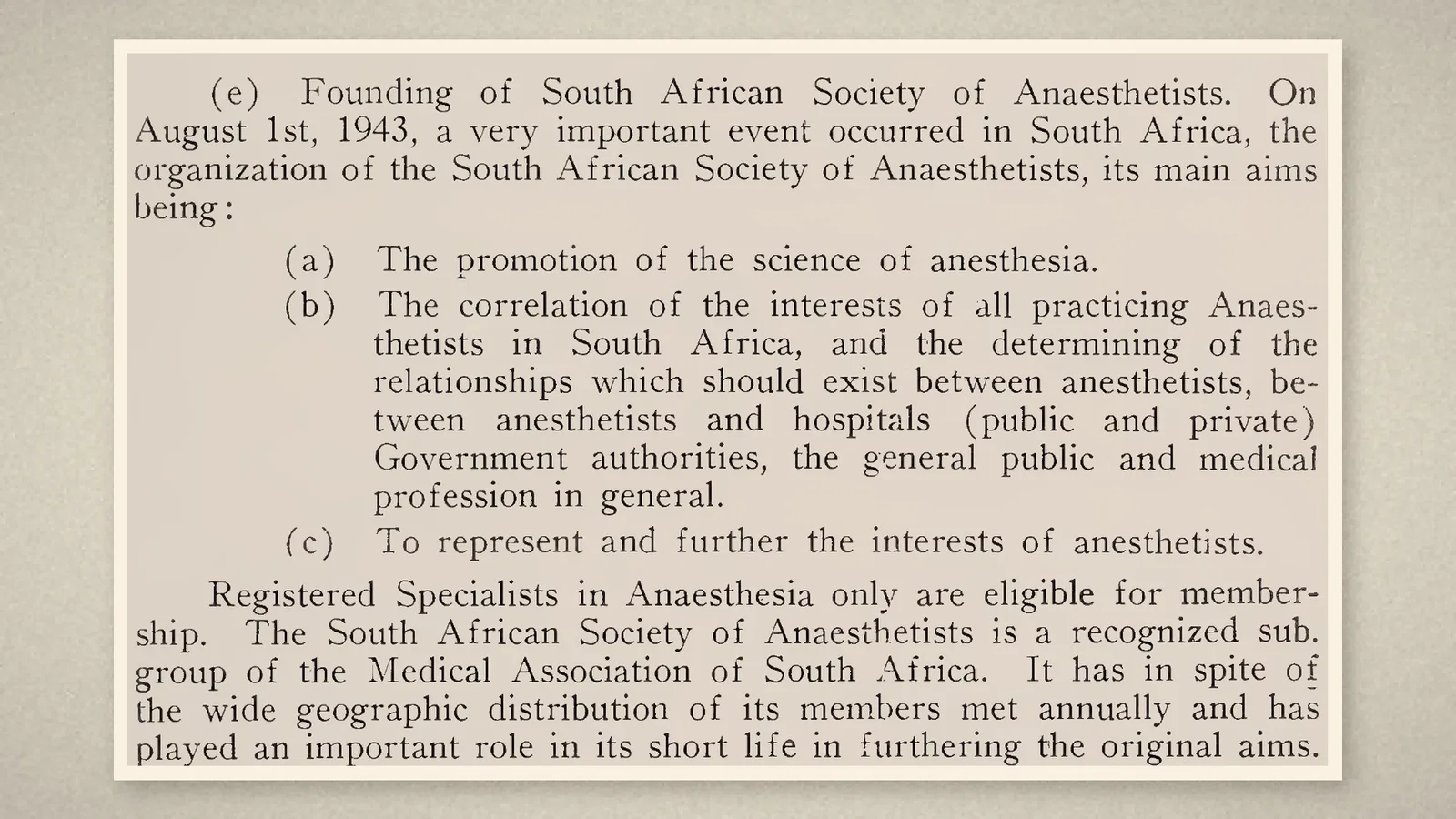
"On August 1st, 1943, a very important event occurred" in South Africa: the organisation of the South African Society of Anaesthetists. Its main aims were "the promotion of the science of anesthesia"; the correlation of the interests of all practising anaesthetists and the settling of their relations with one another, with hospitals public and private, with government, public and profession; and "to represent and further the interests of anesthetists". "Registered Specialists in Anaesthesia only are eligible" for membership; the "Society of Anaesthetists is a recognized sub"-group of the Medical Association of South Africa, and despite its scattered members it met every year. [1, scan p. 25]
Gordon and James write that the meeting was held at the "Johannesburg Hospital in August 1943", when there were "only 26 anaesthetists (including three" women) on the Medical and Dental Council's register, and that Weinbren was elected president. [2, p. 2] The photograph of the inaugural meeting is captioned "Johannesburg, 1st August 1943"; several of the dozen or so present are in uniform, and in the front row sit Weinbren, as president, and the woman anaesthetist Barlow among others. [2, p. 2] Grant Whyte also names Weinbren as "the first President of the South African Society" of Anaesthetists. [1, scan p. 22]
The first years
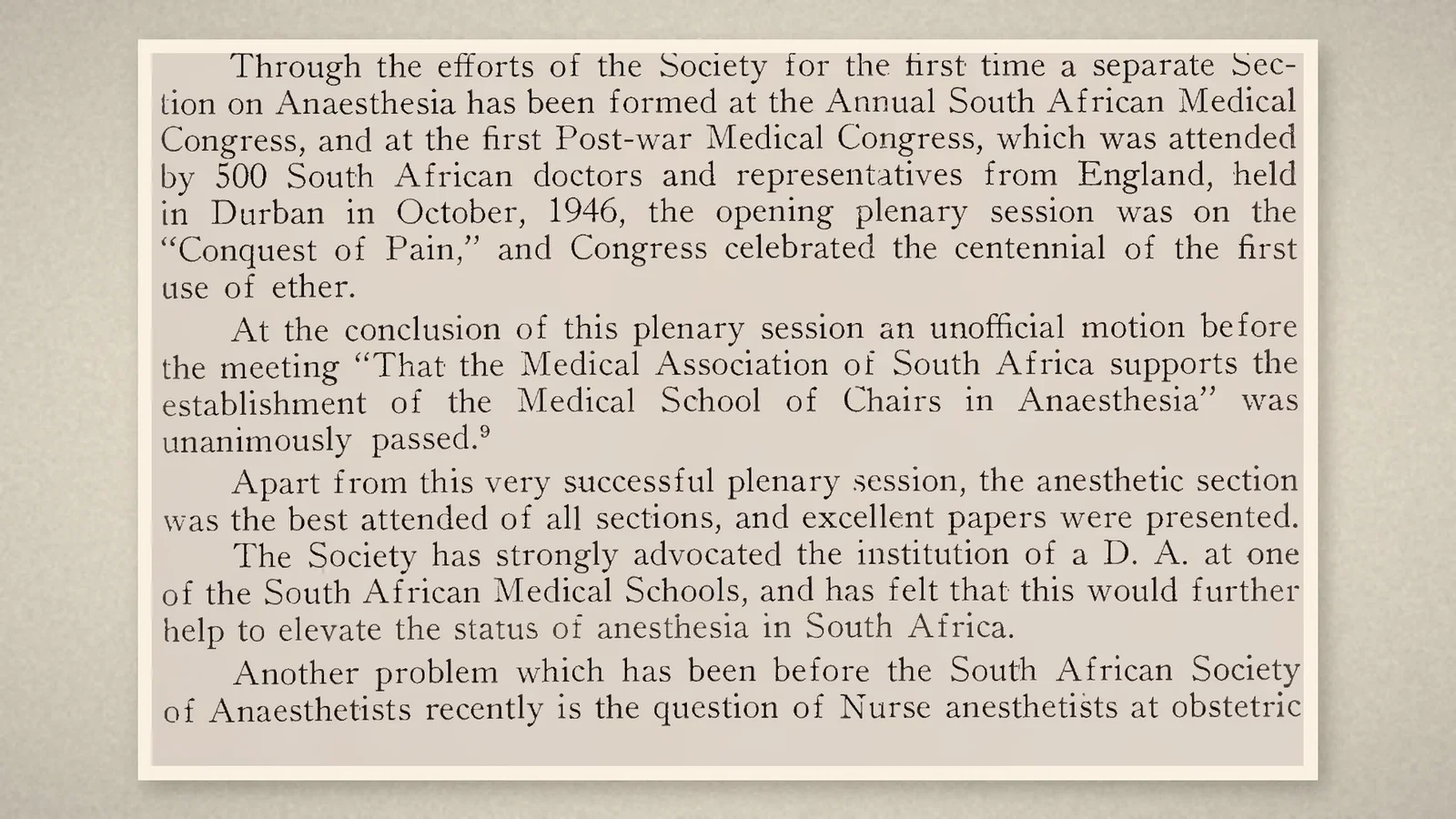
"Through the efforts of the Society for the first time" a separate Section on Anaesthesia was formed at the annual South African Medical Congress, Grant Whyte wrote; at the first post-war congress, in Durban in October 1946, attended by 500 South African doctors and visitors from England, the opening plenary session was on the "Conquest of Pain", marking the centenary of ether; afterwards an unofficial motion that the Medical Association support chairs in anaesthesia at the medical schools "was unanimously passed". The Society also pressed for a D.A. at a South African medical school. [1, scan p. 25] It had taken a firm line on "Nurse anesthetists at obstetric deliveries". [1, scan p. 26]
By the time of the address, "the membership of the Society has now grown to 50", fifteen of them with the English diploma, and a News Letter "has been started with the idea of keeping members" informed. A "Diploma in Anaesthesia has been instituted at the Witwatersrand" in 1947. Yet no medical school had a well-organised department of anaesthesia, and teaching of anaesthesiology was "almost nil"; Grant Whyte hoped some public-spirited person would "emulate Lord Nuffield" and endow a chair in South Africa. [1, scan p. 26]
What the record shows
The South African Society of Anaesthetists was born in wartime, behind it the 1936 inquiry into anaesthetic deaths, the Medical Council's specialist register, and a war that closed the road to the London diploma. It limited membership to registered specialists, wrote the anaesthetist's relations with hospitals, government and public into its aims, and quickly won a section at the medical congress and a motion for chairs.
Sources and reading limits
Read: Grant Whyte, "The development of anesthesia in South Africa", in full (McMechan memorial volume, address of September 1948, scan pp. 20–27); Gordon and James, "A brief history of anaesthesia in South Africa", J Coll Med S Afr 2023, in full (3 pages).
Not covered: the minutes of the founding meeting, the 1936 commission's report and the SAMJ issues Grant Whyte cites (SAMJ issues of 1936–47 are not on the Internet Archive) are not covered; the 1936 figures and recommendation are used as Grant Whyte quotes them. Grant Whyte dates the founding to 1 August 1943; Gordon and James to a meeting at the Johannesburg Hospital in August 1943; the figure of 26 registered anaesthetists, three of them women, comes only from Gordon and James. The memorial volume's scan carries no printed page numbers, so it is cited by scan page.
Three illustrations are crops of the two sources (one is the inaugural meeting photograph printed in the 2023 article); one is a timeline drawn from Grant Whyte's account.
- Grant Whyte H. The development of anesthesia in South Africa. In: Francis Hoeffer McMechan [memorial volume]. New York; presented at the McMechan Memorial Session, Twenty-Second Annual Congress of Anesthetists, New York, 8-11 September 1948. Wellcome Library copy. Internet Archive
- Gordon PC, James MF. A brief history of anaesthesia in South Africa. J Coll Med S Afr. 2023;1(1):a53. doi:10.4102/jcmsa.v1i1.53. JCMSA
Continue exploring
Related reading connects shared questions and contexts; it does not by itself establish historical influence.
- 1941–2002: Three White Women Anaesthetists in Johannesburg, and Black Women Kept Out
- 1907: George Daniell Becomes Johannesburg's Specialist Anaesthetist
Anesthesia Epochs · The Source Room · About & Editorial Method
Published November 2, 2026. Sources and reading limits are stated above. Illustrations are labelled as original source images or AI-made. Historical accounts are educational; they are not current treatment instructions.