Barlow, Ginsberg and Vetten came to head the anaesthetic departments of Johannesburg's three teaching hospitals; the first black woman anaesthesia specialist qualified only in 1992.
Reading Library · Anesthesia Epochs · 中文版
Watch the education video (for clinicians)
1941: Women Anaesthetists in South Africa — Who Was Kept Out · Anesthesia Epochs Education Series
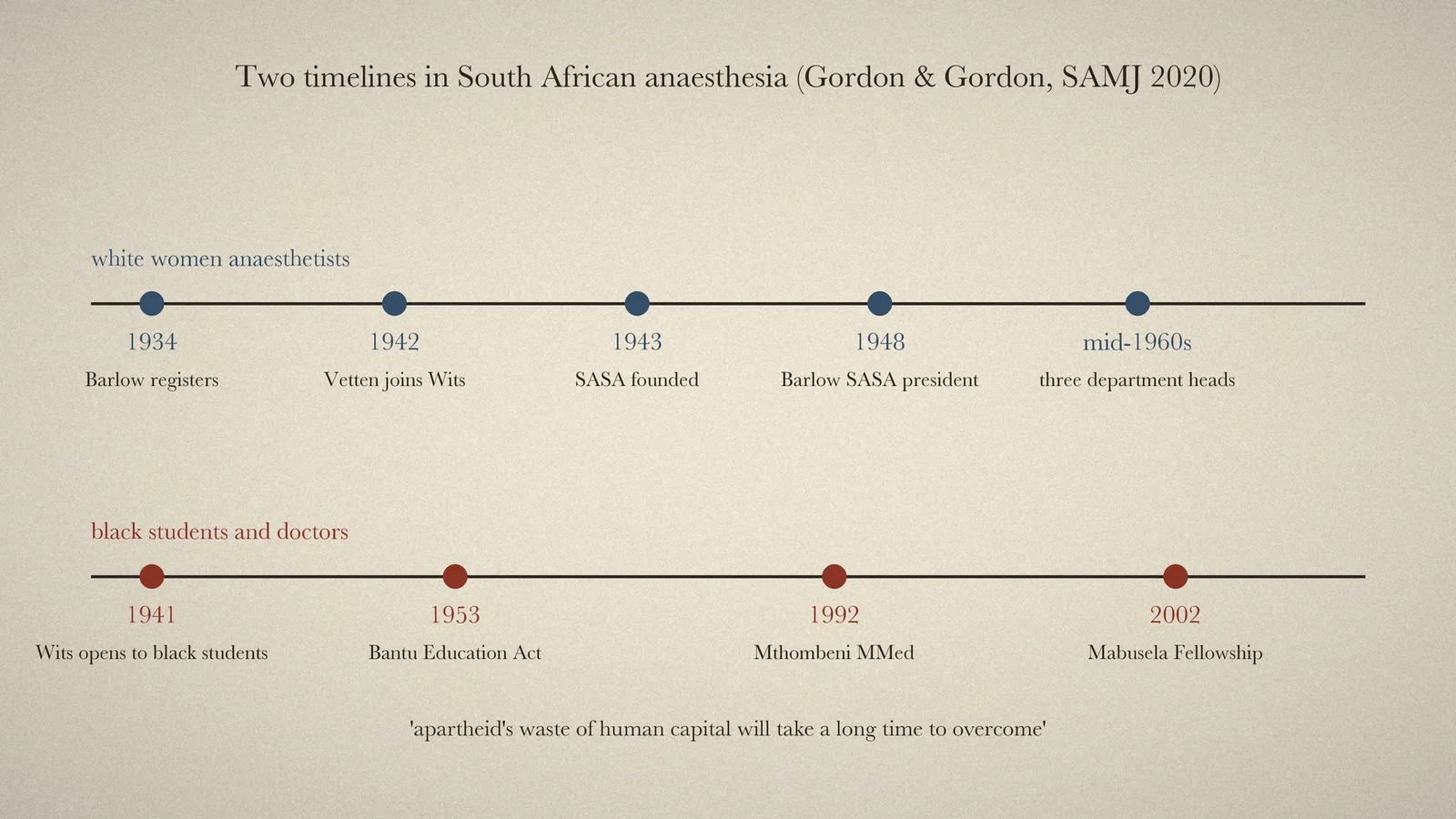
Histories of a specialty are often written as a string of firsts. In South Africa those firsts run along two timelines. White women entered specialist anaesthesia before the Second World War and within three decades ran the anaesthetic departments of Johannesburg's great hospitals; the first black woman to specialise in anaesthesia qualified only in 1992. This article follows both timelines as set out by Gordon and Gordon in "Handmaidens and pioneers", published in the South African Medical Journal in 2020.
A closed door
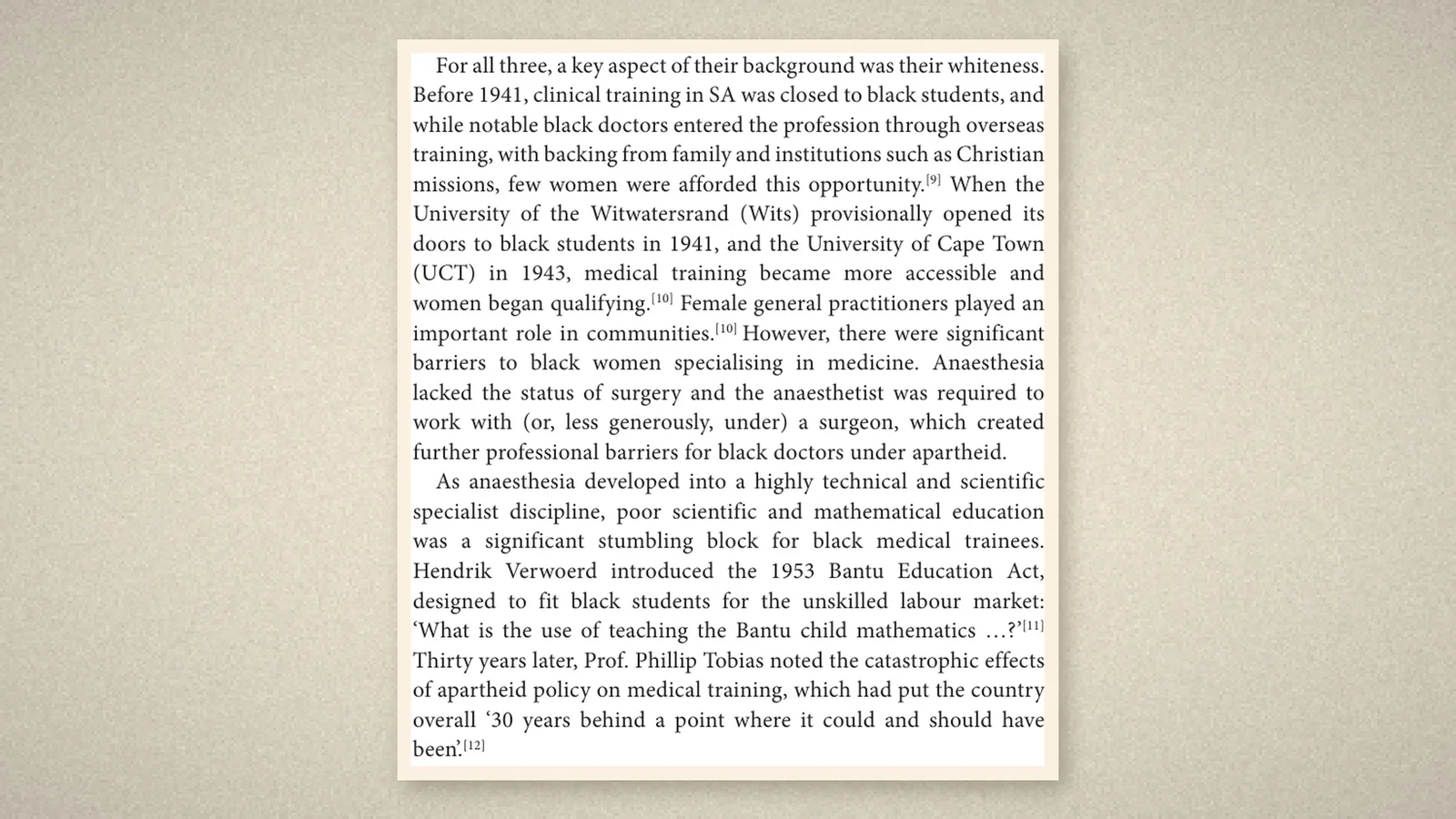
For the three women at the centre of the article, it says, a key aspect of their background was their whiteness. "Before 1941, clinical training in SA was closed to black students"; a few notable black doctors trained overseas with family or mission support, and few women had that chance. When the University of the Witwatersrand "provisionally opened its" doors to black students in 1941, and the University of Cape Town in 1943, medical training became more accessible and women began qualifying. [1, p. 1089]
Black women who wished to specialise still faced great barriers. "Anaesthesia lacked the status of surgery", the authors write, and the anaesthetist worked with, or under, a surgeon, which under apartheid created further professional barriers for black doctors. As anaesthesia became technical and scientific, "poor scientific and mathematical education" was a stumbling block for black trainees: the "1953 Bantu Education Act" was designed to fit black students for unskilled labour. Thirty years later Phillip Tobias found apartheid had put medical training "30 years behind a point where it could and should have" been. [1, p. 1089]
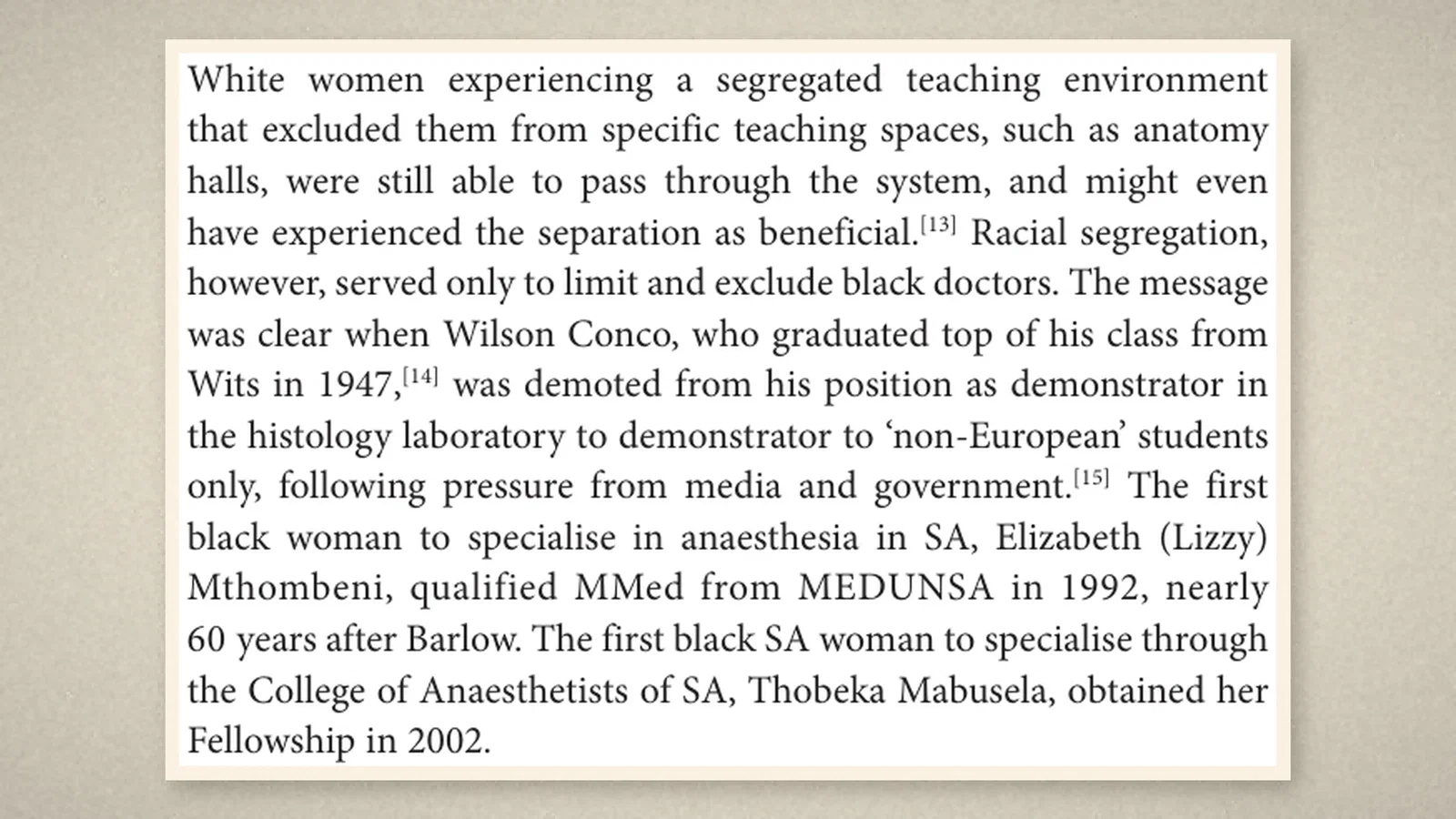
The article gives the case of Wilson Conco, top of the Wits class of 1947, who under press and government pressure was demoted from histology demonstrator to demonstrator for "non-European" students only. Elizabeth (Lizzy) Mthombeni, the first black woman to specialise in anaesthesia in South Africa, "qualified MMed from MEDUNSA in 1992", nearly sixty years after Barlow; Thobeka Mabusela, the first black South African woman to specialise through the College of Anaesthetists, "obtained her Fellowship in 2002". [1, p. 1089]
Three white women anaesthetists
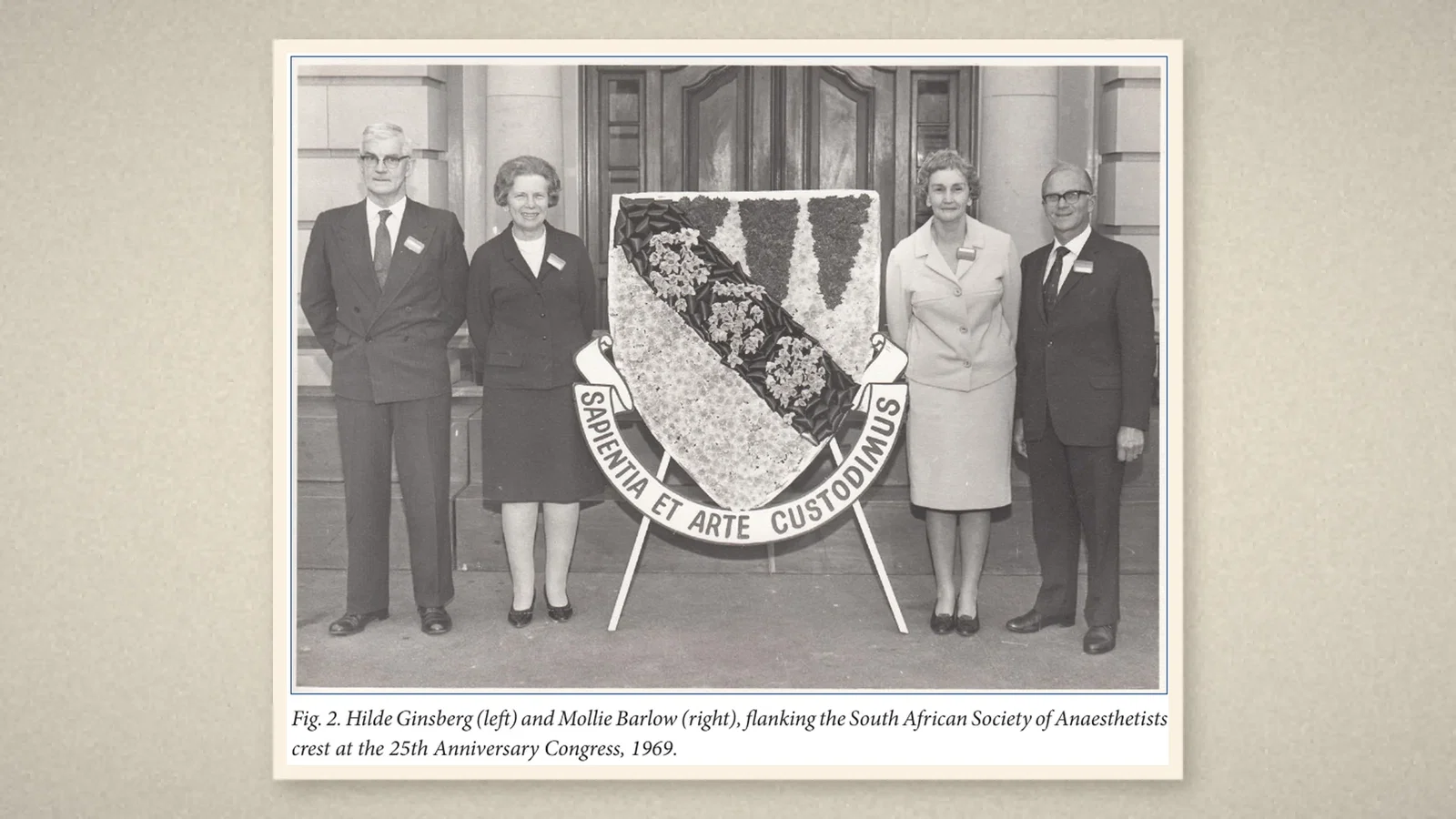
On the other timeline stood three white women trained before and during the war. Mollie Barlow returned from training in England in 1934 as "the first female to register as a specialist anaesthetist in SA", was a founding member of the South African Society of Anaesthetists in 1943, and "was elected the Society's" first woman president in 1948. She had chosen anaesthesia because her future husband thought it would "fit in with married" life. [1, p. 1089–1090] Hilde Ginsberg, the Society's co-founder, worked with Barlow at Coronation Hospital, where their collaboration brought "a dramatic decrease in on-table deaths" and postoperative mortality, credited to better training and supervision of juniors; Ginsberg "was a member of the Black Sash". [1, p. 1090] Barbara Vetten wanted surgery but was told "Surgery is not for women", and joined the Wits anaesthesia department at "Johannesburg Hospital in July 1942". [1, p. 1091]
They pushed teaching forward. Prompted by the Society, the Medical and Dental Council ruled in 1959 that every intern must show proof of "having administered 50 anaesthetics under" supervision; the Colleges of Medicine instituted the "Diploma in Anaesthetics in 1974". In its first fifty years the Society would "elect only two female presidents", Ginsberg and Barlow. [1, p. 1090] By the mid-sixties the three women headed the anaesthetic departments of Johannesburg's three main teaching hospitals, "serving the white, black and coloured populations" of the city. [1, p. 1091]
Handmaids at home
The article ends by returning to its title. Colonial "administration and apartheid government ensured a supply of" domestic labour that eased the work of white South Africans, and Bantu education, which equipped black South Africans so poorly for anaesthesia, was designed to feed that pool of unskilled labour. Barlow, Ginsberg and Vetten helped anaesthesia rise above being surgery's handmaid, the authors write, while handmaids in a literal sense shared the burden in their homes. The grandchildren of that generation may now enter anaesthesia, "although apartheid's waste of human capital will take a long time to overcome". [1, p. 1092]
What the record shows
One specialty, two timelines. White women went from the first registered specialist in 1934 to department heads by the mid-sixties; black women were first kept out of clinical training, then out of science and mathematics by education policy, and the first black woman anaesthesia specialist qualified only in 1992. The article is a reminder that the history of specialist education is also a history of who was allowed into the classroom.
Sources and reading limits
Read: Gordon C and Gordon PC, "Handmaidens and pioneers: Three female anaesthetists and their contribution to anaesthesia in South Africa", S Afr Med J 2020;110(11):1088–1092, in full (SciELO South Africa PDF and HTML).
Not covered: the primary sources the article cites (the Society's minutes, Barlow's medical biography, Vetten's CV and interview, the Wits Gazette, Barlow and colleagues' 1953 paper, and institutional records for Mthombeni and Mabusela) are not covered; the SAMJ volumes of that period are not on the Internet Archive. Every statement here therefore rests on this one modern peer-reviewed article and is attributed to it; no figure, date or quotation is taken from elsewhere. The article's photograph is used only as a crop of the published page, under its CC BY-NC 4.0 licence.
Three illustrations are crops of the article's pages; one is a timeline drawn from it.
- Gordon C, Gordon PC. Handmaidens and pioneers: Three female anaesthetists and their contribution to anaesthesia in South Africa. S Afr Med J. 2020;110(11):1088-92. doi:10.7196/SAMJ.2020.v110i11.14588. SciELO
Continue exploring
Related reading connects shared questions and contexts; it does not by itself establish historical influence.
- 1945: Sydney Opens a Diploma Course in Anaesthesia
- 1945: McGill's Department of Anaesthesia and Its Diploma Course
Anesthesia Epochs · The Source Room · About & Editorial Method
Published November 2, 2026. Sources and reading limits are stated above. Illustrations are labelled as original source images or AI-made. Historical accounts are educational; they are not current treatment instructions.