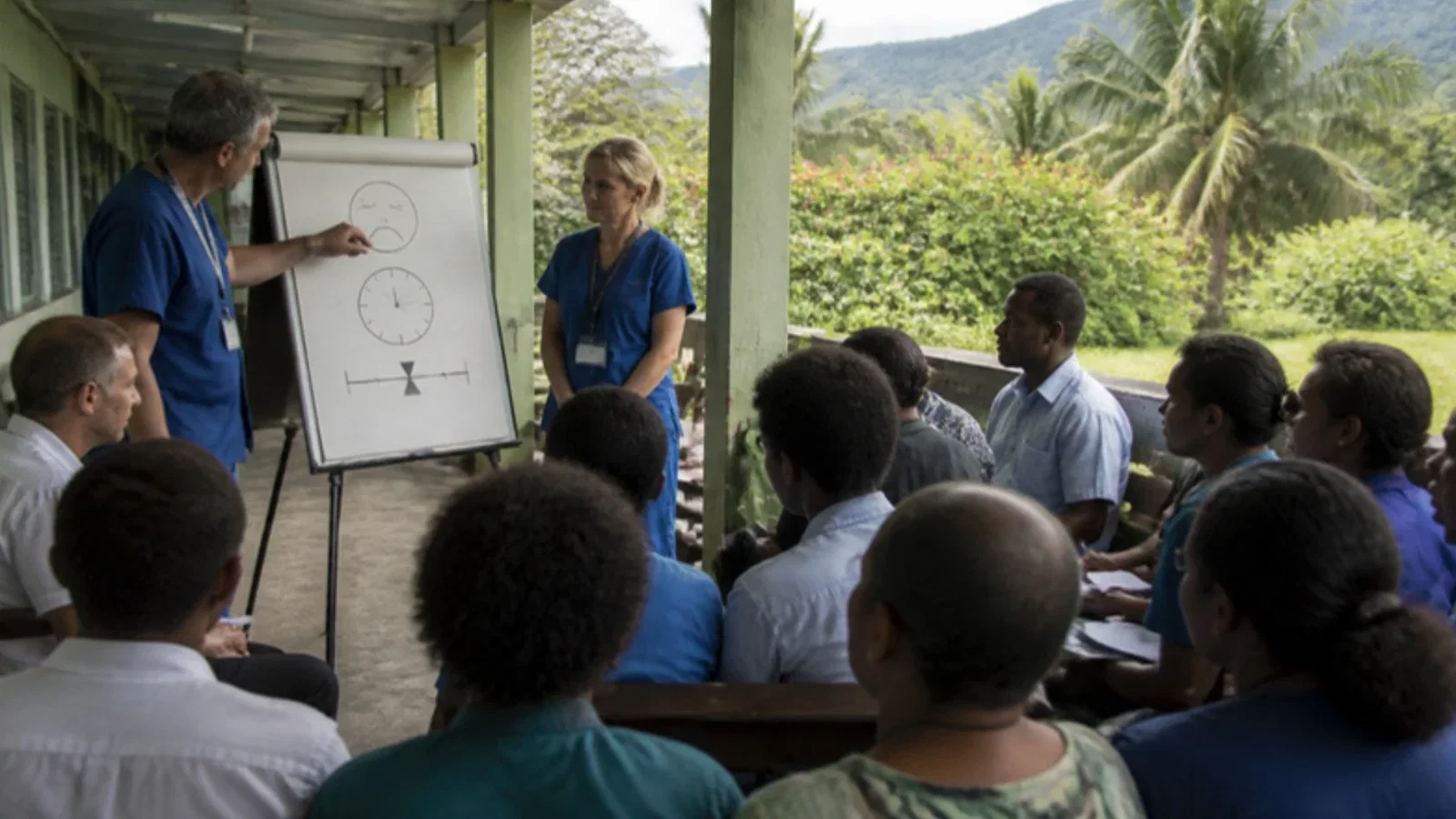
Two anaesthetists from Australia and New Zealand turned a conversation with Papua New Guinea colleagues into a one-day course built on three words, recognise, assess and treat, designed to be handed over to local teachers.
Reading Library · Anesthesia Epochs · 中文版
Watch the education video (for clinicians)
2010: Essential Pain Management — A Course Built to Be Handed Over · Anesthesia Epochs Education Series
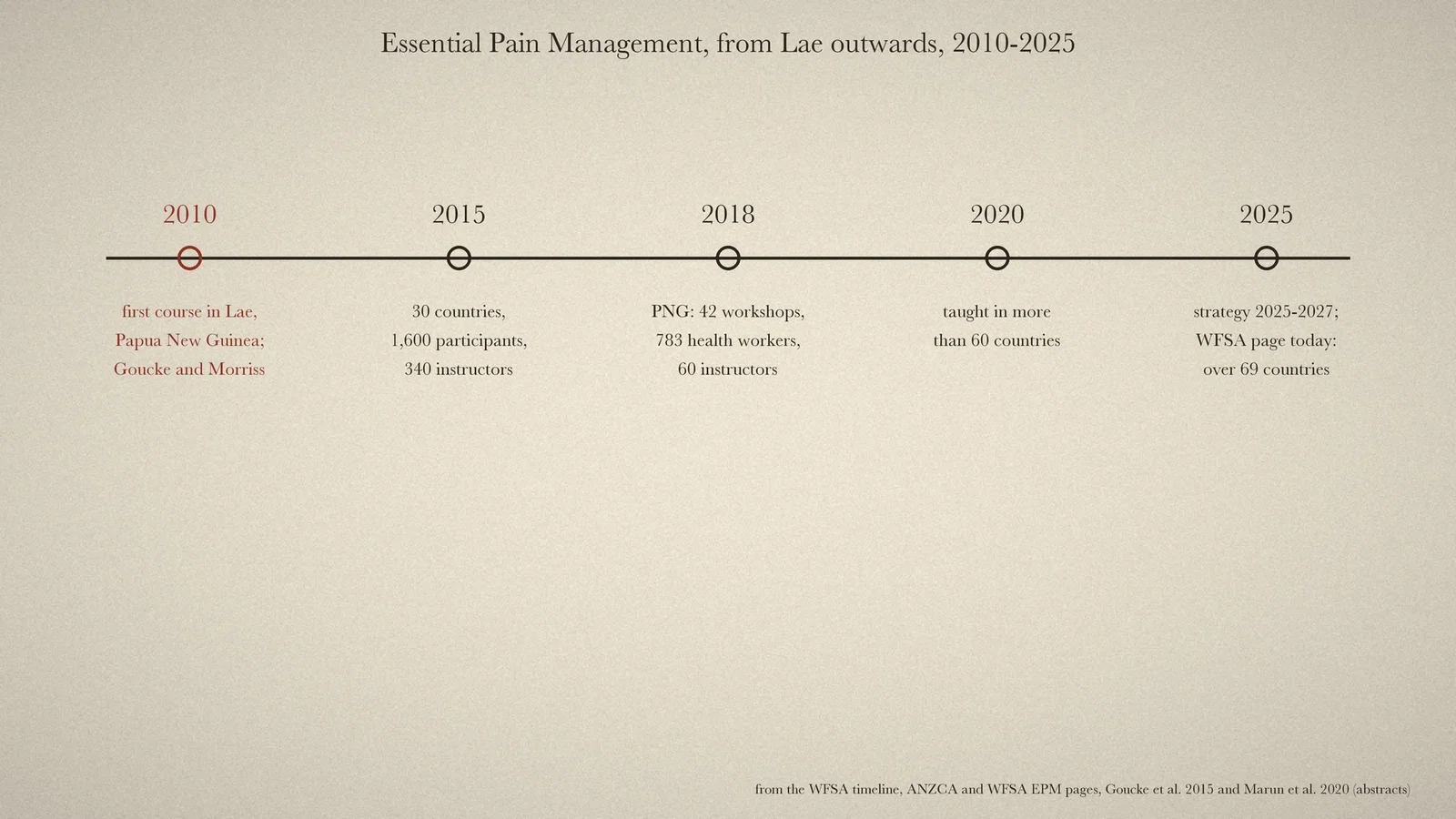
The World Federation of Societies of Anaesthesiologists (WFSA) history timeline has a single sentence for this event under 2010: "First EPM course took place in Lae, PNG." [1] EPM stands for Essential Pain Management, a one-day course that has since been taught in dozens of countries. This article goes back to why it began in Papua New Guinea and what its developers and Papua New Guinean colleagues later reported.
A conversation about pain
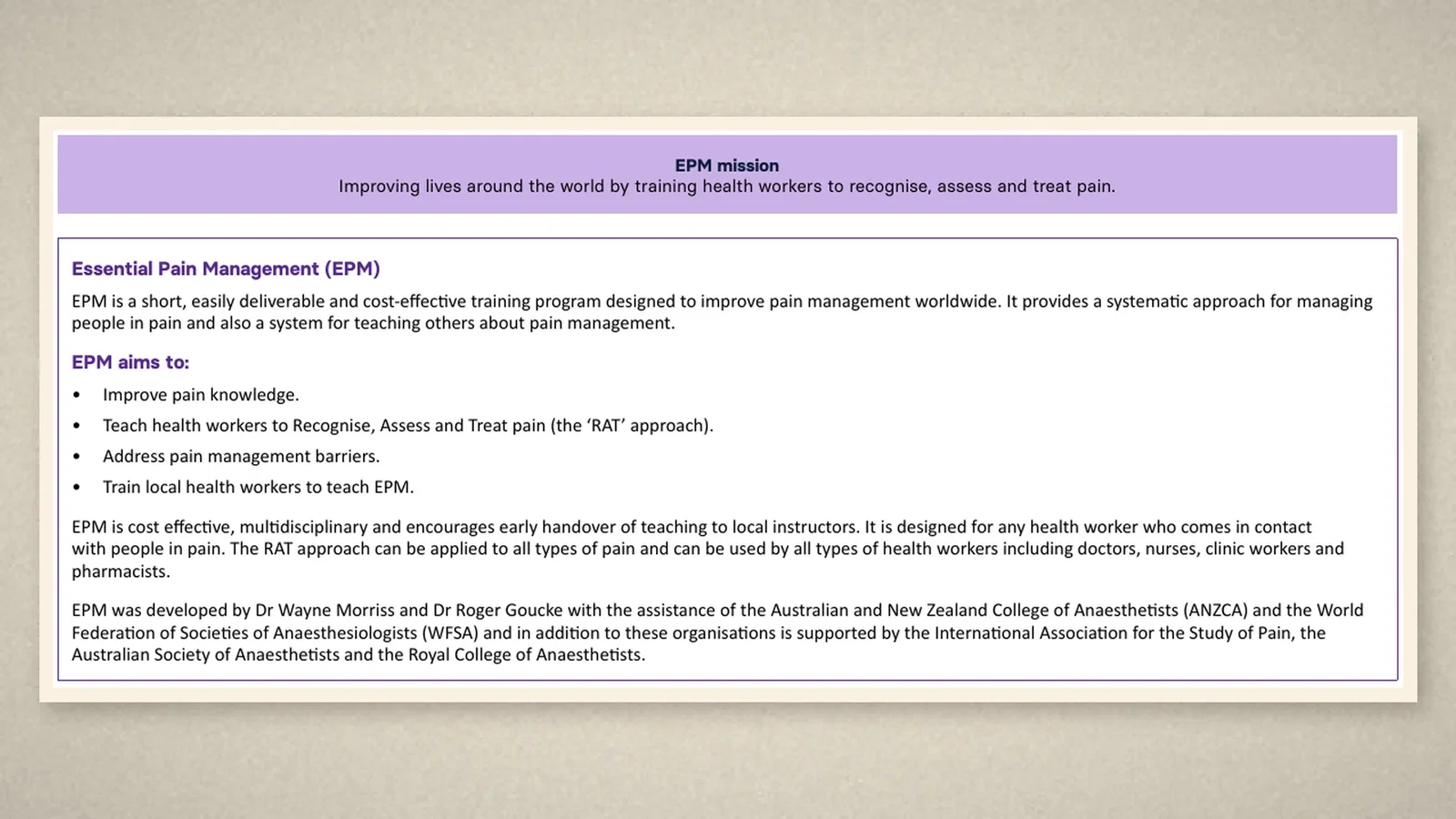
According to the Australian and New Zealand College of Anaesthetists (ANZCA), EPM was "established in 2010 by ANZCA fellows Dr Roger Goucke and Dr Wayne Morriss" after discussions with anaesthetists in Papua New Guinea "about the lack of training opportunities for pain management in that country". [2] The current programme strategy says the course was developed by Morriss and Goucke with the help of ANZCA and the WFSA, and is also supported by the International Association for the Study of Pain, the Australian Society of Anaesthetists and the Royal College of Anaesthetists. [4]
A 2020 account led by G. N. Marun of Madang Provincial General Hospital describes Papua New Guinea as a low-resource country in the South-West Pacific with a high burden of painful disease, and says EPM was developed "to address the challenge of inadequate pain education in PNG". [6] The 2015 report by the developers adds that the programme was built "following a needs analysis in Papua New Guinea". [5]
Three words and a handover
EPM's teaching device is a simple framework: recognise, assess and treat pain, abbreviated RAT. It is meant for any health worker who meets people in pain, from doctors and nurses to clinic workers and pharmacists, and for pain of all types. [3,4] The aims are to improve pain knowledge, teach the RAT approach, address local barriers to pain management and "train local health workers to teach EPM". [3,4]
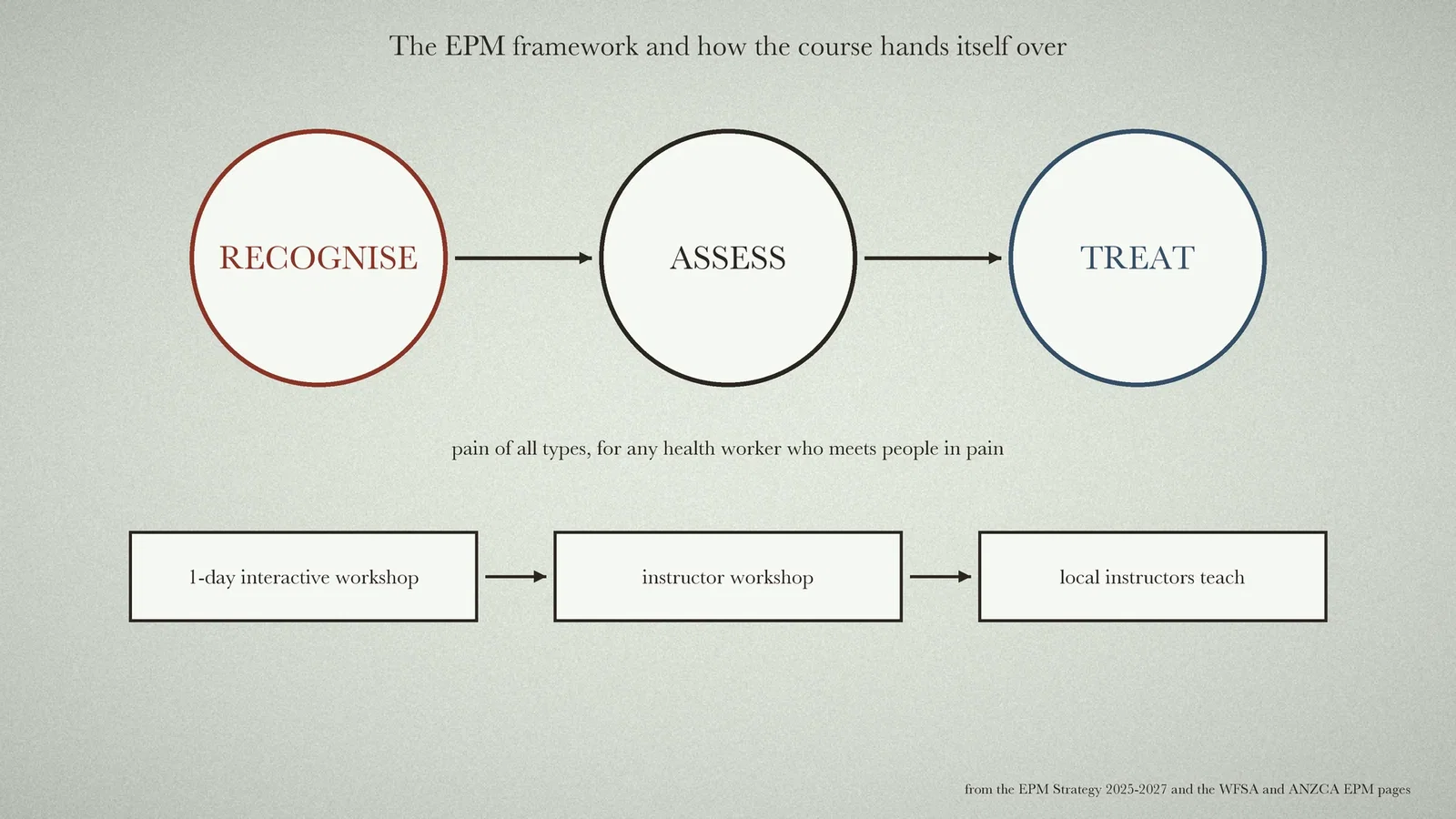
The last aim shaped the format. Besides the one-day workshop there is an instructor workshop, so that participants can soon run courses themselves with support from more experienced instructors. The strategy calls this "early handover of teaching to local instructors". [3,4] A 2018 review placed EPM with Primary Trauma Care and the SAFE obstetric and paediatric courses as short, packaged courses of one to three days with a teach-the-teacher component, while noting the need for research to confirm their role. [7]
The first five years
In 2015 Goucke, T. Jackson, Morriss and J. Royle reported that an 8-hour programme had run in 30 countries for 1,600 participants, and that 340 instructors had been trained. In pre- and post-course tests at 27 sites (581 respondents), the mean score rose from 65.89% to 75.23%; doctors and nurses improved by similar amounts. Courses taught by newly trained local instructors produced results comparable to those taught by overseas instructors. [5]
Back in Papua New Guinea
The 2020 paper counted what had happened in the country where the course began. Between 2010 and 2018, 42 one-day workshops and 6 instructor workshops were held across Papua New Guinea; 783 health workers and 60 instructors were trained, and more than two-thirds of the one-day workshops were taught entirely by local instructors. A shorter "EPM Lite" version trained 109 medical and nursing students. [6]
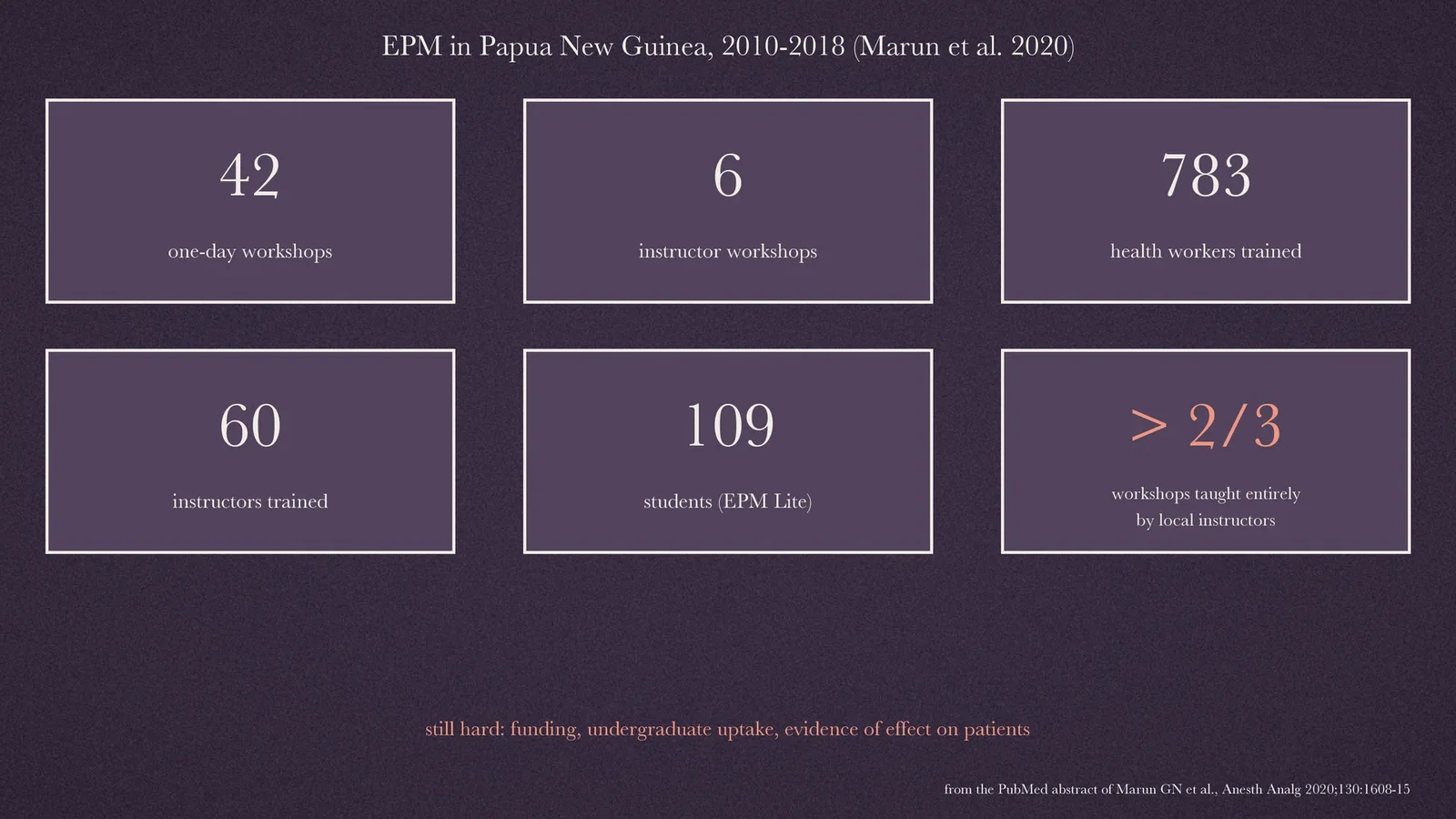
The same paper was candid. Participant feedback and knowledge tests had been collected since the start, but evaluating changes in behaviour and organisation "has proved more challenging". It listed continuing problems: a lack of funding, limited uptake in undergraduate teaching, the need for formal evaluation of clinical impact, and the need for a whole-system approach to pain management in Papua New Guinea. By then EPM had been taught in more than 60 countries. [6] The paper drew letters in the same journal from Tasmania, Nepal and the United Kingdom. [8-10] The WFSA now describes EPM as run in over 69 countries. [3]
What the record shows
EPM is an example of education designed to leave. Its framework is three words, and its success is measured partly by how quickly local teachers take over. In Papua New Guinea, where it started, local instructors were teaching most workshops within eight years. Whether patients there suffer less pain is the question the programme's own authors say still needs answering.
Sources and reading limits
Read: the WFSA history timeline (2010 entry); the current WFSA and ANZCA EPM pages; the EPM Strategy 2025-2027 in full (3 pages, p. 1 also as a page image); the PubMed abstracts of Goucke et al. 2015, Marun et al. 2020 and Evans et al. 2018; the PubMed records of three letters responding to Marun et al.
Not covered: the full texts of Goucke et al. and Marun et al.; the PNG needs analysis; the EPM manual; the text of the letters; any study of patient outcomes. The date, place and teachers of the Lae course are known here only from the one-line WFSA timeline entry; the sources read do not name the participants. Almost all sources come from the programme's developers or sponsoring bodies; the PNG view is represented by the first author of the 2020 paper.
One illustration is a crop of the EPM Strategy 2025-2027; three are drawn from the sources.
- World Federation of Societies of Anaesthesiologists. WFSA history timeline. Website
- Australian and New Zealand College of Anaesthetists. Essential Pain Management program. Website
- World Federation of Societies of Anaesthesiologists. Essential Pain Management. Website
- ANZCA, WFSA. Essential Pain Management (EPM) Strategy 2025-2027. PDF
- Goucke CR, Jackson T, Morriss W, Royle J. Essential pain management: an educational program for health care workers. World J Surg. 2015;39(4):865-70. PubMed
- Marun GN, Morriss WW, Lim JS, Morriss JL, Goucke CR. Addressing the challenge of pain education in low-resource countries: Essential Pain Management in Papua New Guinea. Anesth Analg. 2020;130(6):1608-15. PubMed
- Evans FM, Duarte JC, Haylock Loor C, Morriss W. Are short subspecialty courses the educational answer? Anesth Analg. 2018;126(4):1305-11. PubMed
- Ottaway AJ, Roche AM, Sarma M. Addressing the challenge of pain education in low-resource countries: Essential Pain Management in Papua New Guinea [letter]. Anesth Analg. 2020;131(5):e227-8. PubMed
- Subedi A, Thapa P, Gurung R, Shrestha N. Essential Pain Management: perspective from Nepal [letter]. Anesth Analg. 2020;131(5):e230-1. PubMed
- Makins HJ. Experience of the Essential Pain Management structure to address the challenge of pain education in the United Kingdom [letter]. Anesth Analg. 2020;131(6):e256. PubMed
Continue exploring
Related reading connects shared questions and contexts; it does not by itself establish historical influence.
Anesthesia Epochs · The Source Room · About & Editorial Method
Published November 2, 2026. Sources and reading limits are stated above. Illustrations are labelled as original source images or AI-made. Historical accounts are educational; they are not current treatment instructions.