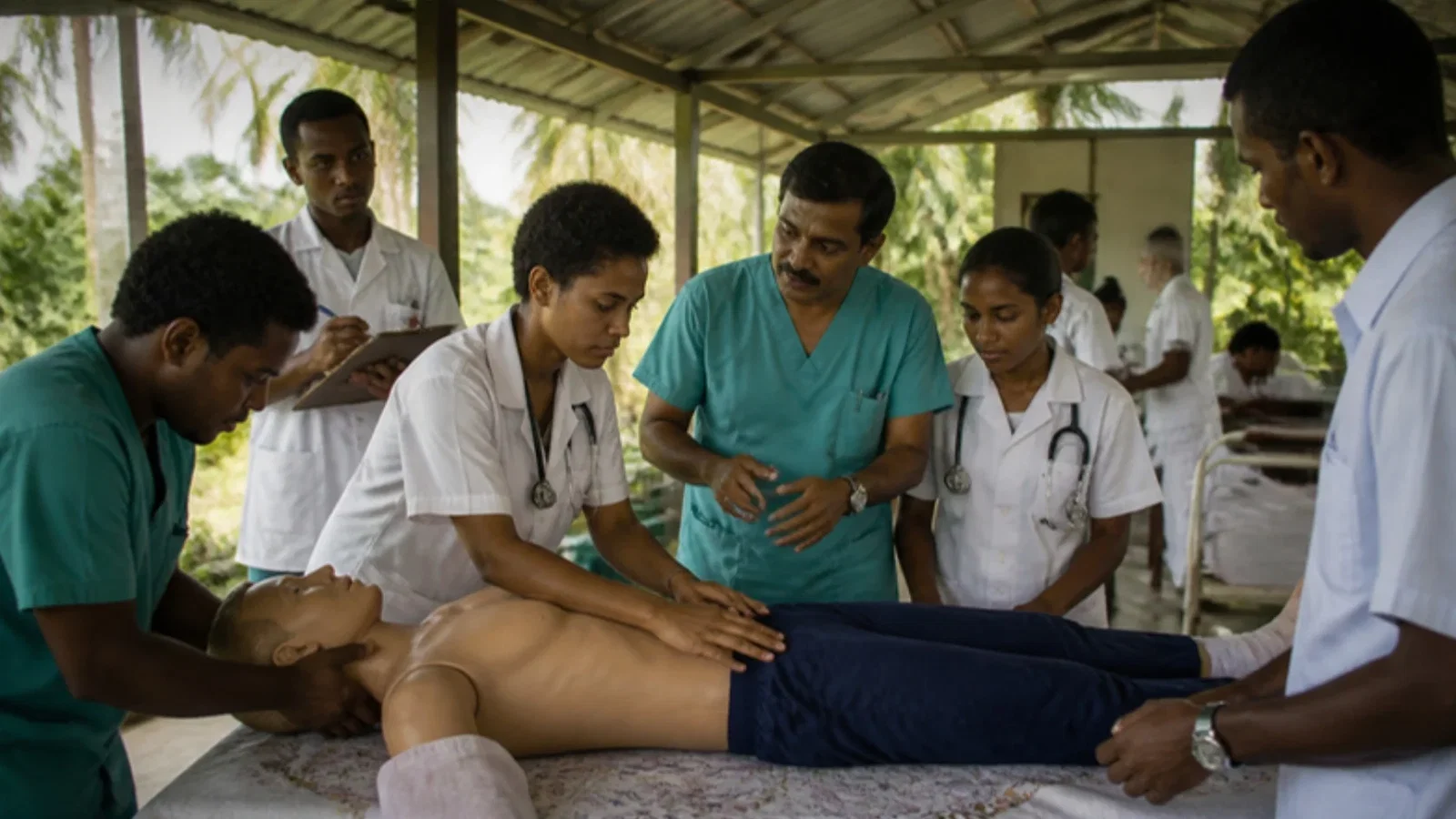
A short, cheap course in the systematic care of the injured, written for doctors and nurses at district hospitals that could not afford ATLS, was first taught in Fiji in 1997 and had reached 76 countries twenty years later.
Reading Library · Anesthesia Epochs · 中文版
Watch the education video (for clinicians)
1997: Primary Trauma Care — A Course Built to Travel · Anesthesia Epochs Education Series
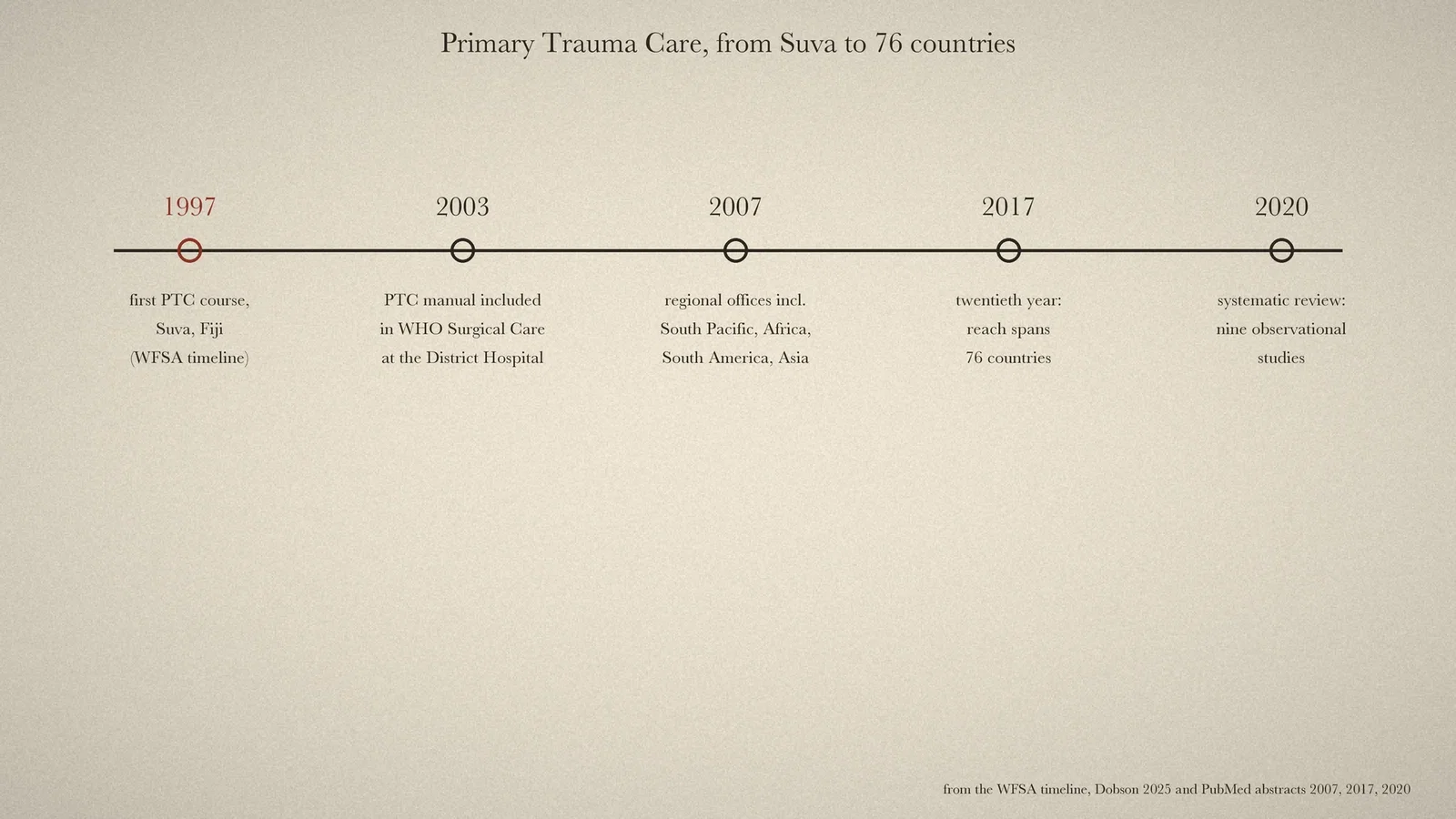
Among the World Federation of Societies of Anaesthesiologists' (WFSA) entries for 1997 is a single line: "First PTC course took place in Suva, Fiji." [1] PTC, Primary Trauma Care, was a course for doctors and nurses who had to manage severely injured patients in small hospitals without the resources of the Advanced Trauma Life Support (ATLS) course that an earlier article in this series traces to Nebraska. [3, 5] This article follows PTC from that first course, using the WFSA timeline, the recollection of the WFSA's liaison officer with WHO, and three published accounts. None of them describes the Suva course itself.
A course for the district hospital
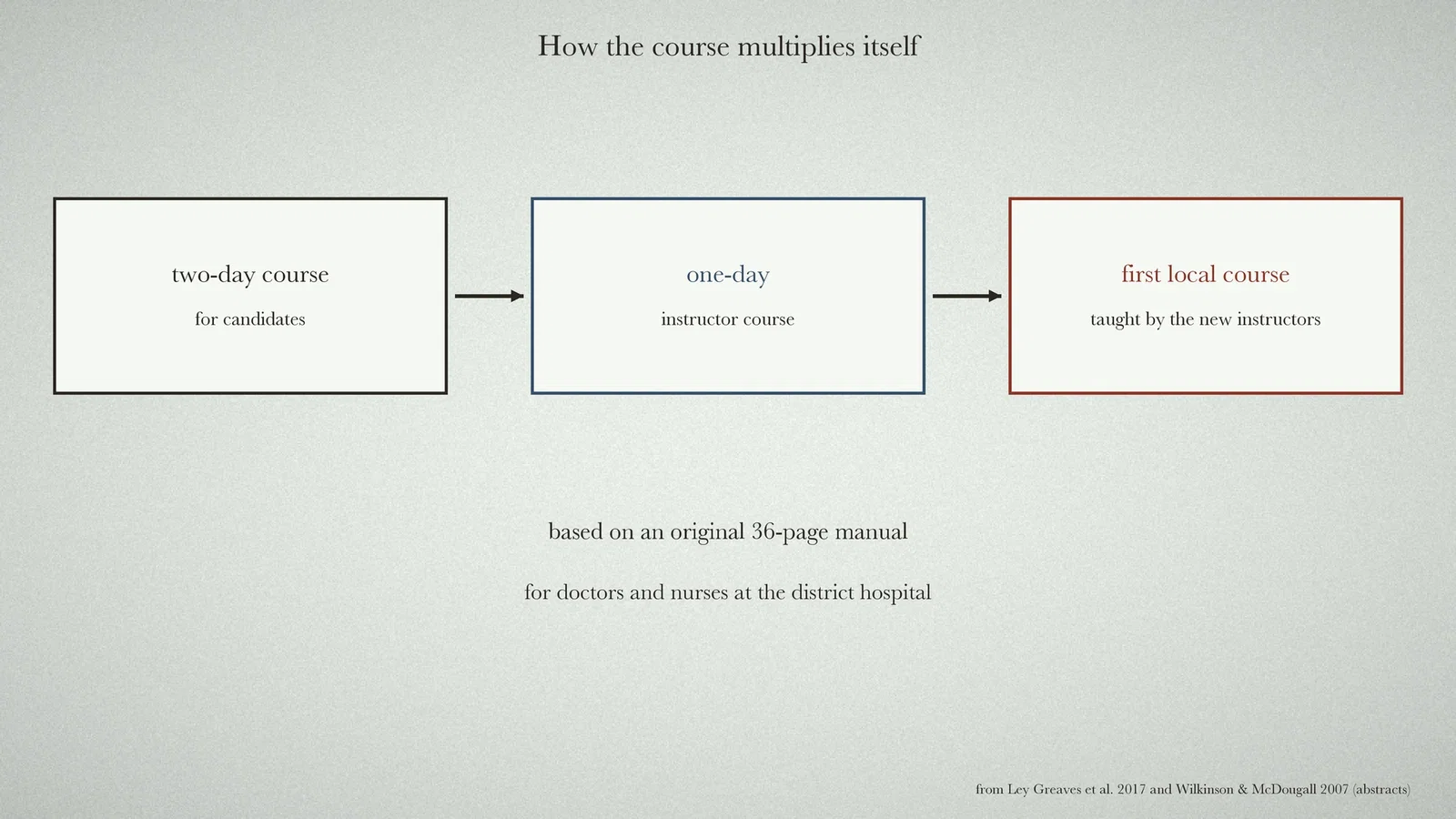
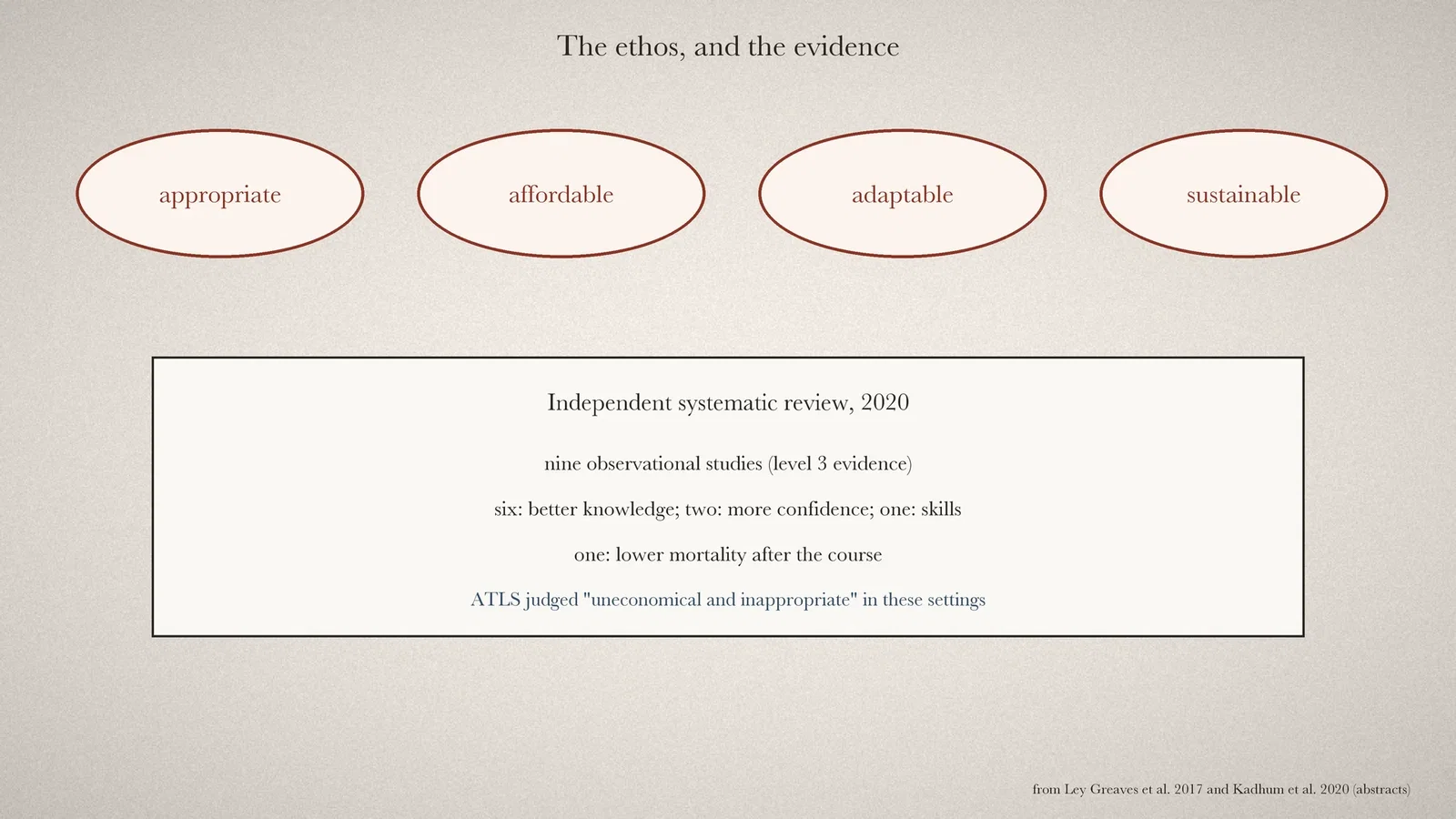
In 2007 D. Wilkinson and R. McDougall of the PTC Foundation at the John Radcliffe Hospital in Oxford described PTC as "a course designed to train anaesthetists, surgeons and others in the systematic review and management of severe trauma victims at the District Hospital". [3] A review published in 2017, the Foundation's twentieth year, with D. A. Wilkinson, "Founder of Primary Trauma Care Foundation", as an author, set out its design. The course was based on "the original 36-page PTC manual" and on an ethos of being "appropriate to the target audience, affordable to those who need it, adaptable to the needs of each local area and sustainable to perpetuate itself". [4]
The format was meant to reproduce itself. "The concept is simple: a two-day course for candidates, followed by a one-day instructor course, and finally a first course delivered to local healthcare staff by the first cohort." [4] By 2007 local courses were coordinated by regional offices in South America, India, China, Indonesia, the South Pacific and Africa. [3] By 2017, the review said, PTC's "reach spans 76 countries" and the course was part of the syllabus of many health systems. [4]
Independent, but close to the WFSA and WHO
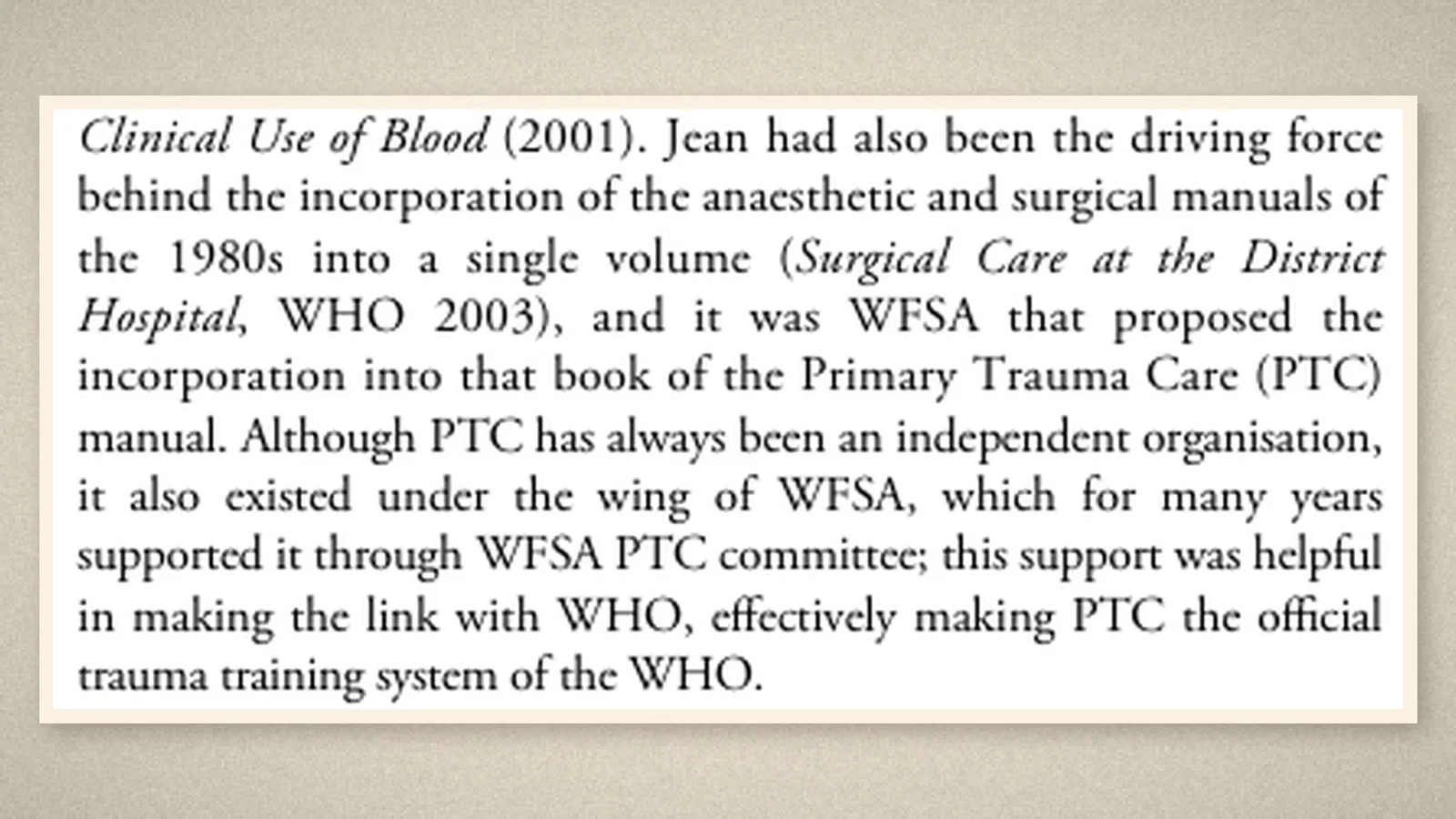
Mike Dobson, the WFSA's liaison officer with the World Health Organization until 2003, describes the relationship in the WFSA's 2025 history issue. When WHO combined its district hospital manuals into Surgical Care at the District Hospital (2003), "it was WFSA that proposed the incorporation into that book of the Primary Trauma Care (PTC) manual". Dobson adds: "Although PTC has always been an independent organisation, it also existed under the wing of WFSA, which for many years supported it through WFSA PTC committee". That support helped link PTC with WHO, "effectively making PTC the official trauma training system of the WHO". [2, p. 8]
Does it work?
A systematic review by Kadhum, Sinclair and Lavy in 2020 began from the premise that ATLS courses "remain uneconomical and inappropriate" in low- and middle-income countries. It found nine observational studies, the lowest of the usual levels of evidence. Six reported better knowledge of injury management after the course, two more confidence and one better skills, and one study reported "a reduction in mortality rates" after the course. [5]
What the record shows
PTC began with a small manual and a course meant to be cheap enough to run where ATLS could not be afforded. Its rule that each new group of instructors teaches the next course let it spread without a large central staff. The evidence that it saves lives is still limited to observational studies.
Sources and reading limits
Read: the WFSA history timeline; Dobson's chapter in Update in Anaesthesia 2025;40, p. 8 (text and page image); the PubMed abstracts of Wilkinson and McDougall 2007, Ley Greaves, Wilkinson and Wilkinson 2017, and Kadhum, Sinclair and Lavy 2020.
Not covered: anything about the Suva course itself, including its date, teachers, participants and why Fiji was chosen; the original manual; the PTC Foundation's website, which did not respond; the full texts of the three papers. The first course in Suva rests on one line in the WFSA timeline. The 2017 review's twentieth anniversary is consistent with 1997 but does not mention Fiji. PTC was an independent organisation and is not described here as a WFSA programme. The 2007 and 2017 accounts are by or with the founder.
One illustration is a crop of Dobson's chapter; three are drawn from the sources. No patients or injuries are depicted.
- World Federation of Societies of Anaesthesiologists. WFSA history timeline. Website
- Dobson M. WFSA and WHO liaison - the first 20 years. Update in Anaesthesia. 2025;40:7-8. PDF
- Wilkinson D, McDougall R. Primary trauma care. Anaesthesia. 2007;62 Suppl 1:61-4. PubMed
- Ley Greaves RA, Wilkinson LF, Wilkinson DA. Primary trauma care: a 20-year review. Trop Doct. 2017;47(4):291-4. PubMed
- Kadhum M, Sinclair P, Lavy C. Are Primary Trauma Care (PTC) courses beneficial in low- and middle-income countries - a systematic review. Injury. 2020;51(2):136-41. PubMed
Continue exploring
Related reading connects shared questions and contexts; it does not by itself establish historical influence.
- 1978: A Surgeon's Plane Crash Leads to the ATLS Course
- 1988: A WHO Manual of Anaesthesia for the District Hospital
Anesthesia Epochs · The Source Room · About & Editorial Method
Published November 2, 2026. Sources and reading limits are stated above. Illustrations are labelled as original source images or AI-made. Historical accounts are educational; they are not current treatment instructions.