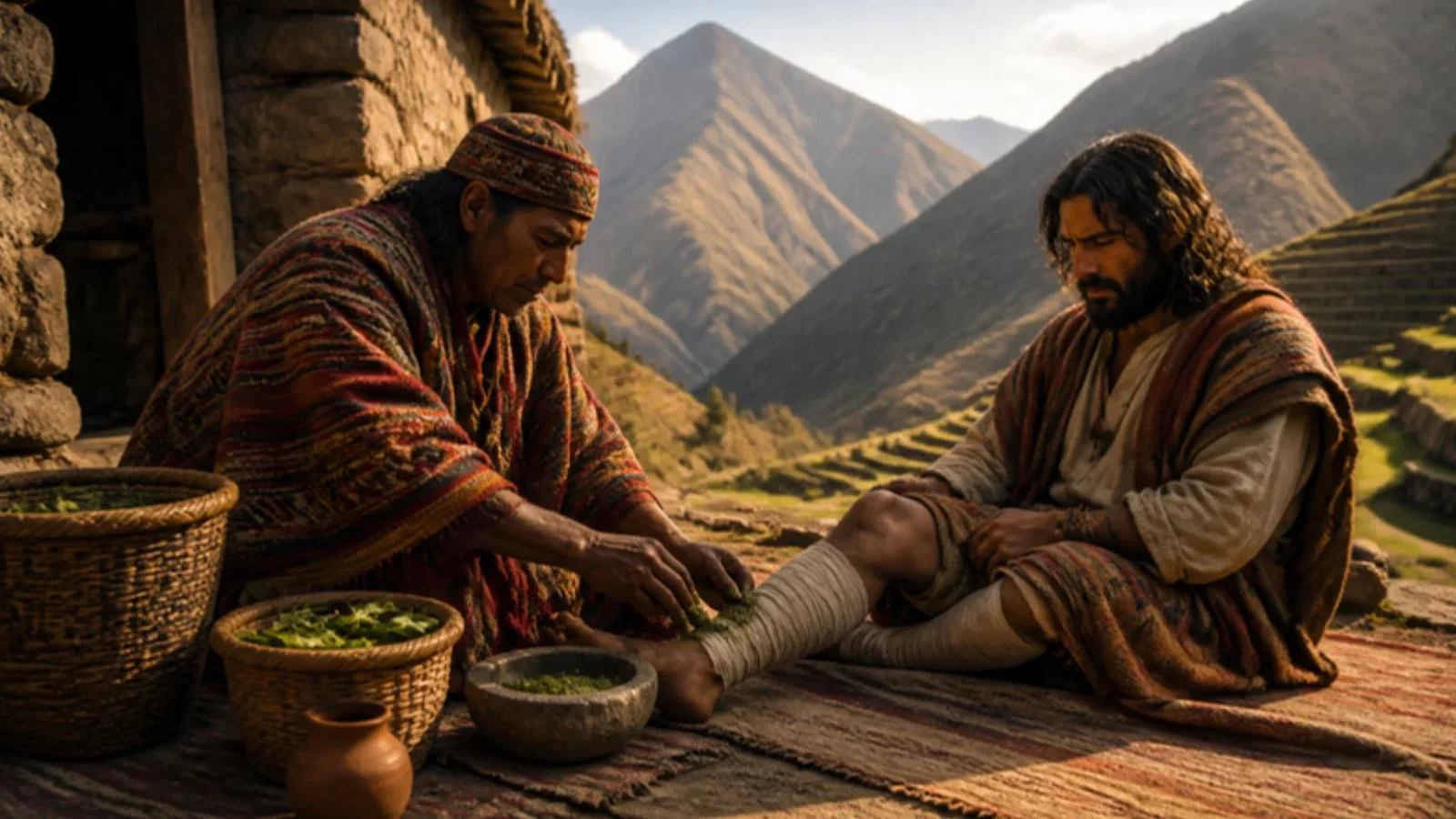
Garcilasso's Royal Commentaries of 1609 preserve Blas Valera's note that doctors applied pounded coca to sores and broken bones; it mentions no pain or surgery, so an Inca local anaesthetic is a modern inference.
Reading Library · Anesthesia Epochs · 中文版
Watch the education video (for clinicians)
1609: Coca on Sores — Garcilaso and 'Inca Anaesthesia' · Anesthesia Epochs Education Series
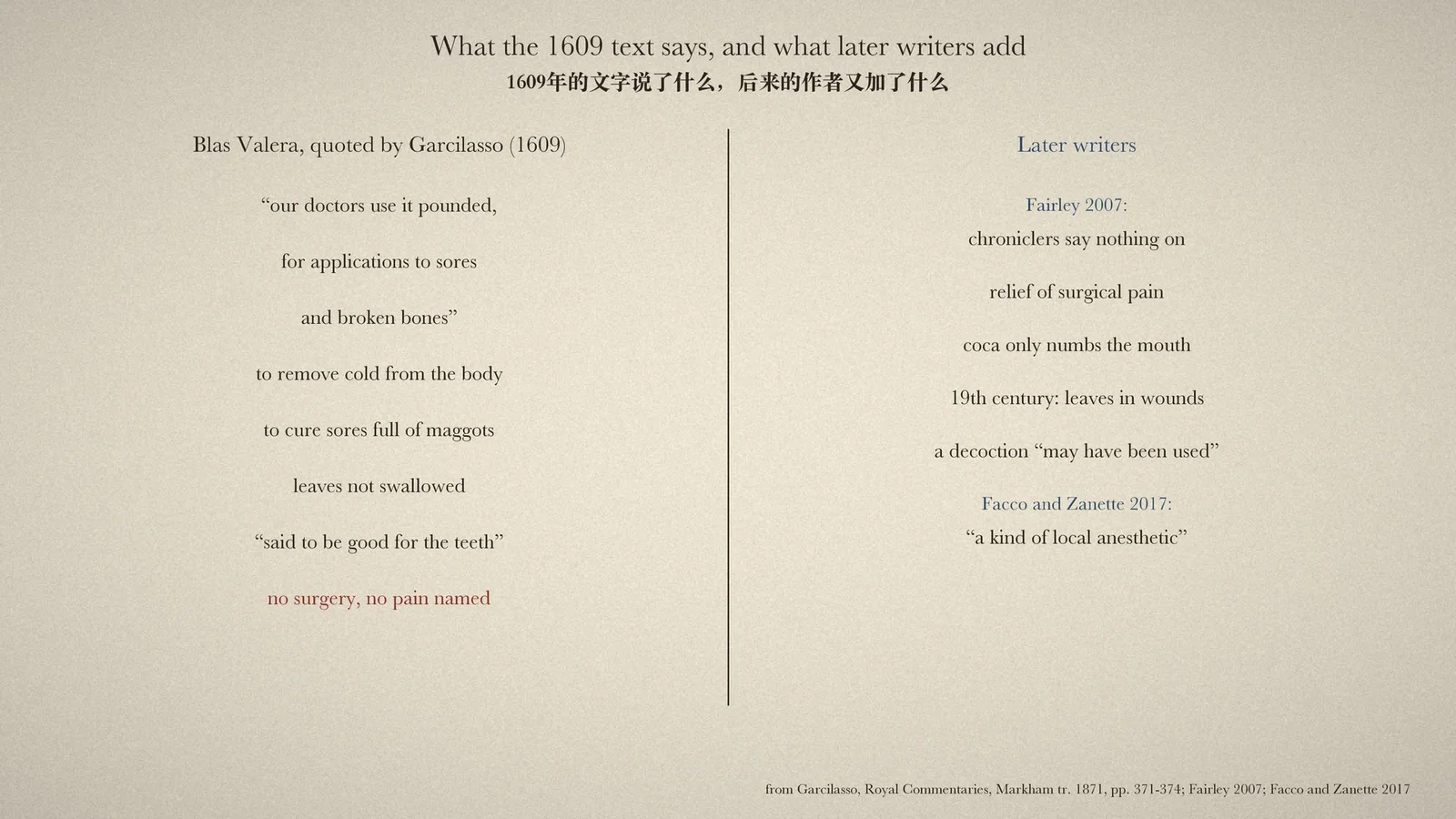
Short histories of local anaesthesia often begin in the Andes. A 2017 review of dental anxiety, for example, says that the Inca used "Erythroxylum coca leaf extract as a kind of local anesthetic". [4] The sentence is easy to repeat, because cocaine is the best-known alkaloid of the coca leaf. [5] This article goes back to the oldest text usually behind the idea and reads exactly what it says.
The book and its informant
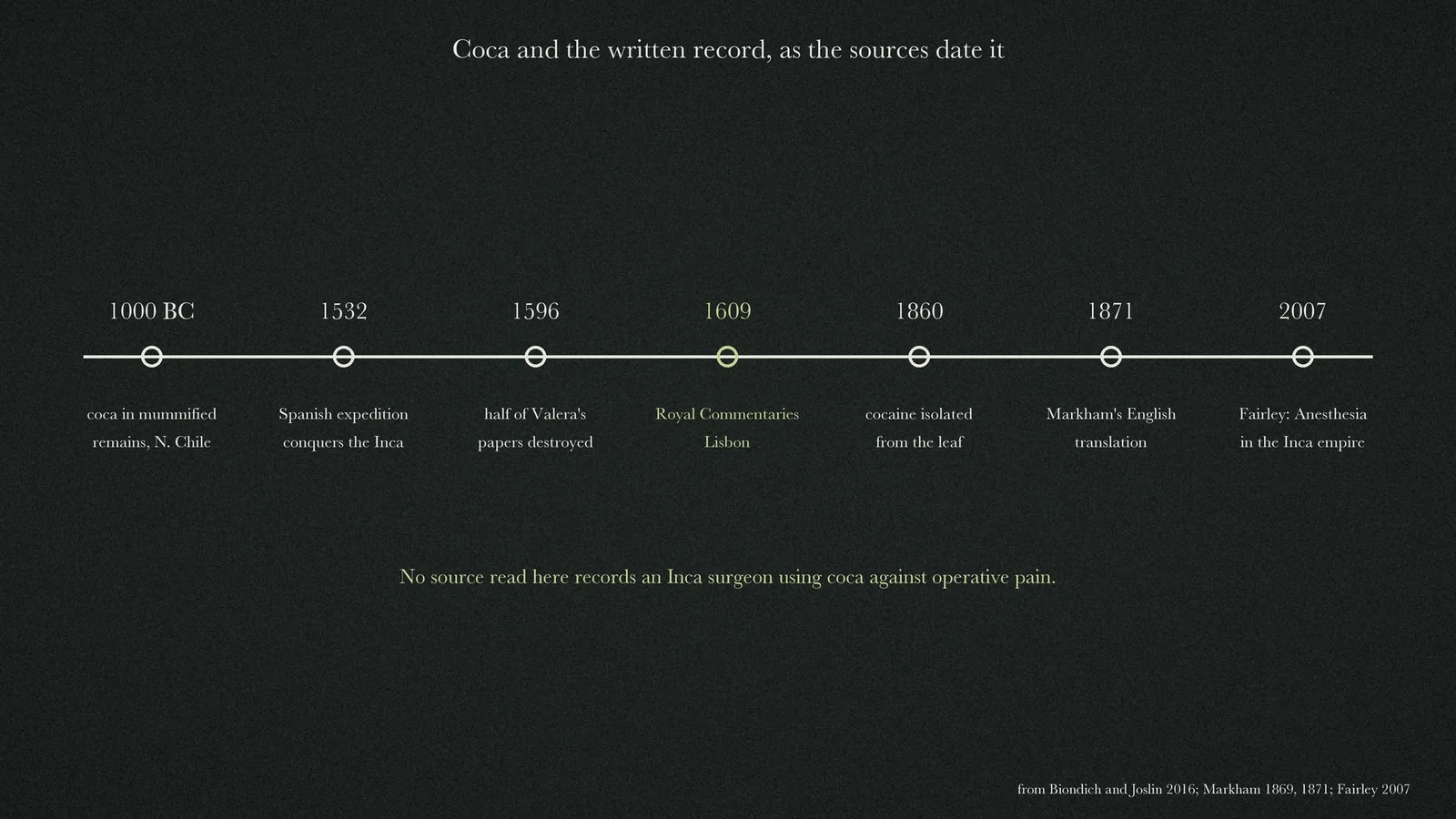
The text is a chapter of the Royal Commentaries of the Yncas by Garcilasso de la Vega, as the Hakluyt Society translator Clements R. Markham spells the name. According to Markham's introduction, the first part of the work received the licence of the Inquisition in 1604 and was published at Lisbon in 1609; Markham translated it from that Lisbon edition, collated with the Madrid edition of 1723, and the Hakluyt Society printed it in 1869 and 1871. [2] For many subjects Garcilasso relied on the papers of the Jesuit missionary Blas Valera, who had been in Peru in the first years of the conquest and had collected Indian traditions while the generation that had seen the Inca empire was still alive. More than half of those papers, Markham adds, were destroyed when the English sacked Cadiz in 1596; the rest passed to Garcilasso and survive only in the Commentaries. [2]
What Valera wrote
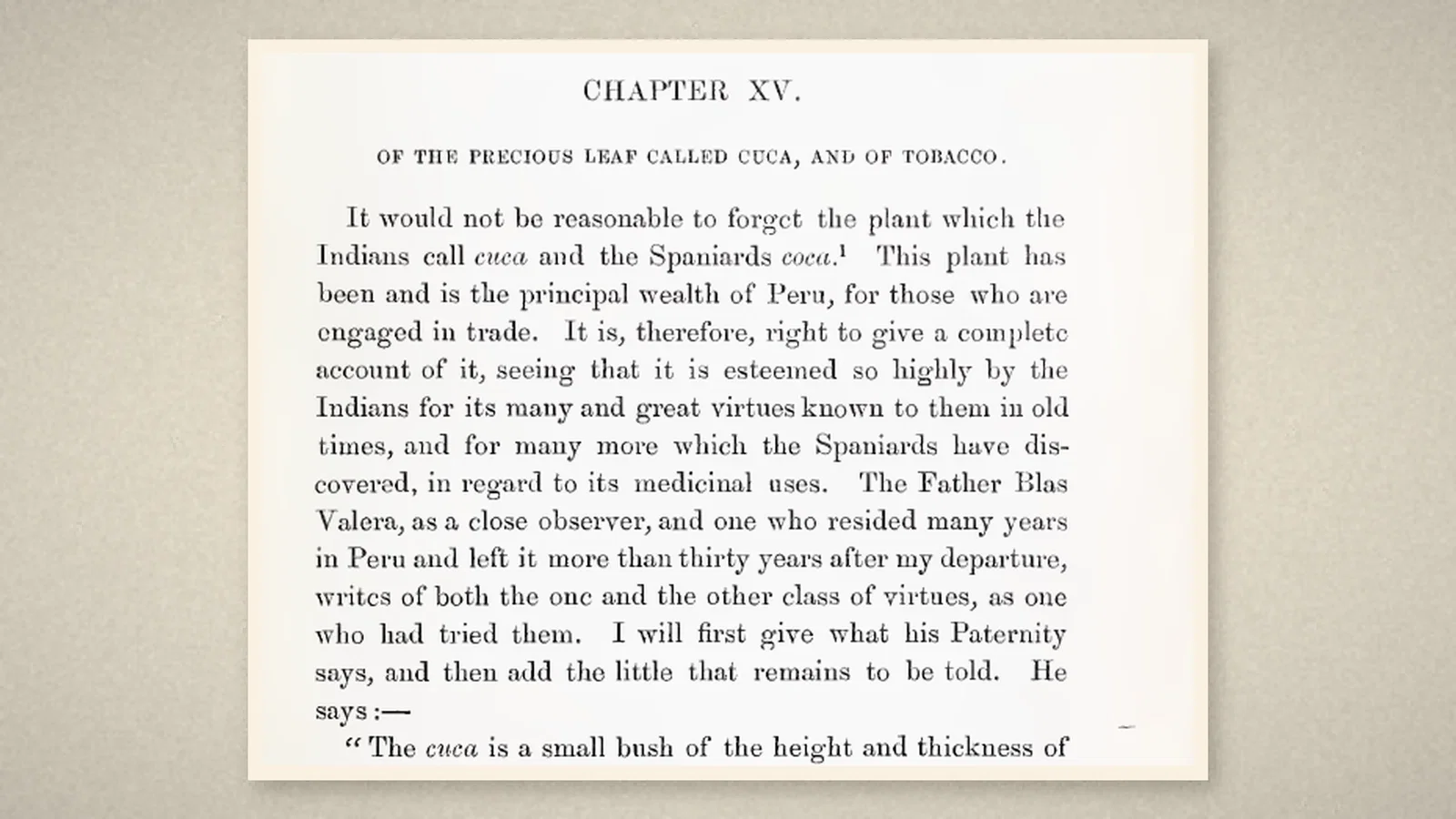
Chapter 15 of Book VIII is headed "Of the precious leaf called cuca, and of tobacco". Garcilasso explains that the plant is the one "the Indians call cuca and the Spaniards coca", that it was the principal wealth of Peru for those in trade, and that its virtues were known to the Indians "in old times" while the Spaniards had discovered "many more" medicinal uses. [1] Garcilasso then hands the page to Valera.
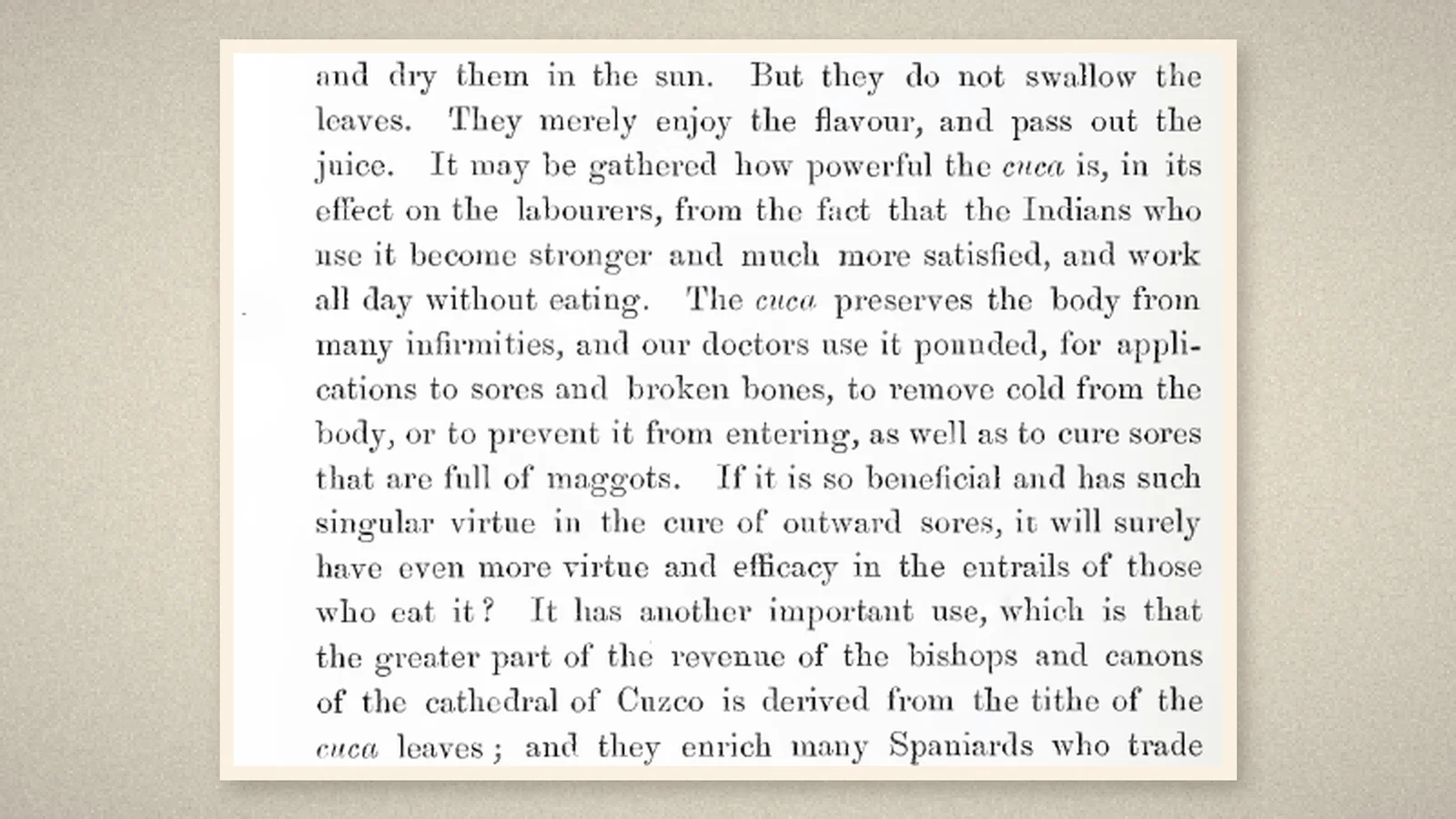
Valera describes a small bush with delicate leaves, picked one by one and dried in the sun. Chewers, Valera says, "do not swallow the leaves"; they enjoy the flavour and pass out the juice, and they work all day without eating. Then comes the sentence that matters here: "The cuca preserves the body from many infirmities, and our doctors use it pounded, for applications to sores and broken bones, to remove cold from the body, or to prevent it from entering, as well as to cure sores that are full of maggots." [1] Valera goes on to argue that a leaf so useful on outward sores must do even more good inside the body, notes that the tithe on coca supported the bishops and canons of the cathedral of Cuzco, and defends the plant against those who wanted it banned because it was offered to idols. [1]
When Garcilasso resumes, the additions concern cultivation, harvest and trade. On medicine there is one line: "Among other virtues of the cuca, it is said to be good for the teeth." [1]
What the passage does not say
Read slowly, the passage is narrower than its later use. The doctors who apply pounded coca are "our doctors", in the voice of a Spanish missionary, not Inca healers. The applications are to sores and broken bones, and the stated purposes are to drive out cold and to cure sores, including maggot-infested ones. There is no surgeon, no operation, no mention of pain, and no mention of numbness. [1] The chapter is evidence that coca was used on wounds in colonial Peru; it is not evidence of Inca operative anaesthesia.
An anaesthetist reached a similar conclusion from a wider reading. In a 2007 article on anaesthesia in the Inca empire, H. B. Fairley wrote that the Incas had no written language and that their chroniclers "say little about their surgery and nothing about their methods for relieving the pain it caused". [3] Fairley noted that modern Peruvian Indians say that "coca only numbs the mouth, though it was observed in the 19th century that coca leaves placed in wounds provided pain relief", and concluded only that a decoction of coca leaves "may have been used as a topical anesthetic". [3] Fairley's abstract also says the Incas chewed coca with lime and "swallowed the resulting juice", which is the opposite of Valera's statement that the leaves were not swallowed and the juice passed out. [3] [1] The two are reported here side by side.
The leaf before and after
Coca is far older than the Inca. A 2016 review cites analysis of mummified remains from northern Chile showing coca use "as early as 1000 BC", and dates the Spanish conquest of the Inca to 1532. [5] The same review records that cocaine was first isolated from the leaf in 1860, and that in Andean folk medicine today coca is "masticated or held in the mouth for relief of painful oral sores" and used for toothache. [5] Those later facts, the numbing of the mouth and the alkaloid, are what make an Inca anaesthetic seem plausible. They are not in the 1609 chapter.
What the record shows
The 1609 text gives anaesthesia history something real and modest: a colonial account of pounded coca applied to sores and fractures for warmth and healing, and a remark that the leaf was good for the teeth. The phrase "Inca local anaesthetic" belongs to later writers who combined that account with nineteenth-century observations and with knowledge of cocaine. Keeping the two apart lets the leaf keep its genuine place in the story without lending it an operation that no source here records.
Sources and reading limits
Read: the coca chapter (Book VIII, chapter 15, pp. 371-375) of Markham's translation of the Royal Commentaries; Markham's introduction to vol. 1 on Garcilasso's sources and the Lisbon edition; the PubMed abstract of Fairley 2007 (article in Spanish); the open-access full texts of Facco and Zanette 2017 and Biondich and Joslin 2016.
Not covered: the 1609 Spanish original; Valera's own papers; other chroniclers on coca; the full text of Fairley's article, including its source for the nineteenth-century observation about leaves in wounds; the works Facco and Zanette cite; a 2003 history of local anaesthesia in Anesthesiology whose PubMed record has no abstract. Quotations from Garcilasso and Valera are Markham's English, not the Spanish. The 1000 BC date and the 1860 isolation of cocaine are as Biondich and Joslin give them. Names follow Markham's printing.
Two illustrations are crops of Markham's translation; two are drawn from the sources.
- Garcilasso de la Vega. First part of the Royal Commentaries of the Yncas. Markham CR, translator. Vol. 2. London: Hakluyt Society; 1871:371-5. Internet Archive
- Markham CR. Introduction. In: Garcilasso de la Vega. First part of the Royal Commentaries of the Yncas. Vol. 1. London: Hakluyt Society; 1869. Internet Archive
- Fairley HB. [Anesthesia in the Inca empire]. Rev Esp Anestesiol Reanim. 2007;54(9):556-62. PubMed
- Facco E, Zanette G. The odyssey of dental anxiety: from prehistory to the present. A narrative review. Front Psychol. 2017;8:1155. DOI
- Biondich AS, Joslin JD. Coca: the history and medical significance of an ancient Andean tradition. Emerg Med Int. 2016;2016:4048764. DOI · PMC
Continue exploring
Related reading connects shared questions and contexts; it does not by itself establish historical influence.
- c. 1600 BCE: Weighing the Claim of Shang Acupuncture
- 1859: Scherzer and the Journey of Coca to the Laboratory
Anesthesia Epochs · The Source Room · About & Editorial Method
Published November 2, 2026. Sources and reading limits are stated above. Illustrations are labelled as original source images or AI-made. Historical accounts are educational; they are not current treatment instructions.