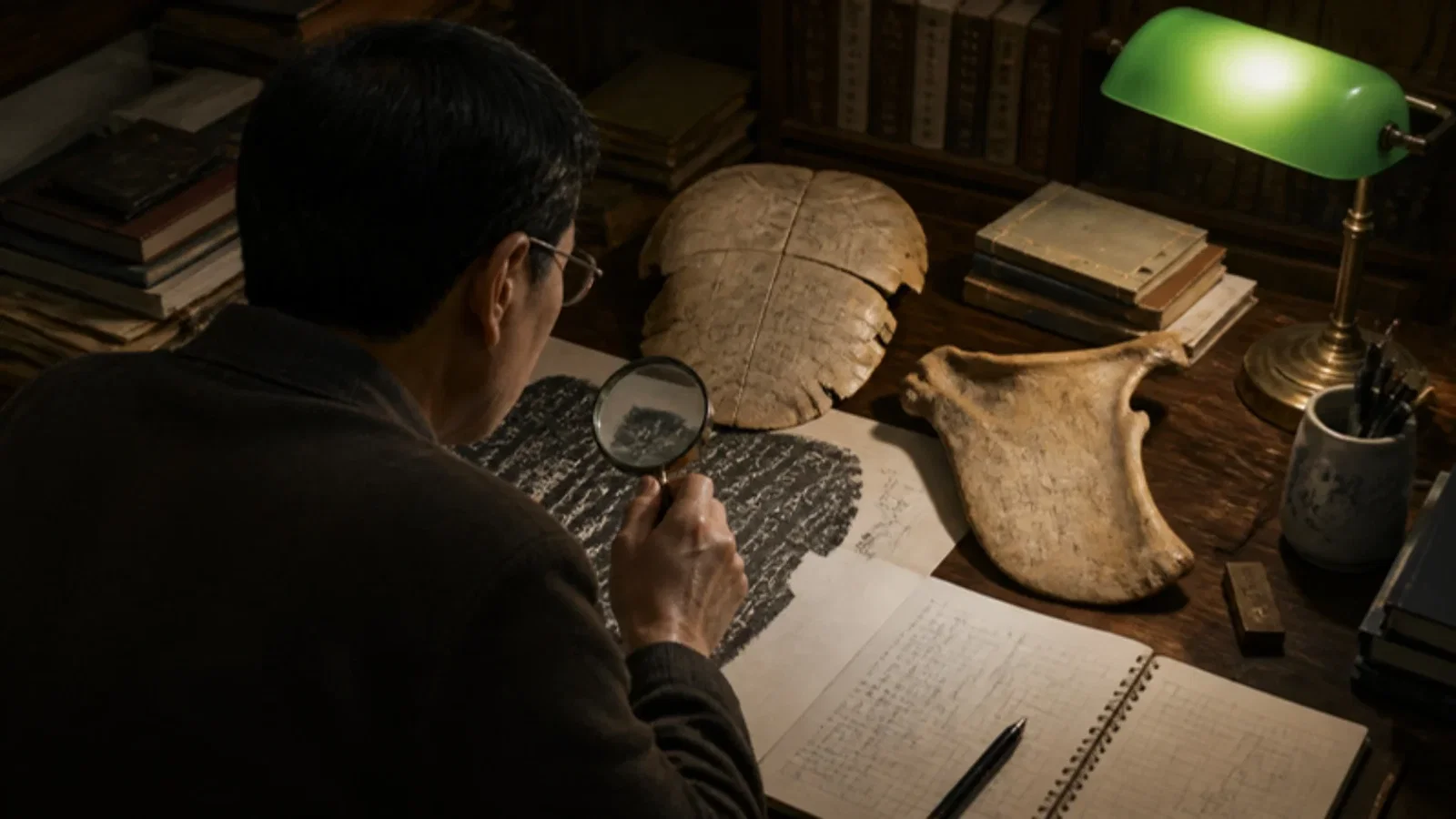
Hu Houxuan read acupuncture, moxibustion and massage into three oracle-bone glyphs; Li Zong-kun reread the evidence in 2001 and found the claims unconvincing, including a 1974 story of painless tooth extraction under Shang acupuncture anaesthesia.
Reading Library · Anesthesia Epochs · 中文版
Watch the education video (for clinicians)
Shang Dynasty: Acupuncture on the Oracle Bones? — Weighing the Claim · Anesthesia Epochs Education Series
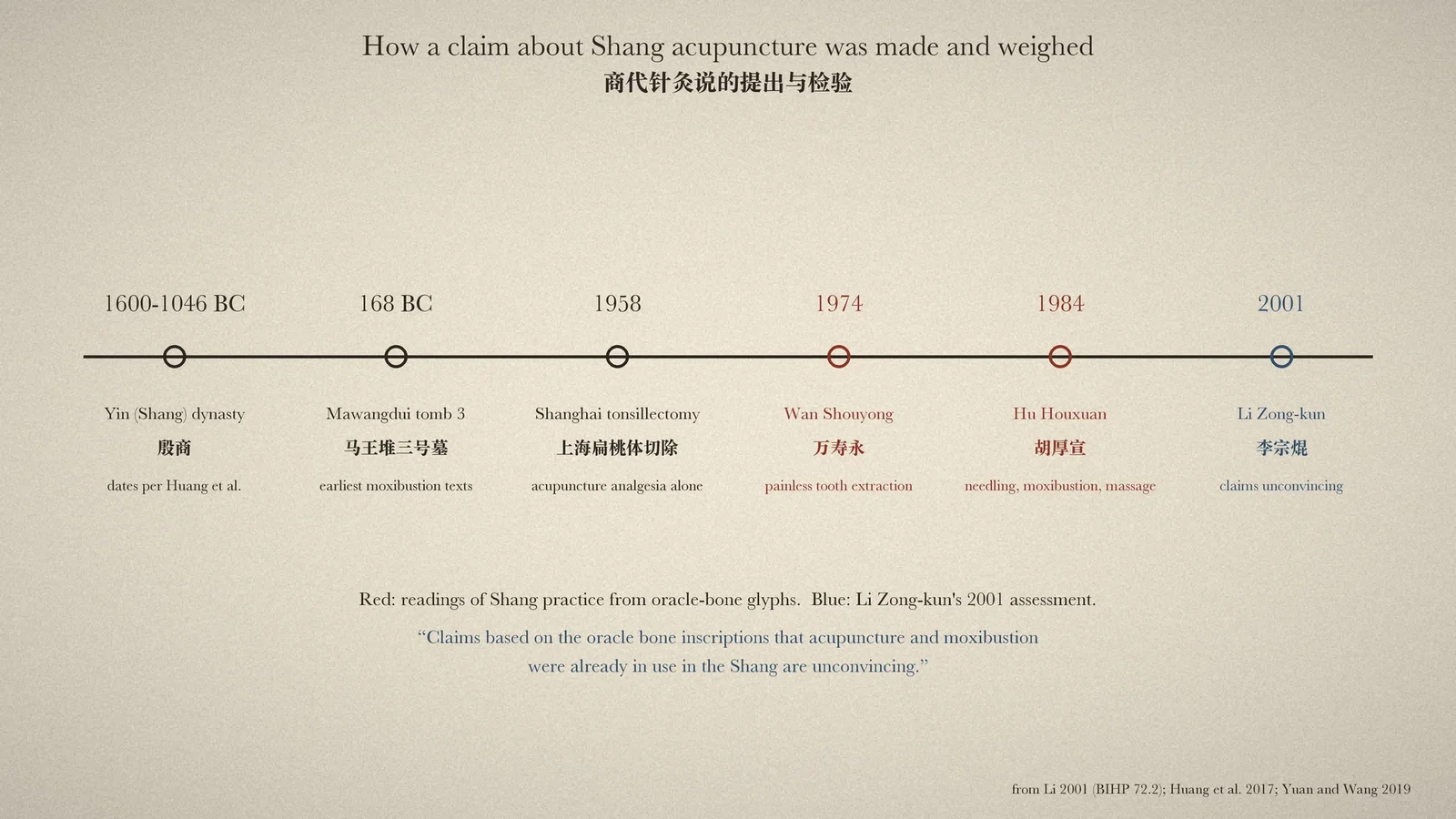
Acupuncture anaesthesia has a modern date. Two reviews by Chinese authors place its beginning in 1958: on 30 August that year, according to Wei Yuan and Qiang Wang, the ear, nose and throat department of Shanghai First People's Hospital needled the Hegu point (LI4) on both hands during a tonsillectomy, "the first reported case, in which, acupuncture analgesia was solely used". [3] Jin and colleagues write that the technique spread widely in China and reached other countries after 1971. [4] A practice that arrived so suddenly invited a search for ancestors, and some writers looked for them in the oldest Chinese writing of all: the divination inscriptions of the Shang, the oracle bones. This article follows one careful reading of that search, by Zong-kun Li of the Institute of History and Philology, Academia Sinica, published in 2001. [1]
Three glyphs read as three treatments
Li begins with the scholar whose reading most later writers followed. Hu Houxuan had first held that prayer to spirits was the "only" Shang method of treating disease; about forty years later, in an article of 1984, Hu revised the view and proposed three treatments, each read from the shape of a single oracle-bone character. [1] In one glyph Hu saw a sharp point held in a hand beside a person with a sick body, and read "a person pricking the illness with a needle". In a second, from an inscription of the king Wu Ding, Hu saw a person lying on a sickbed beside the element for wood, and read moxibustion with burning mugwort. In a third, Hu saw a person lying ill while another person pressed the abdomen by hand, and concluded that the Shang knew massage. [1]
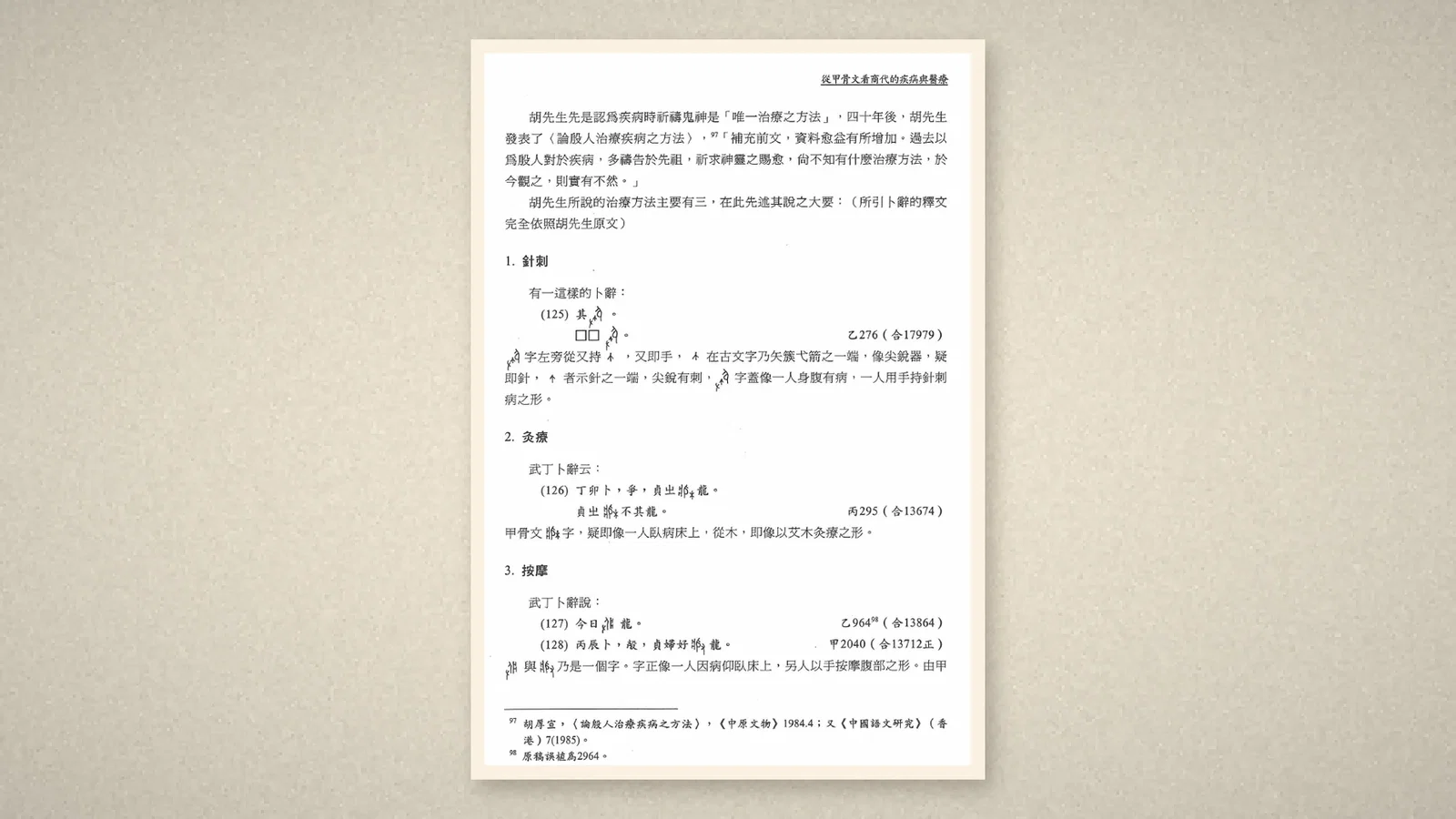
The readings were attractive, and Li notes that they were cited in almost every later article on Shang medicine and widely believed. [1]
Li's objections
Li's first objection is about the kind of evidence. Hu's argument rests mainly, "even solely", on the forms of characters, and some of those forms survive in only one fragmentary inscription. [1] For the "needling" glyph, Li works through how the character's components change across oracle-bone and bronze script and concludes that a once-seen variant cannot carry the reading; Li adds that Yu Xingwu's interpretation, treatment with a massage implement, at least fits the glyph better. [1] For the "moxibustion" glyph, Li cites Yao Xiaosui's earlier doubt: the character shows only wood, and nothing in it shows the burning of moxa. [1] For the "massage" glyph, Li points to an inscription in which the character follows a negative of intention, and suggests the shape may simply picture a person holding the belly in pain, a natural reaction rather than a therapy. [1] Characters elsewhere in the corpus with a similar structure, Li adds, cannot be explained by the same reasoning. [1]
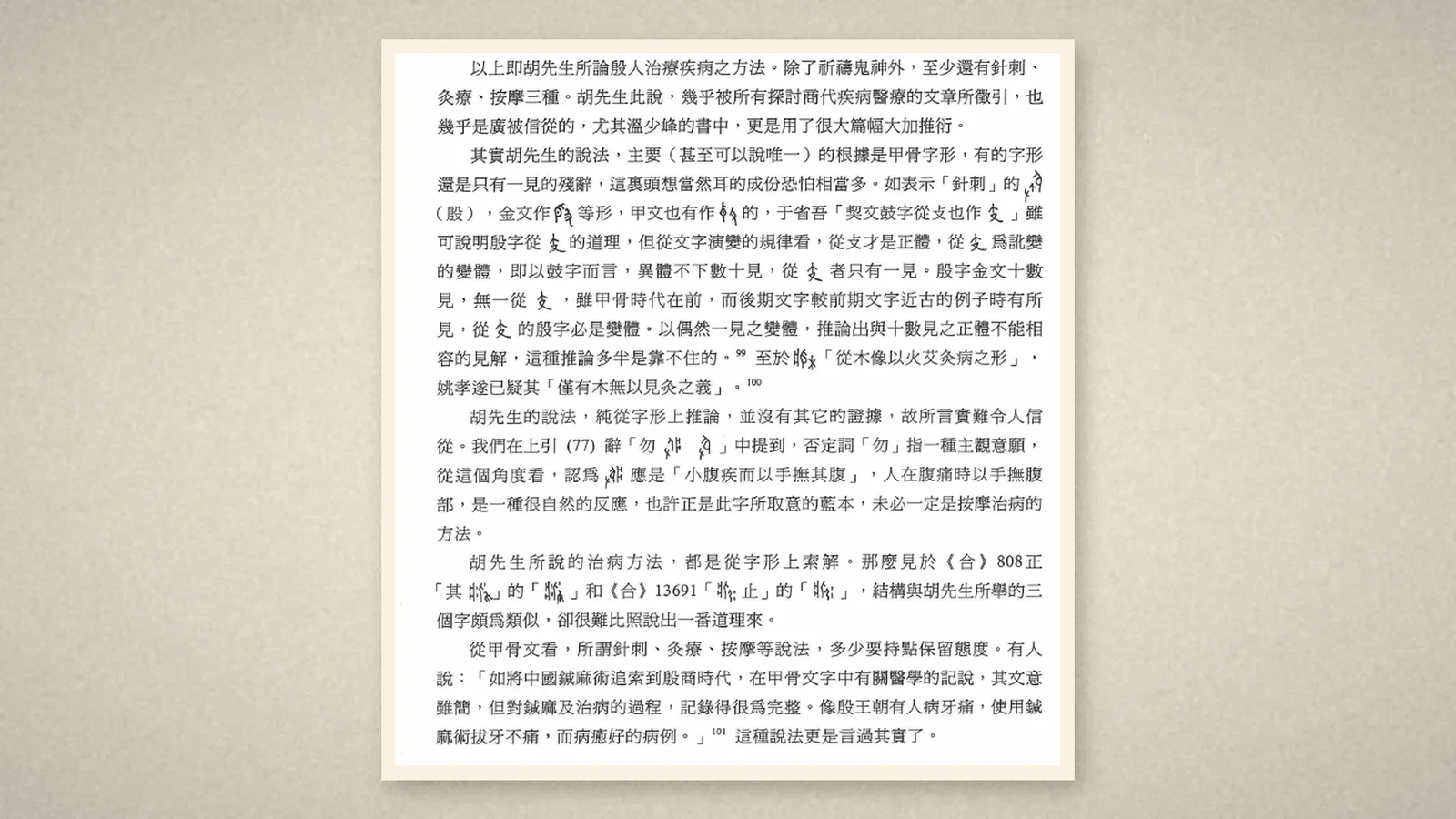
The page then turns to anaesthesia. Li quotes an article by Wan Shouyong, published in 1974, which claimed that if Chinese acupuncture anaesthesia were traced back to the Shang, the oracle-bone records gave a complete account of it, including a Shang patient with toothache whose tooth was pulled painlessly under acupuncture anaesthesia and who recovered. Li's verdict is brief: this claim "goes even further beyond the facts". [1] On the oracle bones as a whole Li concludes that the readings of needling, moxibustion and massage call for "some reserve". [1]
What the bones do say
Li's broader survey is not a dismissal of Shang medicine. The inscriptions record many illnesses, but in Li's English abstract "they focus on the narrow field of prognostications for sicknesses in particular parts of the body", are terse, and have led scholars who extrapolated from them to "conclusions that are unsubstantiated by the evidence". [1] Healing in the inscriptions is almost entirely religious: "Most of the information on healing in the oracle bone inscriptions relates to sacrifices to spirits and prayers for improved health." [1] Li adds a caution in the other direction. The absence of other treatments in the inscriptions does not mean the Shang had none. In 1973 a stone sickle was found in a lacquer box in tomb 14 at the Shang site of Taixi, Gaocheng, Hebei, and was interpreted, in an article by Ma Jixing, as a medical tool, a kind of bian stone; seeds of peach and of yu li ren, both used as medicines, were found in Shang house remains at the same site. [1] The tomb dates to the middle Shang, so Li expects the late Shang to have had medicines too; the bones simply do not say so. [1]
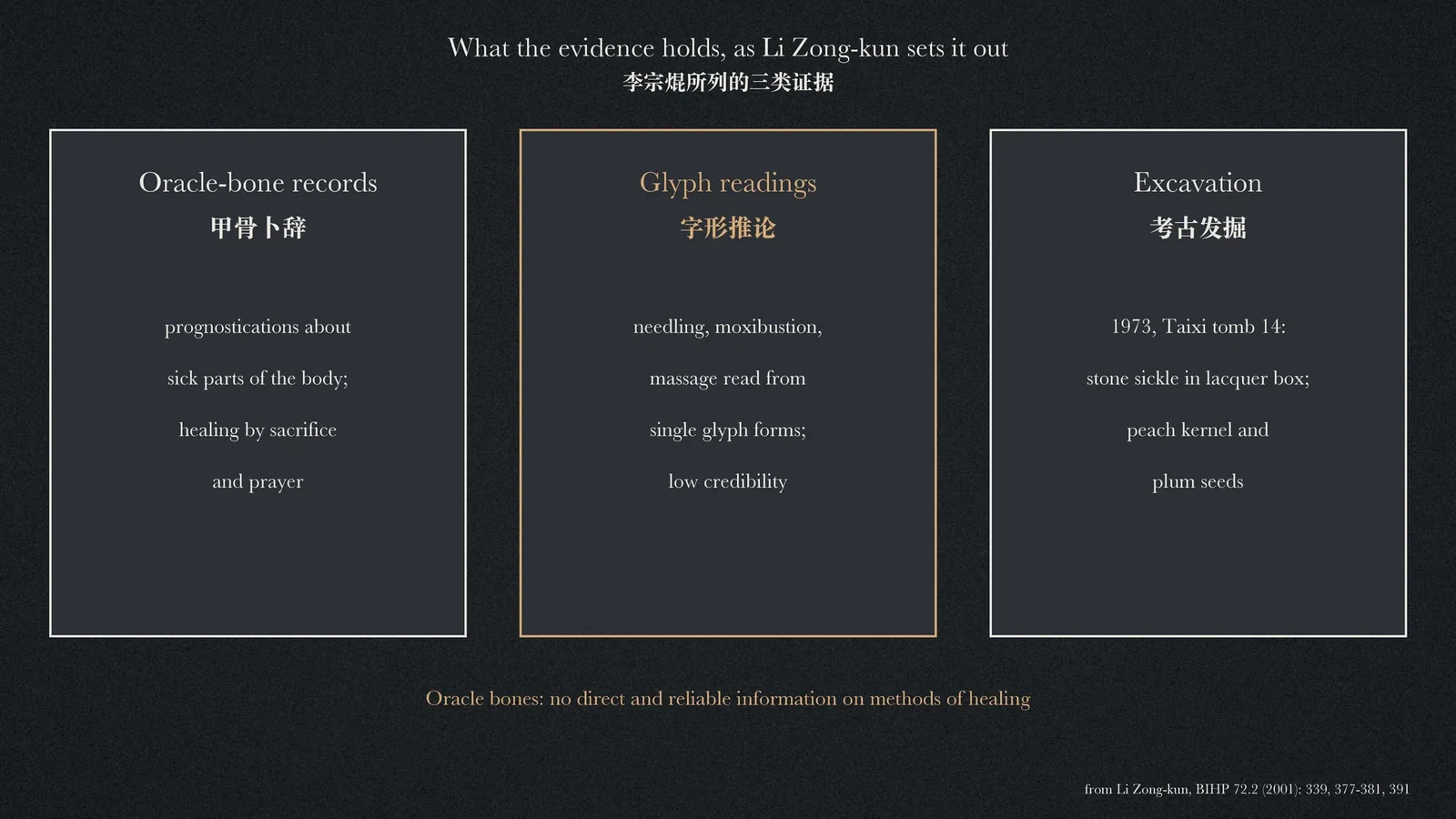
"Claims based on the oracle bone inscriptions that acupuncture and moxibustion were already in use in the Shang are unconvincing," the abstract concludes. "Archaeologists have uncovered some simple medicine from the Shang, but the oracle bones provide no such direct and reliable information on methods of healing." [1]
The other reading
The question is not closed for everyone. A 2017 review by Chang Huang and colleagues states that studies of the oracle-bone script "indicated that moxibustion might have been applied in Yin dynasty (1600 BC–1046 BC)". [2] The same review places the earliest monographs on vessels and moxibustion in tomb 3 at Mawangdui, buried in 168 BC, and notes that early needles were crude and mostly of stone. [2] This article reports both positions. It does not read the inscriptions independently and cannot settle the palaeography.
What the record shows
Anaesthetists meet acupuncture today mainly as an adjunct. Yuan and Wang write that acupuncture used alone "has gradually phased out" in surgery because of its limits, including its inability to provide complete anaesthesia, and argue for perioperative acupuncture alongside drugs. [3] Whatever its present role, its claim to antiquity has to be argued from evidence. Li's article shows what that evidence is for the Shang: a few character shapes, read in different ways by different scholars, and a story of painless tooth extraction that Li found far beyond what the inscriptions record.
Sources and reading limits
Read: Li's 2001 article in the Bulletin of the Institute of History and Philology, downloaded from the Institute's site. The PDF is a scan without a text layer and was read as page images: the Chinese abstract (p. 339), the treatment section (pp. 375-379), the conclusion (pp. 380-381) and the English abstract (p. 391); the English abstract was also read as text on the Bulletin's web page. Also read: the open-access full texts of Huang et al. (2017) and Yuan and Wang (2019), and the PubMed abstract of Jin et al. (2017).
Not covered: Hu Houxuan's article of 1984; Wan Shouyong's article of 1974; Ma Jixing's report on the Taixi sickle; the oracle-bone rubbings themselves; the study Huang et al. cite for the Yin-dynasty reading; the full text of Jin et al. These are known here only through the works that cite them. The Shang date range is Huang et al.'s; Li gives no absolute dates in the pages read. "First reported case" is Yuan and Wang's wording. Quotations from Li's Chinese text are translated for this article. Romanised names of scholars are pinyin renderings of names printed in Chinese characters in Li's article; Li's own name is given as printed on the English abstract.
Two illustrations are crops of Li's article; two are drawn from the sources.
- Li Zong-kun. Disease and healing in the Shang as reflected in the oracle bone inscriptions. Bulletin of the Institute of History and Philology, Academia Sinica. 2001;72(2):339-91. Article page (archived copy)
- Huang C, Liang J, Han L, Liu J, Yu M, Zhao B. Moxibustion in early Chinese medicine and its relation to the origin of meridians: a study on the unearthed literatures. Evid Based Complement Alternat Med. 2017;2017:8242136. DOI
- Yuan W, Wang Q. Perioperative acupuncture medicine: a novel concept instead of acupuncture anesthesia. Chin Med J (Engl). 2019;132(6):707-15. DOI
- Jin L, Wu JS, Chen GB, Zhou LF. Unforgettable ups and downs of acupuncture anesthesia in China. World Neurosurg. 2017;102:623-31. PubMed
Continue exploring
Related reading connects shared questions and contexts; it does not by itself establish historical influence.
- Antiquity: Suśruta Prescribes Wine Before the Knife
- c. 350 BCE: Plato's Anaisthēsia, a Word in Two Settings
Anesthesia Epochs · The Source Room · About & Editorial Method
Published November 2, 2026. Sources and reading limits are stated above. Illustrations are labelled as original source images or AI-made. Historical accounts are educational; they are not current treatment instructions.