'Anaesthesia in the newborn', BMJ 23 December 1950: neonatal physiology, and controlled breathing through a T-piece with a double-ended bag.
Reading Library · Anesthesia Epochs · 中文版
Watch the education video (for clinicians)
1950: Jackson Rees's T-Piece — A Bag for Newborn Anaesthesia · Anesthesia Epochs Education Series
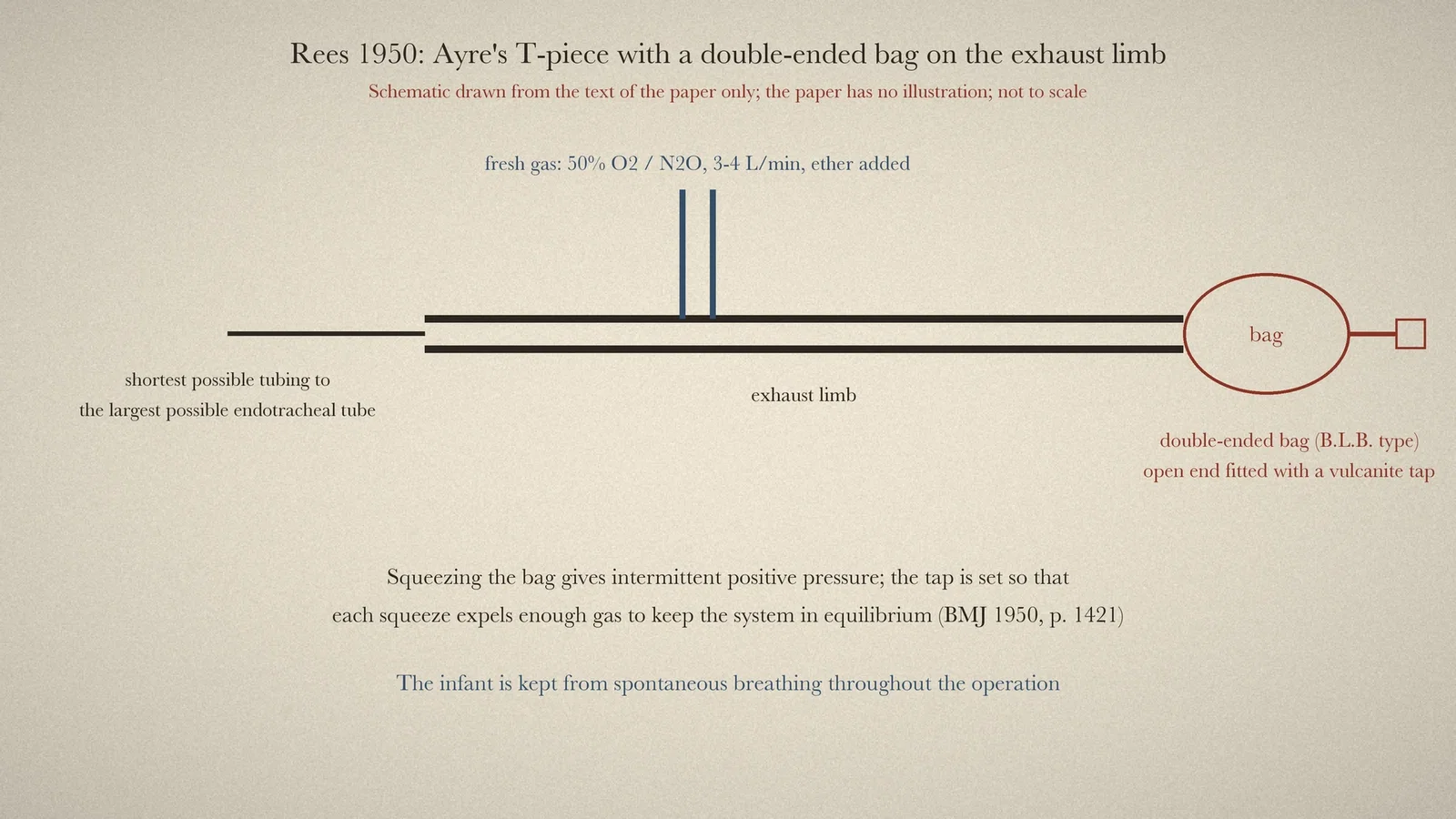
Philip Ayre's T-piece of 1937 has its own article in this series. In December 1950 the British Medical Journal printed a paper by a Liverpool anaesthetist that added one component to it: a bag on the exhaust limb, with which an anaesthetist could breathe for a newborn baby throughout an operation. Later writers called this the "Jackson Rees modification". The paper itself does not use the phrase. It argues from the physiology of the newborn, and the bag comes in only near the end.
A different patient
G. Jackson Rees, demonstrator in anaesthetics at the University of Liverpool, had read the paper to the Section of Anaesthetics at the British Medical Association's annual meeting in Liverpool in 1950. [1, p. 1419] It opened with a principle: "The newborn infant differs so greatly from the adult in his anatomy and physiology that the approach to anaesthesia in the two groups must be quite different." The tendency had been to adapt adult methods; "the time has come" to consider the newborn in relation to their own physiology. [1, p. 1419]
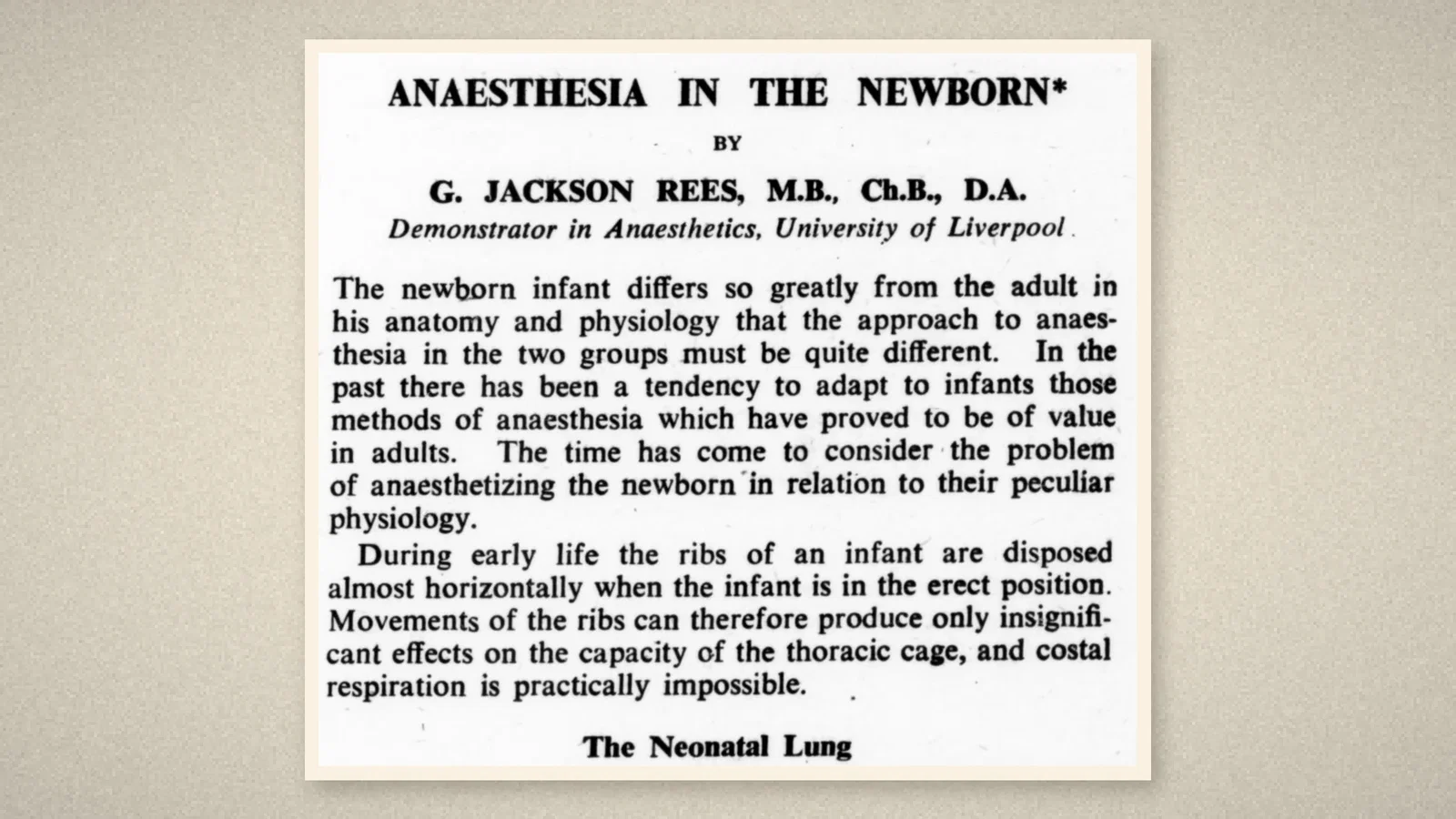
Rees set out the differences. The infant's ribs lie almost horizontally, so costal respiration is practically impossible. [1, p. 1419] The trachea is a quarter or a fifth of the adult's diameter; if flow followed Poiseuille's law, an increase in flow that raised an adult's resistance by x would raise the infant's by 256x, so a technique should not increase the minute volume and should reduce the work of breathing. [1, p. 1420] Because the infant's muscle tone is slight, the lungs could be inflated at "surprisingly low pressures", and the lightly anaesthetised infant behaved like a curarised adult, so breathing was easily controlled. [1, p. 1420] On these grounds Rees judged relaxants contraindicated in the newborn and had abandoned them, rejected cyclopropane because of greater bleeding and post-operative shock, and chose diethyl ether, provided that its effect on breathing was reduced by controlled respiration. [1, p. 1420]
The apparatus
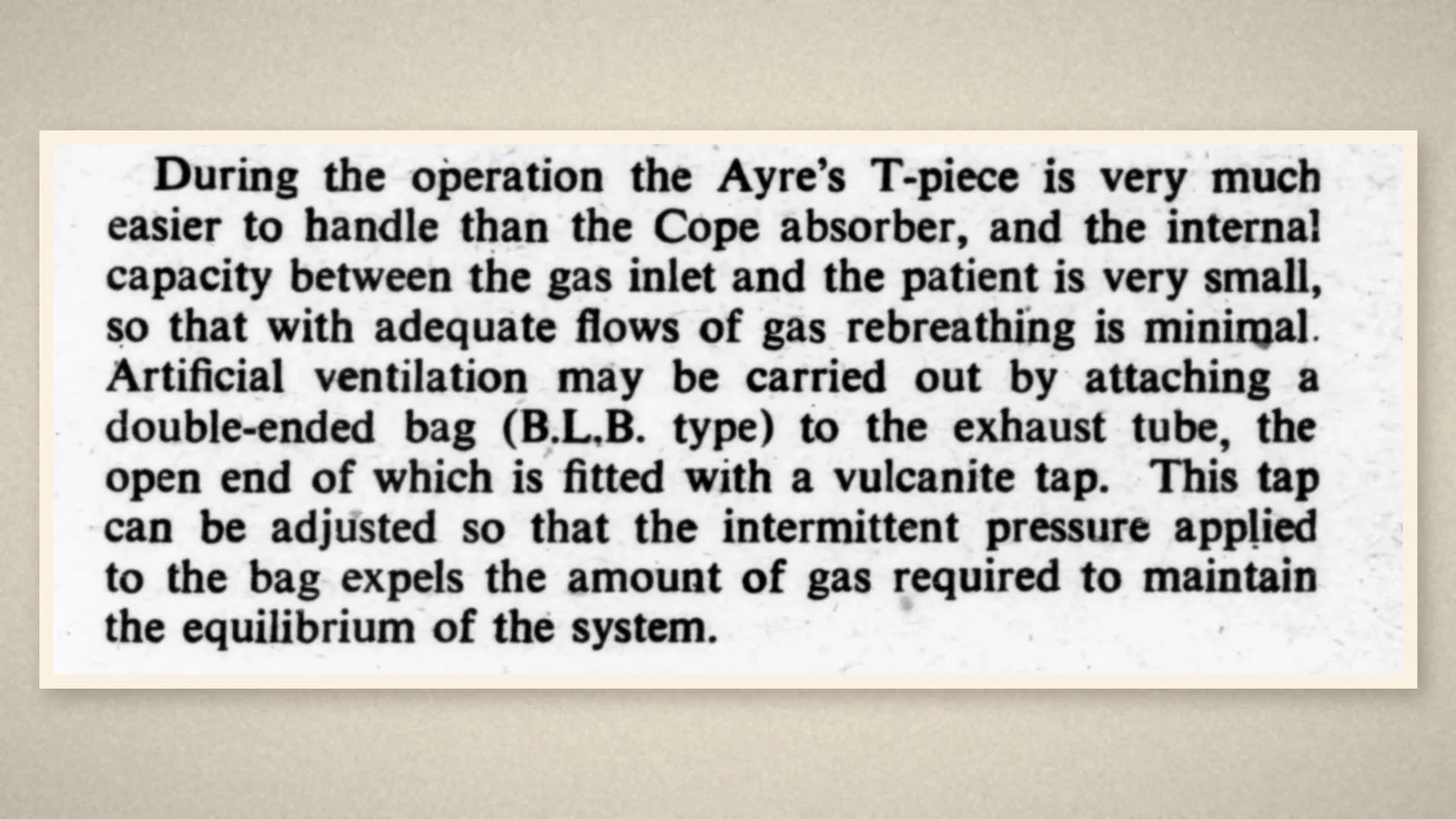
The only suitable standard carbon dioxide absorber, Cope's small Waters canister, had too much internal capacity between the patient and the soda lime, and was awkward to place. "During the operation the Ayre's T-piece is very much easier to handle than the Cope absorber," Rees wrote; its internal capacity between gas inlet and patient was very small, so that with adequate flows rebreathing was minimal. Then the addition: "Artificial ventilation may be carried out by attaching a double-ended bag (B.L.B. type) to the exhaust tube, the open end of which is fitted with a vulcanite tap." The tap was adjusted so that each squeeze expelled the gas needed to keep the system in equilibrium. [1, p. 1421]
The routine
Rees had adopted a routine for thoracic and abdominal operations on newborn infants. The baby came to theatre in a gamgee jacket and bonnet with the limbs bound in cotton wool, with an intravenous drip and, if obstructed, a gastric tube, and lay on an electric pad. Induction was under a Schimmelbusch mask: oxygen at 2 litres a minute for a minute, then 100 ml of carbon dioxide a minute, then ether "to the limit of the patient's tolerance". [1, p. 1421] The largest possible endotracheal tube was inserted and joined by the shortest possible tubing to the T-piece; the flow was a 50% oxygen and nitrous oxide mixture at 3-4 litres a minute, with ether just enough to prevent movement. [1, p. 1421] When the incision was made, respiration was "brought under control by intermittent positive pressure applied by squeezing the bag", and the child was "kept from spontaneous breathing throughout the operation". The ether was turned off every 20 minutes until the limbs moved, to keep anaesthesia light. [1, p. 1421] The babies, Rees reported, appeared to be in much better condition afterwards than those allowed to breathe spontaneously, there seemed to be rather less bleeding, and "the surgeon is unhampered by respiratory activity". [1, p. 1422]
The journal's view
A leading article in the same issue took up the theme. With surgery for congenital abnormalities advancing, "more newborn infants are likely to be operated on than a few years ago", and anaesthetists needed a technique that overcame the resistance of the infant's air passages, "avoids excessive rebreathing", and maintained light anaesthesia. The writer repeated Rees's point that, because muscle tone is slight, the infant's lungs could be ventilated at very low pressures. [1, p. 1433]
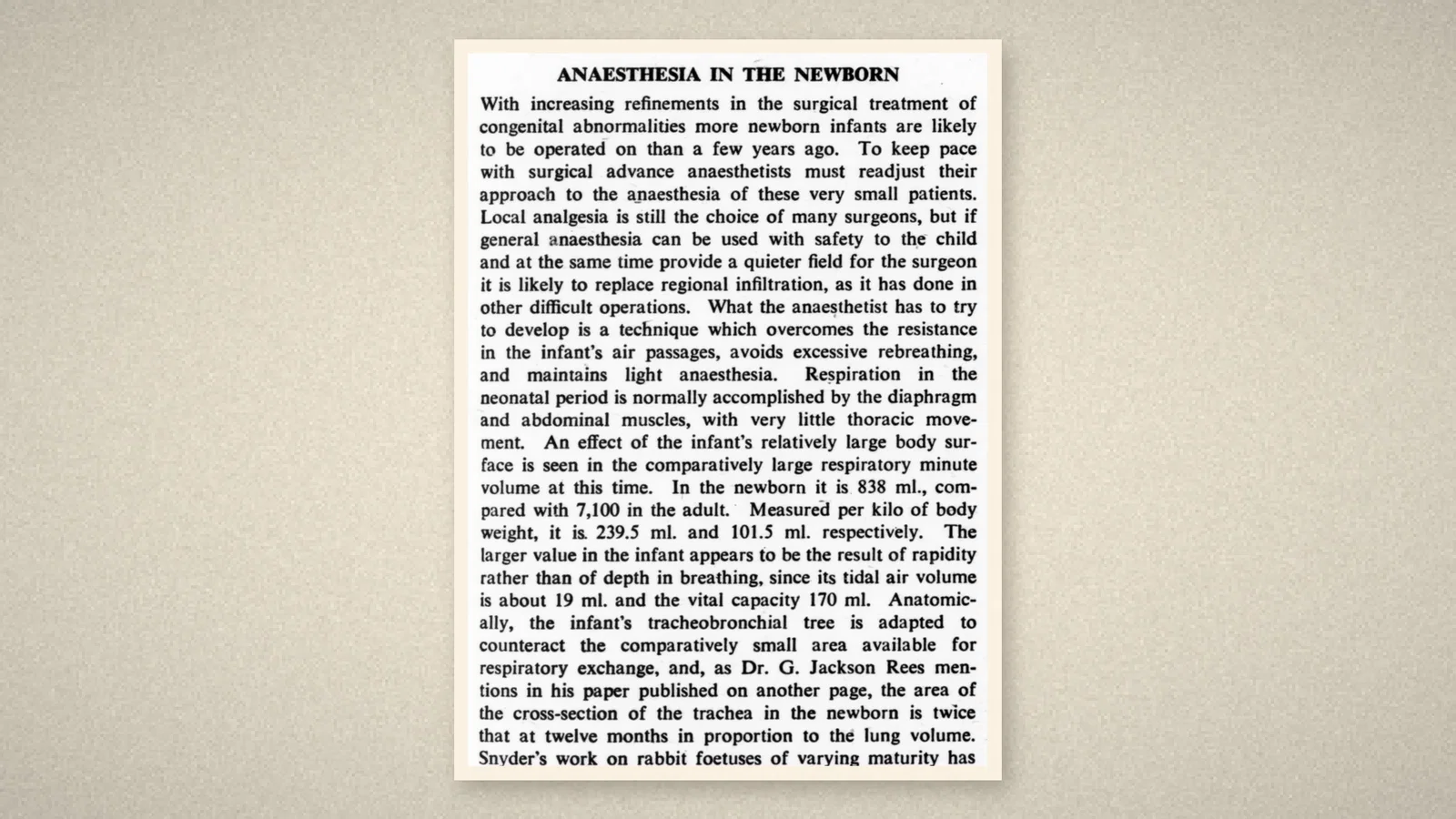
What the record shows
The 1950 paper began with the infant's ribs, trachea and muscles and ended with a bag. The bag let the anaesthetist control breathing through a valveless, low-volume system, at light ether anaesthesia and without relaxants. Rees offered impressions rather than numbers, and the name later attached to the arrangement is not in the paper.
Sources and reading limits
Read: G. Jackson Rees, "Anaesthesia in the newborn", BMJ 23 December 1950, pp. 1419-1422, and the leading article on p. 1433 of the same issue.
Not covered: Ayre's own papers of 1937 (covered in the existing article on the T-piece) were not re-read for this article, nor were Rees's later papers or later descriptions of the "Jackson Rees modification". The 1950 paper has no illustration of the apparatus and gives no numbers of patients, complications or deaths; the drawn schematic follows its text only and is not to scale. Its physiological figures are Rees's own, with the sources Rees cited.
One illustration is a schematic drawn from the paper; three are crops of its pages.
- Rees GJ. Anaesthesia in the newborn. Br Med J. 1950;2(4694):1419-22; and Anaesthesia in the newborn [leading article]. Br Med J. 1950;2(4694):1433. Internet Archive
Continue exploring
Related reading connects shared questions and contexts; it does not by itself establish historical influence.
- 1937: Ayre's T-Piece Eases the Apparatus Burden on Infant Breathing
- 1949: Decamethonium and Gallamine Tried in Man
Anesthesia Epochs · The Source Room · About & Editorial Method
Published November 2, 2026. Sources and reading limits are stated above. Illustrations are labelled as original source images or AI-made. Historical accounts are educational; they are not current treatment instructions.