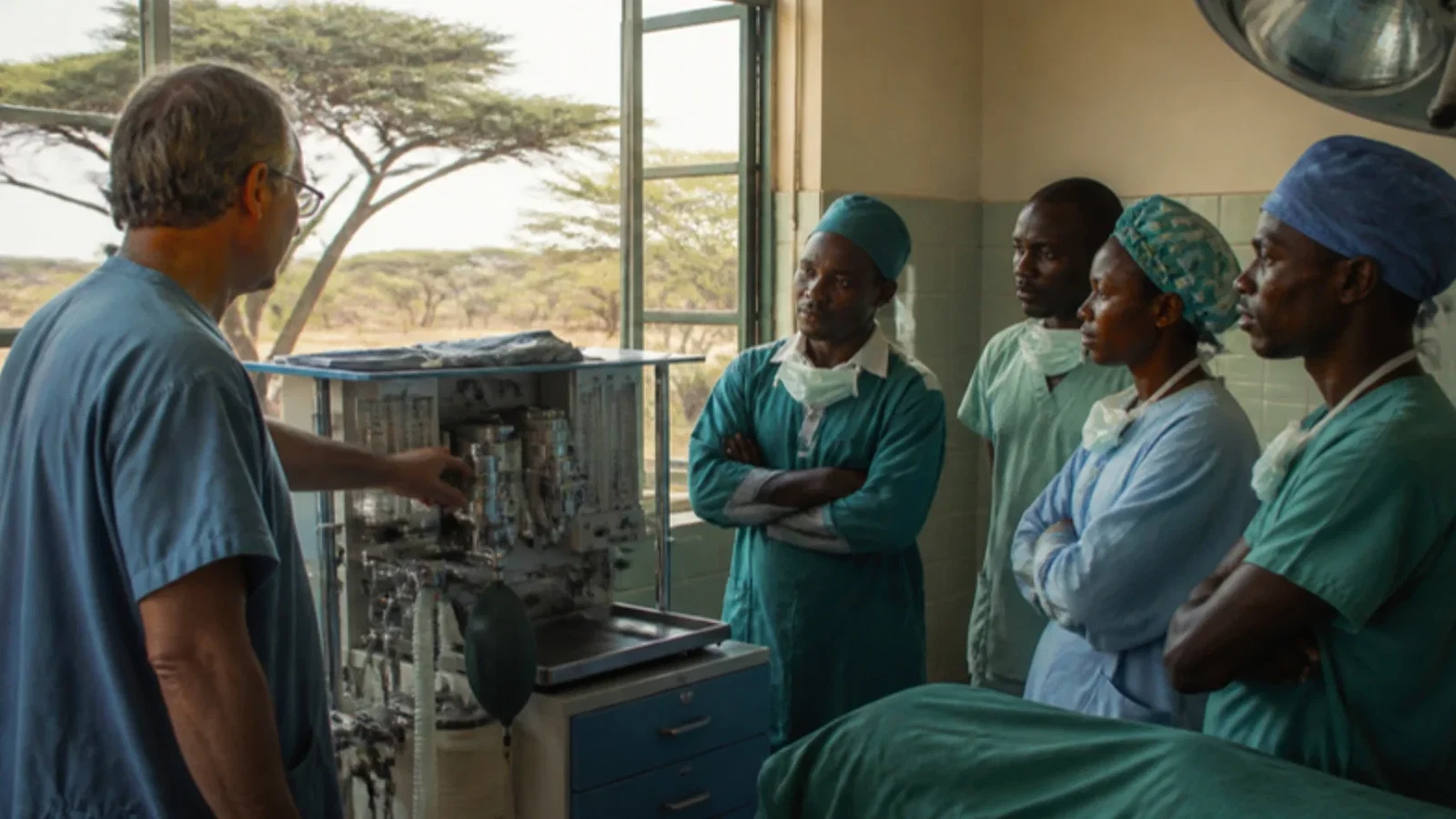
Convinced that East Africa was performing only about 15 percent of the surgery it needed because there were too few anaesthetists, a former Yale chairman of anaesthesiology persuaded the American Society of Anesthesiologists to send volunteer teachers, one at a time, to two African training programmes, under rules written with African colleagues.
Reading Library · Anesthesia Epochs · 中文版
Watch the education video (for clinicians)
1990: Nicholas Greene's Overseas Teaching Program · Anesthesia Epochs Education Series
"The Overseas Teaching Program (OTP) was founded by Nicholas M. Greene, M.D., in 1990," says the American Society of Anesthesiologists (ASA) today. Its purpose was to have anaesthesiologists teach anaesthesia providers in Africa, where trained anaesthesiologists were scarce. [4] Greene (1922-2004) had founded Yale's section of anaesthesiology in 1955, chaired it until 1973, and edited both Anesthesia and Analgesia and Anesthesiology. [6, p. 84; 1, p. 30] Greene announced the programme in Anesthesiology in January 1990 and described it in the Yale Journal of Biology and Medicine in 1991; only the records of those two articles could be read here. [2, 3] The fullest account is the one Greene wrote for the Yale alumni magazine in the summer of 1993, and this article follows it. [1]
What Greene saw
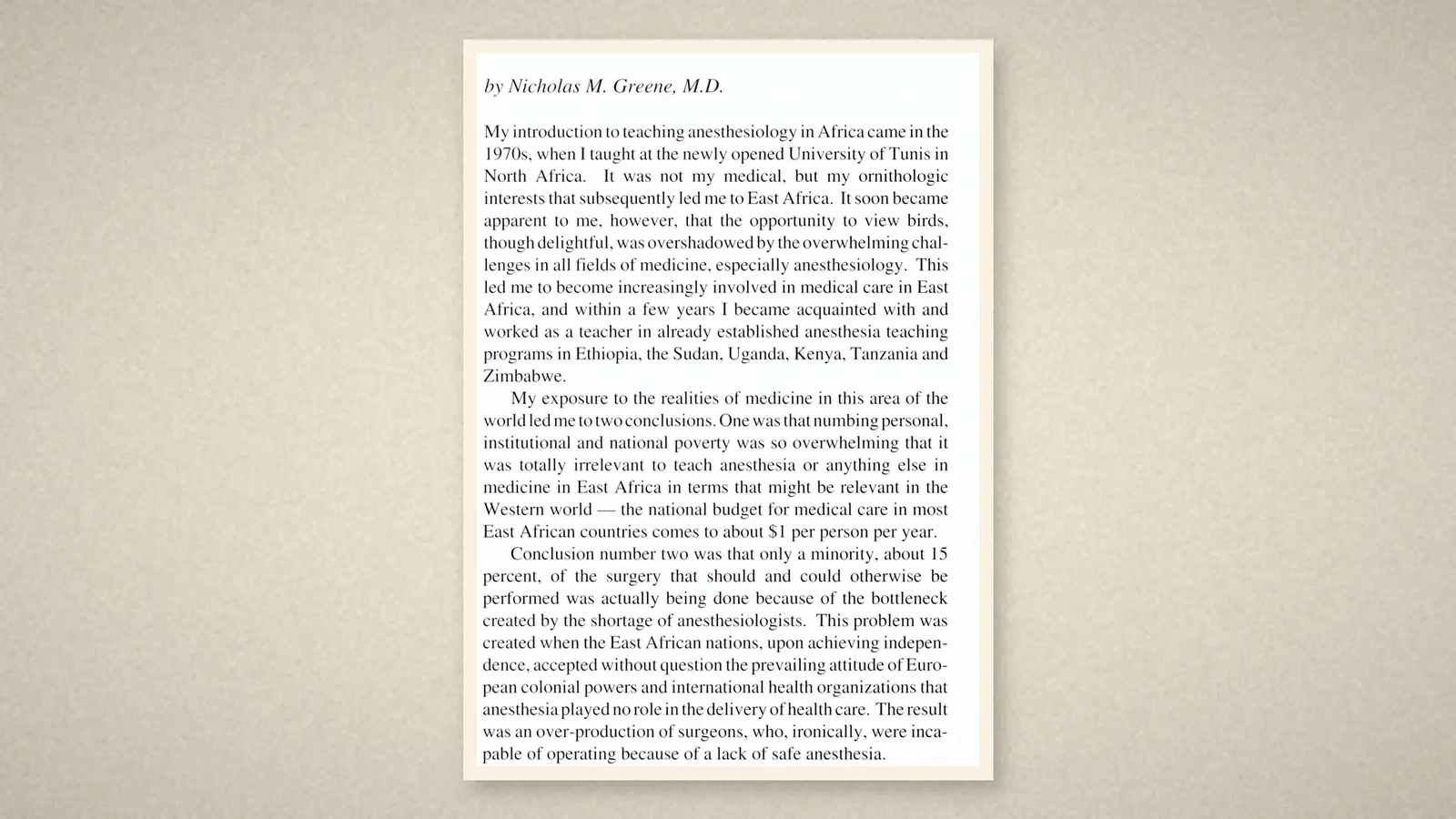
Greene first taught anaesthesia in Africa at the University of Tunis. Ornithology, not medicine, later drew Greene to East Africa, and Greene went on to teach in established anaesthesia programmes in Ethiopia, the Sudan, Uganda, Kenya, Tanzania and Zimbabwe. [1, p. 30] Two conclusions followed. Poverty was so great that the national budget for medical care in most East African countries came to "about $1 per person per year", so it was pointless to teach anaesthesia in terms that might suit the Western world. And "only a minority, about 15 percent, of the surgery that should and could otherwise be performed was actually being done", because of the shortage of anaesthetists. [1, p. 30] In Greene's account, newly independent states had accepted the view of colonial powers and international health organisations that anaesthesia played no role in health care. The result was "an over-production of surgeons, who, ironically, were incapable of operating because of a lack of safe anesthesia". [1, p. 30]
A programme designed in Africa
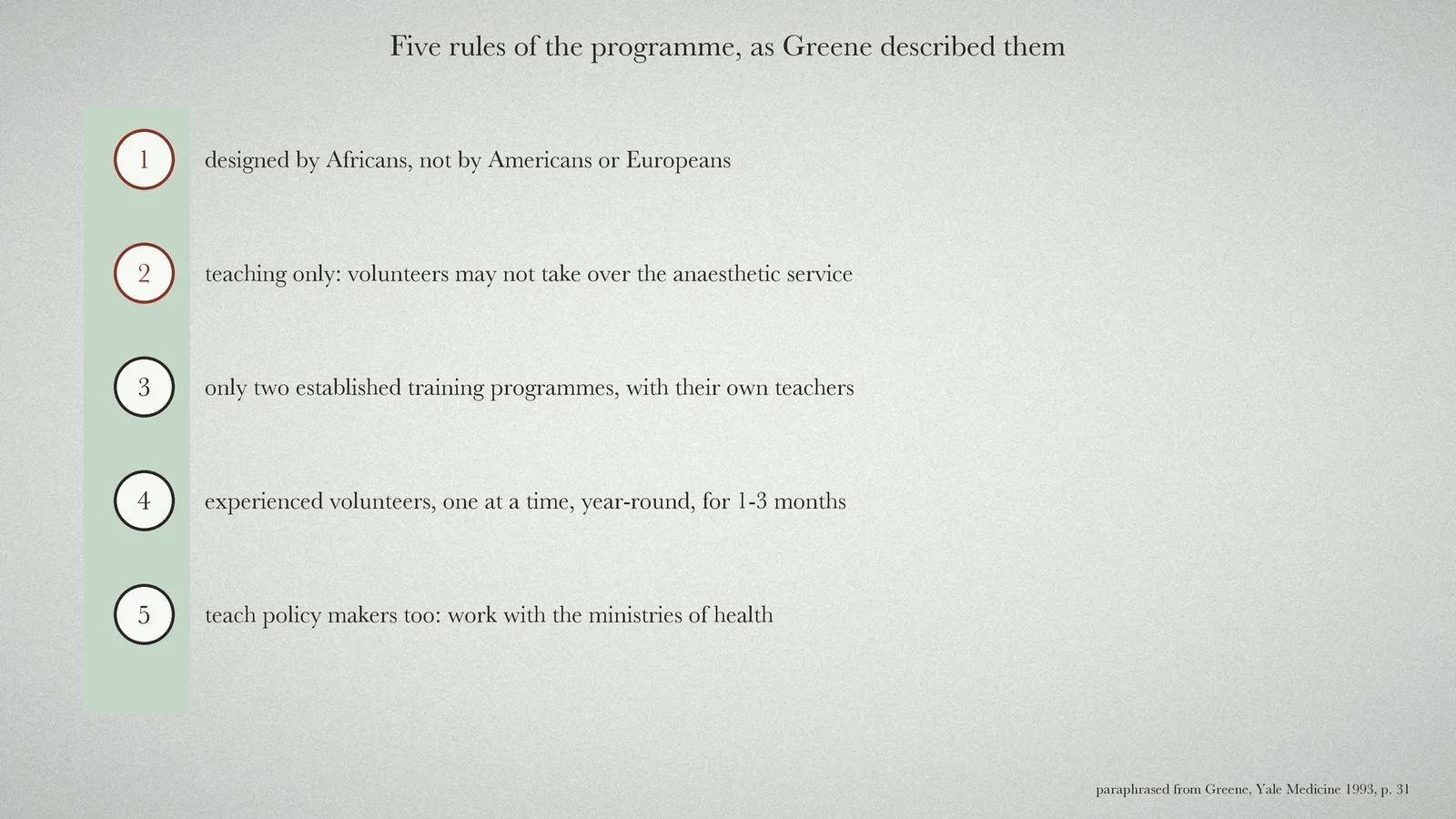
Greene proposed to African colleagues that, instead of teaching alone and intermittently, Greene should build "a large, continuous teaching program designed along lines that the African leaders in anesthesia thought would be best". The colleagues agreed, and the programme was sponsored by the ASA and the Foundation for Anesthesia Education and Research (FAER). [1, p. 30] Greene listed what made it unusual. It was designed by Africans. It concentrated on teaching, and instructors were forbidden to take over the giving of anaesthetics. It worked with only two established training programmes. Experienced American and Canadian volunteers served one at a time, all year round. And it set out to educate policy makers, so Greene worked closely with ministries of health. [1, p. 31] Volunteers got a tourist-class air fare, $10 a day and simple lodging, did their own shopping and cooking, and stayed for one to three months. Each new volunteer arrived four days early to be briefed by the one leaving. [1, p. 31]
Lusaka and Moshi
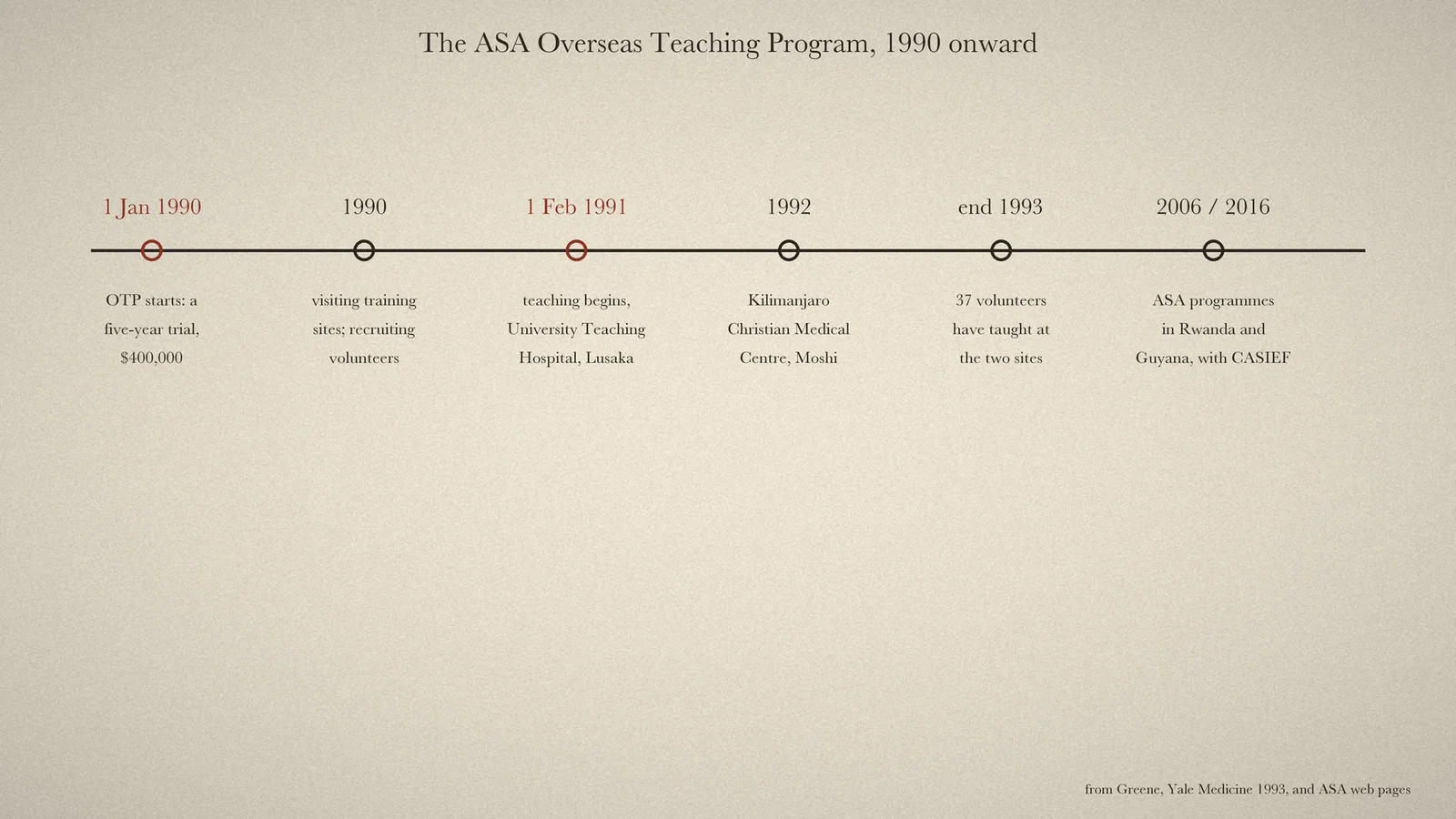
The OTP ran as a five-year trial under an ASA committee of six anaesthesiologists, chaired by Greene. It cost $400,000: $275,000 for volunteers' expenses through FAER and $125,000 for administration through the ASA. [1, p. 31] "On January 1, 1990, OTP started on its five-year course." The first year was spent visiting every anaesthesia training programme in East Africa, setting up an administration and recruiting volunteers. [1, p. 31] On 1 February 1991 the first volunteers began teaching at the University of Zambia's Teaching Hospital in Lusaka, a 1,500-bed hospital where they taught medical students, doctors entering anaesthesia and anaesthetic officers. A year later teaching began at Kilimanjaro Christian Medical Centre in Moshi, Tanzania, a 420-bed referral hospital where the volunteers taught only paramedical anaesthetic staff. [1, pp. 31-32]
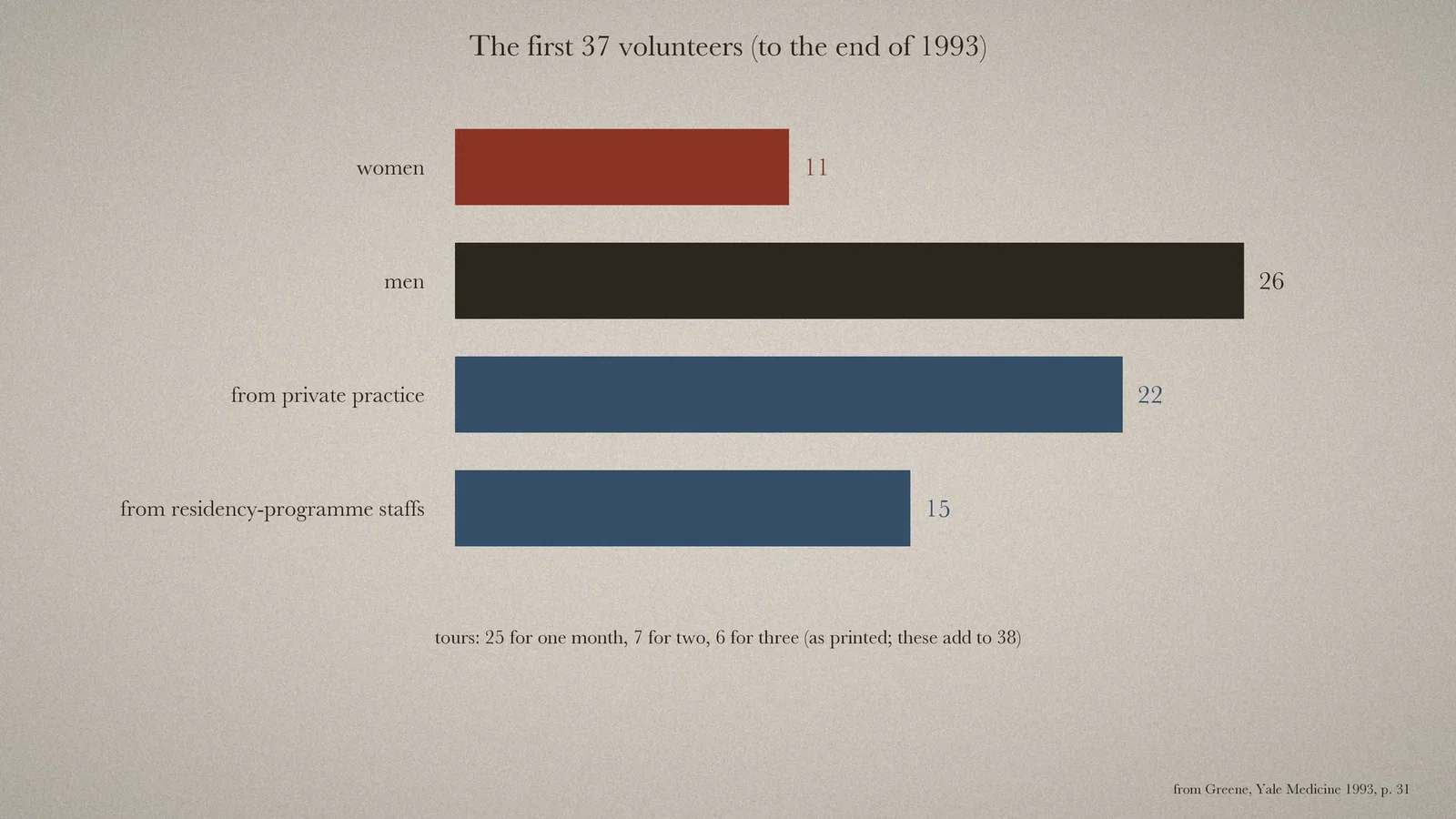
By the end of 1993, Greene wrote, 37 volunteers would have taught at the two hospitals. Eleven were women, and 22 came from private practice. [1, p. 31] The figures Greene gives for length of service (25 for one month, 7 for two, 6 for three) add up to 38, not 37. [1, p. 31] At Lusaka, three Zambian doctors began anaesthesia training at home when the programme started, "the first Zambian doctors" to do so, and the OTP helped the Ministry of Health and the University of Zambia approve a specialist Master of Medicine (MMed) course in anaesthesiology. [1, p. 32] Greene argued that African doctors could and should be trained in Africa. Training them in Europe often meant they stayed there, and taught them techniques irrelevant at home. [1, p. 32]
What came after
The trial was due to end in December 1994, when an ad hoc committee was to recommend its future to the ASA. [1, p. 31] According to the ASA, the OTP went on to support education programmes in Tanzania, Ghana, Zambia and Rwanda. Two remain: a programme in Rwanda established in 2006 and one in Guyana established in 2016, both run with the Canadian Anesthesiologists' Society International Education Foundation (CASIEF). [4] The ASA's Charitable Foundation writes that "for decades" the society has supported anaesthesia education in remote African hospitals through the programme. [5]
What the record shows
Greene's programme was built on the idea that the bottleneck in East African surgery was a shortage of people who could give anaesthetics. Its answer was to send teachers, not providers, into programmes run by Africans. The rule that volunteers must not take over the service was meant to make sure the teaching stayed behind when they left.
Sources and reading limits
Read: Greene's article in Yale Medicine, Summer 1993, pp. 30-32, in full; the PubMed records of Greene's 1990 Anesthesiology article (title only) and 1991 Yale J Biol Med article (abstract); the ASA's current Overseas Training Programs and Charitable Foundation pages; the Australian ASA timeline, p. 84.
Not covered: the full texts of the 1990 and 1991 articles; ASA committee records; the 1994 review; reports from the two hospitals. Almost everything here is the founder's own account, written while the trial was still running. The later Ghana sites and the Rwanda and Guyana programmes are mentioned only as the ASA lists them. A photograph of Greene in the 1993 article is not reproduced.
One illustration is a crop of Greene's article; three are drawn from the sources.
- Greene NM. An overseas teaching program in anesthesiology. Yale Medicine. Summer 1993:30-32. Internet Archive
- Greene NM. An A.S.A. (American Society of Anesthesiologists) Overseas Teaching Program. Anesthesiology. 1990;72(1):1-2. PubMed
- Greene NM. Anesthesia in underdeveloped countries: a teaching program. Yale J Biol Med. 1991;64(4):403-7. PubMed
- ASA Charitable Foundation and Committee on Global Health. Overseas Training Programs. Website
- ASA Charitable Foundation. About ASA Charitable Foundation. Website
- Australian Society of Anaesthetists. Anaesthesia History Timeline 2024. PDF
Continue exploring
Related reading connects shared questions and contexts; it does not by itself establish historical influence.
- 1988: A WHO Manual of Anaesthesia for the District Hospital
- 1986: The ASA Founds a Research Foundation
Anesthesia Epochs · The Source Room · About & Editorial Method
Published November 2, 2026. Sources and reading limits are stated above. Illustrations are labelled as original source images or AI-made. Historical accounts are educational; they are not current treatment instructions.