
Asked by a state senator for a cheaper, more humane way to execute, an anaesthesiology department chair proposed an intravenous barbiturate and muscle relaxant; three decades later the specialty's societies told their members not to take part.
Reading Library · Anesthesia Epochs · 中文版
Watch the education video (for clinicians)
1977: Lethal Injection — An Anaesthesiology Chair's Letter · Anesthesia Epochs Education Series
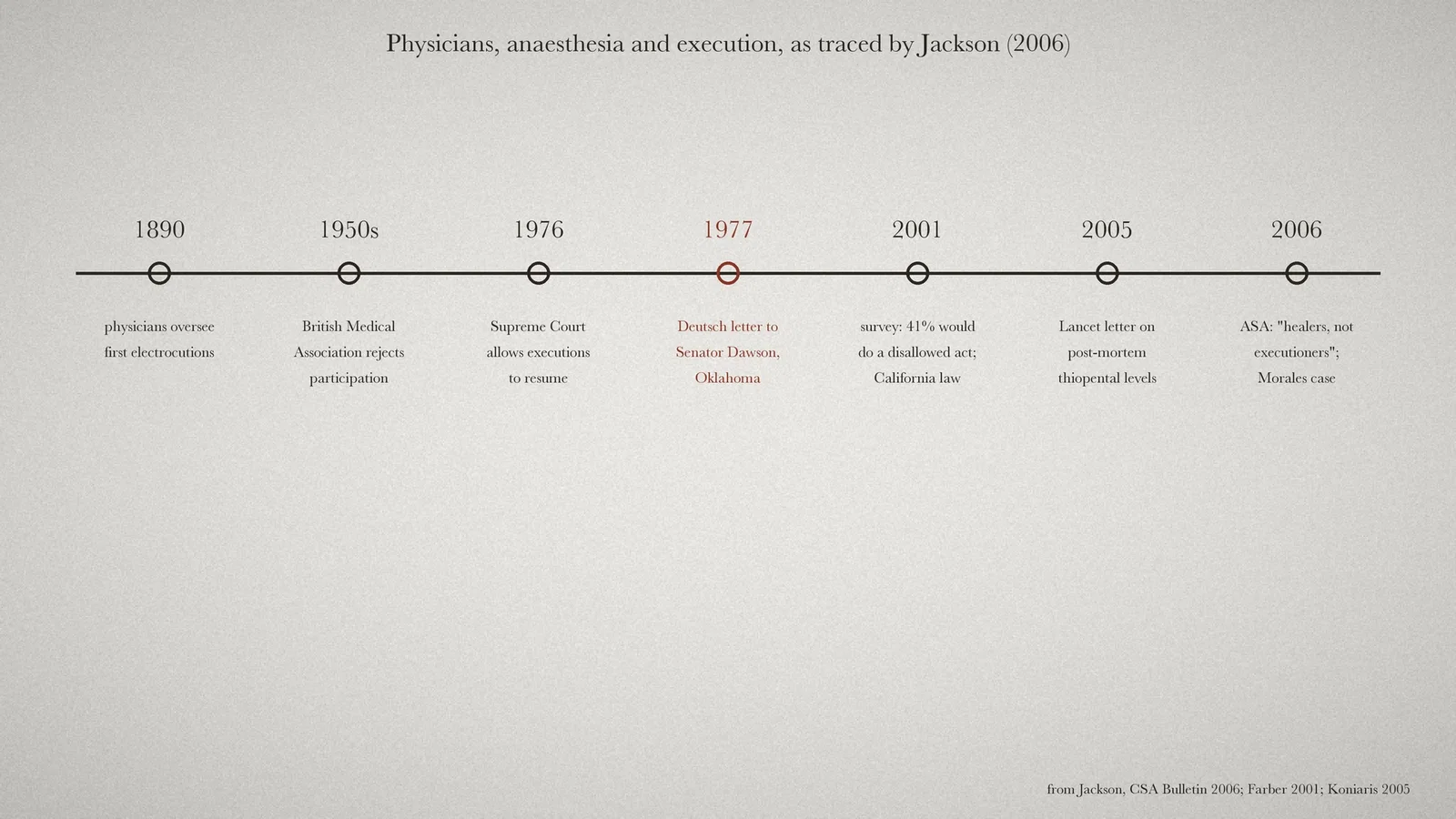
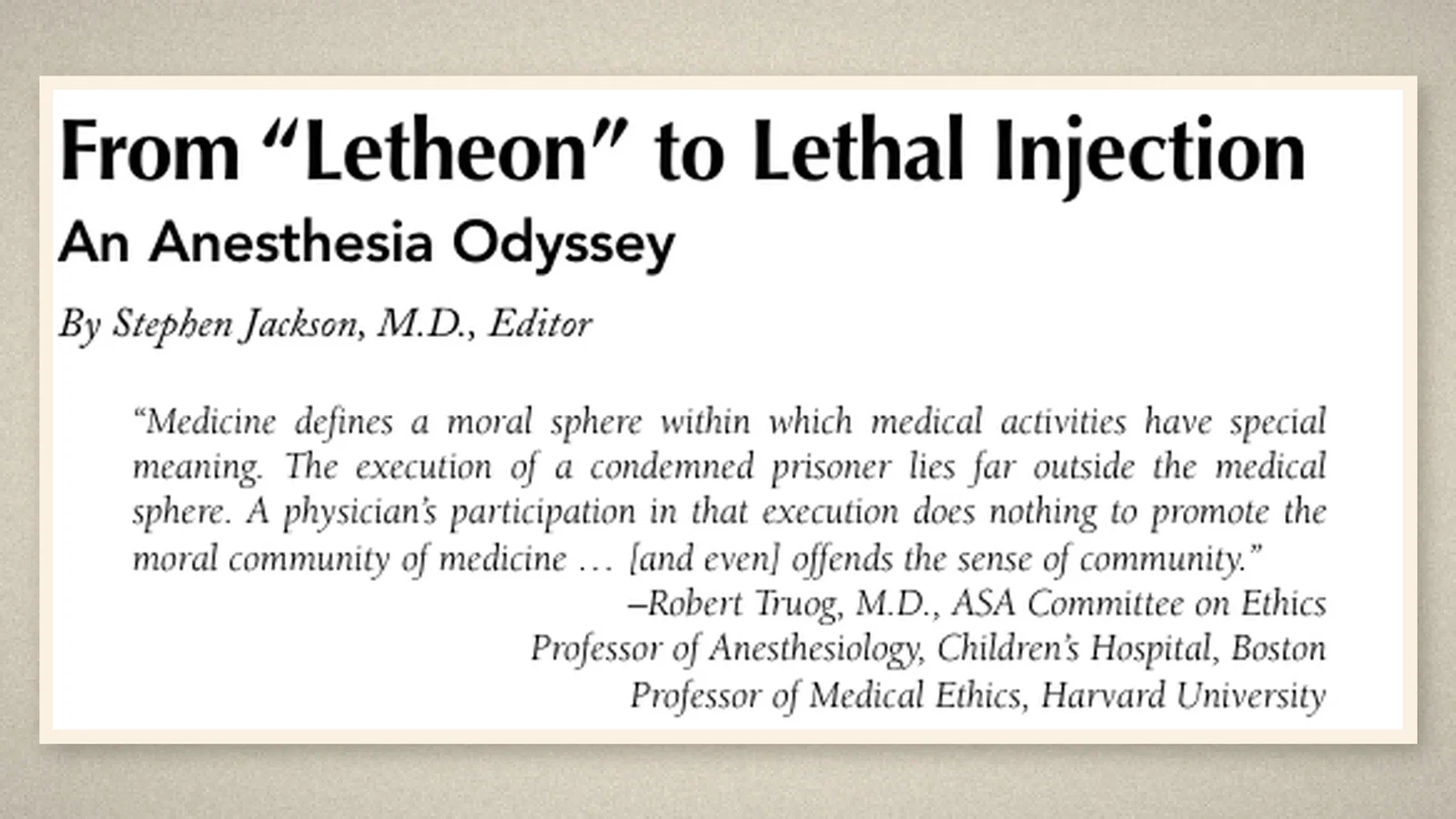
In 2006 Stephen Jackson, editor of the CSA Bulletin, opened an essay with a play on words. "Letheon" was the name given to diethyl ether in its earliest days as a surgical anaesthetic, after Lethe, the river of forgetting in Greek myth. A century and a half later, lethal injection had become "by far the most common way" prisoners were executed in the United States, and it had pulled anaesthesiology onto the front pages. [1] This article follows Jackson's account of how an anaesthetic induction became an execution method in 1977, and of how the specialty's professional bodies answered. Drug doses quoted in that history are not repeated here.
Before 1977
Jackson begins with the search for a "humane" execution. In the late nineteenth century a New York legislative committee considered injection, but the medical profession disapproved and the committee proposed electrocution; in 1890, Jackson notes, physicians oversaw the first electrocutions. [1] In the early 1950s a British Royal Commission raised lethal injection again, and the British Medical Association rejected physician participation. [1] In 1973 the California governor, Ronald Reagan, compared execution to a veterinarian putting down an injured horse. [1] After an informal moratorium from 1967 and a 1972 Supreme Court ruling against the death penalty as then imposed, the Court allowed executions to resume in 1976. [1]
The letter
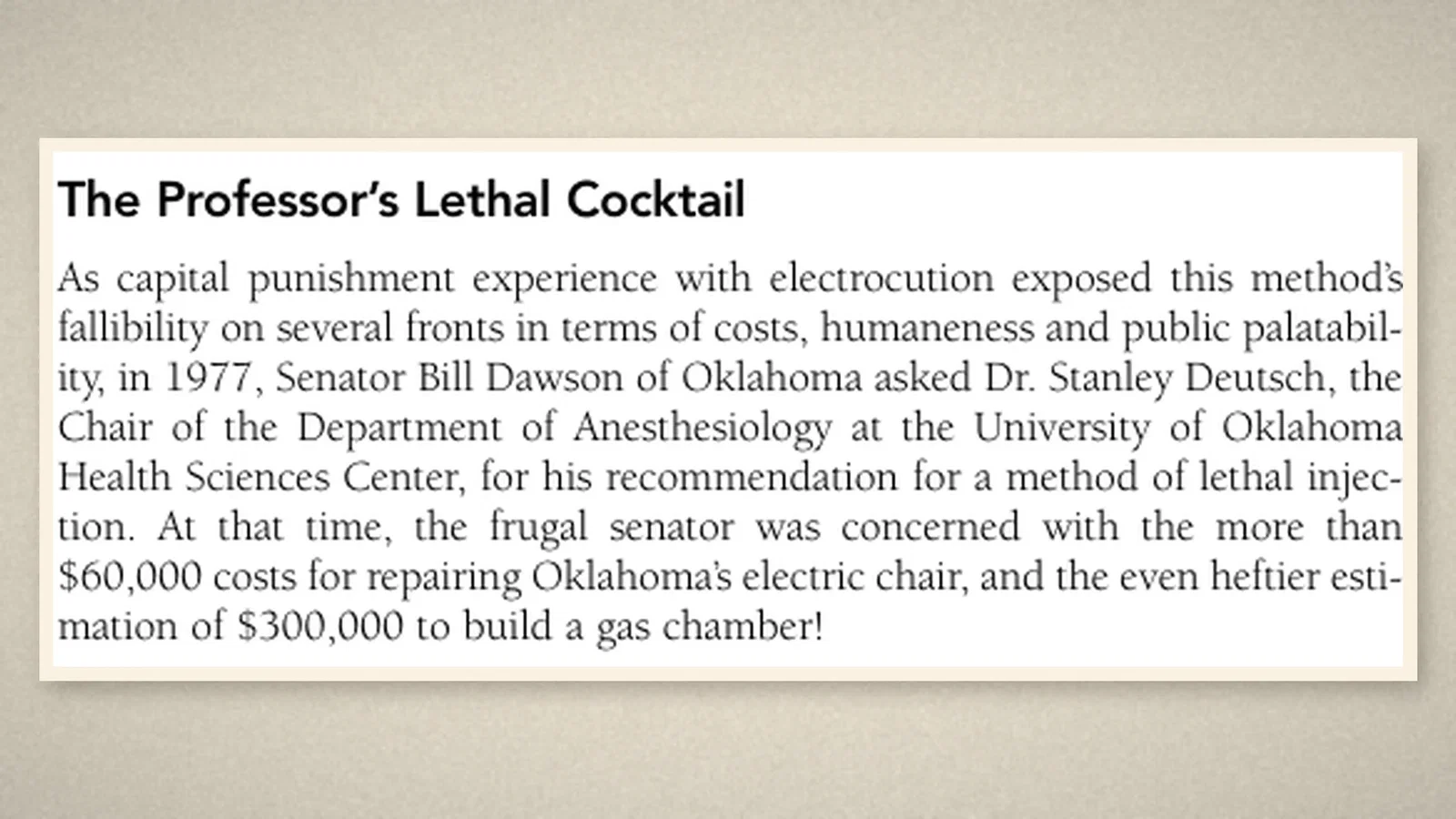
In 1977, Jackson writes, Senator Bill Dawson of Oklahoma, concerned at the cost of repairing the state's electric chair and the higher cost of building a gas chamber, asked Stanley Deutsch, "the Chair of the Department of Anesthesiology at the University of Oklahoma Health Sciences Center", to recommend a method. [1] Deutsch's written answer was that execution by intravenous drugs would be "extremely humane in comparison" with electrocution or poisonous gas, and it named an ultra-short-acting barbiturate followed by a neuromuscular blocking drug. [1] Oklahoma adopted lethal injection; Texas adopted a statute quickly and used the method first; other states followed in varying form, and a third drug, potassium, was later added in some protocols. [1] Jackson reports that Deutsch stood by the 1977 letter in an interview as late as 2003. [1]
The profession's codes
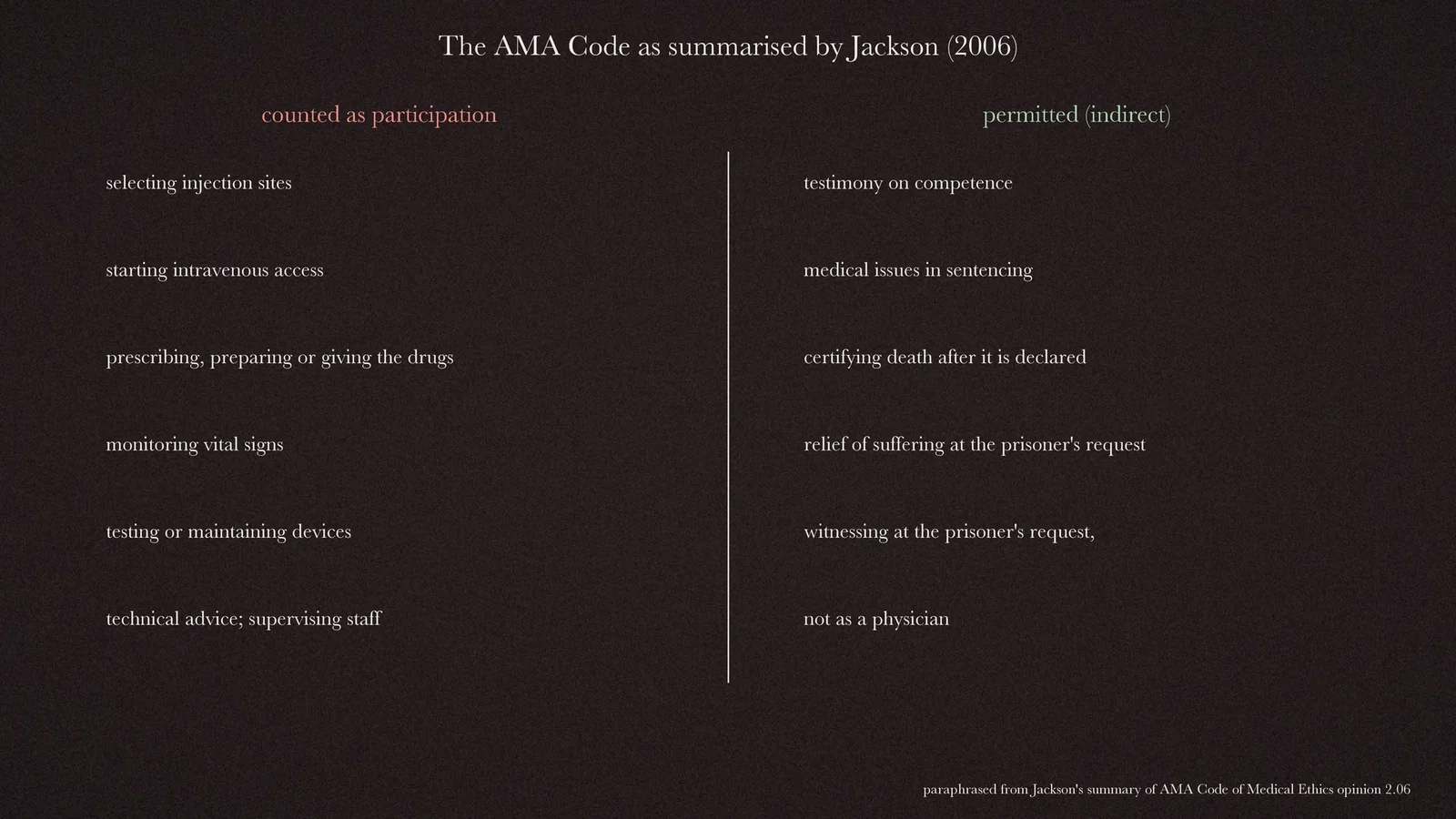
Jackson sets out the ethical problem as a conflict between beneficence and nonmaleficence: an anaesthesiologist's skills, used at an execution, serve purposes other than the welfare of the person receiving the drugs. [1] The American Medical Association's Code of Medical Ethics stated that a physician "should not be a participant in a legally authorized execution", and listed what counted: selecting injection sites, starting intravenous access, prescribing or administering the drugs, monitoring, maintaining devices and advising staff. [1] It allowed indirect roles such as testimony on competence or certifying death after it had been declared. [1] The ASA's own guidelines did not address execution directly, so the ASA issued a statement endorsing the AMA position: "Physicians are healers, not executioners." [1] The California Society of Anesthesiologists said it was "unequivocally opposed" to its members' participation. [1]
Knowledge of these rules was thin. A 2001 survey of 1,000 randomly selected physicians found that 41 per cent would perform at least one action the AMA disallowed, and only 3 per cent knew of any guidelines. [3]
2005-2006
In 2005 a research letter in The Lancet reported that executioners in Texas and Virginia had no anaesthesia training and that post-mortem thiopental concentrations in 21 of 49 executed inmates were "consistent with awareness". [2] Jackson called the evidence "controversial and possibly flawed", and noted published critiques that most samples had been drawn many hours after death. [1] In California the letter fed the challenge to the planned execution of Michael Morales. A federal judge required either expert medical personnel to ensure the prisoner was unconscious, or a change of drugs; the two anaesthesiologists scheduled to attend withdrew, saying intervention "would be medically unethical", and executions in California stopped while the case continued. [1]
What the record shows
The anaesthesia link to lethal injection began with one specialist's letter answering a cost problem, and grew because anaesthetic drugs seemed to make killing look medical. By 2006 the specialty's answer, stated by the AMA, ASA and CSA, was that its knowledge belonged to patients. Jackson's essay records that answer at the moment it was tested.
Sources and reading limits
Read: Jackson's ten-page 2006 essay in the CSA Bulletin (text-layer PDF archived from the California Society of Anesthesiologists website, with page images); the PubMed abstracts of Koniaris et al. (2005) and Farber et al. (2001); the PubMed citation of Truog and Brennan (1993). [4]
Not covered: Deutsch's 1977 letter itself, known here only through Jackson's quotations; the Oklahoma statute; the original AMA and ASA texts; the full Lancet letter and its critiques; court records of the Morales case; events after spring 2006. Doses in the 1977 letter are omitted deliberately. Jackson's assessment of the Lancet letter is Jackson's; the letter's own abstract is reported alongside it.
Two illustrations are crops of Jackson's essay; two are drawn from it and the cited studies.
- Jackson S. From "Letheon" to lethal injection: an anesthesia odyssey. CSA Bull. 2006 Spring:23-32. Internet Archive PDF
- Koniaris LG, Zimmers TA, Lubarsky DA, Sheldon JP. Inadequate anaesthesia in lethal injection for execution. Lancet. 2005;365(9468):1412-4. PubMed
- Farber NJ, Aboff BM, Weiner J, Davis EB, Boyer EG, Ubel PA. Physicians' willingness to participate in the process of lethal injection for capital punishment. Ann Intern Med. 2001;135(10):884-8. PubMed
- Truog RD, Brennan TA. Participation of physicians in capital punishment. N Engl J Med. 1993;329(18):1346-50. PubMed
Continue exploring
Related reading connects shared questions and contexts; it does not by itself establish historical influence.
Anesthesia Epochs · The Source Room · About & Editorial Method
Published November 2, 2026. Sources and reading limits are stated above. Illustrations are labelled as original source images or AI-made. Historical accounts are educational; they are not current treatment instructions.