A researcher in the Nuffield Department writes a 640-page history for the anaesthesia centenary, telling the story of inhalation anaesthesia from 1846 to 1900 in the words of its own literature.
Reading Library · Anesthesia Epochs · 中文版
Watch the education video (for clinicians)
1947: Barbara Duncum — The Development of Inhalation Anaesthesia · Anesthesia Epochs Education Series
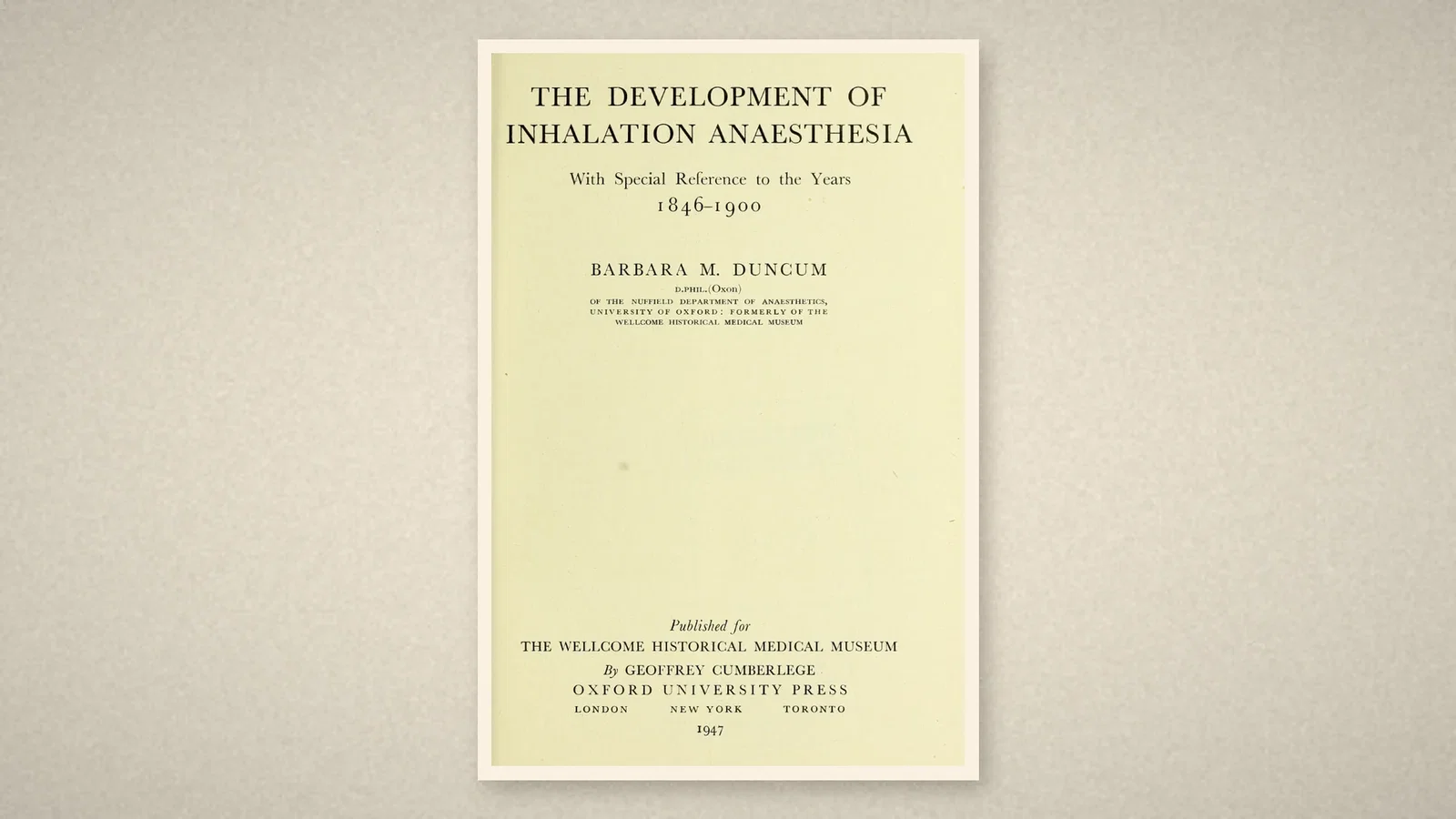
The history of anaesthesia is now a discipline with its own society, journals and archives, and its writers are expected to go back to the original literature. In 1947 that approach had an important example: Barbara M. Duncum, of the Nuffield Department of Anaesthetics at Oxford, published the 640-page The Development of Inhalation Anaesthesia. This article rests on the book itself (its jacket, title page, frontispiece, preface and contents) and on the review in the British Journal of Anaesthesia that July.
The book
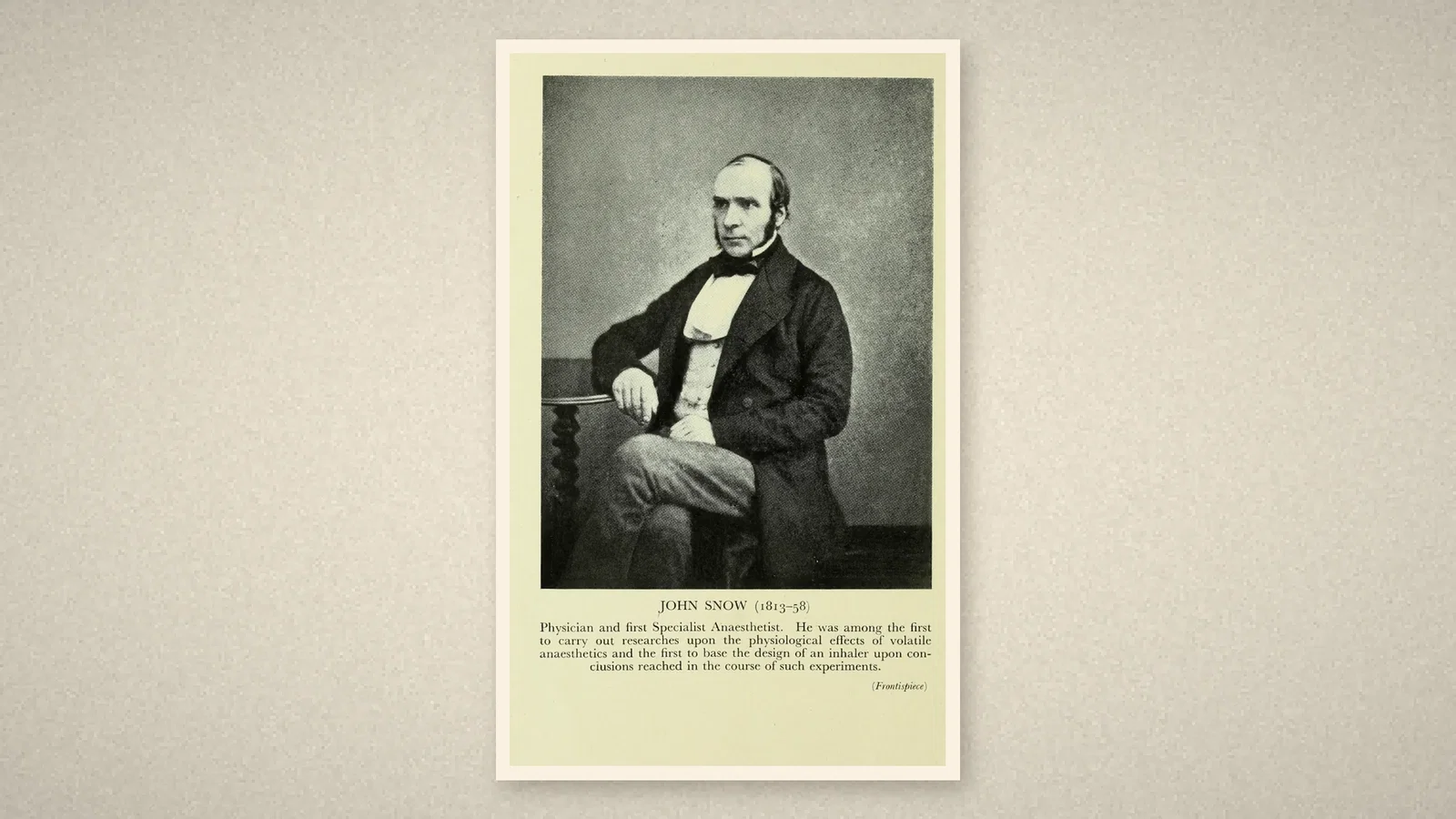
The title page reads The Development of Inhalation Anaesthesia, "With Special Reference to the Years" 1846–1900, by Barbara M. Duncum, D.Phil. (Oxon), "of the Nuffield Department of Anaesthetics", University of Oxford, formerly of the Wellcome Historical Medical Museum, published for "the Wellcome Historical Medical Museum by Geoffrey Cumberlege", Oxford University Press, 1947. [1, title page] It was the second title in the "Publications of the Wellcome Historical Medical Museum" new series. [1, series page] Its frontispiece is a photograph of John Snow (1813–1858), "Physician and first Specialist Anaesthetist", among the first to study the physiological effects of volatile anaesthetics and the first to design an inhaler from the results. [1, frontispiece]
Two aims in the preface
"My first aim in writing this book has been to trace" the beginnings and development of the concepts and practices that made up the science and art of inhalation anaesthesia, Duncum wrote. The search went back into the seventeenth and eighteenth centuries and forward into the twentieth, but the book was chiefly concerned with "the period between the winter of 1846 and the end of the year 1900", the first phase of modern anaesthetic history, when inhalation was "considered to be by far the most important" means of anaesthesia and almost the only one used; in the second phase, still continuing, inhalation had become "only one of several accredited methods". [1, p. vii]
"My secondary aim has been to show" how beliefs and events that seemed unconnected with anaesthesia had affected its evolution. To do so, Duncum chose to "build up the history in a series of quotations" from British, American and Continental literature: journals, year-books, the proceedings of societies, theses, textbooks and monographs, and "manuscript notes and letters in the possession of the Nuffield" Department and the Wellcome Museum. [1, p. vii]
Working in the Nuffield Department had made the research possible, the preface says, and Duncum was "grateful to Professor R. R. Macintosh" and colleagues; the centenary year of the general adoption of anaesthesia in surgery seemed a fit time for the history. The preface also mourns A. W. Haggis of the Wellcome Museum, "whose sudden death in April of this year" was a deep loss. [1, p. viii] The jacket stressed the book's "frequent citation of contemporary records" and original correspondence. [1, jacket]
Six parts, eighteen chapters
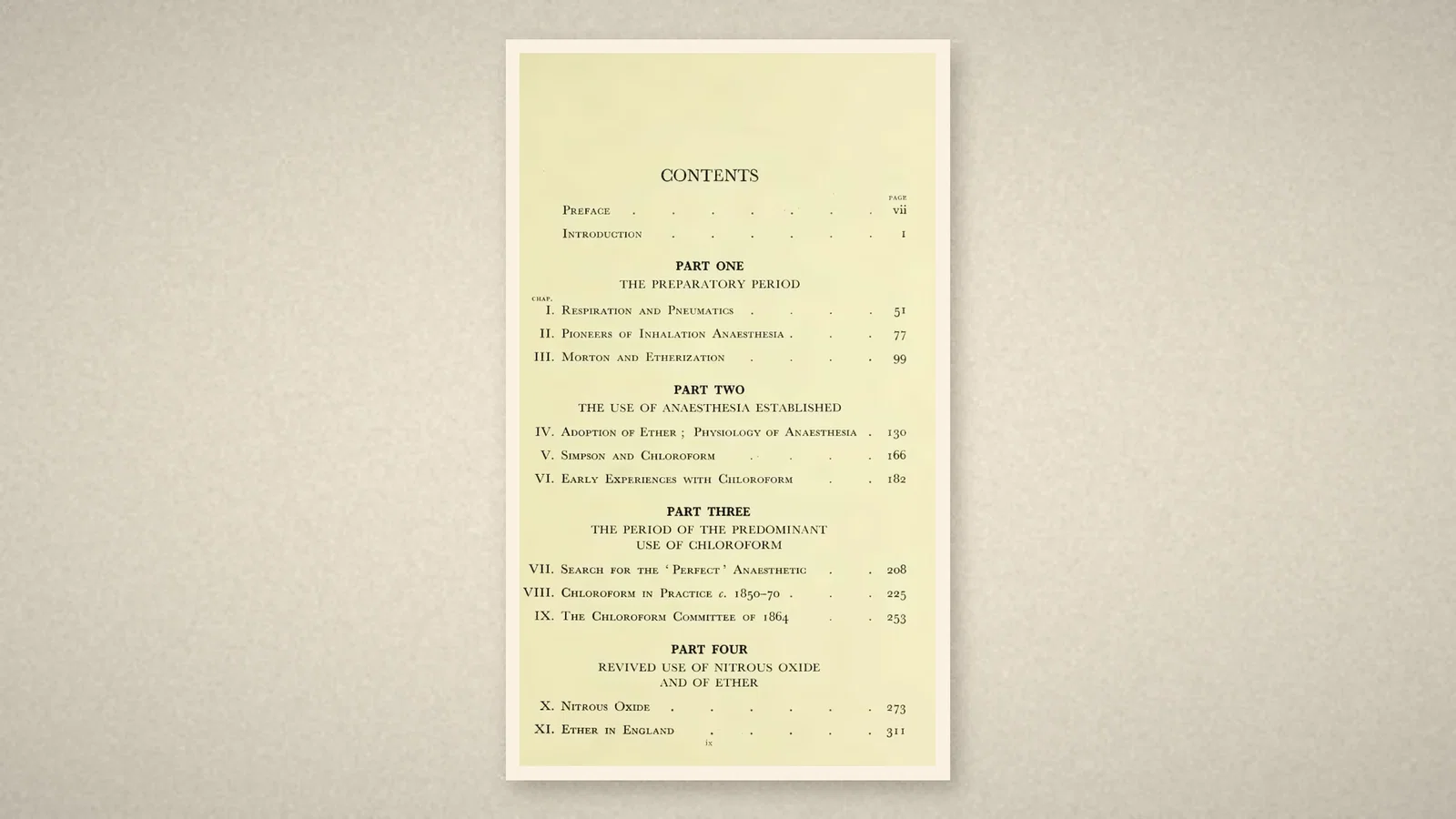
The contents list six parts: the preparatory period (respiration and pneumatics, pioneers, Morton and etherization); the establishment of anaesthesia (ether, Simpson and chloroform); the period of chloroform (the search for the "perfect" anaesthetic, chloroform in practice c. 1850–1870, "the Chloroform Committee of 1864"); the revived use of nitrous oxide and ether; Continental developments (Paul Bert, mixed anaesthesia and premedication, ether on trial); and the beginning of modern anaesthesia (the "Hyderabad Commission and its Consequences", English trends, the jubilee). Appendices cover Morton's inhalers, the term "anaesthesia", resuscitation, warm and open ether, and "Intubation and the Growth of Endotracheal" anaesthesia, with a "Summary of Events in Anaesthesia" from 1772 to 1911. [1, contents]
A review the same year
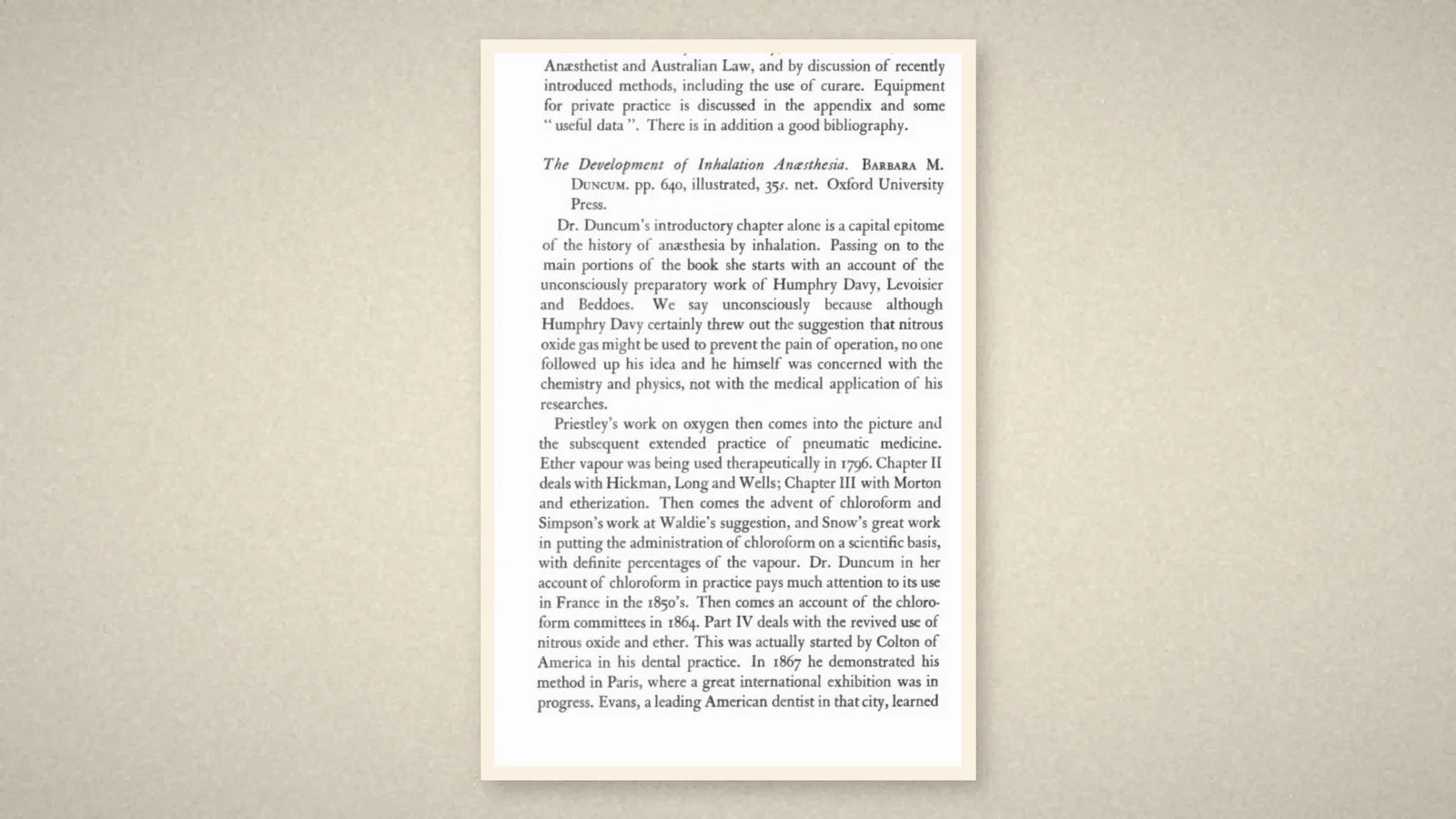
In July 1947 the BJA reviewed the book: "pp. 640, illustrated", 35s. Duncum's introductory chapter alone "is a capital epitome" of the history of inhalation anaesthesia, it said, before following the book from Davy, Lavoisier and Beddoes through Morton, Simpson, Snow's scientific use of chloroform and the Chloroform Committee of 1864 to the revival of nitrous oxide and ether, and Paul Bert's contributions "between 1878 and 1885". "A curious omission in this excellent" and otherwise comprehensive book, the reviewer added, was any account of Magill's work on endotracheal anaesthesia. [2, p. 140–141]
What the record shows
For the anaesthesia centenary, a researcher in the Nuffield Department did not write a hero's tale but tried to rebuild inhalation anaesthesia from 1846 to 1900 in the words of its own time, counting in ideas and events that seemed unrelated. The reviewer admired its comprehensiveness and pointed to the gap left by ending in 1900.
Sources and reading limits
Read: Duncum, The Development of Inhalation Anaesthesia (Oxford University Press, 1947): the jacket, series page, frontispiece, title page, preface (pp. vii–viii) and contents in full; the 640-page body was searched but not read through. The BJA review of July 1947, pp. 140–141, in full.
Not covered: Duncum's later career, the doctoral thesis, other reviews and the 1994 reprint were not used. The book's contents are described only from its own contents list and the review; chapters not read are not summarised.
All four illustrations are pages of the 1947 book and the journal.
- Duncum BM. The development of inhalation anaesthesia, with special reference to the years 1846-1900. London: Oxford University Press for the Wellcome Historical Medical Museum; 1947. Internet Archive
- Review: The development of inhalation anaesthesia, by Barbara M. Duncum. Br J Anaesth. 1947;20(4):140-1. Internet Archive
Continue exploring
Related reading connects shared questions and contexts; it does not by itself establish historical influence.
Anesthesia Epochs · The Source Room · About & Editorial Method
Published November 2, 2026. Sources and reading limits are stated above. Illustrations are labelled as original source images or AI-made. Historical accounts are educational; they are not current treatment instructions.