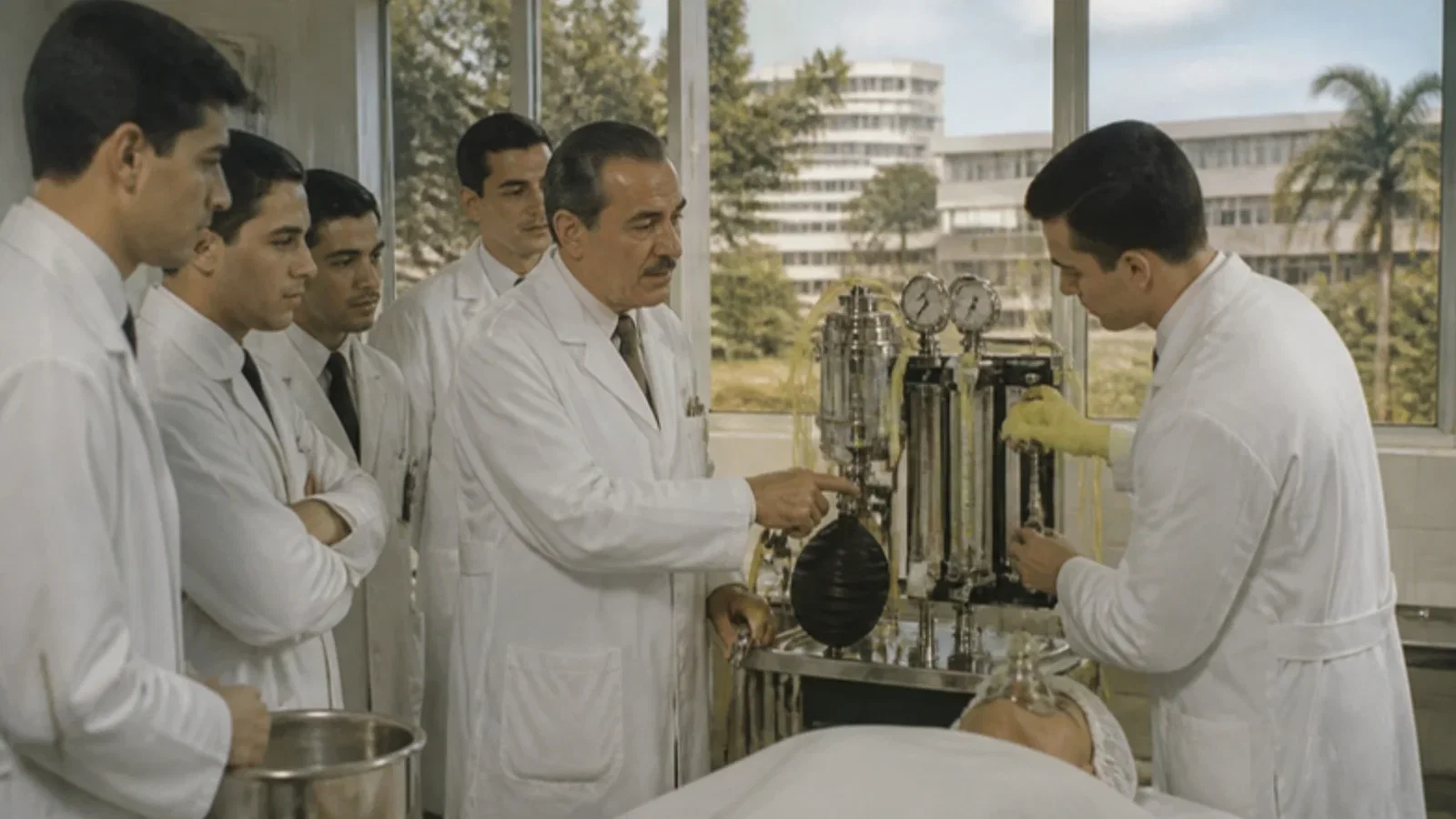
São Paulo Law No. 2,380, reprinted in the Revista Brasileira de Anestesiologia in 1958, and the one-year traineeship at the Hospital das Clínicas.
Reading Library · Anesthesia Epochs · 中文版
Watch the education video (for clinicians)
1953: São Paulo's Training Law — Paying for Anaesthetists · Anesthesia Epochs Education Series
In Brazil a national society of anaesthetists and a system of training came into being within a few years of each other. The Sociedade Brasileira de Anestesiologia (SBA) dates its history from 1948 and lists "1953 – Criação do Centro de Ensino e Treinamento (CET)" on its online timeline, but that entry carries no text. [3] This article looks at 1953 through a document of the time instead: a São Paulo state law, reprinted in 1958 in the society's journal by an anaesthetist of the Hospital das Clínicas.
A society first
The SBA's timeline, citing Meira (1981), says that on 13 March 1948 the society's first board meeting was held at the home of its president, Mario d'Almeida, in Botafogo, Rio de Janeiro; after the society was formed with 33 founding members, all members met on 2 April, approved the statutes and elected the first board, citing Machado (1991). [3] In 1982 the chairman of the SBA's teaching and training committee, José Roberto Nocite, wrote that the society had concerned itself with teaching anaesthesiology in Brazil since 1953, and that its Centros de Ensino e Treinamento had received specific regulation from 1957. [2, p. 389]
The law of 18 November 1953
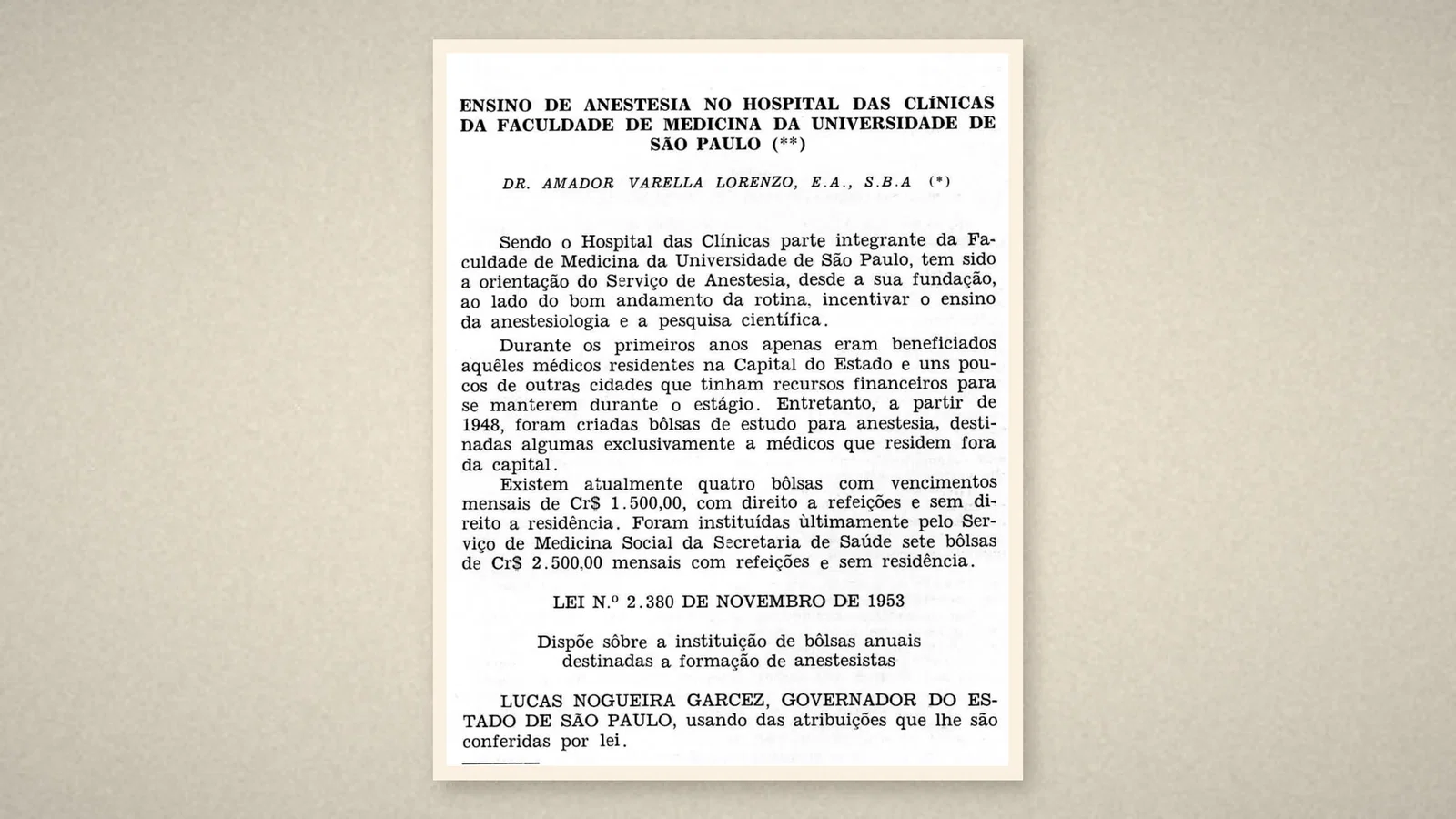
Amador Varella Lorenzo, of the anaesthesia service of the Hospital das Clínicas of the University of São Paulo medical school, presented a paper on teaching at the fourth Brazilian Congress of Anesthesiology in Porto Alegre in October 1957; it was printed in the Revista Brasileira de Anestesiologia in December 1958. [1, p. 283] Teaching and research, Varella Lorenzo wrote, had been the service's aim since its foundation. In the first years only doctors living in the state capital, and a few from other cities who could support themselves, could benefit; from 1948, scholarships for anaesthesia were created, some reserved for doctors living outside the capital. [1, p. 283]
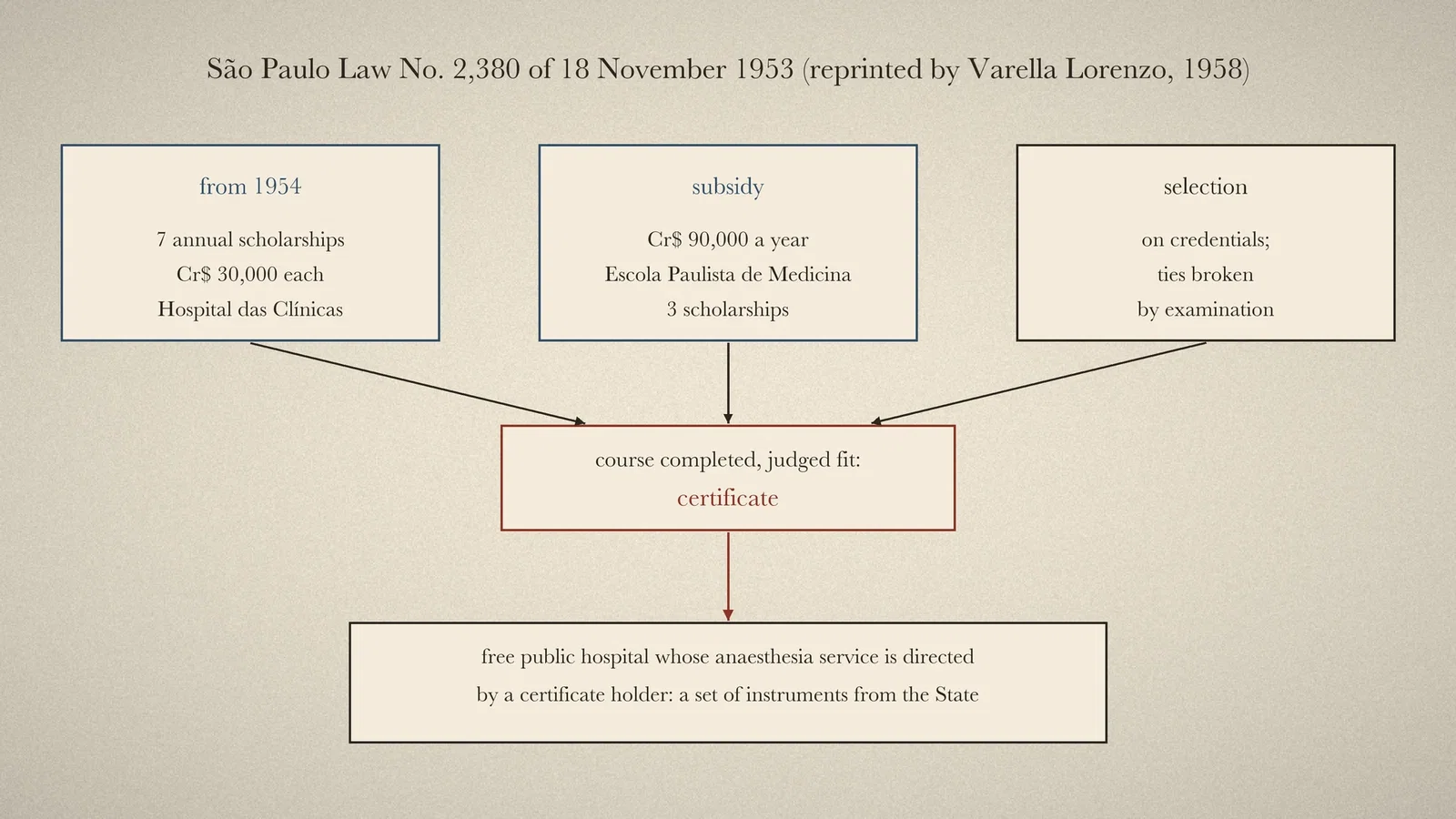
The paper then reprints Law No. 2,380, which "dispõe sôbre a instituição de bôlsas anuais destinadas a formação de anestesistas", issued by Governor Lucas Nogueira Garcez. [1, p. 283] From 1954 it created seven annual scholarships of Cr$ 30,000 each, under the Social Medicine Service of the state health secretariat, for training anaesthetists at the Hospital das Clínicas, and authorised a yearly subsidy of Cr$ 90,000 to the Escola Paulista de Medicina for three more at its Hospital São Paulo. [1, p. 284] If candidates outnumbered places they were selected on credentials, with an examination to break ties; those who completed the course and were judged fit received a certificate. [1, p. 284]
One article looked beyond the two schools. Free public hospitals, in the capital or the interior, whose anaesthesia service was directed by a holder of that certificate would receive from the state, as an incentive, a set of instruments suitable for the practice of anaesthesia. [1, p. 284] The law was signed on 18 November 1953 and published the next day. [1, p. 285]
One year, full time
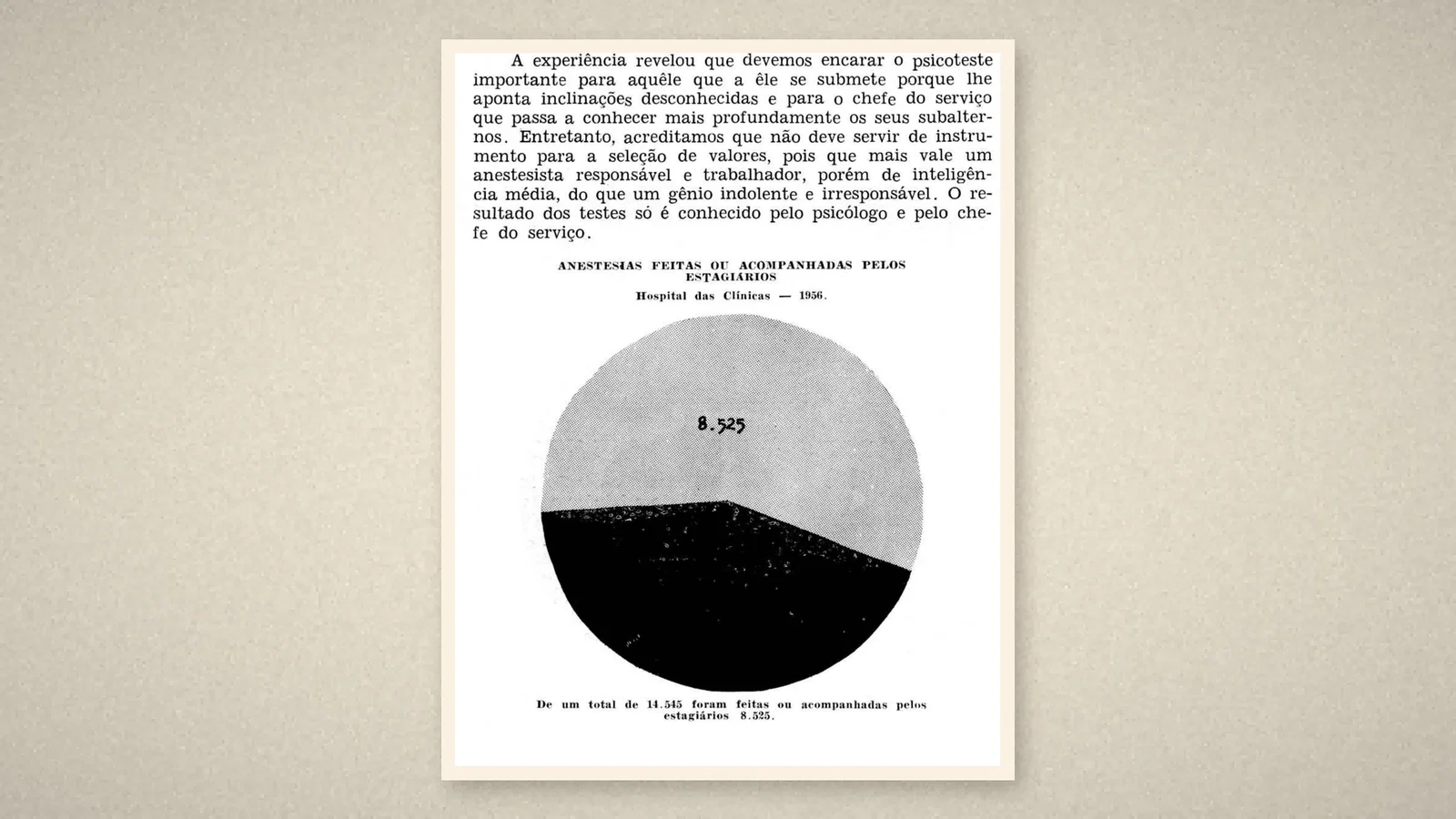
By 1957 the hospital had four scholarships of Cr$ 1,500 a month, with meals but no lodging, and the Social Medicine Service had added seven of Cr$ 2,500. [1, p. 283] Foreign doctors also trained in the service under international agreements and lived in the hospital, and unpaid volunteers took part in the same activities. [1, p. 285] The traineeship lasted a year and was demanding: full time, with a visit to and premedication of each patient on the next day's list, arrival in the operating room before 7:30, staying until the surgical lists ended, and obligatory shifts in the emergency department. [1, p. 287] In 1956, of 14,545 anaesthetics at the Hospital das Clínicas, the trainees gave or accompanied 8,525. [1, p. 287]
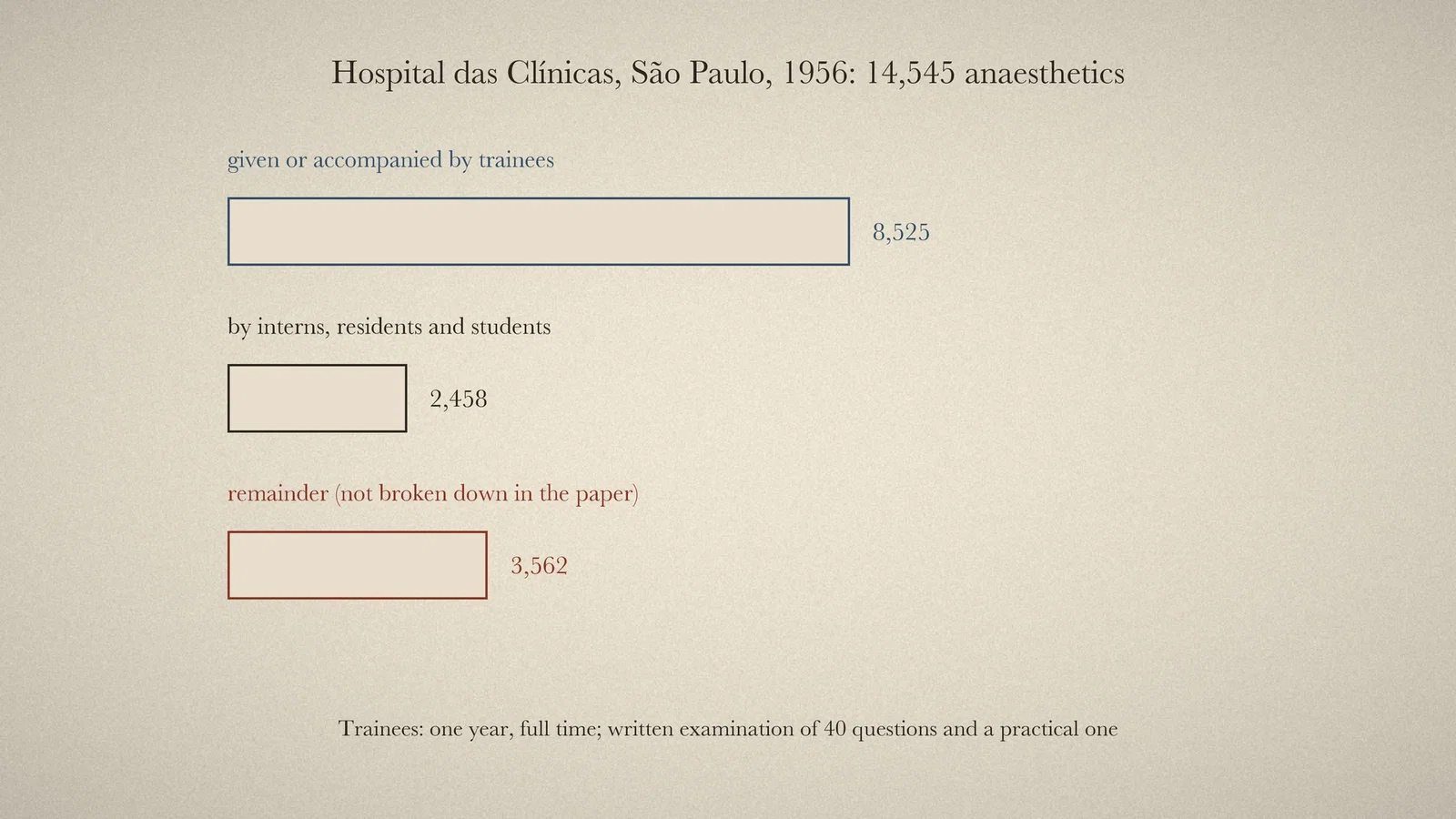
The year ended with a written examination of 40 questions to be answered in two hours and a practical one, an anaesthetic chosen by the candidate; the service then issued a certificate listing the anaesthetics given and the marks, and the hospital a diploma. [1, p. 287–288] Medical students met anaesthesia through pharmacology and surgery, attended sessions in the operating rooms and presented the anaesthetic record to the professor of pharmacology, Charles Corbett, for discussion. [1, p. 285] Residents and interns rotated through the service for six weeks to two months; in 1956 they and the students gave or took part in 2,458 anaesthetics. [1, p. 288]
A test that did not decide
The hospital also gave candidates a psychological test. Varella Lorenzo found the results interesting but contradictory: some people considered good professionals were judged psychologically unfit for anaesthesia, and even for medicine. The test told trainees about unknown inclinations and helped the chief know the staff, but it should not be used to select people, "pois que mais vale um anestesista responsável e trabalhador, porém de inteligência média, do que um gênio indolente e irresponsável". Only the psychologist and the chief saw the results. [1, p. 285–286]
What the record shows
By its own account the SBA began its work in teaching in 1953. In November of that year a state legislature paid for anaesthetists to be trained, made a certificate the outcome, and tied equipment for free public hospitals to the presence of a certified anaesthetist. Twenty-nine years later the SBA counted 56 accredited CETs and noted that only 20 of the 219 trainees finishing by the end of 1982 (9.1%) were training outside the South and Southeast. [2, p. 389]
Sources and reading limits
Read: Varella Lorenzo's 1958 paper (pp. 283–288), including the text of Law No. 2,380; Nocite's 1982 editorial in the same journal (p. 389); the SBA's online timeline.
Not covered: the timeline entry for the 1953 CET has no text, and no document of 1953 on the creation of SBA training centres was found; the first centres, their dates and the 1957 regulation are therefore not described, and this article does not treat the São Paulo law as the SBA's CET. Meira (1981) and Machado (1991), cited by the SBA for the 1948 founding, were not read. The law's publication in the official gazette was not consulted; its text is taken from the 1958 reprint. Varella Lorenzo describes one hospital; other services are outside this article.
Two illustrations are drawn from the law and the 1956 figures; two are crops of the 1958 pages.
- Varella Lorenzo A. Ensino de anestesia no Hospital das Clínicas da Faculdade de Medicina da Universidade de São Paulo. Rev Bras Anestesiol. 1958;8(3):283–288. BJAN
- Nocite JR. S.B.A. e política de ensino [editorial]. Rev Bras Anestesiol. 1982;32(6):389–390. BJAN
- Sociedade Brasileira de Anestesiologia. Nossa história (linha do tempo) [Internet]. Rio de Janeiro: SBA; [cited 2026 Nov 1]. sbahq.org
Continue exploring
Related reading connects shared questions and contexts; it does not by itself establish historical influence.
- 1964: Carlos Parsloe and the São Paulo Congress
- 1935: London Holds the Diploma in Anaesthetics Examination
Anesthesia Epochs · The Source Room · About & Editorial Method
Published November 2, 2026. Sources and reading limits are stated above. Illustrations are labelled as original source images or AI-made. Historical accounts are educational; they are not current treatment instructions.