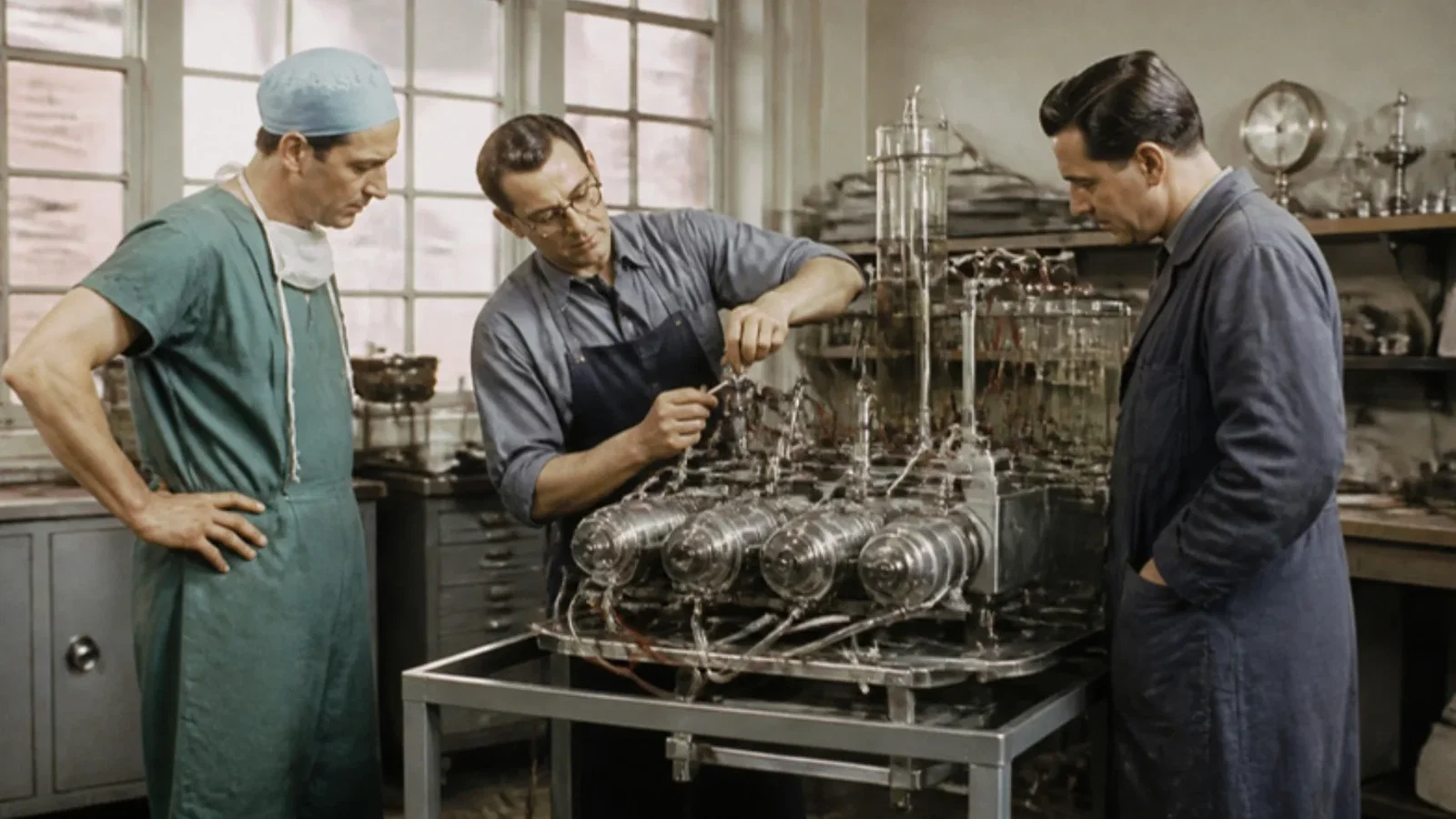
A 1960 paper in the Medical Journal of Australia: the machine that the surgeon Cohen, the anaesthetist Hercus and the pump maker Ebsary built for the Royal Alexandra Hospital for Children, with a 1959 leading article on open-heart surgery in Australia.
Reading Library · Anesthesia Epochs · 中文版
Watch the education video (for clinicians)
1959: Sydney's Heart-Lung Machine — Built Locally · Anesthesia Epochs Education Series
An existing article in this series follows Gibbon's 1953 repair of an atrial defect with heart-lung support in Philadelphia. This one moves to Sydney, where in December 1959 a children's hospital began using a heart-lung machine built locally. Three people described it: a cardiac surgeon, an anaesthetist and the pump manufacturer who made it. Their paper appeared in the Medical Journal of Australia in November 1960.
Where Australia stood in 1959
In February 1959 a leading article in the same journal, "Cardiac Surgery, Past and Future", reviewed the field. "In Australia open heart surgery has not yet been extensively practised." [2, p. 268] About 40 simple atrial septal defects had been closed under hypothermia in Sydney: 20 at the Royal Prince Alfred Hospital and 10 each at St Vincent's and the Royal Alexandra Hospital for Children. [2, p. 268] Extracorporeal circulation with a pump oxygenator was "in clinical use only" at the Alfred Hospital in Melbourne and the Royal Prince Alfred Hospital in Sydney. In the two centres, 27 patients with ventricular septal defect had been treated, with 10 deaths. [2, p. 268]
The Australian Society of Anaesthetists' timeline gives 1957 for "the first heart-lung machine in Australia". It says this was built by an anaesthetist, Dr Jeanne Collison, at the Alfred Hospital in Melbourne after experience at the Mayo Clinic, and was used on a small child with a "hole in the heart". [3, PDF p. 64] No first-hand account of that machine was found for this article.
The machine
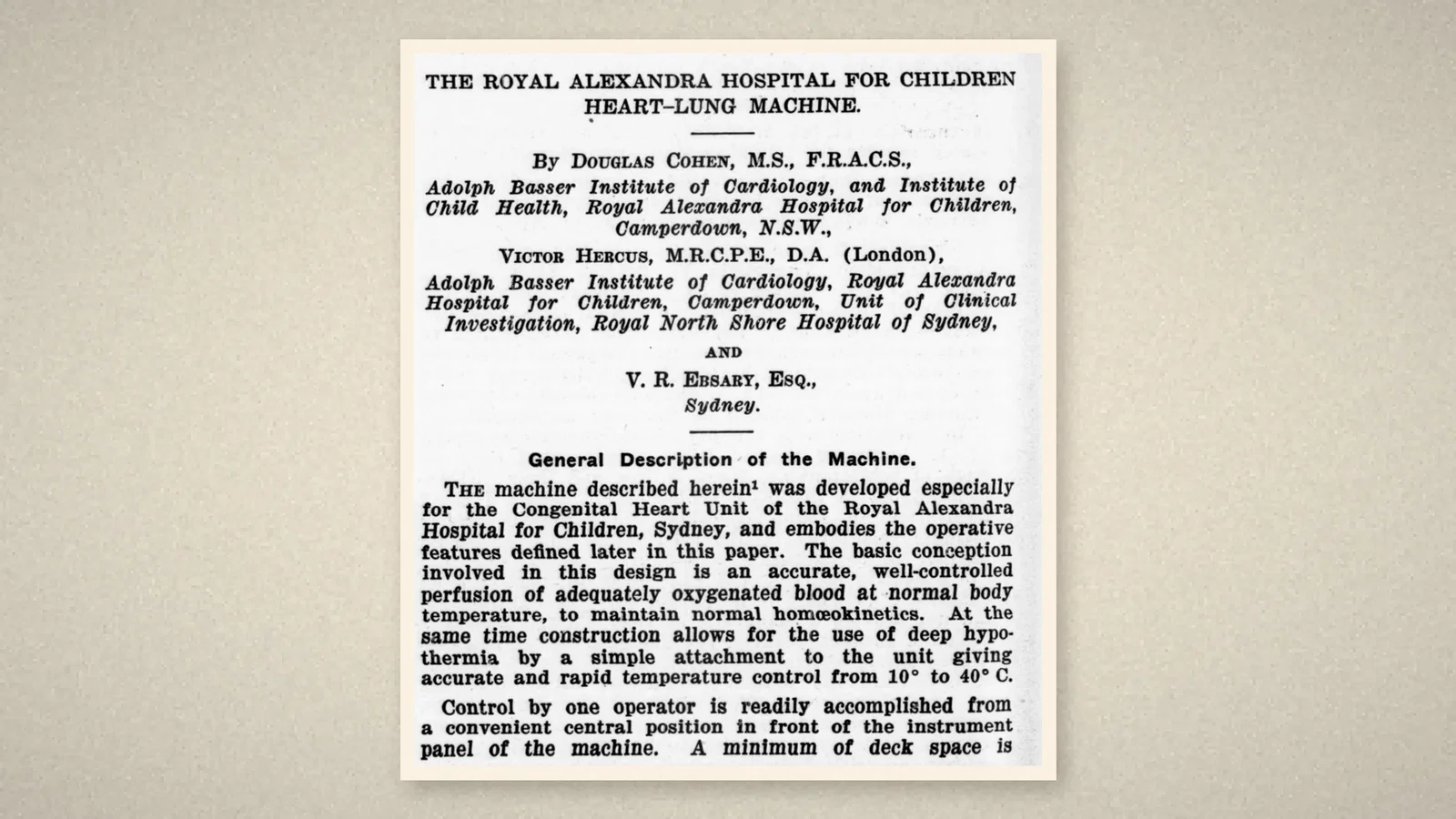
The 1960 paper was written by Douglas Cohen, a surgeon, and Victor Hercus, "M.R.C.P.E., D.A. (London)", both of the Adolph Basser Institute of Cardiology at the Royal Alexandra Hospital for Children, with V. R. Ebsary of Sydney. [1, p. 734] It describes a machine "developed especially for the Congenital Heart Unit" of the hospital. Its "basic conception" was "an accurate, well-controlled perfusion" of oxygenated blood at normal body temperature, with deep hypothermia available through "accurate and rapid temperature control from 10° to 40°C". It was built by Ebsray Pumps Pty. Ltd. of Sydney, and "control by one operator is readily accomplished". [1, p. 734]
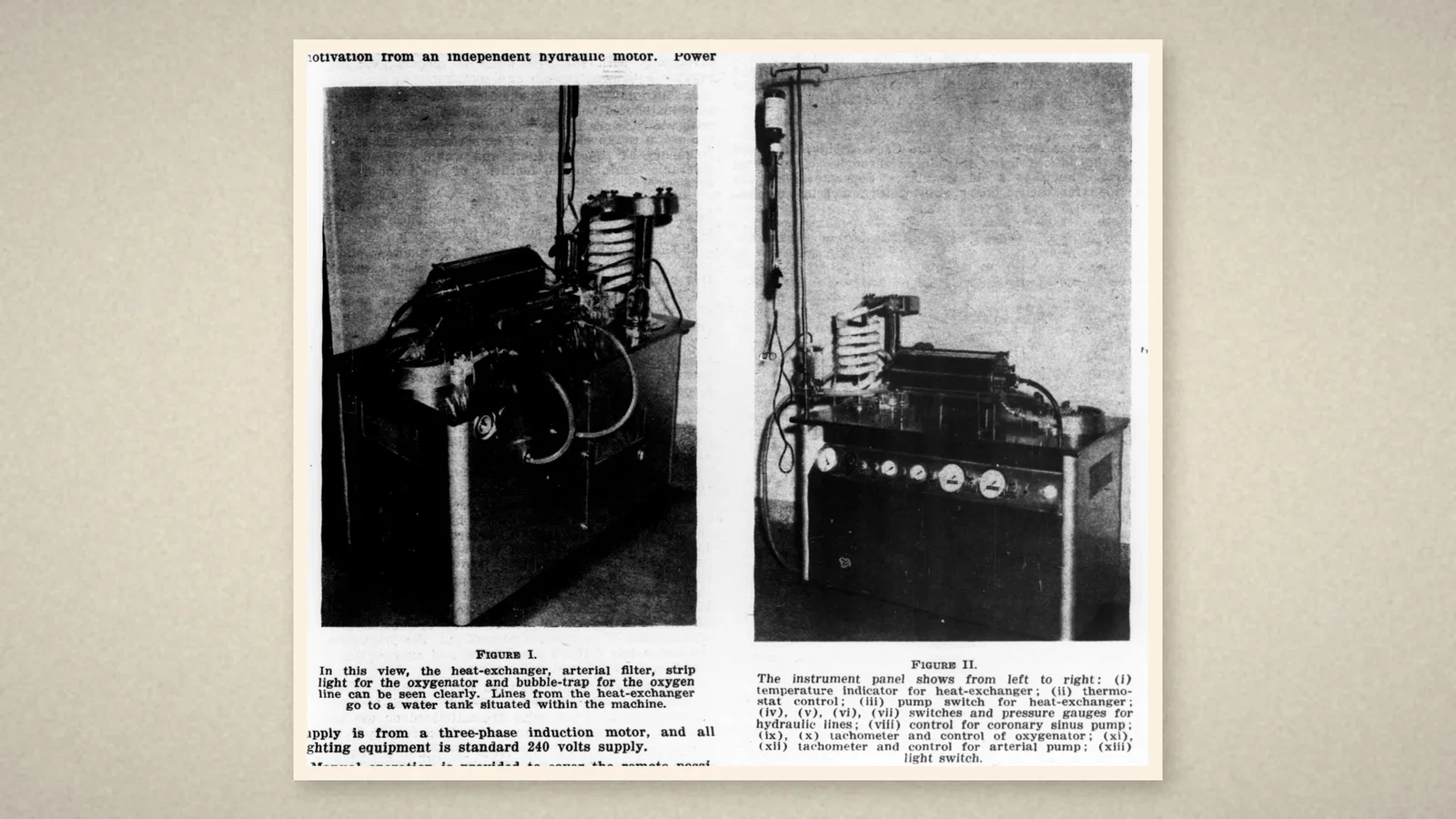
The unit held an oxygenator, a heat-exchanger, an occlusive roller arterial pump, a coronary sinus suction pump and a venous reservoir. [1, p. 735] Both pumps and the oxygenator spindle "can be rotated manually within a few seconds" if the power failed. The machine measured 42 inches long, 24 wide and 26 high. "After extensive laboratory testing the machine was applied clinically." [1, p. 735]
Why build it at home
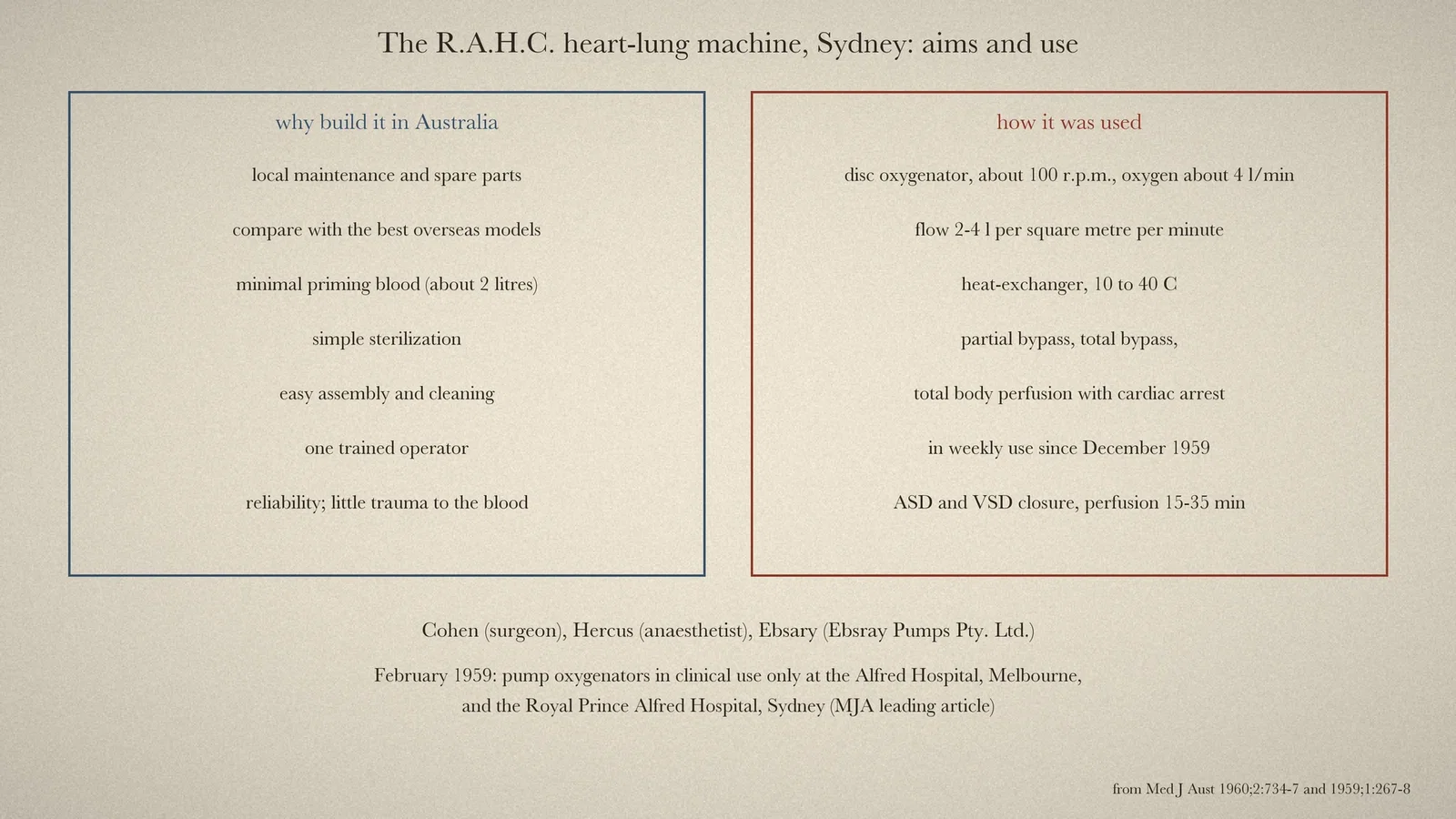
The authors set out their reasons. A locally built machine meant easier maintenance and spare parts. It had to compare with the best overseas models in construction and cost. Priming volume had to be kept low, because such operations would become more frequent and would place a considerable strain on "the facilities of the blood-transfusion service". [1, p. 736] Sterilisation, assembly and cleaning had to be simple, and the machine should be "capable of running under the control of one trained operator". [1, p. 736]
How it worked
About 2 litres of heparinised blood primed the circuit. [1, p. 736] Venous blood passed to a disc oxygenator whose discs turned "at approximately 100 r.p.m." in oxygen. Flows were estimated at "2-4 litres per square metre" of body surface per minute, and each turn of the arterial pump returned about 60 ml. The blood went through the heat-exchanger and a filter, then "through a metal cannula back into the external iliac artery". [1, p. 736] No anti-foam was used anywhere in the circuit. [1, p. 737]
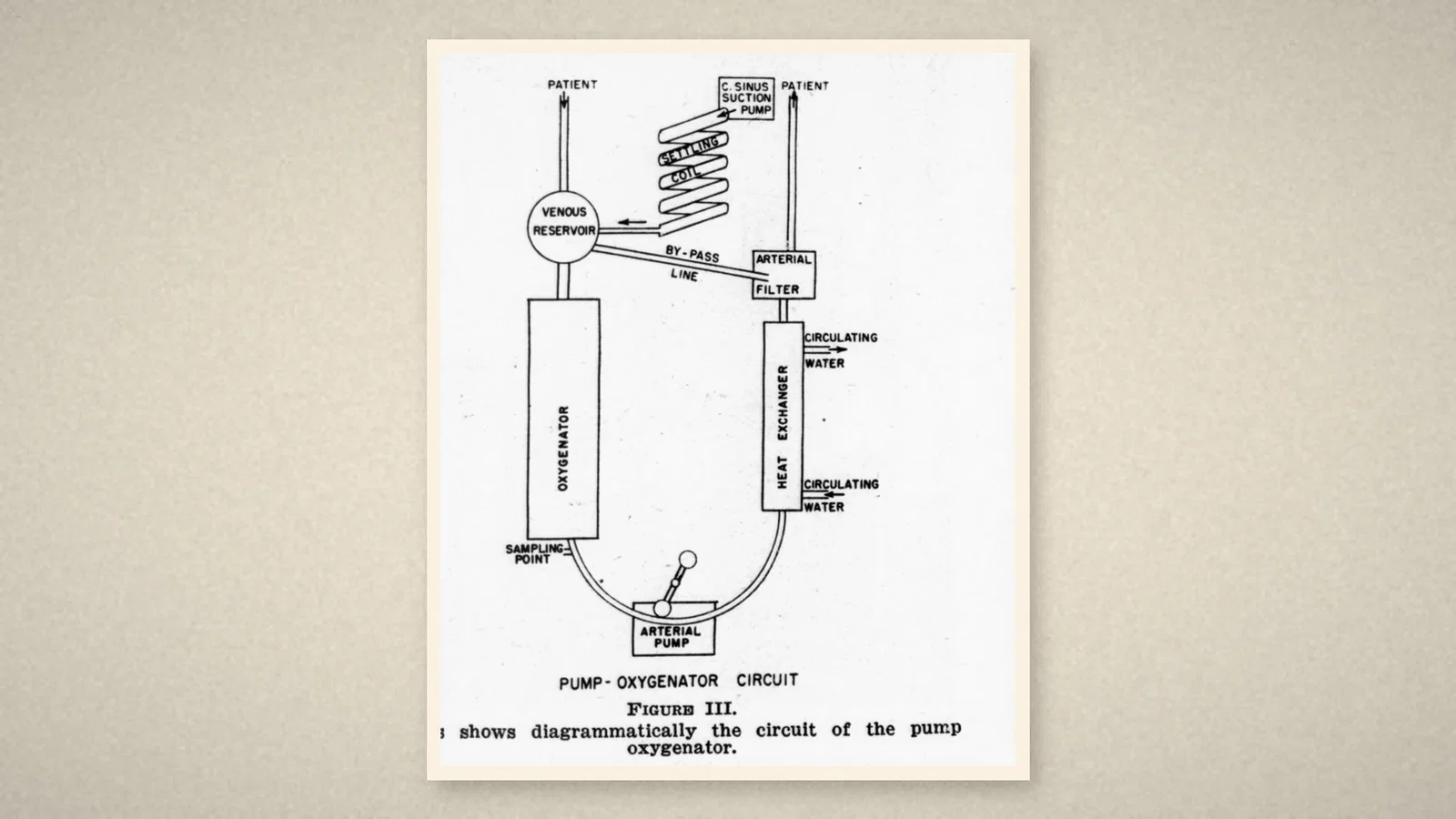
The authors described three phases: partial bypass, total bypass, and "total body perfusion with cardiac arrest" once the aorta was clamped. They noted that "the still heart allows suturing to be carried out more easily". [1, p. 737] The machine had been "in weekly use since December, 1959" for closing atrial and ventricular septal defects, with perfusions of 15 to 35 minutes. Biochemical and blood-gas results were being collected for a later paper. [1, p. 737]
The anaesthetist's part
According to the Australian Society of Anaesthetists' timeline, the project began after a child with a ventricular septal defect died during surgery under hypothermia. Ebsary and the philanthropist Sir Adolph Basser then sponsored a trip to American heart hospitals by Cohen and Hercus, "the anaesthetist", to learn what such a machine required. Ebsary became the perfusionist. [3, PDF p. 65] The 1960 paper itself gives Hercus as co-author but says nothing about the anaesthetic.
What the record shows
An anaesthetist co-wrote the description of the machine that a children's hospital in Sydney used every week from December 1959. The paper argued for building it locally on practical grounds: spare parts, a low priming volume and one operator. In 1959, a leading article could still name the only two hospitals in Australia using a pump oxygenator.
Sources and reading limits
Read: Cohen, Hercus and Ebsary, Med J Aust 1960;2:734-737, in full, including the photographs and the circuit diagram; the leading article "Cardiac Surgery, Past and Future", Med J Aust 1959;1:267-268; the ASA timeline entries for 1957 and 1959.
Not covered: no first-hand record of the 1957 Alfred Hospital machine was found. The ASA timeline is the only source for Collison's part, and its spelling "Jeanne" is kept. The later paper on the machine's clinical results was not traced. The American visit and Ebsary's work as perfusionist come from the ASA timeline alone. The 1960 paper gives no patient numbers and no anaesthetic technique.
One illustration is a summary drawn from the two papers; three are crops of the 1960 paper.
- Cohen D, Hercus V, Ebsary VR. The Royal Alexandra Hospital for Children heart-lung machine. Med J Aust. 1960;2(19):734-7. Internet Archive
- Cardiac surgery, past and future [leading article]. Med J Aust. 1959;1(8):267-8. Internet Archive
- Australian Society of Anaesthetists. Anaesthesia History Timeline. 2024. PDF
Continue exploring
Related reading connects shared questions and contexts; it does not by itself establish historical influence.
Anesthesia Epochs · The Source Room · About & Editorial Method
Published November 2, 2026. Sources and reading limits are stated above. Illustrations are labelled as original source images or AI-made. Historical accounts are educational; they are not current treatment instructions.