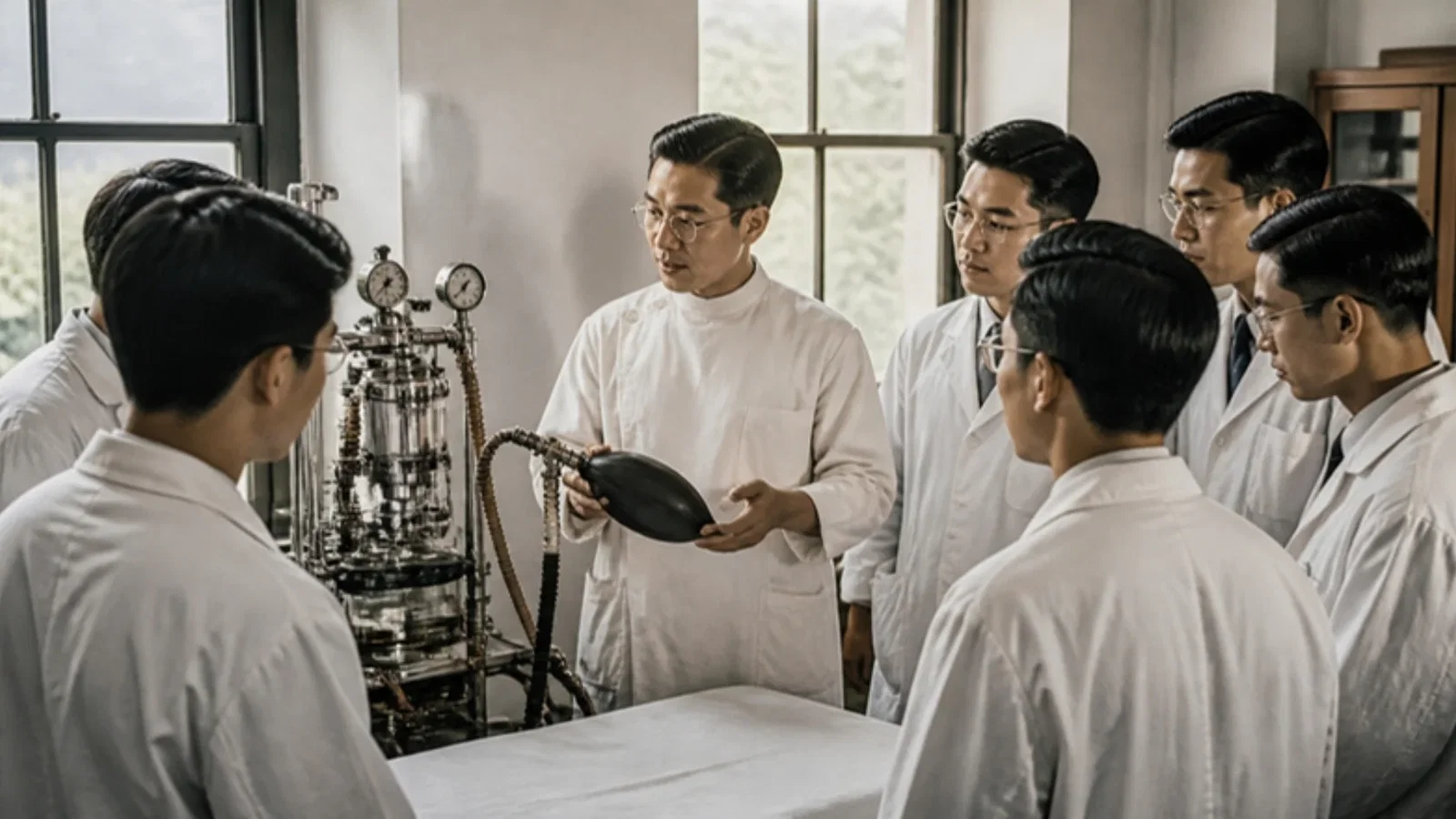
The JSA museum booklet and the JSA history: a GARIOA fellowship, residency training at the University of Chicago, and the first course of August 1952.
Reading Library · Anesthesia Epochs · 中文版
Watch the education video (for clinicians)
1952: Michinosuke Amano at Keio — Opening Anaesthesia Courses · Anesthesia Epochs Education Series
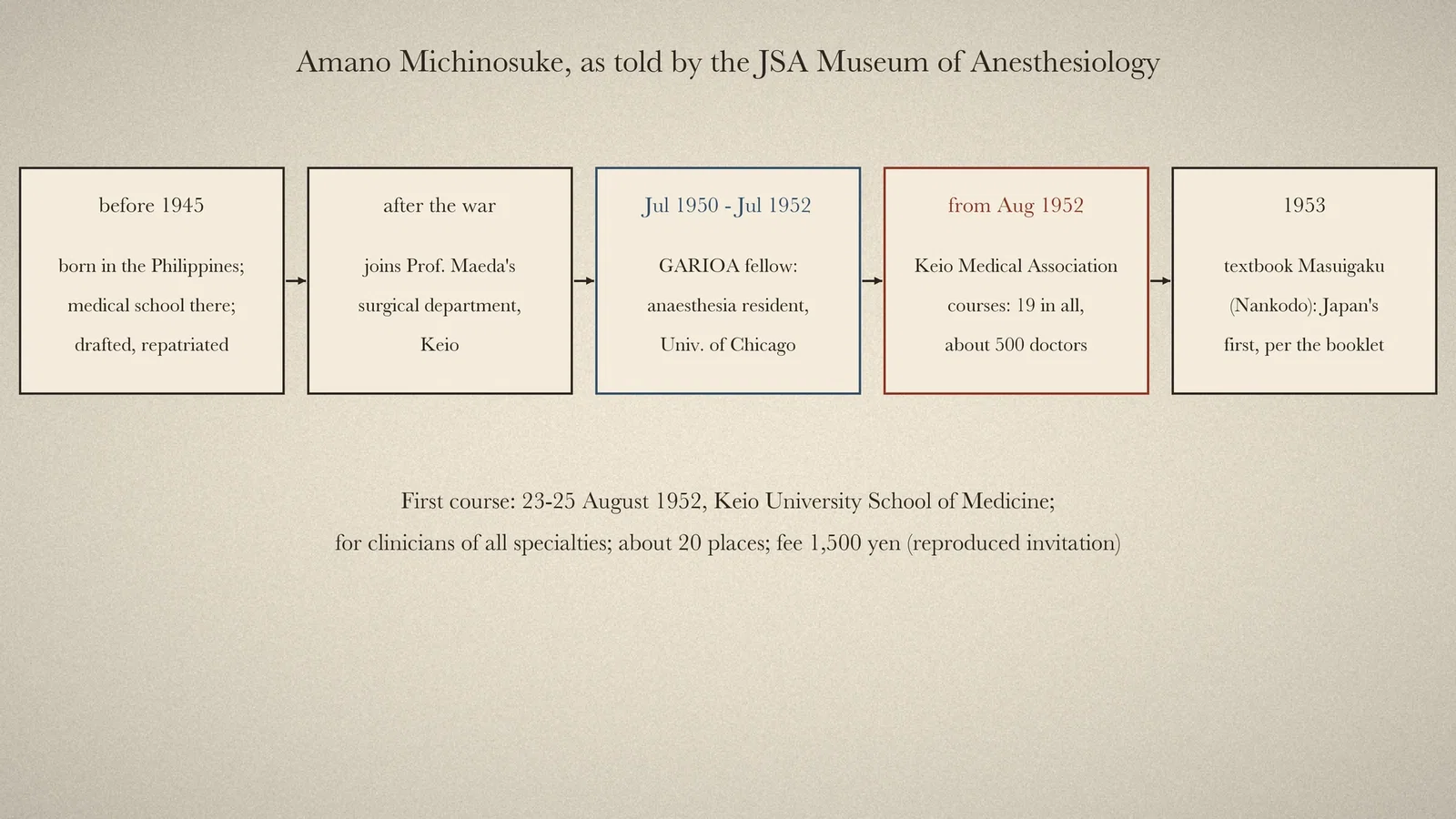
In the summer of 1950 an American lecture on anaesthesia startled the surgery professors of Japan; that story belongs to the article on Meyer Saklad. This article follows one of the doctors who turned such ideas into everyday teaching: Amano Michinosuke of Keio University, whom the Japanese Society of Anesthesiologists (JSA) remembers, with Hideo Yamamura of Tokyo, as one of the two pioneers of Japanese anaesthesia. The account comes from the JSA's Museum of Anesthesiology, whose tenth-anniversary booklet also reproduces the invitation to Amano's first course.
From Manila to Keio
According to the museum booklet, Amano was born in the Philippines to a Japanese family. While a student at the University of the Philippines medical school, Amano came to know Ishikawa and Inoue of Keio; drafted into the army, Amano came close to death before the war ended and was repatriated. A chance meeting with Inoue at Shinjuku station led to a place in Professor Maeda's surgical department at Keio. [1, p. 24] The JSA's English history adds that Amano graduated from the University of the Philippines in 1943 and had some exposure to anaesthesia at an American army hospital in Manila. [2]
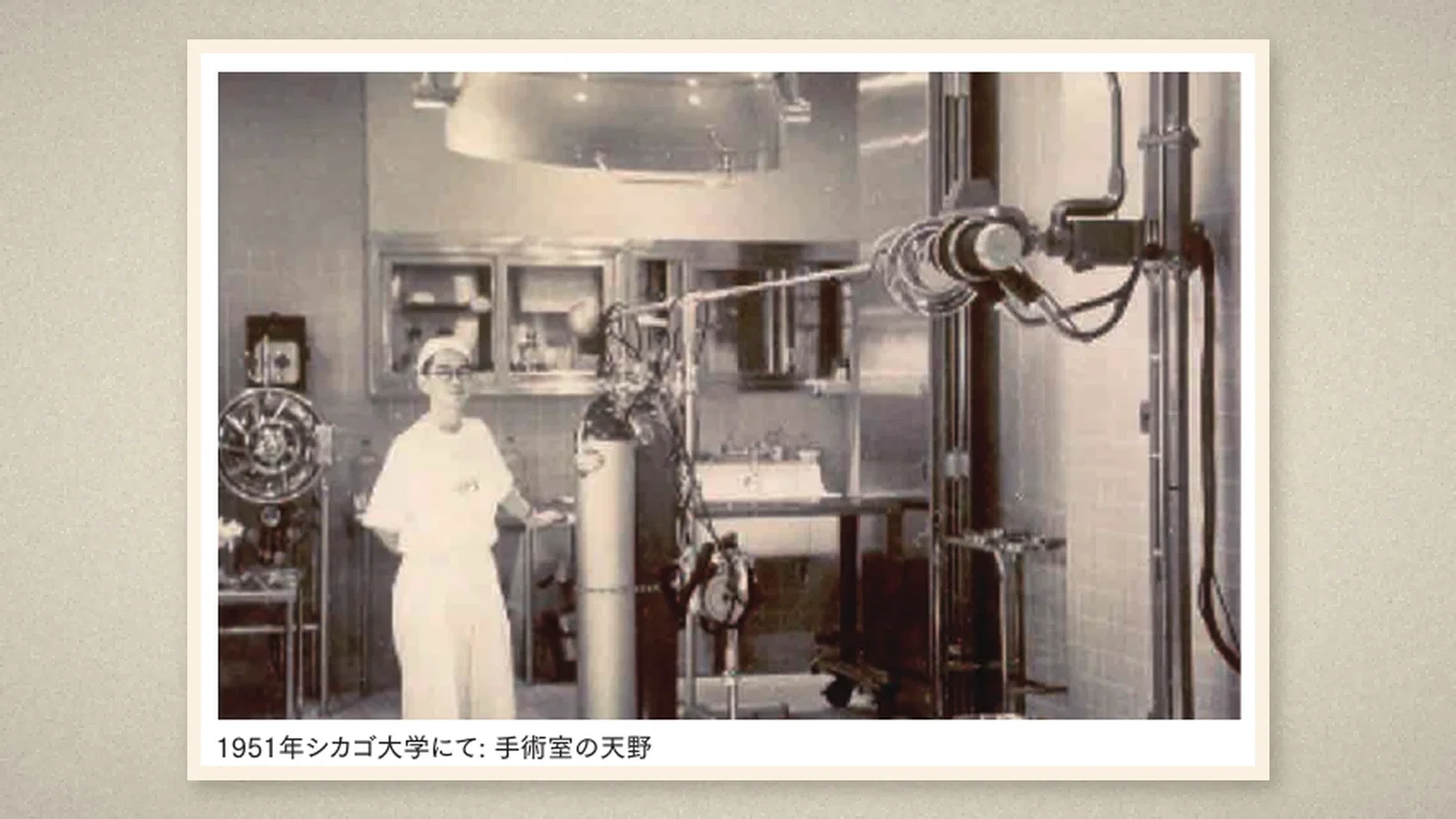
In 1949 a newspaper carried an advertisement for study abroad funded by GARIOA (Government Appropriation for Relief in Occupied Areas). Amano passed the selection and, from July 1950 to July 1952, trained as an anaesthesia resident under Professor Livingstone at the University of Chicago. [1, p. 24] A photograph in the booklet shows Amano in an operating room at the University of Chicago in 1951. [1, p. 24]
The courses
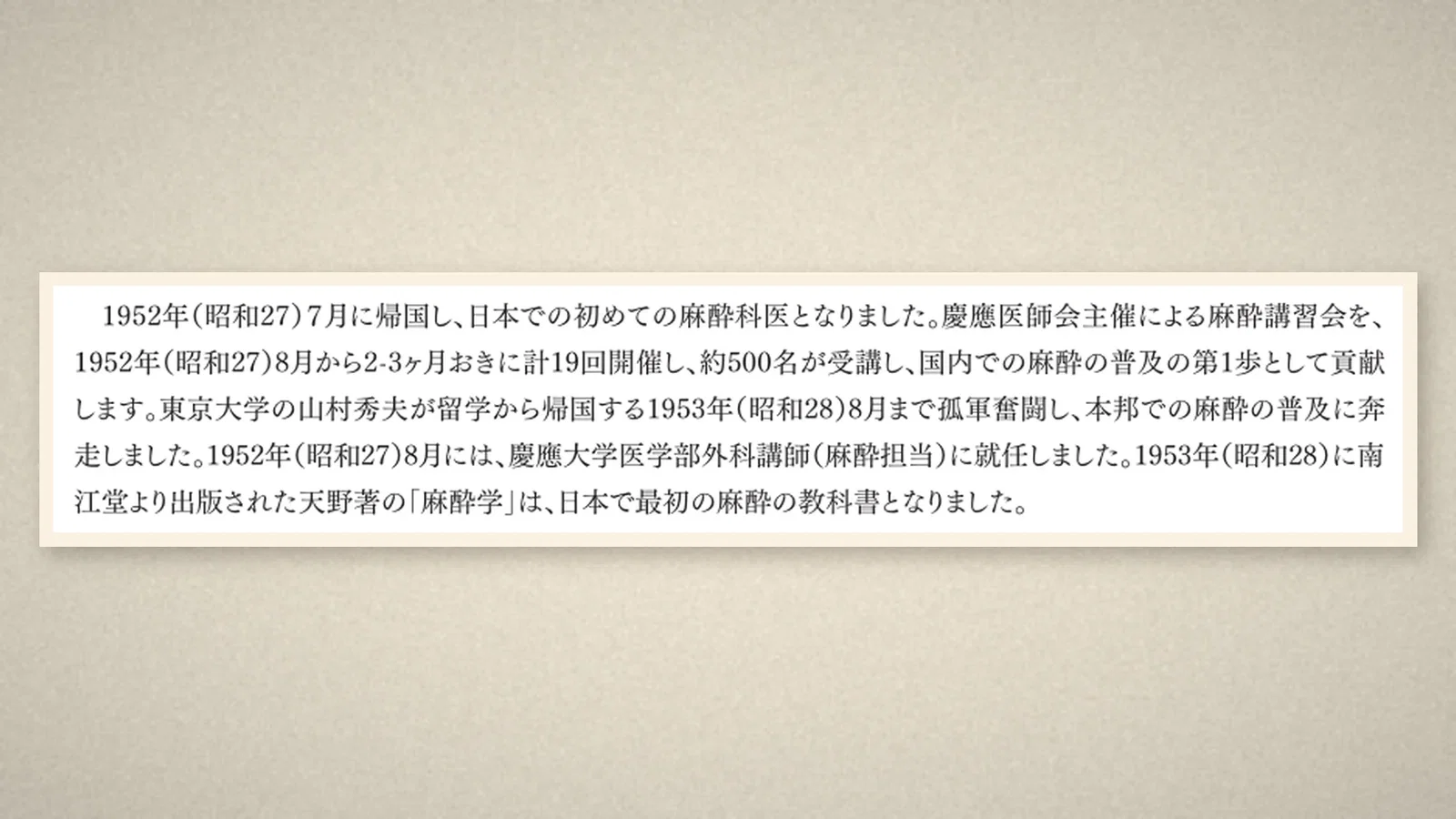
Amano returned in July 1952 and, in the booklet's words, became the first anaesthetist in Japan. [1, p. 24] In August 1952 Amano was appointed lecturer in surgery (in charge of anaesthesia) at the Keio medical school. From August 1952, the Keio Medical Association ran anaesthesia courses every two or three months, 19 in all, attended by about 500 doctors, which the booklet calls the first step in spreading anaesthesia in Japan. [1, p. 24] Until Yamamura returned from study in the United States in August 1953, the booklet says, Amano worked on alone. [1, p. 24] The JSA's English history describes the same courses as "open to physicians outside of Keio", and says they motivated many young doctors to specialise in anaesthesia. [2]
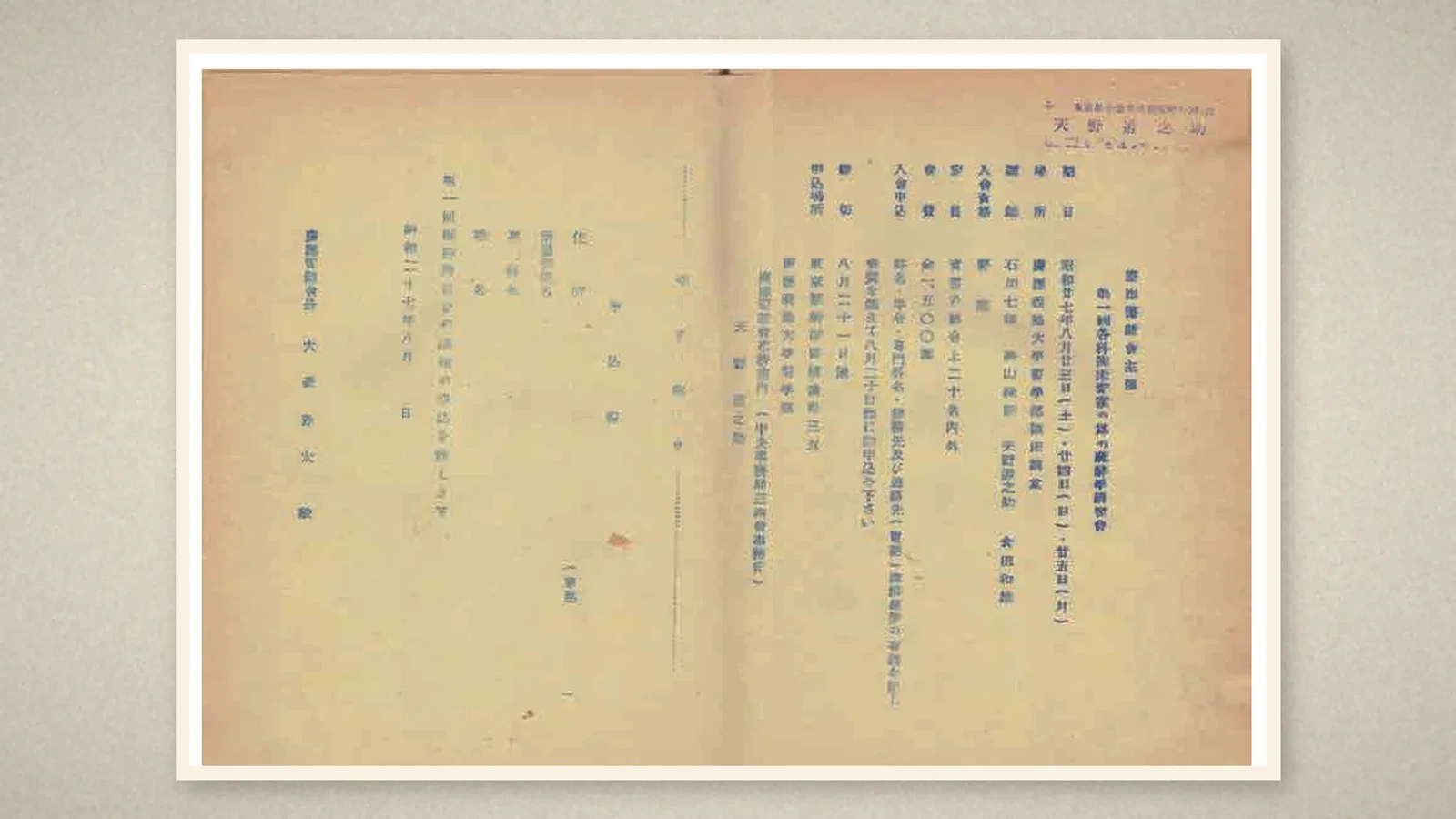
The invitation to the first course, now in the museum's collection, is reproduced in the booklet. As far as it can be read in the reproduction, it announces a course in anaesthesia for clinicians of all specialties, organised by the Keio Medical Association, on 23, 24 and 25 August 1952 at the Keio University School of Medicine; the lecturers include Ishikawa and Amano Michinosuke; because of the size of the venue the course was limited to about 20 participants; and the fee was 1,500 yen. [1, p. 25]
A textbook and a society
In 1953 Nankodo published Amano's Masuigaku (Anaesthesiology), which the booklet calls the first anaesthesia textbook in Japan. [1, p. 24] The background was the one the booklet sets out on the facing page: at the 1950 conference the Keio professor of surgery Maeda, president of the Japan Surgical Society, had served as an organiser, and had given a presidential address arguing that research and education in anaesthesia were an emergency. [1, p. 23] When a society of anaesthesia was discussed in January 1954, Yamamura and Amano took part; its founding was decided at the Japan Surgical Society meeting of 2 May 1954. [1, p. 26]
What the record shows
A doctor born in Manila, repatriated after the war, trained for two years in Chicago on a GARIOA fellowship, came back to a surgical department and opened its doors: courses every few months for any clinician, a textbook within a year, and a part in founding a national society. The courses were small; the first was planned for about twenty people. Their importance lay in their number and their openness.
Sources and reading limits
Read: the JSA Museum of Anesthesiology tenth-anniversary booklet, the section on Yamamura Hideo and Amano Michinosuke (booklet pp. 23-26), text and page images, including the reproduced invitation of August 1952, read from a high-resolution render; the JSA English history page.
Not covered: nothing written by Amano or the Keio Medical Association in 1950-1953 was found online apart from the reproduced invitation. Amano's 1953 textbook, the record of the 1950 conference and University of Chicago records are not covered. Parts of the invitation are illegible in the reproduction; only clearly legible items are reported, and the names of the other lecturers are not given. The numbers of courses and participants, and the descriptions "the first anaesthetist in Japan" and "the first anaesthesia textbook in Japan", are the booklet's and are attributed to it. Both sources are the JSA's own accounts.
One illustration is drawn from the booklet; three are crops of its pages.
- Japanese Society of Anesthesiologists. The Japanese Museum of Anesthesiology 10th Anniversary [booklet]. Kobe: JSA; pp. 23-26. anesth.or.jp
- Japanese Society of Anesthesiologists. History [Internet]. Kobe: JSA; [cited 2026 Nov 1]. anesth.or.jp
Continue exploring
Related reading connects shared questions and contexts; it does not by itself establish historical influence.
- 1950: Saklad and the Institute on Medical Education for Japan
- 1954: Japan's Anesthesia Society Is Founded and Holds Its Opening Meeting
Anesthesia Epochs · The Source Room · About & Editorial Method
Published November 2, 2026. Sources and reading limits are stated above. Illustrations are labelled as original source images or AI-made. Historical accounts are educational; they are not current treatment instructions.