A journal and a chair: Kokuseido's Masui vol. 1 no. 1 (April 1952), and the JSA's account of how an 'anaesthesia group' inside a surgical department at Tokyo became an anaesthesia chair.
Reading Library · Anesthesia Epochs · 中文版
Watch the education video (for clinicians)
1952: Masui and the Tokyo Chair — Hideo Yamamura · Anesthesia Epochs Education Series
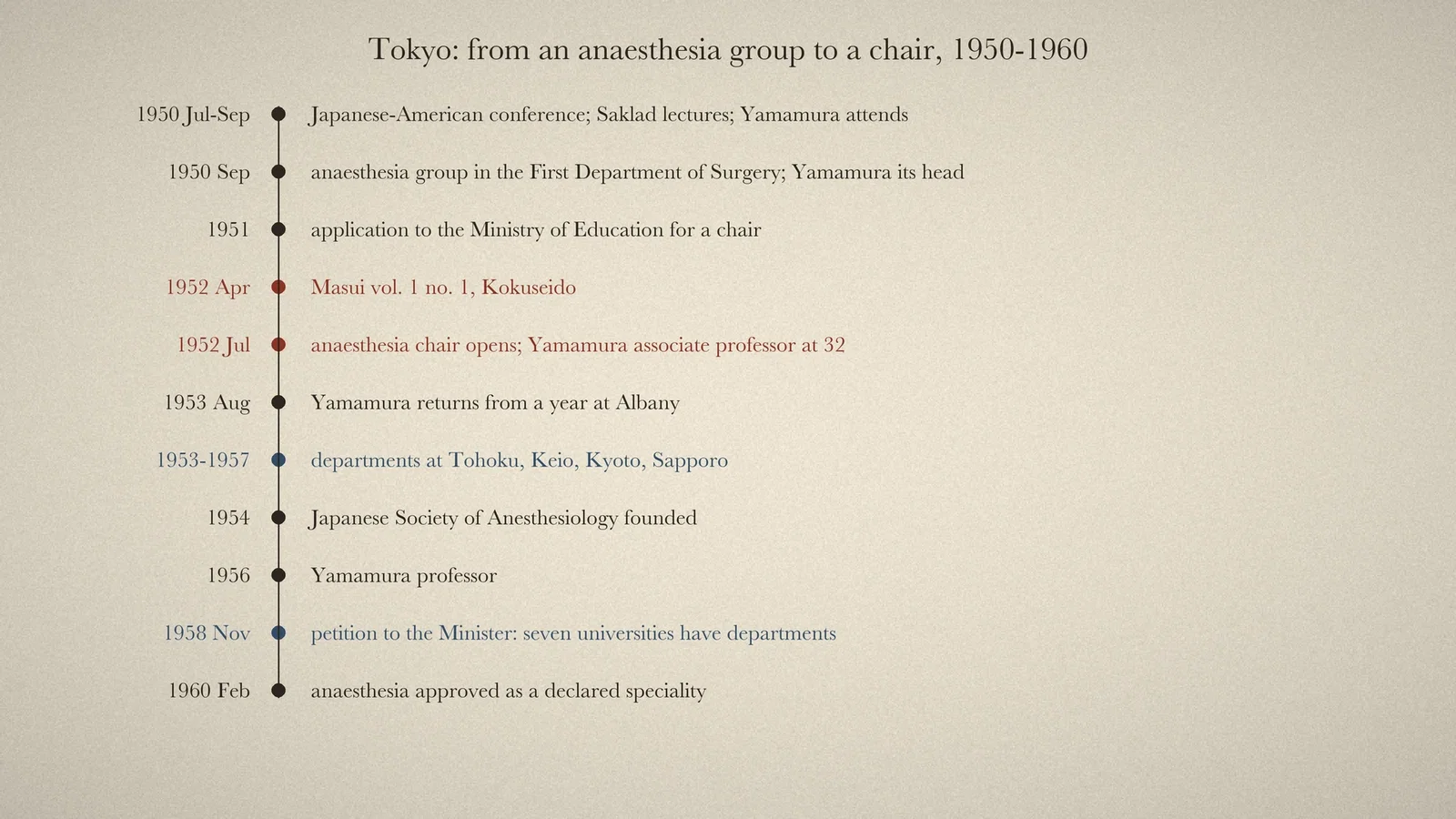
Two things that a specialty needs, a journal and a university chair, appeared in Tokyo within a few months of each other in 1952. In April the publisher Kokuseido issued the first number of Masui. In July, in the account of the Japanese Society of Anesthesiologists (JSA), the University of Tokyo opened Japan's first anaesthesia chair. A society for the specialty did not yet exist. This article follows both, using the JSA's own museum booklet and website and a 2023 article that quotes the journal's first issue.
Where things stood in 1950
The JSA's history describes the starting point bluntly. As of 1950, medical textbooks, contemporary literature in English and essential anaesthetic equipment were "scarce or even absent", and in Japan "the words anesthesiology and anesthesiologist were non-existent". Most anaesthesia in hospitals was given by physicians who belonged to the surgery department. [2]
From July to September 1950 the Japanese-American joint conference on medical education was held. Saklad lectured in its anaesthesia section. Professor Shimizu of the University of Tokyo was serving as an interpreter, so the department sent Hideo Yamamura in Shimizu's place, and the JSA booklet says that this changed the course of Yamamura's career. [1, p. 23] Professor Maeda (前田和三郎) of Keio, one of the conference's organisers, told the 51st meeting of the Japan Surgical Society in a presidential address that research and education in anaesthesia were an emergency. [1, p. 23]
From a group to a chair
Shimizu recognised the importance of anaesthesia, the booklet says, and in September 1950 organised an "anaesthesia group" inside the First Department of Surgery, with Yamamura as its head. In 1951 Shimizu applied to the Ministry of Education for an anaesthesia chair. It opened in July 1952, which the booklet calls the first anaesthesia chair in Japan. Yamamura, aged 32, was appointed associate professor and left almost at once for a year at Albany in the United States, returning in August 1953. Plans for a national society waited for that return. In 1956 Yamamura became professor, the first professor of an anaesthesia chair in Japan. [1, p. 23] The JSA website adds that Yamamura also served as chief physician of the new department. [2]
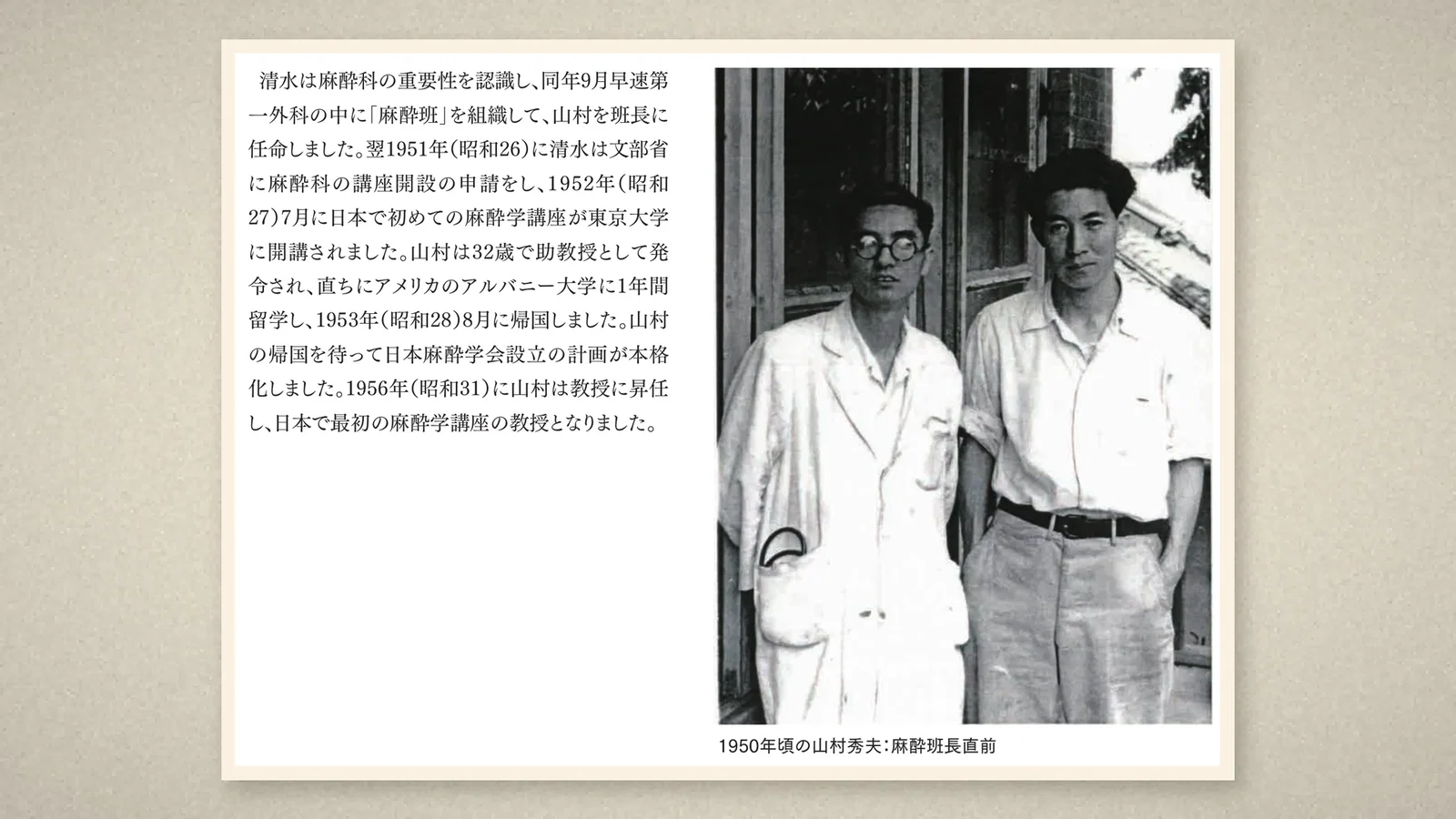
The booklet prints beside this paragraph a photograph captioned "Yamamura around 1950, just before becoming head of the anaesthesia group". Two people stand in front of a wooden building; the caption does not say which one is Yamamura. [1, p. 23]
A journal before a society
The JSA website states that in 1952 "the first academic journal 'Masui'", specialising in anaesthesia and related topics, "was launched by Kokuseido Publishing". [2] The CiNii library record gives the title as Masui = The Japanese Journal of Anesthesiology, published by Kokuseido from 1952, with holdings beginning at vol. 1 no. 1, April 1952. [4] Writing in the journal in 2023, Shiroh Isono noted that it had appeared two years before the Japanese society was founded in 1954, and reproduced a photograph of the first issue's cover: "Vol. 1 No. 1, April, 1952", the English title, the large characters 麻酔, and Kokuseido's name at the foot. [3, p. 416]
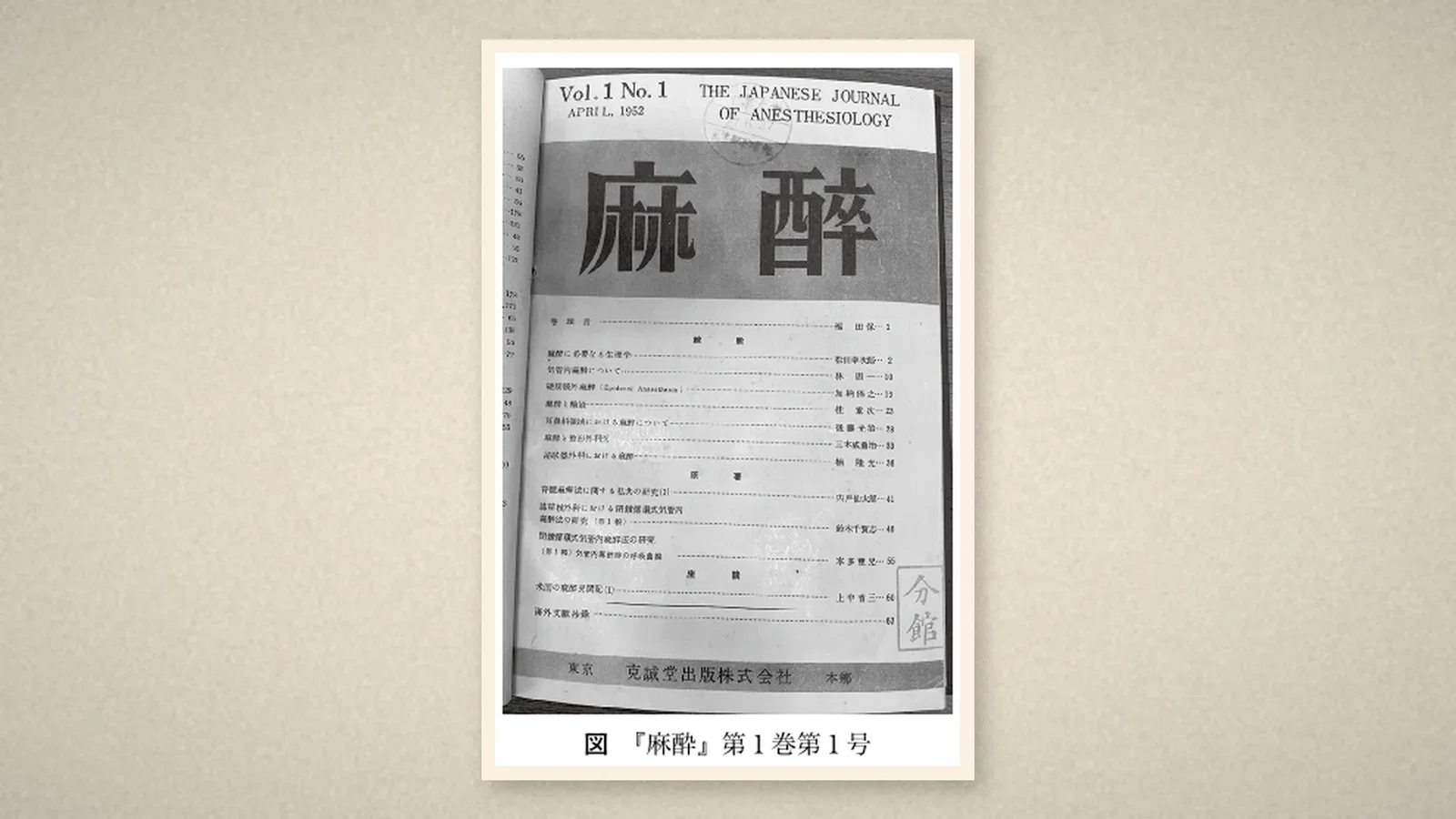
The foreword to that first issue was written by a surgeon, Professor Fukuda (福田保) of the Second Department of Surgery at the University of Tokyo. Isono quotes it, with Isono's own omissions. Major and difficult operations had lately become easy and successful, and alongside antibiotics such as penicillin, the foreword said, the progress of anaesthesia had to be given credit. Yet "we have no anaesthesia specialists who will take over the whole management of the patient", not only the pain during an operation. Anaesthesia needed the interest of many fields, centred on those who held the scalpel: pharmacy and pharmacology, biochemistry, physiology and serology, and internal medicine of the lungs, circulation and metabolism. "Here," the foreword ended, "the activity of this journal is expected." [3, p. 416-417]
What followed
The JSA website lists the departments that came after Tokyo: Tohoku in 1953 under Kenichi Iwatsuki, Keio in 1955 under Michinosuke Amano, Kyoto in 1956 under Akira Inamoto, and Sapporo Medical University in 1957 under Takeo Takahashi. [2] The Japanese Society of Anesthesiology was founded by decision of the Japan Surgical Society on 2 May 1954, and on 19 February 1960 anaesthesia was approved as a declared specialty. [1, p. 26]
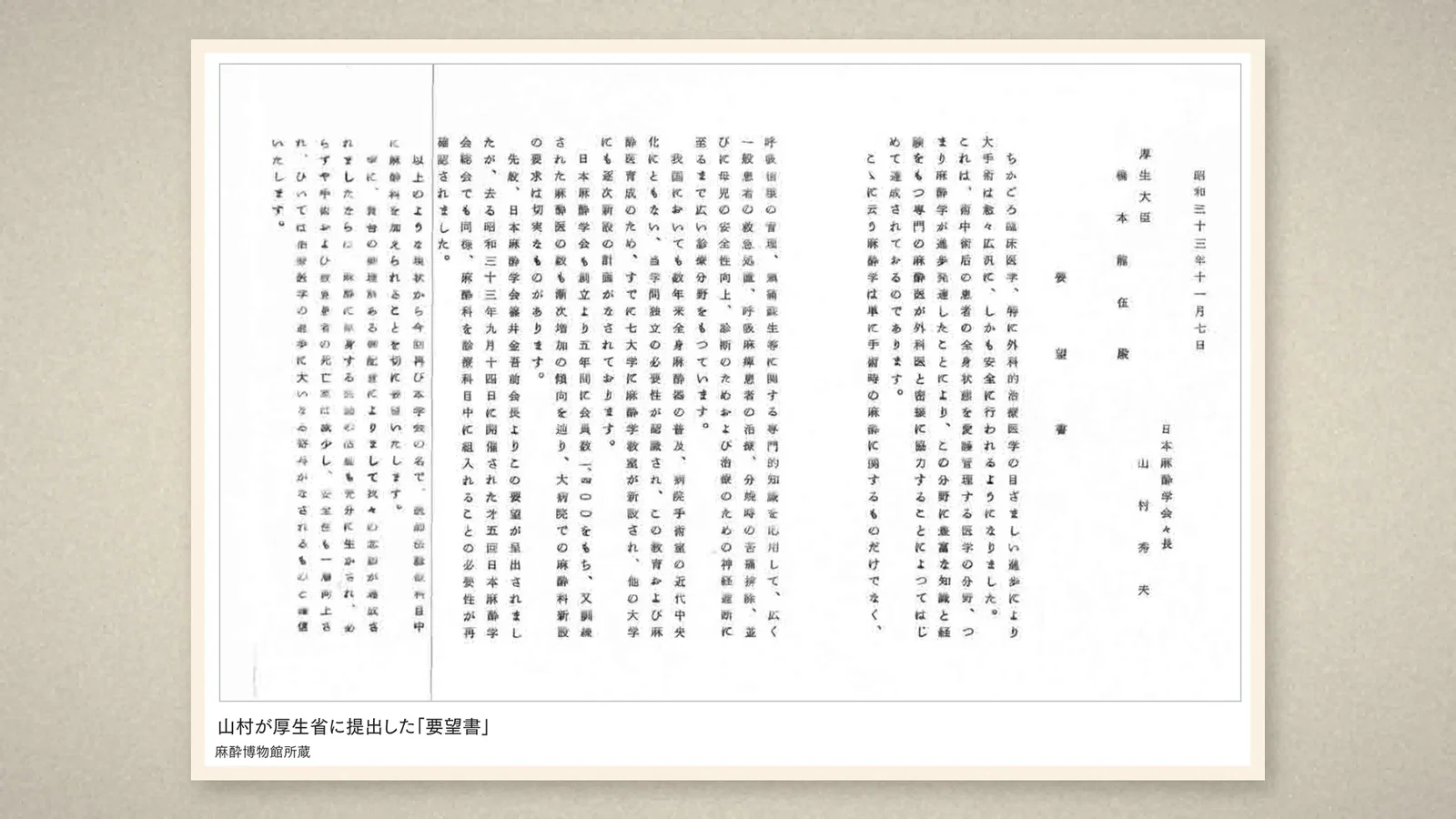
The booklet also reproduces a petition. Dated 7 November 1958 and addressed to the Minister of Health and Welfare, it is signed by Yamamura as president of the society. Its legible lines say that seven universities had already opened anaesthesia departments, that the society had 1,400 members five years after its founding, and that the petition asked again for anaesthesia to be added to the declared clinical departments. [1, p. 26]
A name came with the chair. In 2000 A. Matsuki wrote that the Japanese term masuigaku had been used for anaesthesiology ever since the first department was established at Tokyo in 1952, and argued that it was wrong: clinical specialties in Japanese carry the character ka, so the word should be masuikagaku. Matsuki also noted that masui itself was coined by Seikei Sugita in 1850, in a translation of a Dutch edition of Schlesinger's monograph on ether. [5]
What the record shows
In Tokyo the journal came first and the chair a few months later, and both came before the society. The first issue's foreword was written by a surgeon asking for specialists who did not yet exist. The chair grew out of a group inside a surgical department, and its first holder went abroad to train as soon as the appointment was made.
Sources and reading limits
Read: the JSA museum booklet, pp. 23-26 (text and page images, including the 1950 photograph and the 1958 petition, of which only legible phrases are used); the JSA English history page; the publisher's abstract page and free first-page preview of Isono 2023; the CiNii record for Masui; the PubMed abstract of Matsuki 2000.
Not covered: Masui vol. 1 no. 1 itself is not covered. Its foreword is known only through Isono's quotations, and its contents only through a low-resolution cover photograph, so no article in it is named here. The University of Tokyo centennial history has a section on the anaesthesia department, but its text was not found online. No Ministry of Education documents were obtained, nor were Yamamura's own recollections. The full texts of Isono 2023 and Matsuki 2000 were not read. The dates and the word "first" for the chair are the JSA's, from the society's own accounts. Shimizu's given name and the romanised readings of Fukuda's and Maeda's names are not in these sources, so none is supplied.
One illustration is a timeline drawn from the sources; three are crops of the booklet and of Isono's figure.
- Japanese Society of Anesthesiologists. The Japanese Museum of Anesthesiology 10th Anniversary [booklet]. pp. 23-26. PDF
- Japanese Society of Anesthesiologists. History. Website
- Isono S. [Preface and comments: patient safety during anesthesia in Japan at the time of the first issue of MASUI]. Masui. 2023;72(5):416-9. doi:10.18916/masui.2023050004
- CiNii Books. Masui = The Japanese journal of anesthesiology. Kokuseido, 1952-. NCID AN0023223X. CiNii
- Matsuki A. [Anesthesia, department of anesthesiology and anesthesiology: why has anesthesiology not been accepted socially in Japan?]. Masui. 2000;49(2):195-200. PubMed
Continue exploring
Related reading connects shared questions and contexts; it does not by itself establish historical influence.
- 1950: Saklad and the Institute on Medical Education for Japan
- 1952: Amano Returns from Chicago and Opens Anaesthesia Courses at Keio
Anesthesia Epochs · The Source Room · About & Editorial Method
Published November 2, 2026. Sources and reading limits are stated above. Illustrations are labelled as original source images or AI-made. Historical accounts are educational; they are not current treatment instructions.