The JSA museum booklet and history, and two Ministry of Health documents: the Medical Ethics Council's approval of anaesthesia as a special declared department in February 1960, the Ministry's notice of March 1960, the first instructor examination of February 1963, and the permission system that still exists.
Reading Library · Anesthesia Epochs · 中文版
Watch the education video (for clinicians)
1960: Japan Recognizes Anaesthesia — Who Could Advertise? · Anesthesia Epochs Education Series
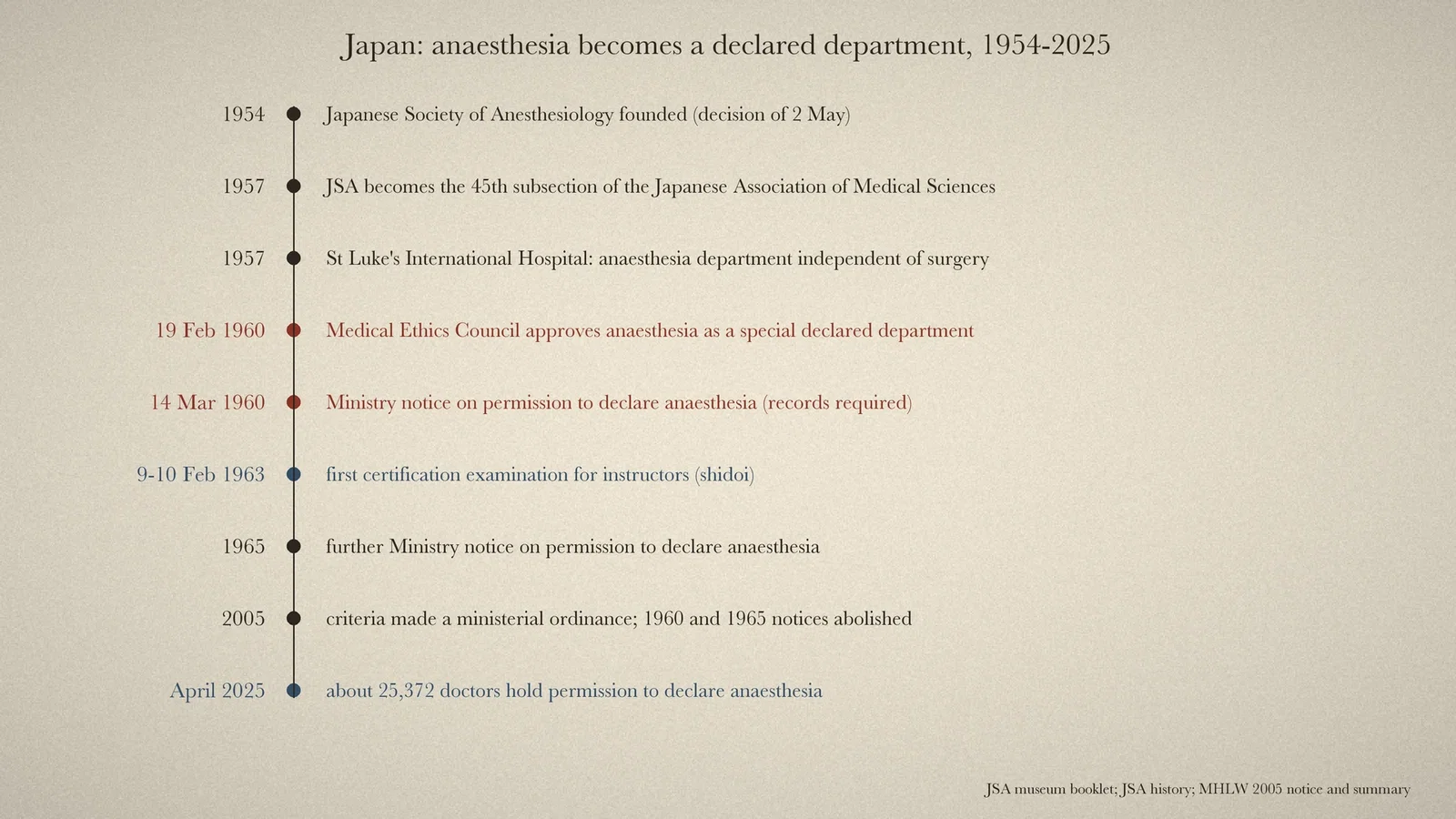
Earlier articles in this series follow Japanese anaesthesia from the Keio courses and the Tokyo chair of 1952. This one follows its entry into the state's rules. In Japan a doctor may advertise only certain clinical departments. In 1960 anaesthesia joined them under a special permission system that still exists, and three years later the first instructors who would train candidates were certified. The sources are the Japanese Society of Anesthesiologists' own museum booklet and history and two documents from today's Ministry of Health, Labour and Welfare.
From society to subsection
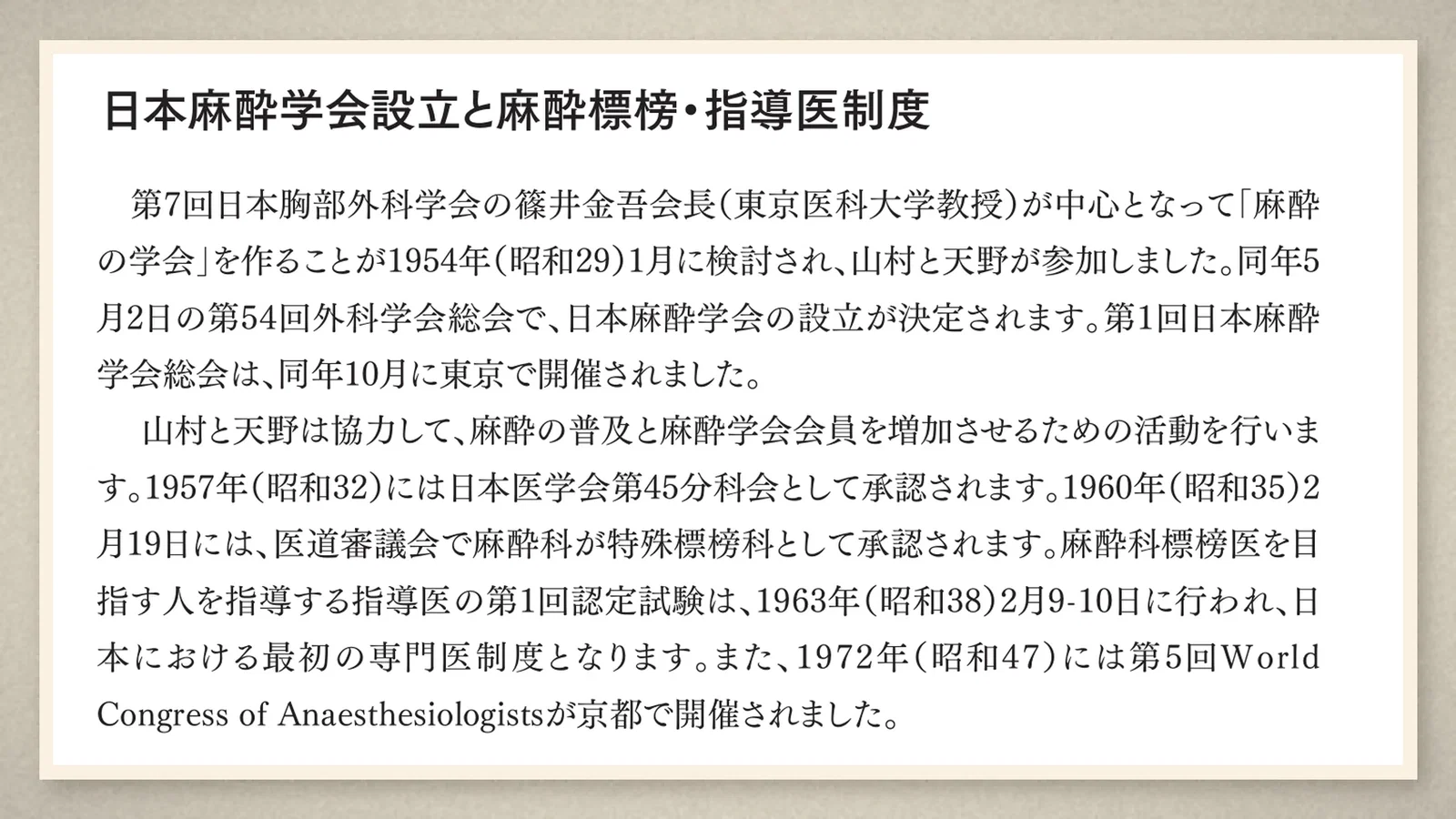
The JSA museum booklet tells the story briefly. In January 1954 a "society for anaesthesia" was discussed around 篠井金吾, president of the 7th meeting of the Japanese Association for Thoracic Surgery, and Hideo Yamamura and Michinosuke Amano took part. On 2 May 1954 the 54th meeting of the Japan Surgical Society decided to found the Japanese Society of Anesthesiology. [1, p. 26] Yamamura and Amano then worked together to spread anaesthesia and enlarge the society. In 1957 it was accepted as the 45th subsection of the Japanese Association of Medical Sciences. [1, p. 26]
The society's English history adds two signs of the time. In 1957 St Luke's International Hospital in Tokyo set up an anaesthesia department independent of surgery, which was "groundbreaking, as most anesthesia in hospitals at the time was delivered by physicians who belonged to the surgery department". In 1958 the Tokyo Society of Anesthesiologists formed, the first local gathering of full-time anaesthesiologists. [2]
February 1960
"On 19 February 1960", the booklet says, the Medical Ethics Council approved anaesthesia as a "special declared department" (特殊標榜科). [1, p. 26] The society's English history puts it more simply: "the Japanese Ministry of Health officially approved of the specialty of anesthesia in 1960". [2]
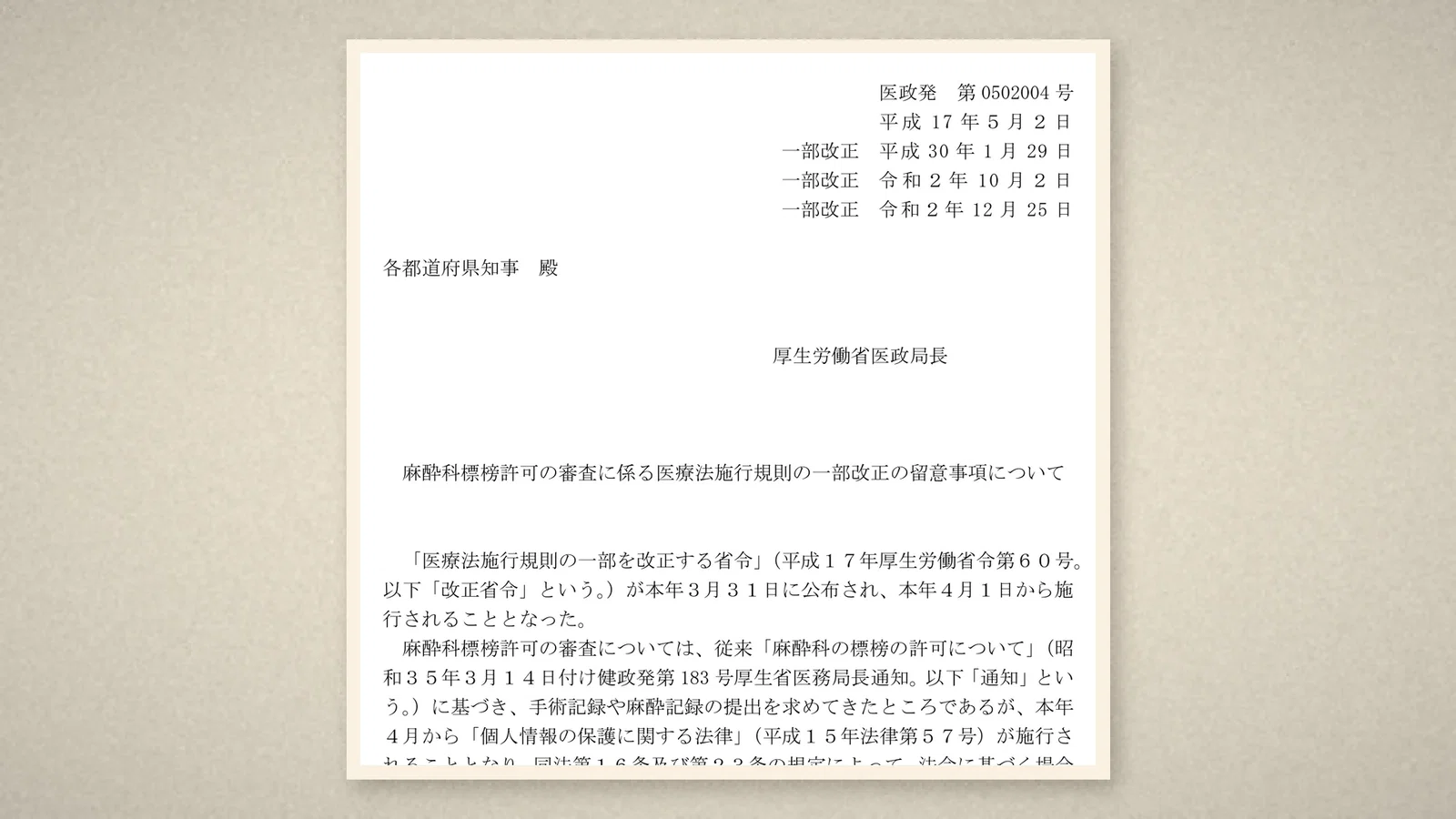
The administrative basis survives in a later Ministry document. A notice of 2 May 2005 explains that permission to declare anaesthesia had been reviewed under a notice of 14 March 1960, "On permission to declare anaesthesia" (Kensei-hatsu no. 183), from the Director of the Ministry's Medical Affairs Bureau. Under it, applicants had to submit surgical and anaesthetic records. [3, p. 1] With Japan's new personal-information law of 2005, those records could no longer simply be handed over. The criteria became a ministerial ordinance, and the 1960 notice and a further notice of 1965 were abolished. [3, p. 1]
February 1963
The booklet records the next step. The first certification examination for the instructors (指導医) who would teach those aiming to become declared anaesthetists was held "on 9-10 February 1963". The booklet calls it "the first specialist system in Japan" (日本における最初の専門医制度). [1, p. 26] The booklet also reproduces a petition that Yamamura, as the society's president, had submitted to the Minister of Health and Welfare; an earlier article in this series reads its date as November 1958. [1, p. 26]
The system today
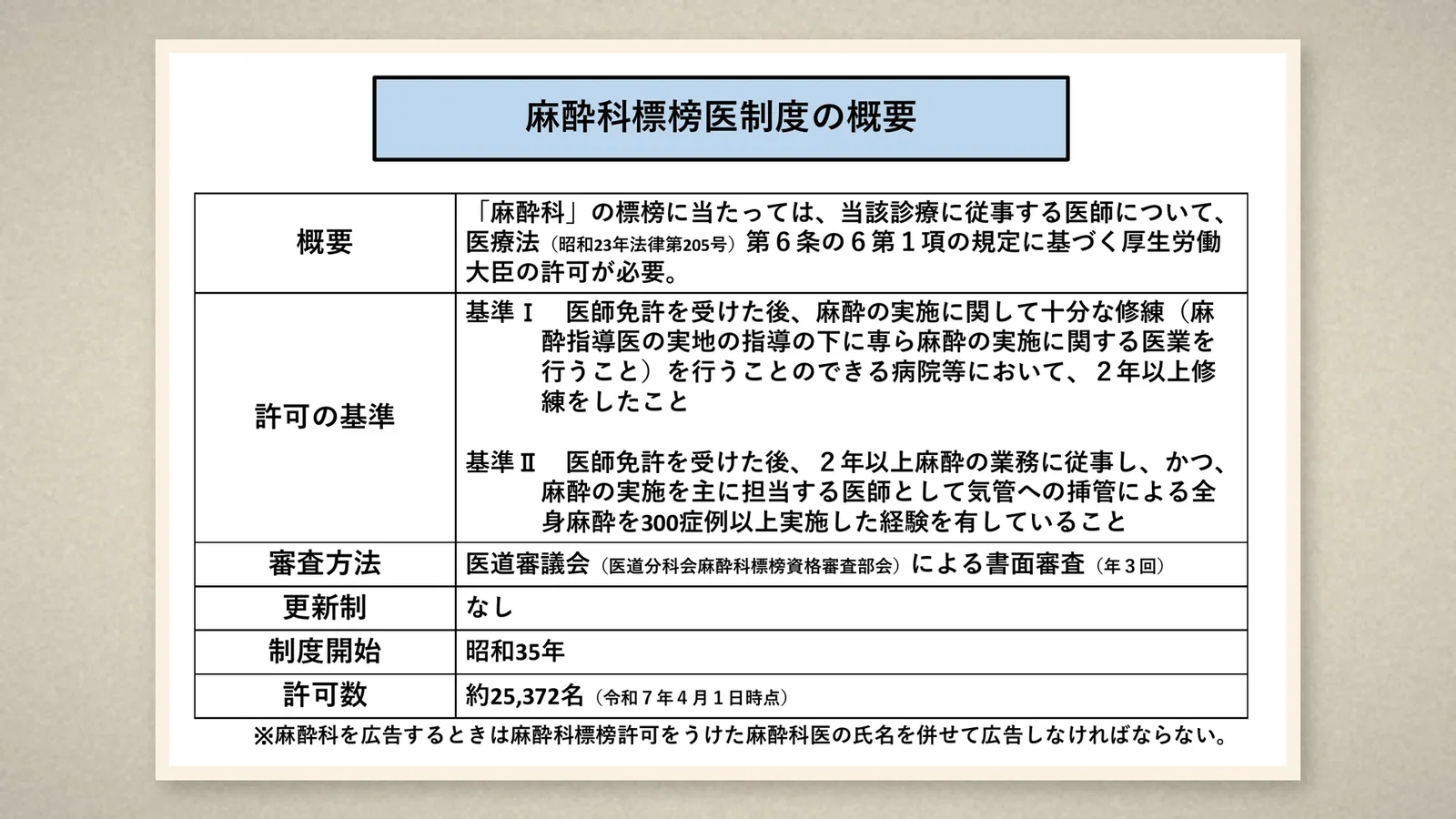
The permission system set up in 1960 is still in force. The Ministry's current one-page summary says that declaring "anaesthesia" requires the Minister's permission under Article 6-6(1) of the Medical Care Act. [4] There are two routes. One is two years' training in a hospital where a doctor can work under an instructor's direct supervision. The other is two years in anaesthesia with experience of at least 300 general anaesthetics with tracheal intubation. [4] Applications are reviewed in writing three times a year by a subcommittee of the Medical Ethics Council. There is no renewal, and the system's start is given as "Showa 35", that is, 1960. [4] About 25,372 doctors held permission on 1 April 2025, and anyone advertising anaesthesia must also name the permitted anaesthetist. [4]
What the record shows
In Japan, recognition of anaesthesia came first as an administrative permission: the right to put the department's name on a sign, granted by the Ministry from 1960. Certification of instructors followed in 1963, and the society's museum calls that the country's first specialist system. The permission itself has outlasted the notice that created it.
Sources and reading limits
Read: the JSA museum booklet, pp. 25-26, text and page image; the JSA English history page; the MHLW notice of 2 May 2005 (first two pages); the MHLW summary of the anaesthesia declaration system.
Not covered: the 1960 and 1965 notices themselves are not covered and are known only through the 2005 notice that cites them. The Medical Ethics Council minutes of 19 February 1960 and the regulations and records of the 1963 examination were not read. The dates of 19 February 1960 and 9-10 February 1963, and the phrase "first specialist system", come from the JSA booklet. The criteria quoted from the current summary are today's rules, not those of 1960. 篠井金吾 is given in the booklet's characters, without a romanised reading.
One illustration is a timeline drawn from the four sources; three are crops of the booklet and the Ministry documents.
- Japanese Society of Anesthesiologists. The Japanese Museum of Anesthesiology 10th Anniversary [booklet]. pp. 25-26. PDF
- Japanese Society of Anesthesiologists. History. Website
- Ministry of Health, Labour and Welfare. Notice Isei-hatsu no. 0502004, 2 May 2005, on the review of permission to declare anaesthesia (as amended). PDF
- Ministry of Health, Labour and Welfare. Summary of the anaesthesia declaration (hyobo) system. PDF
Continue exploring
Related reading connects shared questions and contexts; it does not by itself establish historical influence.
- 1952: Masui Appears and Tokyo Opens an Anaesthesia Chair
- 1952: Amano Returns from Chicago and Opens Anaesthesia Courses at Keio
Anesthesia Epochs · The Source Room · About & Editorial Method
Published November 2, 2026. Sources and reading limits are stated above. Illustrations are labelled as original source images or AI-made. Historical accounts are educational; they are not current treatment instructions.