
Anaesthesia kept its own base-and-time relative value guide when Medicare adopted the resource-based relative value scale, but the 1992 conversion factor that linked it to everyone else fell 29 per cent, to $13.68.
Reading Library · Anesthesia Epochs · 中文版
Watch the education video (for clinicians)
1992: Medicare's Fee Schedule — The Anaesthesia Conversion Factor · Anesthesia Epochs Education Series
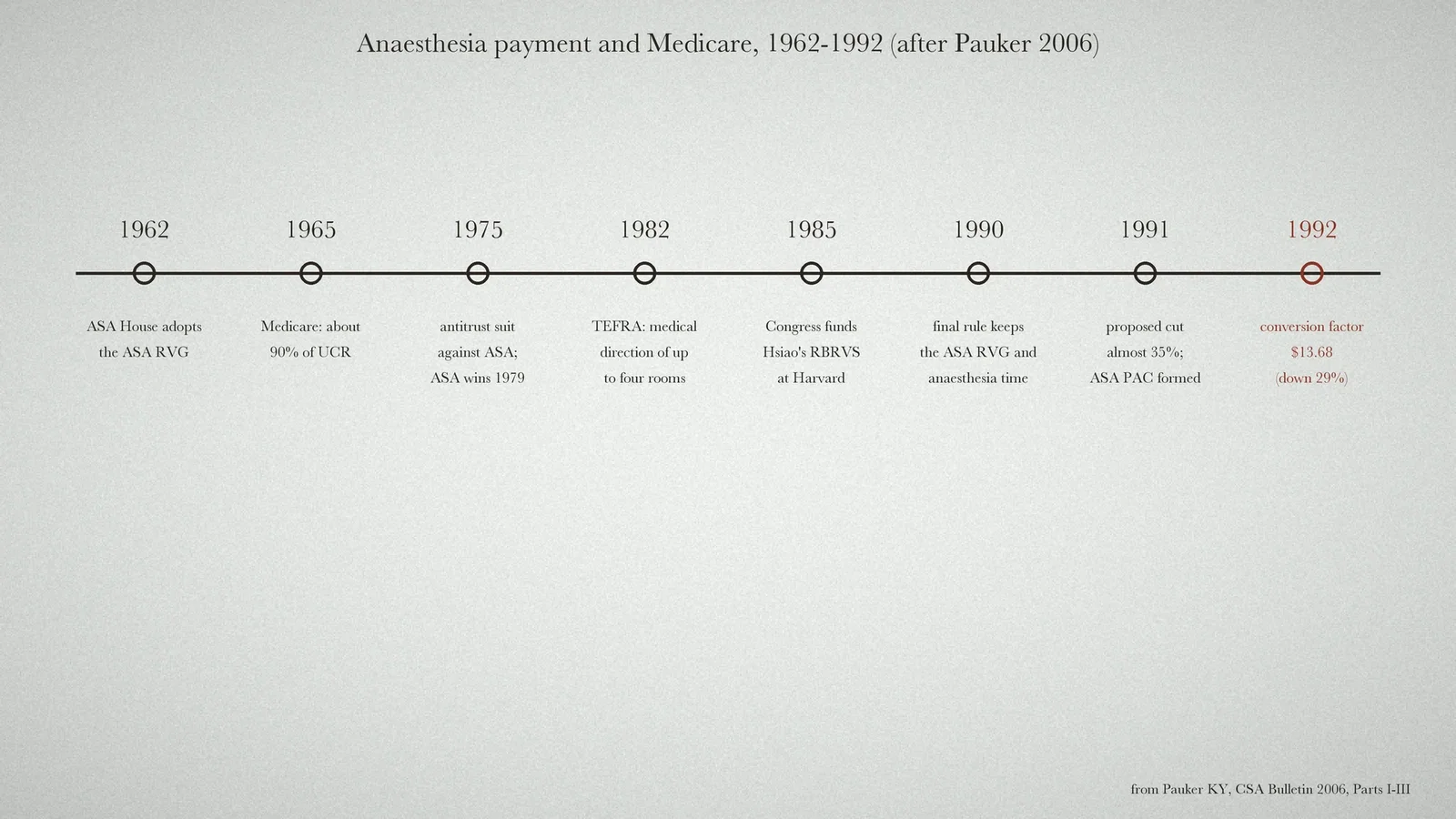
In 2006 Kenneth Y. Pauker, then a director and vice chair of legislative and practice affairs of the California Society of Anesthesiologists, wrote a three-part history of how Medicare came to value anaesthesia services. [1-3] Pauker's purpose was practical: the government was moving toward "pay for performance", and Pauker wanted anaesthesiologists to remember what had happened the last time Medicare rebuilt physician payment. This article follows that history to its central event, the 1992 Medicare Fee Schedule based on the resource-based relative value scale (RBRVS), and checks the reform's starting point against the 1988 report of its designer, William C. Hsiao. [4]
Base units and time
Pauker begins with how anaesthesiologists were paid. By the late 1940s a common arrangement was a flat fee, "typically 20 percent of the surgeon's fee". [1] In the 1950s Joseph H. Failing, a Los Angeles anaesthesiologist, developed the California Relative Value Guide, with base units, time units and risk adjustments, and took it through the CSA and the California Medical Association to the ASA. [1] After debate over whether a national guide smacked of "socialized medicine", the ASA House of Delegates adopted the ASA Relative Value Guide in 1962, a guide that at first was "merely a pamphlet of stapled mimeographed sheets". [1] Other specialties' guides fell to Federal Trade Commission consent orders; the Justice Department sued the ASA in 1975, and when the case was tried in 1979 the ASA prevailed. [1]
When Medicare began in 1965, anaesthesiologists were paid about 90 per cent of usual, customary and reasonable charges. Pauker credits Nick DePiero with persuading Wilbur Mills, chair of the House Ways and Means Committee, that anaesthesiology belonged in Part B with other physicians' services rather than in hospital costs. [1] Tax Equity and Fiscal Responsibility Act rules from 1982-1983 then set limits on medical direction, including a maximum of four simultaneously directed procedures. [1]
Hsiao's scale
The reform began elsewhere. In 1985, Pauker writes, Congress awarded Harvard and the Hsiao group a multimillion-dollar contract to develop an RBRVS, to shift Medicare money from specialists to primary care. [1] Hsiao and colleagues reported their results in 1988: "Invasive procedures are typically compensated at more than double the rate of evaluation-and-management services, when both consume the same resource inputs." Under a budget-neutral simulation the average family practitioner could receive 60 per cent more Medicare revenue and the average ophthalmologist could lose 40 per cent. [4] Anaesthesia was not among the specialties in that report. [4]
For anaesthesia the outcome at first looked like a success. After intense lobbying, the Physician Payment Review Commission recognised the ASA guide as consistent with resource costs, and the final rule published in 1990 kept the ASA guide and anaesthesia time units. [1] The problem lay in the conversion factor that turned anaesthesia units into dollars on the same scale as every other physician's work.
The 1992 conversion factor
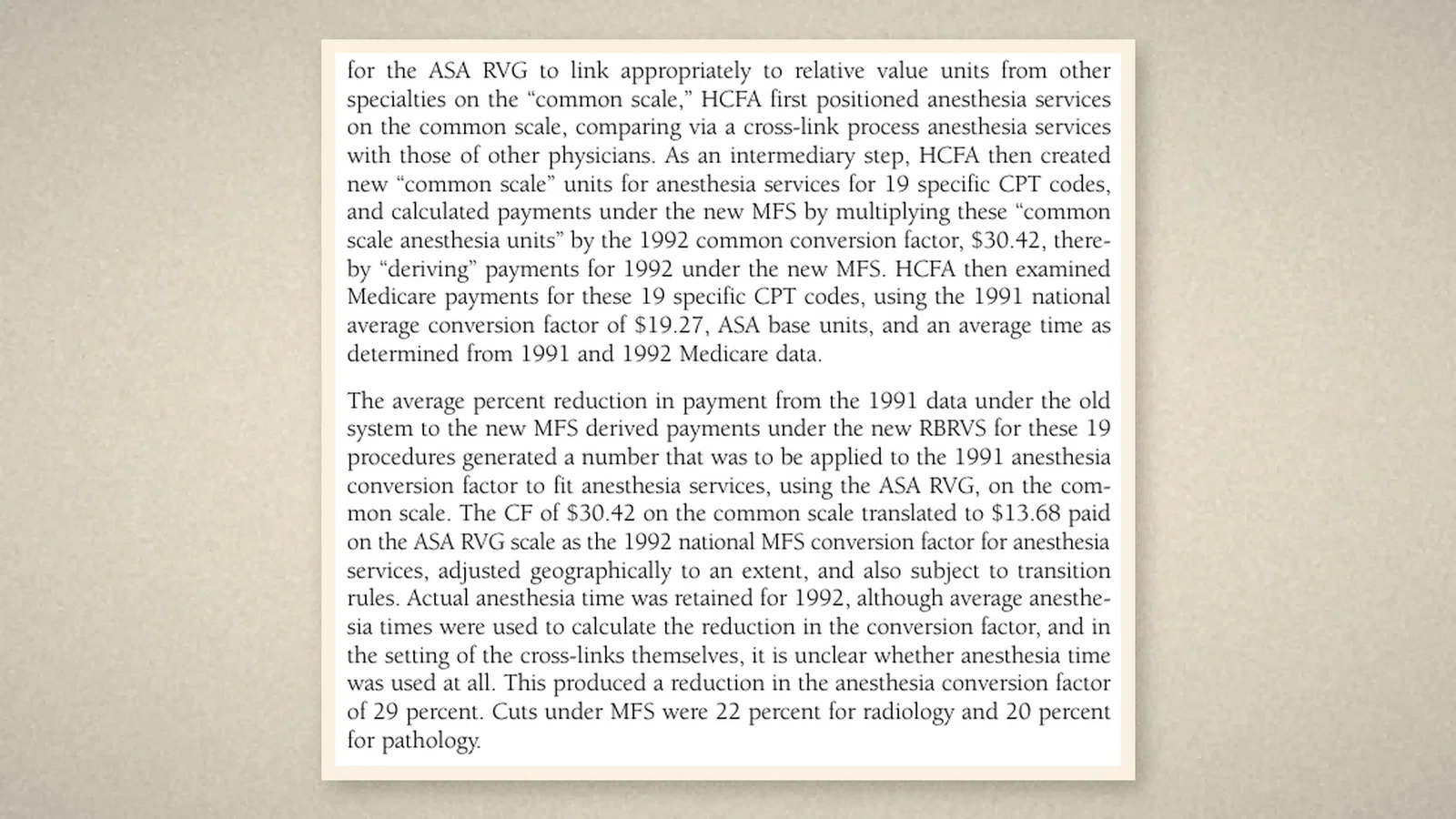
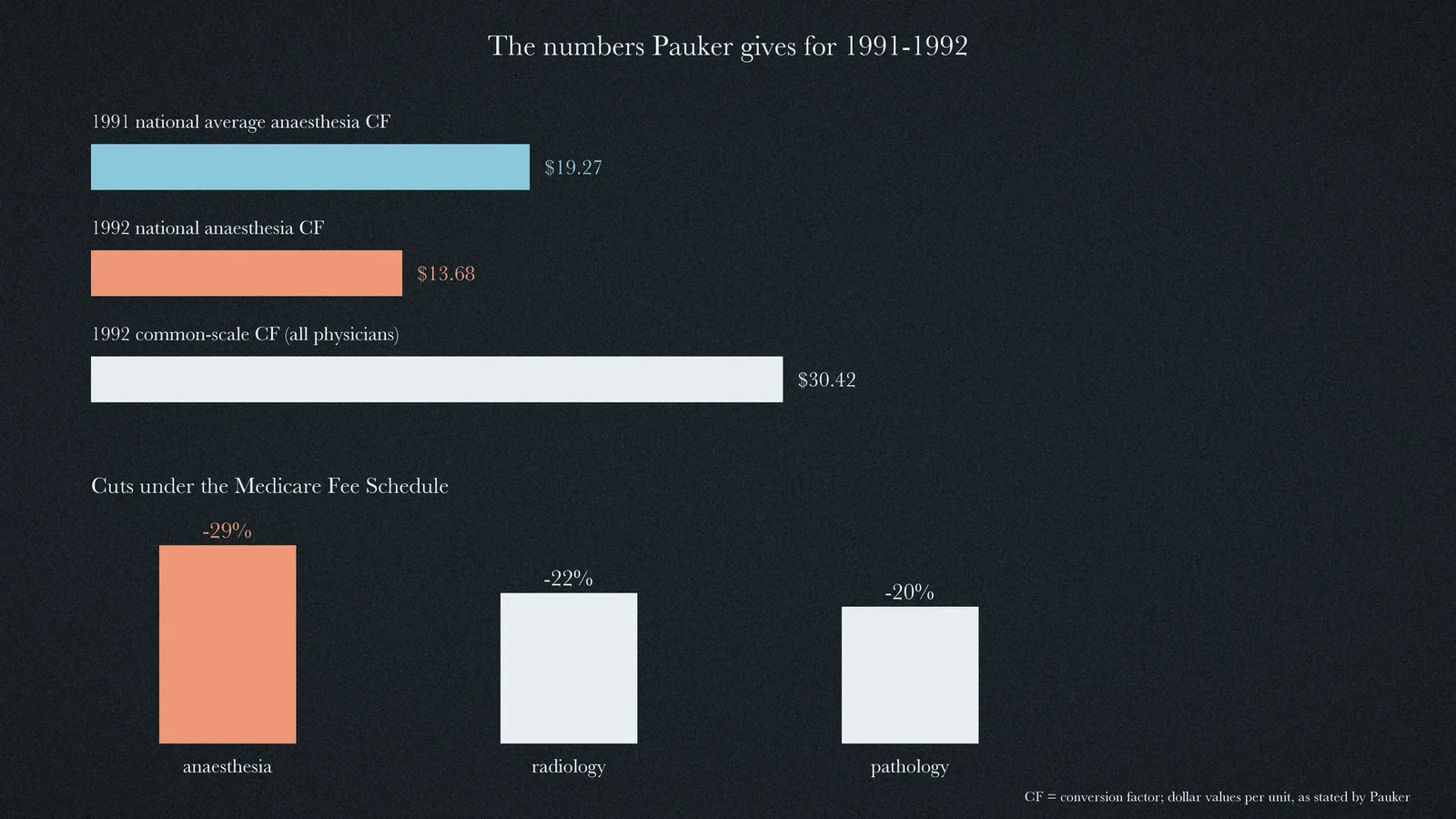
The ASA, Pauker writes, was "shocked in mid-1991" by the proposed reduction, almost 35 per cent against an expected 18 to 20. [2] HCFA's final method cross-linked 19 anaesthesia procedures to the common scale, computed what they would have earned at the 1992 common conversion factor of $30.42, and compared this with 1991 Medicare payments at the national average anaesthesia conversion factor of $19.27. [2] The result was a 29 per cent cut. Anaesthesia work, deemed 69.5 per cent of anaesthesia payment, was reduced by 41.7 per cent, and "the 1992 national anesthesia conversion factor became $13.68". [2] Radiology was cut by 22 per cent and pathology by 20. [2] Pauker also reports participants' recollection that anaesthesia "was addressed at the last moment" in only three meetings. [2]
Afterwards
The ASA Political Action Committee was formed in 1991. [3] In a letter of 6 February 1995 on the five-year refinement, ASA President Bernard Wetchler accepted the methodology "concept" while describing a study by Abt Associates which concluded that the final rule "undervalued anesthesia work by 35 percent". [3] Pauker's verdict, written eleven years later, is that the specialty had perhaps been "a bit politically naïve" and "a bit too passive". [3]
What the record shows
The anaesthesia guide survived the RBRVS reform almost intact; the value of each unit did not. The 1992 episode shows how a payment system can keep a specialty's own scale while changing its worth through one number set elsewhere, and why anaesthesiologists in 2006 looked back on it before the next reform.
Sources and reading limits
Read: all three parts of Pauker's 2006 history in the CSA Bulletin, from text-layer PDFs archived from the California Society of Anesthesiologists website; the PubMed abstract of Hsiao and colleagues' 1988 paper.
Not covered: the full Hsiao papers; the HCFA proposed and final rules of 1991 in the Federal Register; Physician Payment Review Commission reports; ASA House of Delegates records; the 1995 letter and the Abt Associates study, known here only through Pauker. Pauker writes as a CSA officer making an argument about pay for performance; judgments such as the description of Hsiao's work as "egregiously flawed" are Pauker's. Figures are as stated by Pauker and have not been recomputed.
Two illustrations are crops of Pauker's articles; two are drawn from them.
- Pauker KY. A history of RBRVS as a perspective on P4P - Part I. CSA Bull. 2006 Spring:42-8. Internet Archive PDF
- Pauker KY. A history of RBRVS as a perspective on P4P - Part II. CSA Bull. 2006 Summer. Internet Archive PDF
- Pauker KY. A history of RBRVS as a perspective on P4P - Part III. CSA Bull. 2006 Fall. Internet Archive PDF
- Hsiao WC, Braun P, Dunn D, Becker ER, DeNicola M, Ketcham TR. Results and policy implications of the resource-based relative-value study. N Engl J Med. 1988;319(13):881-8. PubMed
Continue exploring
Related reading connects shared questions and contexts; it does not by itself establish historical influence.
- 2009: The ASA Builds a Registry of Every Anaesthetic
- 2012: Anaesthesiologists Propose a Perioperative Surgical Home
Anesthesia Epochs · The Source Room · About & Editorial Method
Published November 2, 2026. Sources and reading limits are stated above. Illustrations are labelled as original source images or AI-made. Historical accounts are educational; they are not current treatment instructions.