Oscar Liebreich's 1869 monograph brought chloral hydrate into human observation, recording sleep case by case while leaving its explanation and its use for larger operations as open questions.
Reading Library · Anesthesia Epochs · 中文版
Watch the education video (for clinicians)
1869: Liebreich's Chloral Hydrate — What the Clock Times Record · Anesthesia Epochs Education Series

An original imagining of a nineteenth-century hospital room. The bed, chair and window light do not reconstruct a particular Charité room or represent an identified patient.
On 31 May 1869, a patient at Berlin’s Charité said that sleepiness was setting in after receiving chloral hydrate. The patient blinked and later closed both eyes. When called, the patient opened them briefly, then returned to sleep. Liebreich recorded these changes against times in the same case history. [1, p. 35]
There is more here than a drug producing sleep. Closed eyes, responsiveness, renewed sleep and a later report about pain were distinct observations. The word sleep cannot combine them into proof of surgical anesthesia.
Oscar Liebreich’s 1869 monograph brought chloral hydrate into human observation while preserving the distance between an observed effect, its explanation and a proposed clinical use.
A question prompted by chemistry
The title called it a new hypnotic and anesthetic. The title page gives Berlin, 1869, and the publisher Grg. Ferd. Otto Müller. This article uses the book’s publication year; a dated case is not made into the starting date of the whole investigation. [1, title page]
In the opening pages, Liebreich distinguished knowing that a substance acts from understanding why it acts. Liebreich asked whether substances entering the body undergo decomposition, seeking questions for therapeutics in their chemical properties. [1, pp. 1–5]
At the start of the animal section, Liebreich considered the production of chloroform under alkaline conditions and extended that reasoning to blood. Liebreich also discussed difficulties in directly identifying and separating the relevant substances, turning to comparison of their effects for support. [1, pp. 15–17]
This was a historical line of investigation, not an in-vivo metabolic pathway established by this essay. A reaction outside the body, direct evidence of products within it and behavioral changes after administration answer different questions. Observing sleep cannot supply all three forms of proof.

Two separate empty glass vessels and a plain divider suggest a gap between an observation and an explanation. This original metaphor is not a reaction apparatus, blood sample or metabolic diagram.
More than one kind of sleep story
The section headed therapeutic experiments describes a move from animals to people, initially using subcutaneous administration in psychiatric patients and subsequently oral administration. Liebreich acknowledged the clinicians and department heads who made their patients available. [1, pp. 33–35]
These statements describe Liebreich’s account of the work. They cannot supply missing evidence of modern informed consent or ethics review.
The first three cases on page 34 repay reading together. In Case I, stimulation could awaken a sleeping patient, who then closed both eyes again. Case II included falling asleep while seated the following morning and falling to the ground. Case III recorded dizziness and a lingering heavy-headed feeling the next morning. [1, pp. 34–35]
Nearby, Liebreich likened appearance, pulse and breathing to natural sleep. Yet the cases themselves contained other observations. Reading Liebreich’s characterization alongside the records prevents resemblance to sleep from becoming a claim of no adverse effects.
These are not incidence data. The selected cases used here supply neither a common follow-up framework nor the complete denominator needed for a risk calculation. No efficacy or complication percentages are derived here.
A dated bedside record
Case IV is dated 31 May 1869. The patient had spinal disease, pain and disturbed sleep. The account follows drowsiness, blinking and eye closure, then brief awakening when called and renewed sleep. Later the patient reported having been free of pain during the preceding period. [1, p. 35]
This is a particular observation worth preserving. No operation is recorded during it, and there is no concurrent control. The patient’s illness, previous treatment and the manner of observation remain part of the account.
The sequence is retained here without turning the original doses, prescriptions or administration steps into a present-day regimen. A dated case locates an attempt; it does not establish worldwide priority.
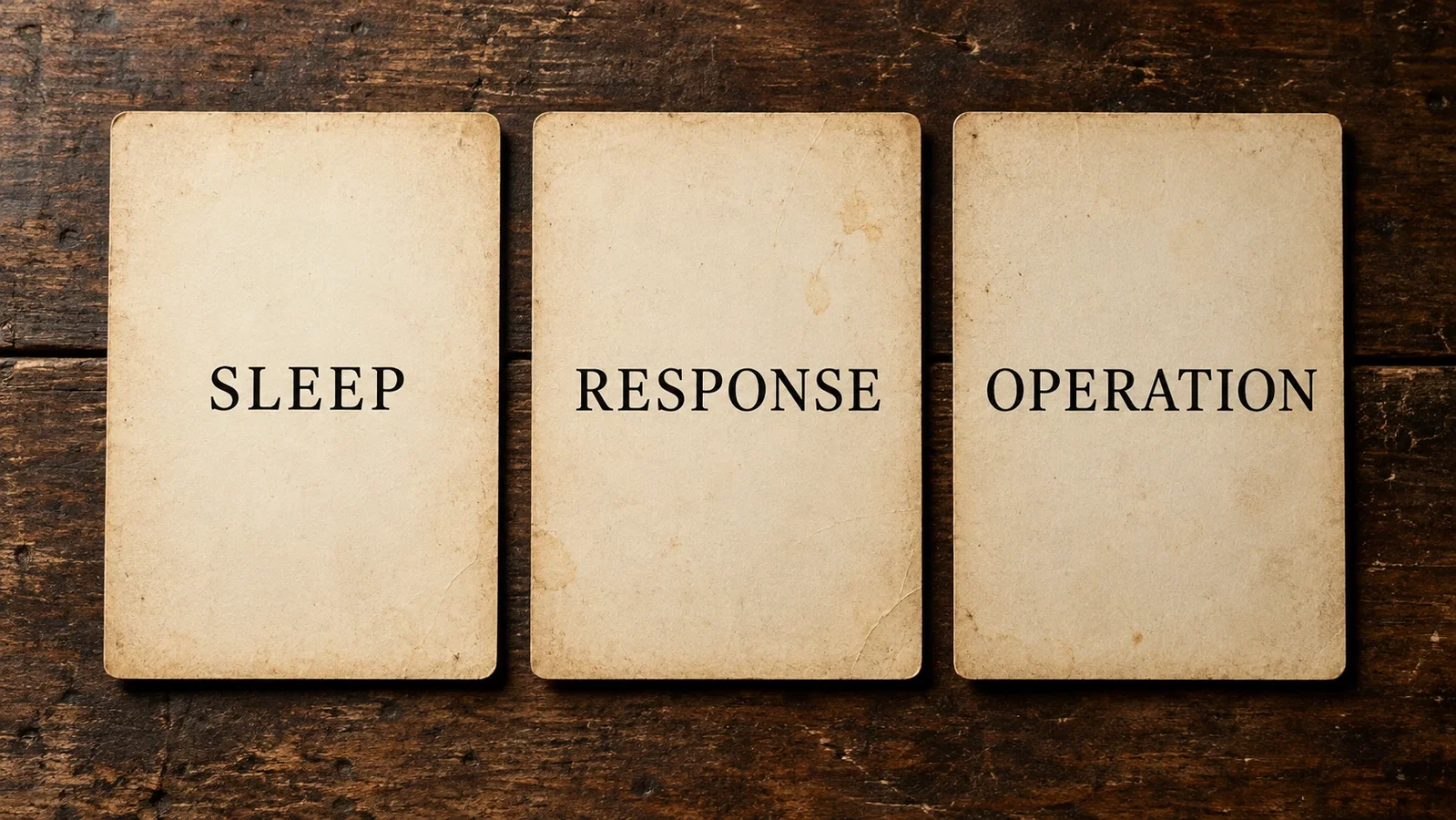
Modern cards reading SLEEP, RESPONSE and OPERATION distinguish sleep, responsiveness and surgical suitability. They are not the book’s stage names, a scoring system or a treatment pathway.
Major surgery remained a prospect
On page 56, Liebreich acknowledged that the human experiments presented mainly showed the first stage Liebreich distinguished and the beginnings of the second. Anesthesia observed in animals encouraged Liebreich’s hopes for larger operations, although Liebreich recognized the need for caution in applying animal experience directly to people. [1, pp. 55–56]
The same discussion identified a practical limitation. Once the drug had been given, its action could not then be interrupted at any chosen moment. Liebreich contrasted this with the gradual administration of inhaled chloroform and left the question of comparative advantage to practical experience. [1, pp. 56–57]
This is not evidence that chloral hydrate had already replaced chloroform. Enthusiastic proposals, individual cases and concern about controlling the effect belong in the history together.
The closing recommendations were broad. Liebreich identified some contraindications and expected continued use to clarify the drug’s action. [1, pp. 57–60] That confidence is itself historical evidence. It is not a present-day conclusion about safety, indications or comparative effectiveness.

A blank open notebook beside an empty chair represents continuing observation. It is not an original casebook, a depiction of the patient’s fall or fabricated handwritten data.
What the book preserves
Liebreich’s book contains both anticipation and particulars. After a patient closed their eyes, there could still be a response, another awakening or discomfort the next day. These records deserve to survive the shorter description of a new drug.
Sources and reading limits
Read: Liebreich’s Das Chloralhydrat (Berlin, 1869), the title page, dedication and pages 1–5, 15–17, 33–35 and 52–60. Pages 33–35 and 55–57 are central here.
Not covered: the rest of the book, including most of the animal experiments and the later cases, among them those from the surgical department; Liebreich’s paper in the Berliner Klinische Wochenschrift of the same year. Earliest oral premedication, priority and the modern mechanism are not judged here. The four illustrations are AI-made interpretive images, not historical evidence.
- Liebreich O. Das Chloralhydrat: ein neues Hypnoticum und Anaestheticum und dessen Anwendung in der Medicin. Berlin: Grg. Ferd. Otto Müller; 1869. Internet Archive
Continue exploring
Related reading connects shared questions and contexts; it does not by itself establish historical influence.
- 1832: Liebig's Observations and Questions on Chloral
- 1847: Chloroform, from Self-Experiment to a Public Report
- 1848: Snow Warns That Chloroform Keeps Deepening After Inhalation
Anesthesia Epochs · The Source Room · About & Editorial Method
Updated October 30, 2026. Sources and reading limits are stated above. Illustrations are labelled as original source images or AI-made. Historical accounts are educational; they are not current treatment instructions.