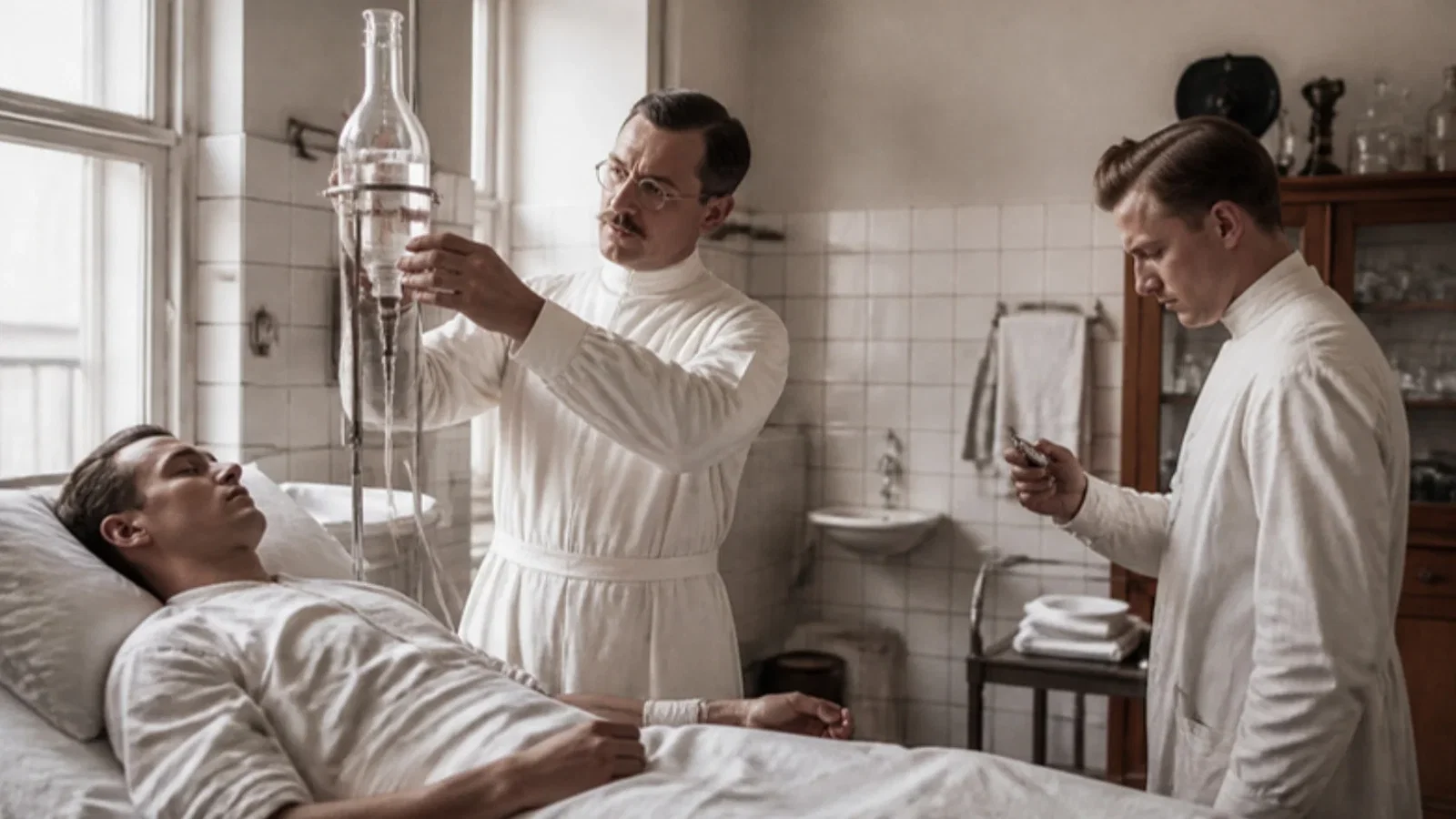
A general anaesthetic called the least dangerous of all met thrombosis on an operating table in Breslau within months.
Reading Library · Anesthesia Epochs · 中文版
Watch the education video (for clinicians)
1909: Burkhardt's Intravenous Anaesthesia — Küttner's Warning · Anesthesia Epochs Education Series
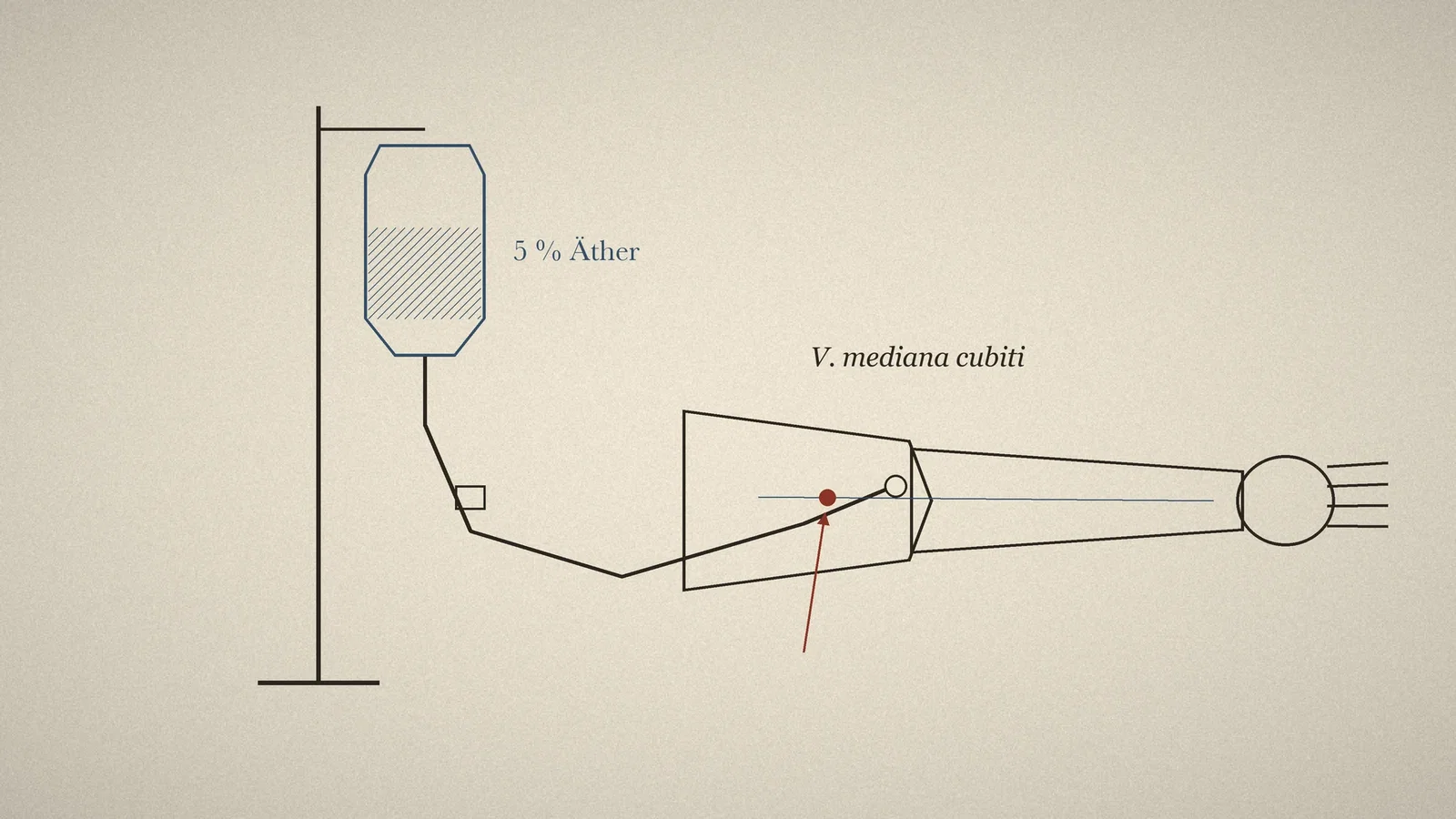
In 1909 a new method of general anaesthesia came out of the pharmacological institute and the surgical university clinic at Würzburg: instead of having the patient breathe the anaesthetic, dissolve it in saline and run it slowly into a vein. Its author was L. Burkhardt. The original papers appeared in the Münchener medizinische Wochenschrift and could not be found for this article; what can be read are the abstracts in the Zentralblatt für Chirurgie, a prominent surgeon's warning, and Burkhardt's own reply.
First step: intravenous chloroform
The Zentralblatt für Chirurgie for 1909, No. 44, abstracted Burkhardt's paper in the Münchener medizinische Wochenschrift 1909, No. 33, noting that it came from the pharmacological institute and surgical university clinic at Würzburg. [1, p. 1500] Burkhardt began with animals, running chloroform-saturated saline slowly through a glass cannula tied into the jugular vein until anaesthesia appeared, and topping it up to maintain it. [1, p. 1500]
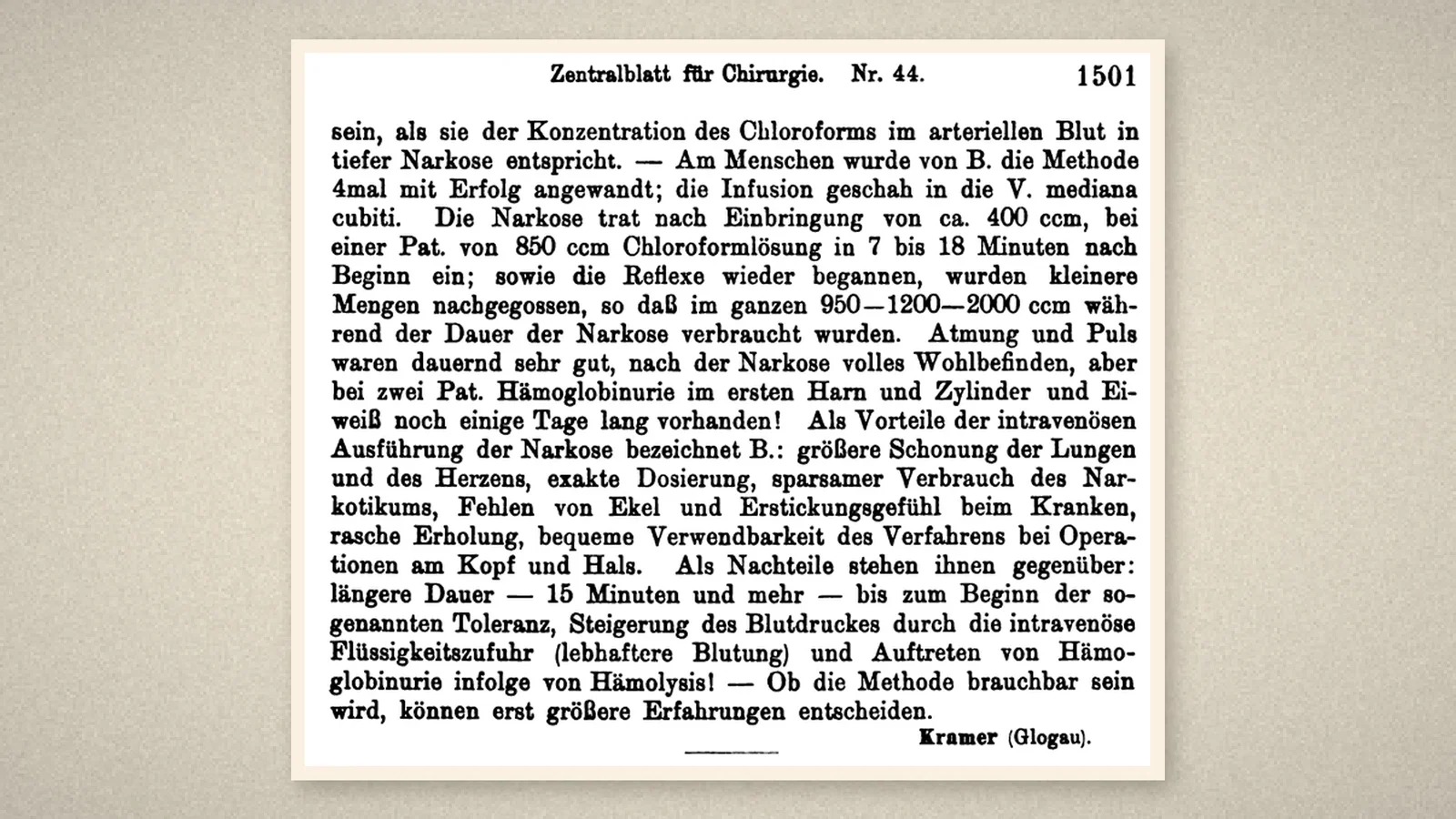
Burkhardt then used the method successfully four times in man, infusing into the median cubital vein. [1, p. 1501] Breathing and pulse remained very good and the patients felt well afterwards, but two had haemoglobinuria in the first urine, with casts and protein for several days. [1, p. 1501]
The advantages listed were greater protection of lungs and heart, exact dosing, economy of the drug, no disgust or feeling of suffocation for the patient, rapid recovery, and convenience for operations on the head and neck. [1, p. 1501] The drawbacks were stated as plainly: fifteen minutes or more before so-called tolerance; a rise in blood pressure from the infused fluid, with livelier bleeding; and haemoglobinuria from haemolysis. [1, p. 1501] The abstracter, Kramer, ended with one line: whether the method would prove useful only larger experience could decide. [1, p. 1501]
Second step: intravenous ether
In No. 46 of the same year Burkhardt published "Die intravenöse Narkose mit Äther und Chloroform". The Zentralblatt abstract of 1910, No. 7, reports that on the basis of 41 intravenous anaesthetics in man, mostly with a 5% ether solution, Burkhardt asserted that "intravenous ether anaesthesia is at present the least dangerous and most pleasant method of general anaesthesia"; because induction was cumbersome, however, it would always be reserved for special cases. [2, p. 238] The same page abstracted Giani's Italian report of two cases of intravenous chloroform, so the idea was being tried in more than one place. [2, p. 238]
A warning from Breslau
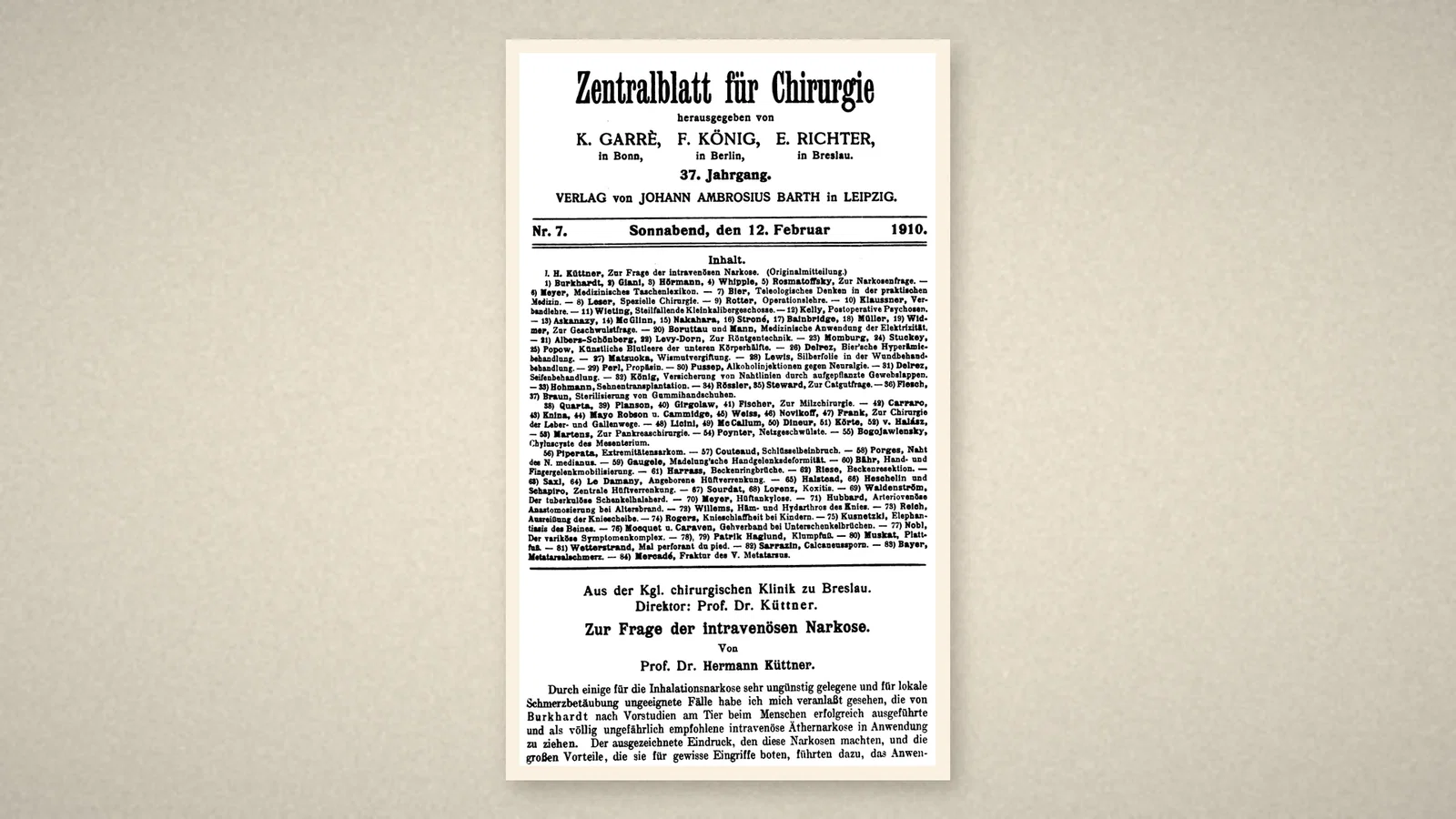
In the same No. 7, dated 12 February 1910, Hermann Küttner, director of the surgical clinic at Breslau, published "Zur Frage der intravenösen Narkose". [2, p. 233] Cases badly suited to inhalation and unsuitable for local anaesthesia had led Küttner to try Burkhardt's intravenous ether; Küttner now reported 23 operations under it, "not to recommend the method but to warn against it". [2, p. 234]
The trouble lay at the infusion site. Twice the solution stopped running and a second vein had to be exposed. During an operation on a recurrent sarcoma of the buttock the patient suddenly became cyanotic, with shallow rapid breathing, and recovered only when the infusion was stopped. Following the median cubital vein upward, they found it completely occluded by a fresh, pea-sized thrombus. [2, p. 234] Küttner took this as an embolism on the table; that patient and another with gastric cancer then developed extensive changes in the right lung, judged by the physicians to be infarcts. Küttner abandoned the method.
Burkhardt's reply
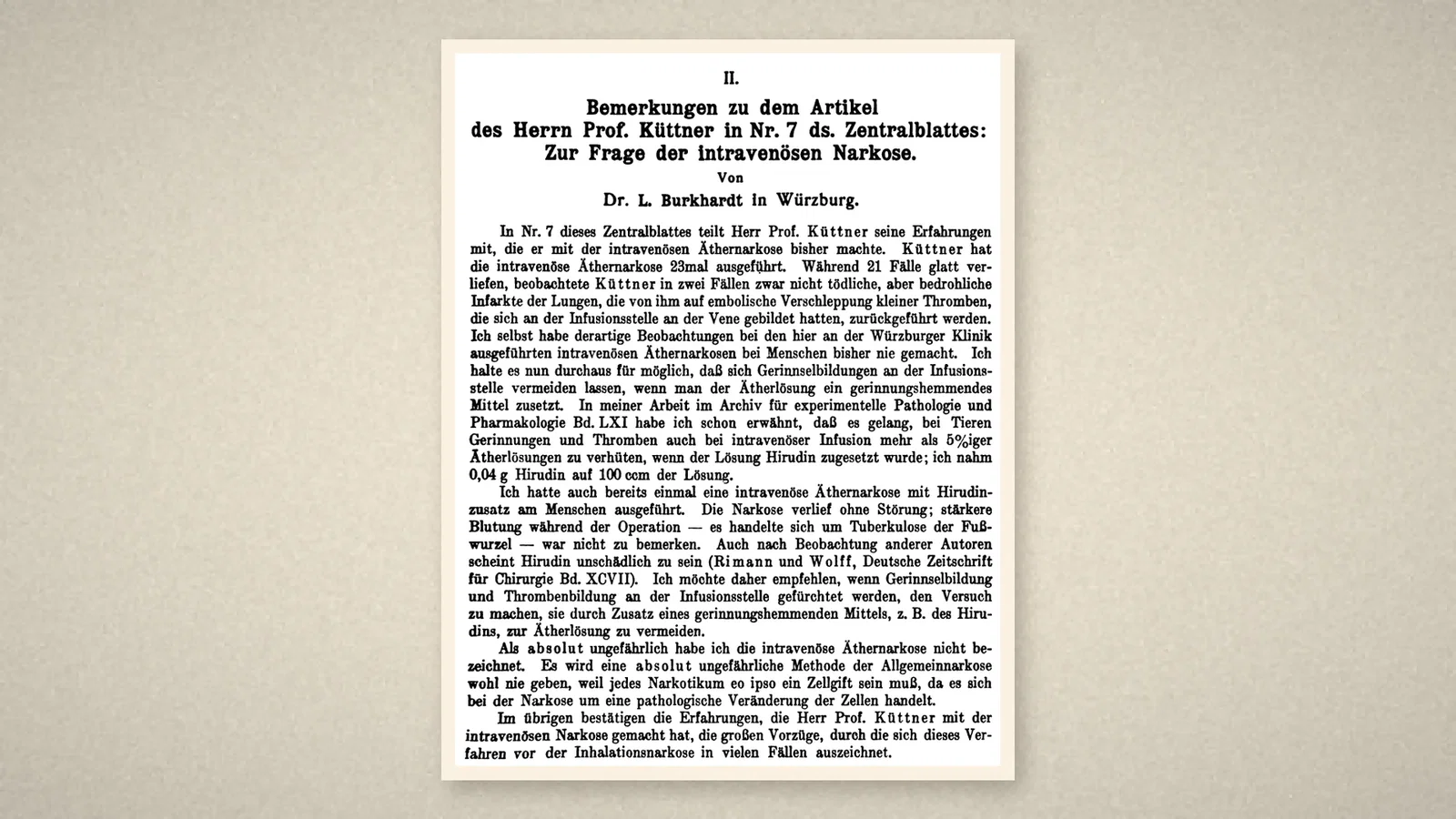
A few weeks later, No. 10 carried Burkhardt's answer. Küttner, Burkhardt summarized, had given 23 intravenous ether anaesthetics; 21 had gone smoothly, and in two there had been threatening, though not fatal, infarcts of the lungs. [2, p. 355] Burkhardt had never seen this at Würzburg, and proposed adding an anticoagulant to the ether solution: in animals Burkhardt had used hirudin, 0.04 g per 100 ccm of solution, and had once used it in a patient without trouble. [2, p. 355]
Burkhardt also corrected the record: intravenous ether anaesthesia had never been called absolutely safe in Burkhardt's work; an absolutely safe method of general anaesthesia would probably never exist, since every narcotic was of itself a cell poison. [2, p. 355]
More objections
Later in 1910 the Zentralblatt abstracted two more papers from the Münchener medizinische Wochenschrift. Sick of Leipzig likewise warned against Burkhardt's method, advocating ether inhalation combined with subcutaneous scopolamine, morphine and similar drugs to avoid large doses of any single agent. [3, p. 1085] Brüning raised theoretical objections: a 7% ether solution caused haemolysis even at body temperature, more so in fever, while weaker solutions meant infusing more fluid. [3, p. 1086]
What the record shows
The idea of intravenous general anaesthesia was clearly on the table in 1909: exact dosing, no irritation of the airway, convenience for head and neck surgery. What it ran into were problems of its own: large volumes of fluid, haemolysis, thrombosis and embolism at the infusion site. Burkhardt sought to answer clotting with hirudin; Küttner simply gave the method up. Their exchange set out early the questions intravenous anaesthesia would later have to answer.
Sources and reading limits
Read: in the Zentralblatt für Chirurgie, the abstract of Burkhardt's intravenous chloroform paper (1909, No. 44, pp. 1500–1501); the abstract of the intravenous ether paper (1910, No. 7, p. 238); Küttner's article (No. 7, from p. 233); Burkhardt's reply (No. 10, p. 355); and the abstracts of Sick and Brüning (No. 33, pp. 1085–1086).
Not covered: Burkhardt's original papers in the Münchener medizinische Wochenschrift 1909, Nos. 33 and 46, and the paper in the Archiv für experimentelle Pathologie und Pharmakologie were not found (the weekly is not on the Internet Archive); the work is described here through contemporary abstracts and Burkhardt's own reply, without the original page numbers or exact dates of issue.
Of the four illustrations, three are crops of Zentralblatt pages and one is a diagram drawn for this article from the sources; it does not represent the specific apparatus used.
- Kramer. [Abstract of] Burkhardt L. Über intravenöse Chloroformnarkose. Münch Med Wochenschr 1909;(33). Zentralbl Chir. 1909;36(44):1500-1. Internet Archive
- Zentralbl Chir. 1910;37: Küttner H. Zur Frage der intravenösen Narkose. (7):233-5; Wilmanns. [Abstract of] Burkhardt L. Die intravenöse Narkose mit Äther und Chloroform. Münch Med Wochenschr 1909;(46). (7):238; Burkhardt L. Bemerkungen zu dem Artikel des Herrn Prof. Küttner. (10):355. Internet Archive
- Kramer. [Abstracts of] Sick; Brüning A. Zur Frage der intravenösen Narkose; Theoretische Bedenken gegen die intravenöse Äthernarkose. Münch Med Wochenschr 1910;(21),(22). Zentralbl Chir. 1910;37(33):1085-6. Internet Archive
Continue exploring
Related reading connects shared questions and contexts; it does not by itself establish historical influence.
Anesthesia Epochs · The Source Room · About & Editorial Method
Published November 2, 2026. Sources and reading limits are stated above. Illustrations are labelled as original source images or AI-made. Historical accounts are educational; they are not current treatment instructions.