Squibb described a steam-heated still for making ether, and a year later said practice had been 'in the hands of the manufacturer'.
Reading Library · Anesthesia Epochs · 中文版
Watch the education video (for clinicians)
1856: Squibb's Steam Apparatus — Making Purer Ether · Anesthesia Epochs Education Series
A navy physician who made the navy's medicines set out a plain argument: an anaesthetic is only as good as the bottle it comes from. In two papers, one on how to make ether and one on how to judge chloroform, Edward R. Squibb moved the question of safety from the patient's bedside back to the still. [1, p. 385][2, p. 1][2, p. 11]
The ether paper
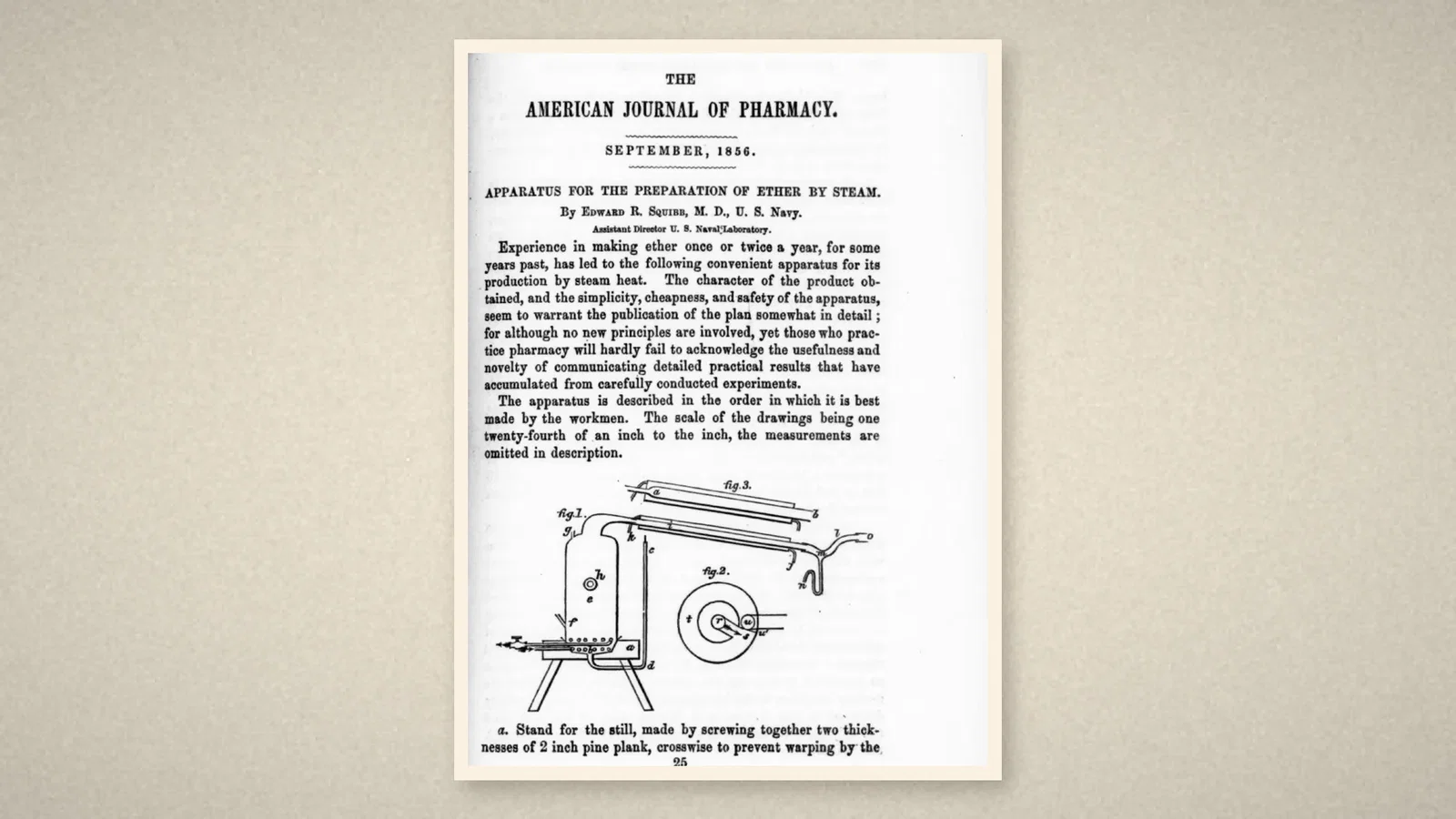
The American Journal of Pharmacy for September 1856 printed "Apparatus for the preparation of ether by steam" by Edward R. Squibb, M.D., US Navy, assistant director of the US Naval Laboratory. It ends with the line "U. S. Naval Laboratory, New York, July 1856." [1, p. 385][1, p. 391]
"Experience in making ether once or twice a year, for some years past," Squibb began, had produced a convenient apparatus heated by steam. The quality of the product and the simplicity, cheapness and safety of the apparatus justified publishing it in detail, "for although no new principles are involved", practical results from careful experiments would be useful to pharmacists. [1, p. 385]
The description follows the order in which workmen would build it. A wooden stand holds a lead pan; inside, a lead pipe coiled in two flat layers carries steam, with a valve on the outlet to control pressure and heat. A lead cylinder soldered onto the pan forms the still, with a thermometer and a small glass window for watching the liquid. Alcohol enters through a pipe at the bottom, the hottest part of the still. Squibb preferred this to a feed tube running down inside the still, which heats up and makes the feeding irregular. [1, p. 386][1, p. 387]
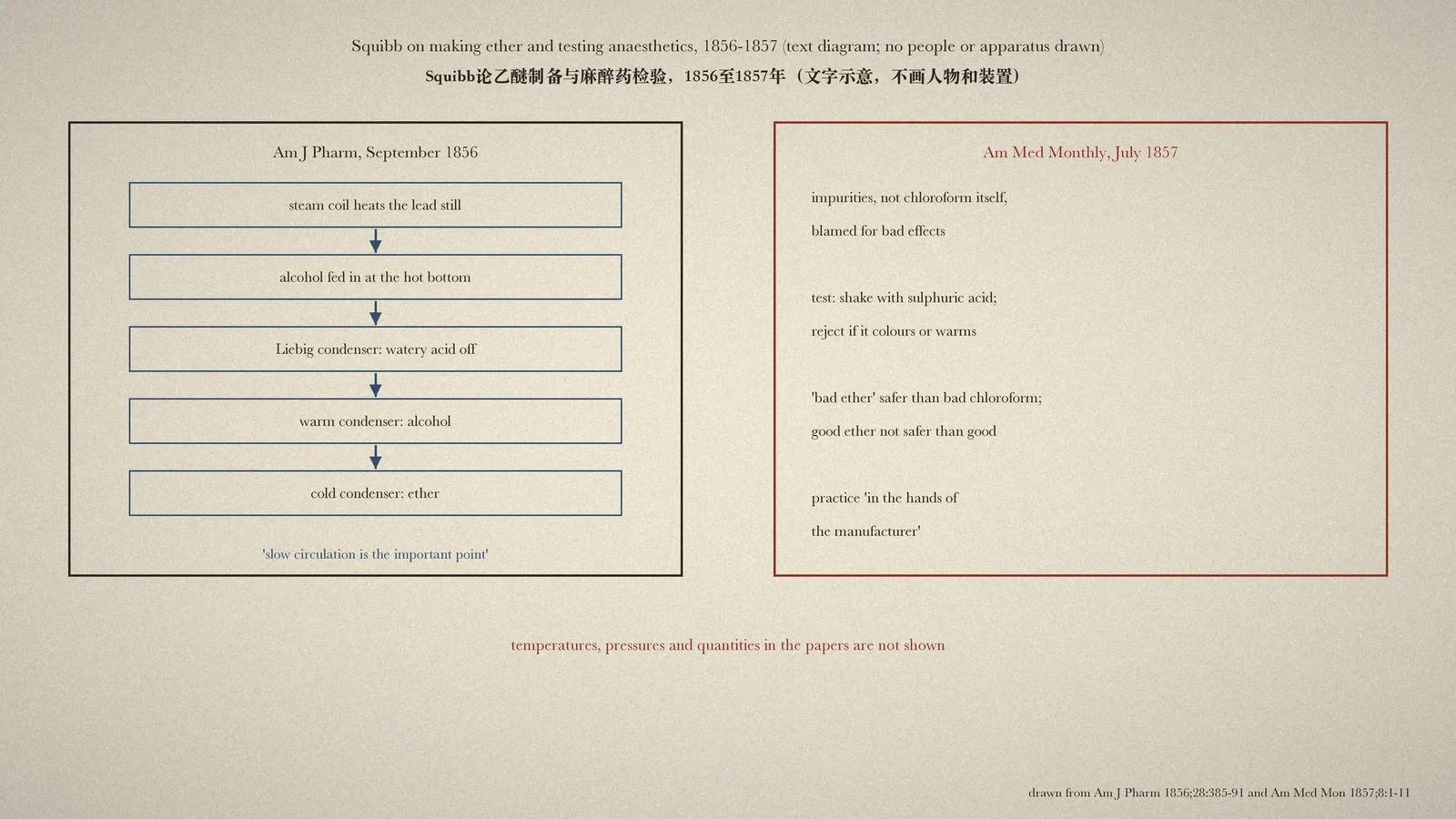
The vapours pass first through a Liebig condenser, which takes off a watery acid liquid, then into two tubs: a warm condenser that holds back alcohol, and a cold one that collects ether. Every passage is wide, Squibb explained, because "slow circulation is the important point in condensation". [1, p. 388][1, p. 389]
Squibb was critical of the official recipe. A mixture like that of the US Pharmacopoeia boils far below the temperature at which ether forms, and so "drives over much undecomposed alcohol"; a mixture that boils too high gives more by-products. The aim was a charge whose boiling point matched the best temperature for making ether. One improvement had been tried only experimentally: a cooler packed with lumps of lime, which might strip acid and some water from the vapour and make workable Soubeiran's method of getting pure, strong ether in one operation. Squibb was not aware that the idea had "ever been successfully applied". [1, p. 389][1, p. 390][1, p. 391]
The chloroform paper
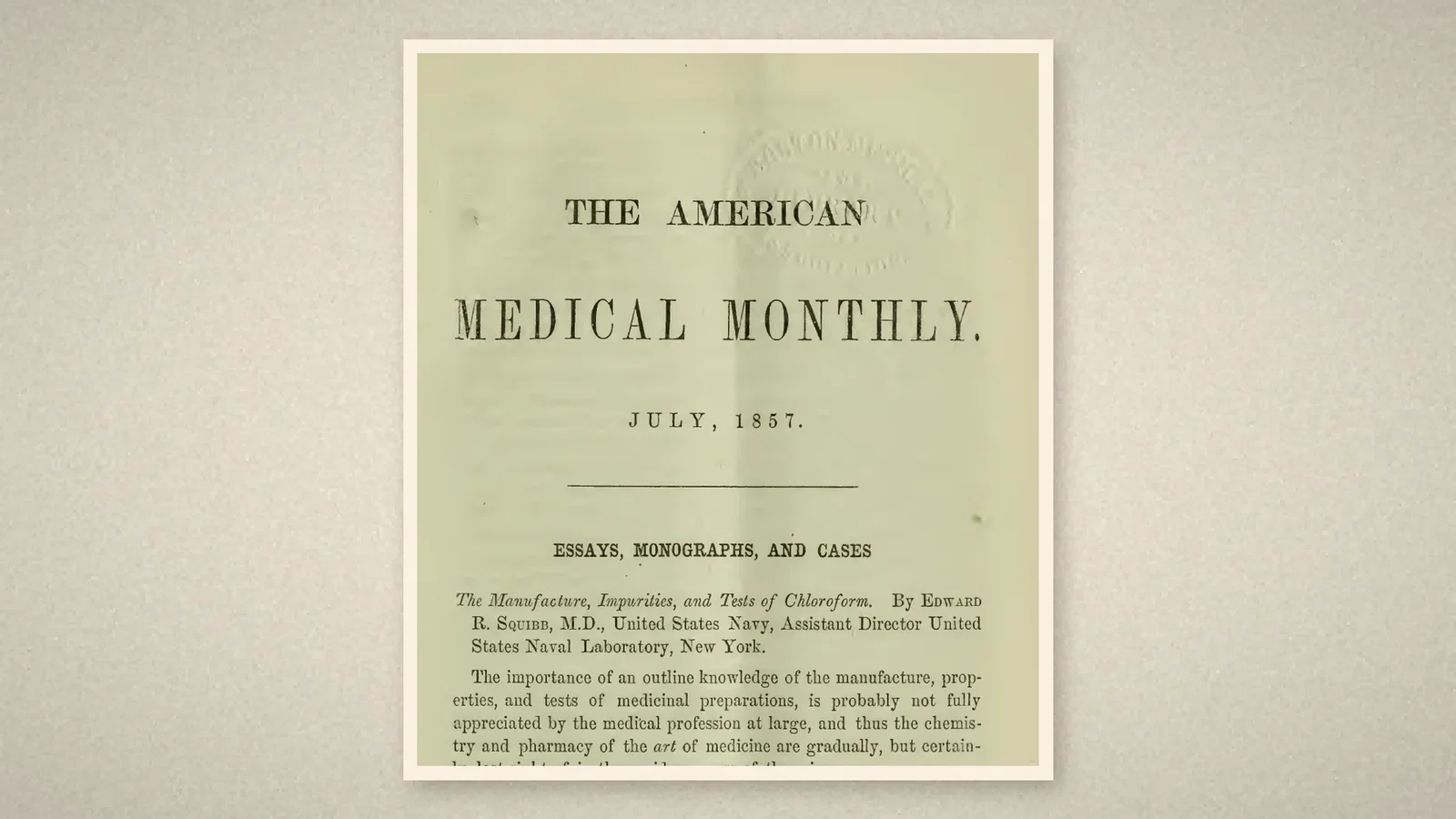
On 17 June 1857 Squibb read "The manufacture, impurities, and tests of chloroform" to the New York Academy of Medicine, and the American Medical Monthly printed it in full in July. [2, p. 1][2, p. 43]
The paper opens with an argument about the profession. Physicians had handed the making of medicines to pharmacists, and pharmacists to large manufacturers. By "relieving itself of the necessity for chemical and pharmaceutical knowledge", Squibb wrote, the profession "has suffered its materia medica to be debased". When a medicine failed, the physician should more often question the agent itself. [2, p. 2][2, p. 3]
Squibb then described the Naval Laboratory's process and charged that large makers used whiskey or spirits "recovered from other processes". Impurities in such alcohol react with chlorine to form harmful compounds, which pass with the chloroform into the market "but also into the lungs of the patients". The bad effects blamed on chloroform, in Squibb's view, came from "foreign deleterious compounds" produced by faulty making and bad materials. [2, p. 5][2, p. 7]
Squibb's remedy was a test that any user could carry out: shake equal volumes of chloroform and strong sulphuric acid, and let them separate. The acid should take at most a faint tinge of colour, and the mixture should not warm. Chloroform that passes "may be used with confidence"; chloroform that fails should be rejected outright. Squibb had even given slightly decomposing chloroform without ill effect, which supported the view that "it is not chloroform, nor its legitimate elements or constituents" that did the harm. [2, p. 7][2, p. 9]
Why ether had seemed safer
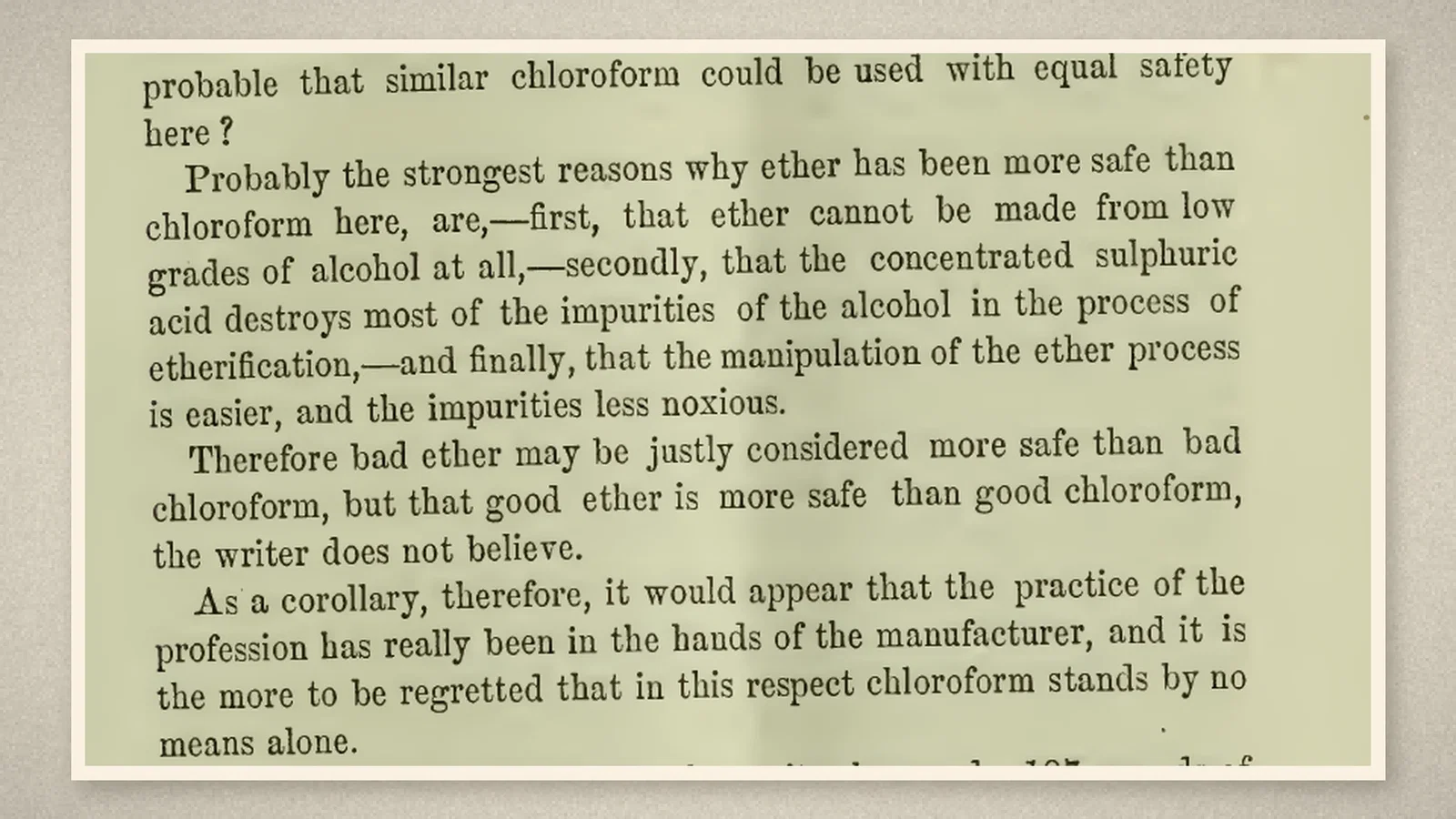
Then came the comparison with ether. "Probably the strongest reasons why ether has been more safe than chloroform here," Squibb wrote, were that ether cannot be made from low grades of alcohol at all; that the strong sulphuric acid "destroys most of the impurities of the alcohol in the process" of making ether; and that the ether process is easier and its impurities less harmful. [2, p. 11]
"Therefore bad ether may be justly considered more safe than bad chloroform, but that good ether is more safe than good chloroform, the writer does not believe." From this Squibb drew a sharp conclusion: the practice of the profession "has really been in the hands of the manufacturer". Squibb also said that the breathing, not the circulation, was the function to watch most closely. [2, p. 11]
In the discussion that followed, Barker told the Academy of a visit to the laboratory "under the charge of Dr. Squibb", where the chloroform could not be told apart from Edinburgh's. Barker called it "unfortunate, disgraceful in fact" that Americans had to send abroad for something so easily made at home. [2, p. 44][2, p. 45]
Leaving the navy
A notice reprinted later in the same volume reported that Squibb had been detached from the Naval Laboratory, at Squibb's own request, to run the manufacturing side of new chemical works in Louisville. Squibb had joined only on condition that the works hold strictly to the Pharmacopoeia, and the notice described Squibb as "the uncompromising enemy of adulterated drugs". [2, p. 260]
What the record shows
A change in where safety was looked for. In these pages the danger of an anaesthetic lies less in the drug itself than in how it was made, and the remedy lies with the physician as well as the maker: test every sample and reject what fails. The ether paper shows that this begins with plain apparatus, built one stage at a time.
Sources and reading limits
Read: Edward R. Squibb, "Apparatus for the preparation of ether by steam", American Journal of Pharmacy 1856;28:385-91, in full; Squibb, "The manufacture, impurities, and tests of chloroform", American Medical Monthly 1857;8:1-11, in full; the report of the New York Academy of Medicine meeting in the same volume, pp. 43-46; the editorial notice at p. 260.
Not covered: later biographies of Squibb; Squibb's notebooks; Squibb's later papers on ether; the founding of the Brooklyn laboratory; the Pharmacopoeia text of the period; Soubeiran's work.
Limits: some timelines date this topic to 1858. Nothing in the pages read here concerns 1858, so the article is dated by the 1856 paper. The ether paper describes equipment and makes no clinical claim. The comparison of ether and chloroform, and the charges against manufacturers, are Squibb's opinions; Barker's remarks are as reported, and Barker's first name is not printed. Temperatures, pressures, quantities, yields, costs and specific gravities in the papers are not repeated.
Three illustrations are crops of the American Journal of Pharmacy (p. 385) and the American Medical Monthly (pp. 1 and 11); one is a text diagram drawn from both papers, with no people or apparatus drawn and no quantities.
- Squibb ER. Apparatus for the preparation of ether by steam. Am J Pharm. 1856;28:385-91. Internet Archive
- Squibb ER. The manufacture, impurities, and tests of chloroform. Am Med Mon. 1857;8:1-11. Internet Archive
Continue exploring
Related reading connects shared questions and contexts; it does not by itself establish historical influence.
- 1832: Guthrie Describes a Cheap Way to Make Chloric Ether
- 1730: Frobenius Shows the Royal Society an Ethereal Spirit of Wine
- 1847: Snow Makes Ether a Question of Observation and Control
Anesthesia Epochs · The Source Room · About & Editorial Method
Published November 3, 2026. Sources and reading limits are stated above. Illustrations are labelled as original source images or AI-made. Historical accounts are educational; they are not current treatment instructions.