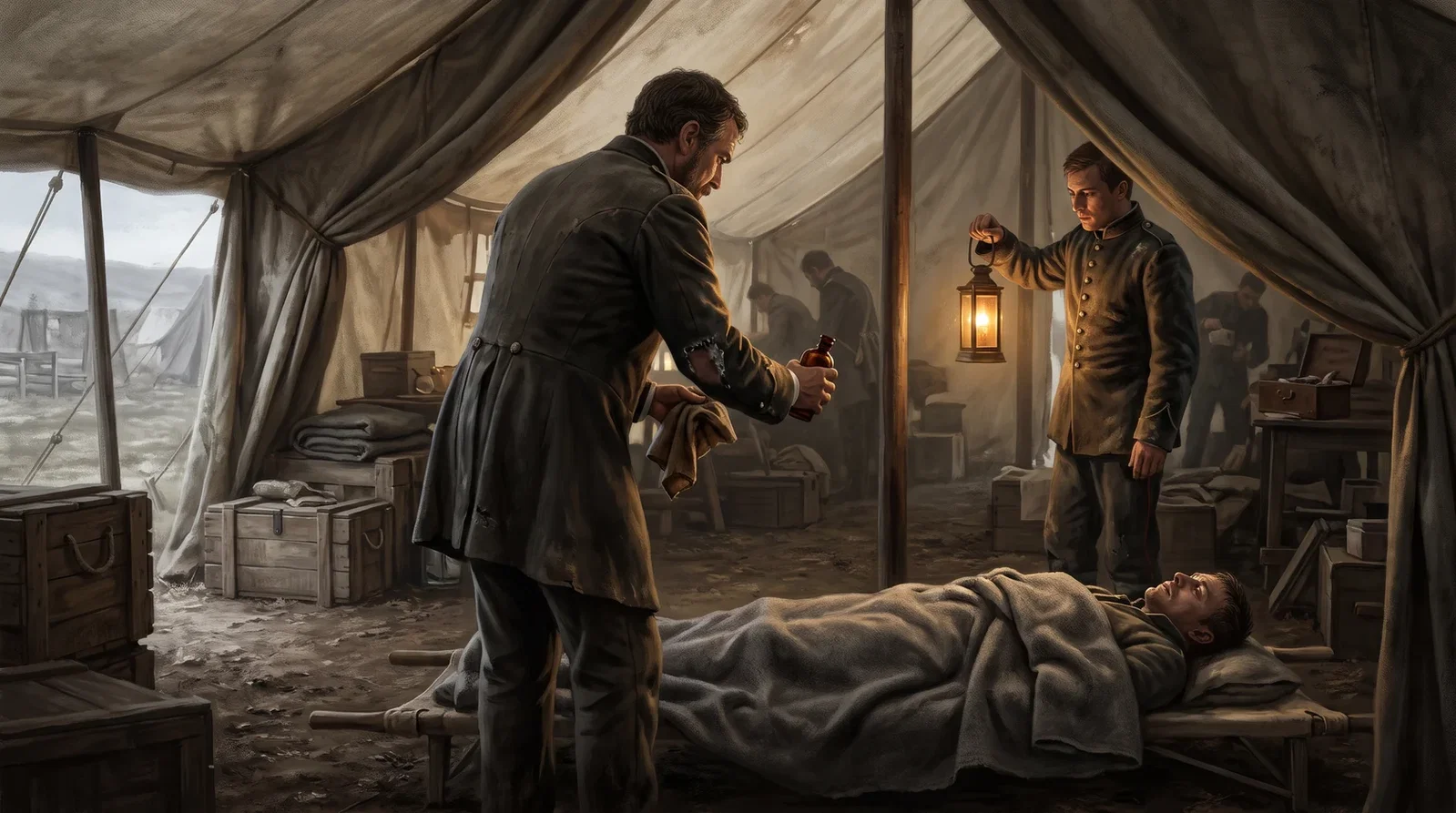
The British Army's official medical and surgical history states that in 1855-56 almost no operation except minor ones was done without chloroform.
Reading Library · Anesthesia Epochs · 中文版
Watch the education video (for clinicians)
1858: Chloroform in the Crimean War — The Official Record · Anesthesia Epochs Education Series
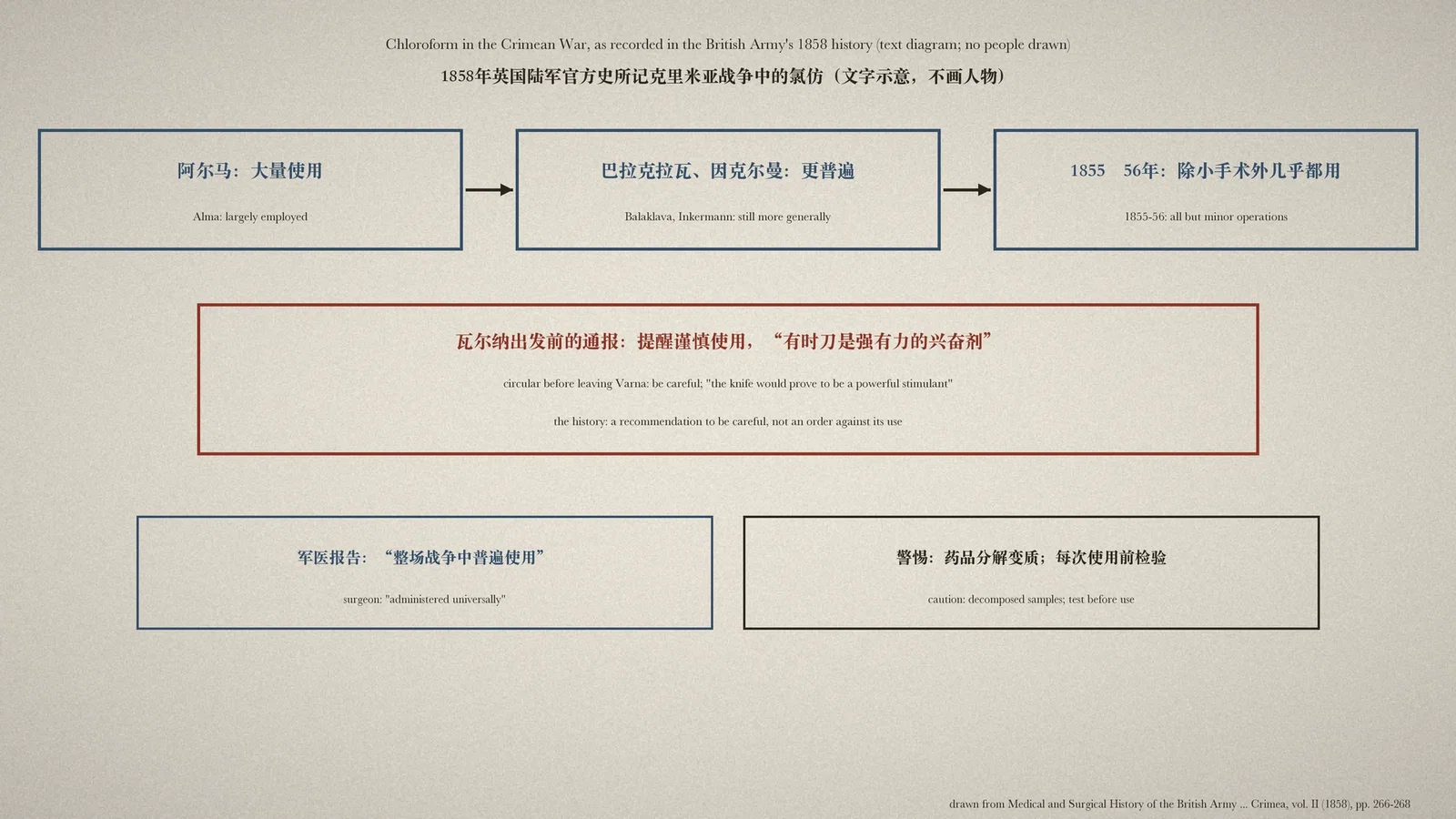
When the Crimean War (1854-1856) began, ether and chloroform anaesthesia were less than ten years old, and whether wounded soldiers should be given chloroform became a heated argument at home in Britain. After the war, the official medical and surgical history compiled by the British Army Medical Department devoted a section to "the employment of chloroform", recording how it had actually been used and answering that argument. This article reads that section. [1, title page][1, p. 266]
An official history
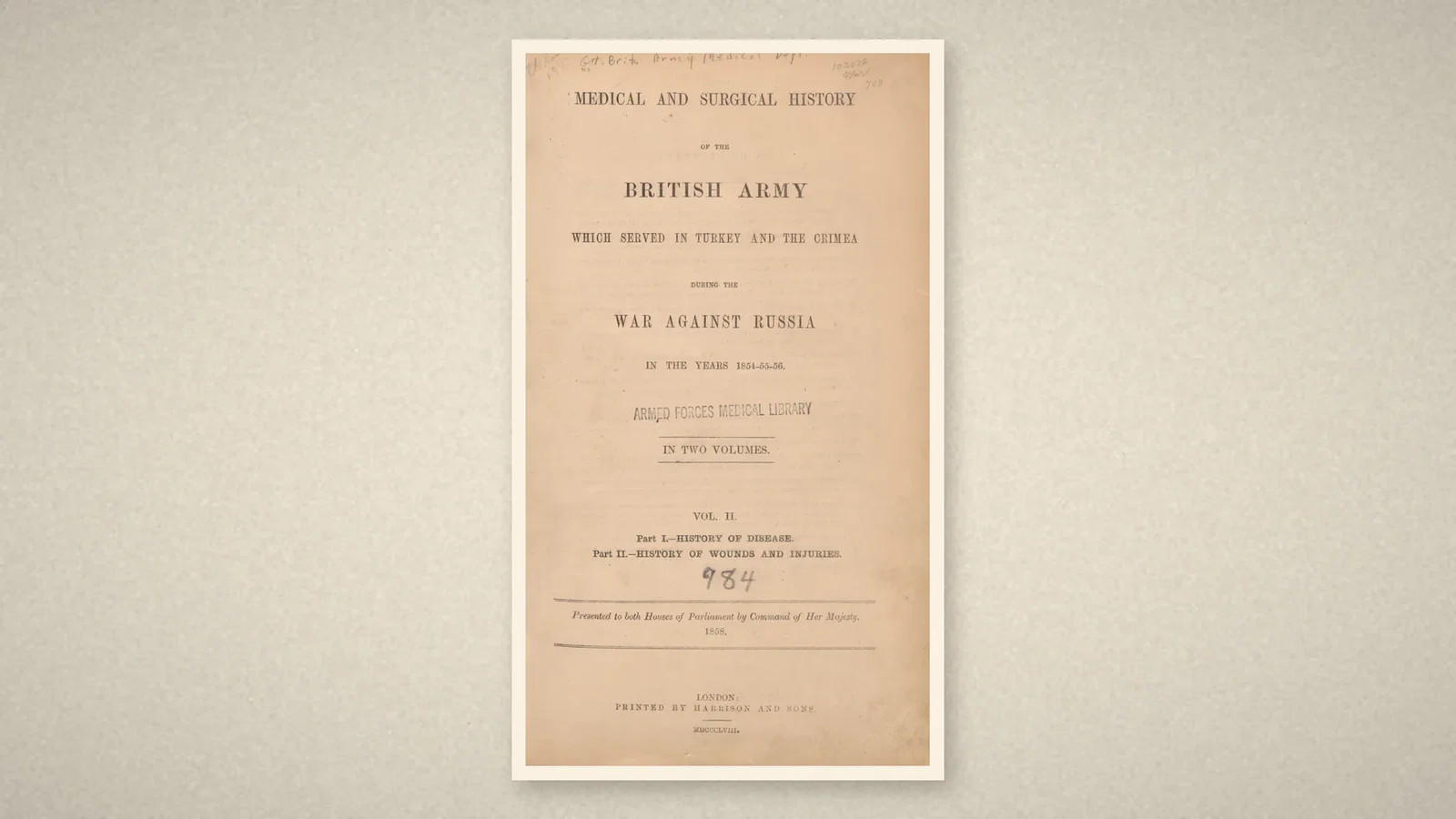
The work, The Medical and Surgical History of the British Army which served in Turkey and the Crimea during the War against Russia in the years 1854-55-56, appeared in two volumes in 1858, printed in London by Harrison and Sons and, as its title page states, presented to both Houses of Parliament by command. Volume II is divided into a history of disease and a history of wounds and injuries; the section on chloroform stands among the general observations of the latter, directly after a discussion of shock after wounding. The copy used is the US National Library of Medicine's, scanned for the Internet Archive. [1, title page][1, pp. 265-266]
Nearly every operation
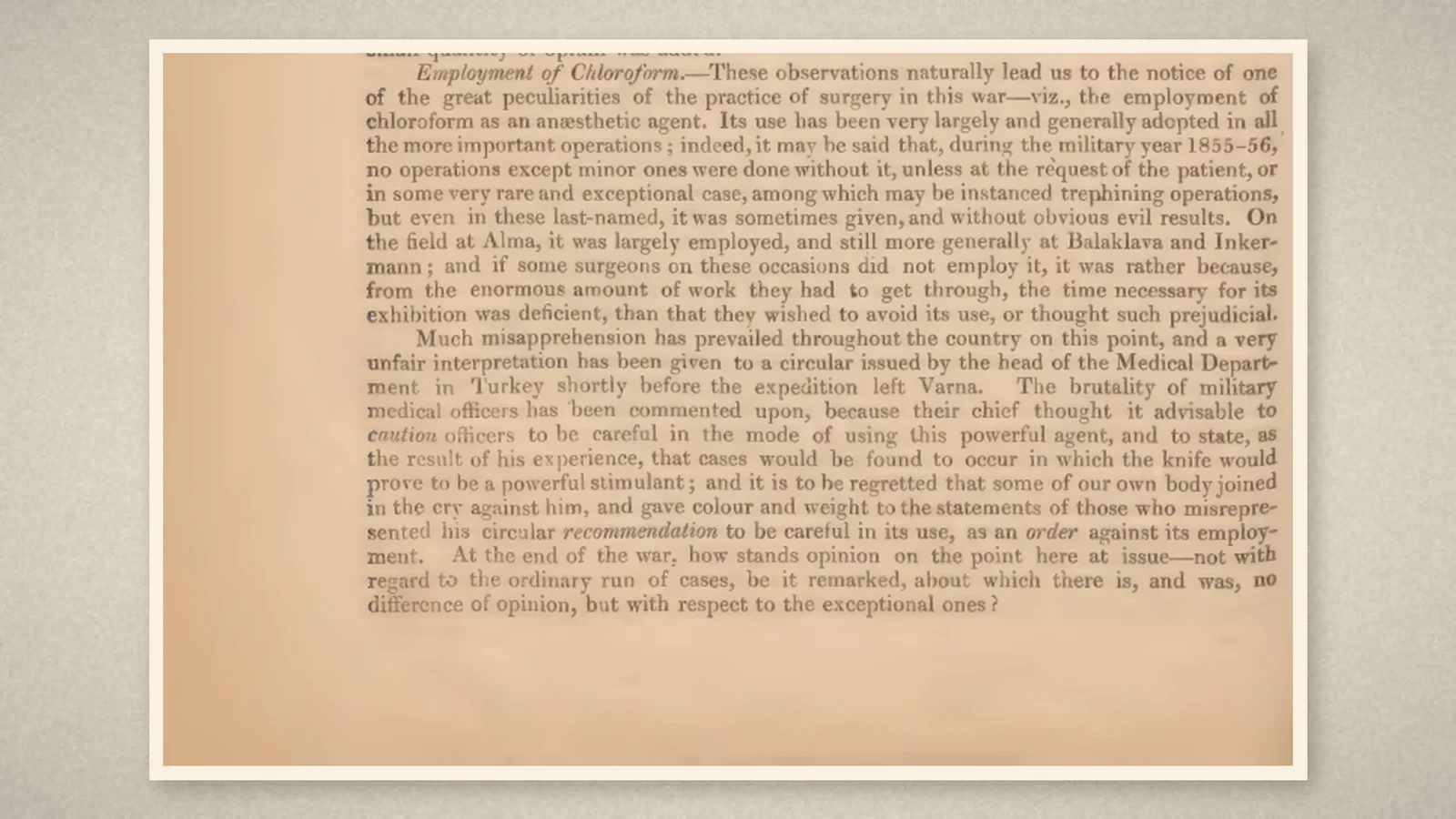
One of the great peculiarities of surgery in this war, the history says, was the employment of chloroform as an anaesthetic agent, very largely and generally adopted in all the more important operations; it may be said that during the military year 1855-56 no operations except minor ones were done without it, unless at the patient's request or in rare exceptions such as trephining, and even in these it was sometimes given without obvious evil results. [1, p. 266]
On the field at Alma it was largely employed, and still more generally at Balaklava and Inkermann. Surgeons who did not use it on those occasions, the history explains, were held back by the enormous amount of work and the time its administration required, not by any wish to avoid it or belief that it did harm. [1, p. 266]
A misread circular
Much misapprehension had prevailed at home, the history continues. An unfair interpretation had been given to a circular issued by the head of the Medical Department in Turkey shortly before the expedition left Varna, and the brutality of military medical officers had been denounced, because their chief had thought it advisable to caution them to be careful with this powerful agent and had stated, from experience, that cases would occur in which the knife would prove a powerful stimulant. Some of the profession at home, the history regrets, joined the cry and represented a recommendation to be careful as an order against its use. [1, p. 266]
The Australian Society of Anaesthetists' history timeline names the author of the circular as the Inspector General of Hospitals, John Hall, and records that Florence Nightingale, after watching an amputation in 1851, expressed a belief in chloroform and during the Crimean War helped advocate its use for wounded soldiers. The official history's section names neither. [2, p. 17]
What the surgeons said
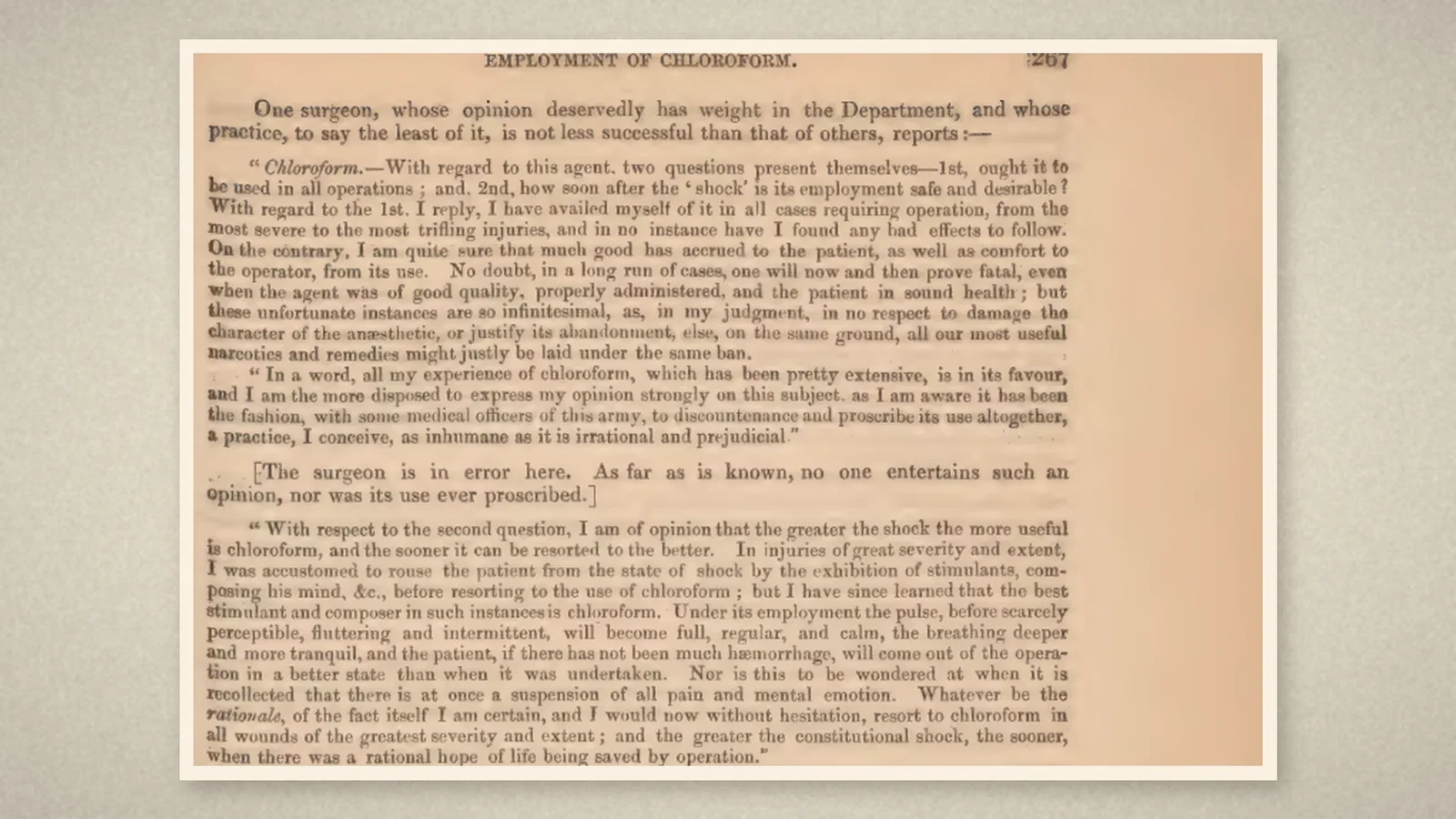
The history quotes several surgeons. One had used chloroform in every case requiring operation, from the most severe injuries to the most trifling, without seeing bad effects; occasional deaths in a long run of cases were, in that surgeon's judgment, so infinitesimal as not to justify abandoning it, and the greater the shock, the more useful chloroform was and the sooner it should be given. Where this surgeon spoke of colleagues who wanted it proscribed, the editors added in brackets that the surgeon was in error: no one held such an opinion, "nor was its use ever proscribed". [1, p. 267]
A second reported chloroform used in every important case in the regiment, with perfect success and safety, as safe in military as in civil surgery. A third, of opposite views, believed that chloroform had been administered universally throughout the war, and had never performed or seen an operation without it except on fingers, yet confessed to disliking it and suspected that the depressing influence of chloroform helped explain why some men, operated on skilfully with little blood lost, "never rallied". [1, p. 267]
A spoiled bottle
The section also records a death attributed directly to chloroform, more probably to a sample in partial decomposition: if bad keeping, a hot climate or the shaking of carriage could spoil chloroform, the fact could not be too widely known, so that surgeons would test the agent before every use. [1, pp. 267-268]
What the record shows
The section placed a public controversy in the official record: chloroform used almost everywhere in the field, alongside an admission of its risks and of variable quality. It also shows how a single phrase taken out of context could become a charge against an entire body of military surgeons.
Sources and reading limits
Read: The Medical and Surgical History of the British Army which served in Turkey and the Crimea during the War against Russia in the years 1854-55-56, vol. II (London, 1858), the title page and, in the general observations on wounds, the passages on shock and the section "Employment of Chloroform" (pp. 265-268). The 1851 entry of the Australian Society of Anaesthetists' 2024 history timeline, p. 17.
Not covered: the text of the circular; Florence Nightingale's own writings on chloroform; John Hall's correspondence.
Limits: the Nightingale and Hall attributions come from the timeline, not from the history's section; the fatal case on p. 268 is summarised without the patient's name or quantities.
Three illustrations are taken from volume II (title page, p. 266, p. 267). One is a text diagram drawn from the history, with no people drawn.
- Great Britain Army Medical Department. The Medical and Surgical History of the British Army which served in Turkey and the Crimea during the War against Russia in the years 1854-55-56. Vol. II. London: Harrison and Sons; 1858. Internet Archive
- Australian Society of Anaesthetists. Anaesthesia History Timeline. 2024. PDF
Continue exploring
Related reading connects shared questions and contexts; it does not by itself establish historical influence.
- 1853: The Queen's Chloroform, Relief Without an End to Debate
- 1856: Squibb Publishes a Steam Apparatus for Making Ether
- 1848: Snow Warns That Chloroform Keeps Deepening After Inhalation
Anesthesia Epochs · The Source Room · About & Editorial Method
Published November 4, 2026. Sources and reading limits are stated above. Illustrations are labelled as original source images or AI-made. Historical accounts are educational; they are not current treatment instructions.