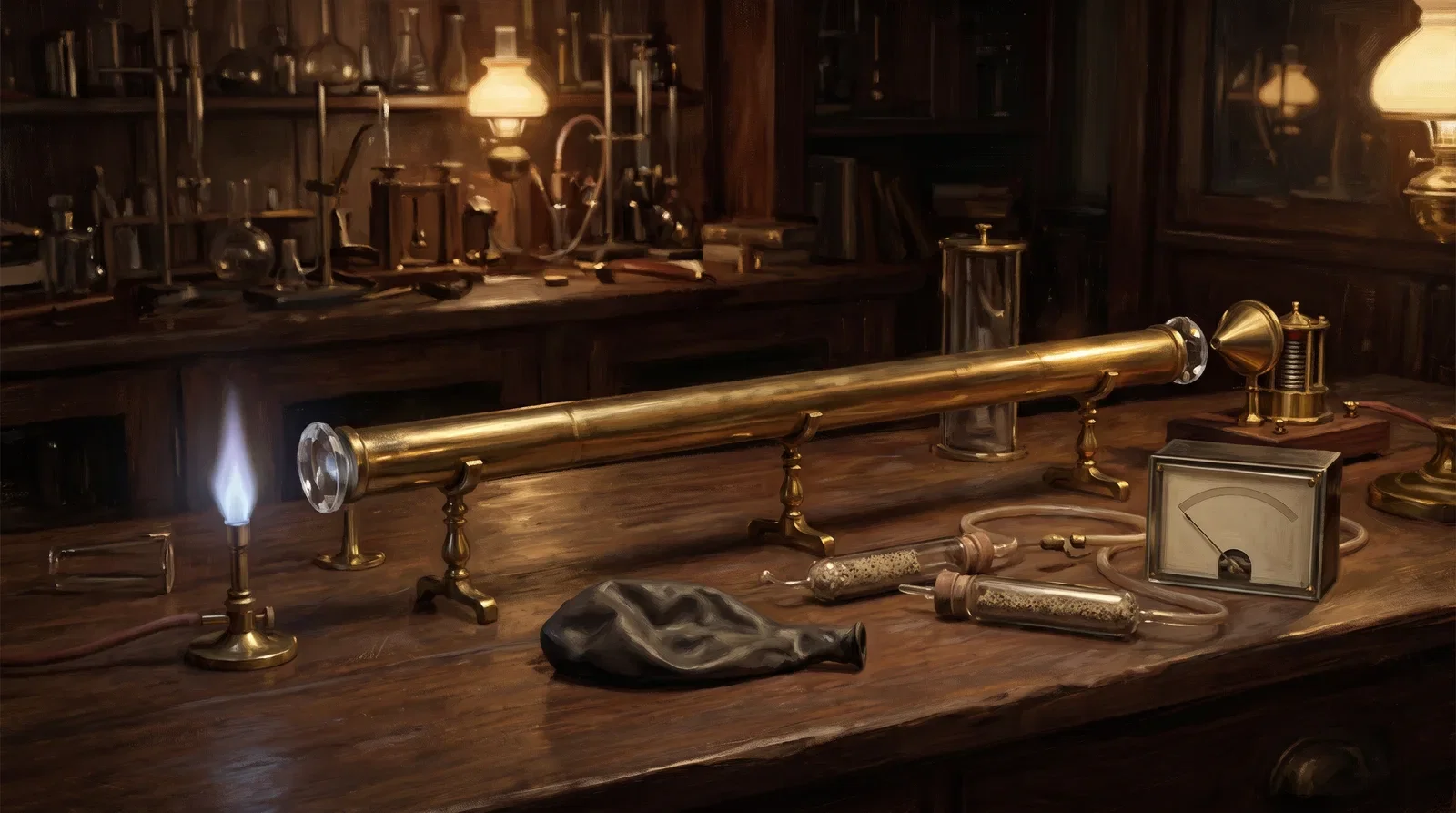
In the 1864 Bakerian Lecture, Tyndall showed that dried breath absorbed radiant heat, a delicate test for exhaled carbonic acid that later matched chemical analysis.
Reading Library · Anesthesia Epochs · 中文版
Watch the education video (for clinicians)
1864: Tyndall Measures the Carbonic Acid of the Breath with Heat · Anesthesia Epochs Education Series
Every capnometer in an operating theatre works by shining infrared radiation through a sample of breath and measuring how much of it the carbon dioxide absorbs. The Australian Society of Anaesthetists' timeline places the beginning of this idea in 1864, with John Tyndall of the Royal Institution, and the first modern infrared instrument in 1943, with Karl Friedrich Luft in Germany. This article reads what Tyndall actually published: one paragraph and a small table in a long physics memoir of 1864, and a short comparison with chemical analysis given in a lecture at Cambridge in 1865. [1][2][3]
A physics memoir
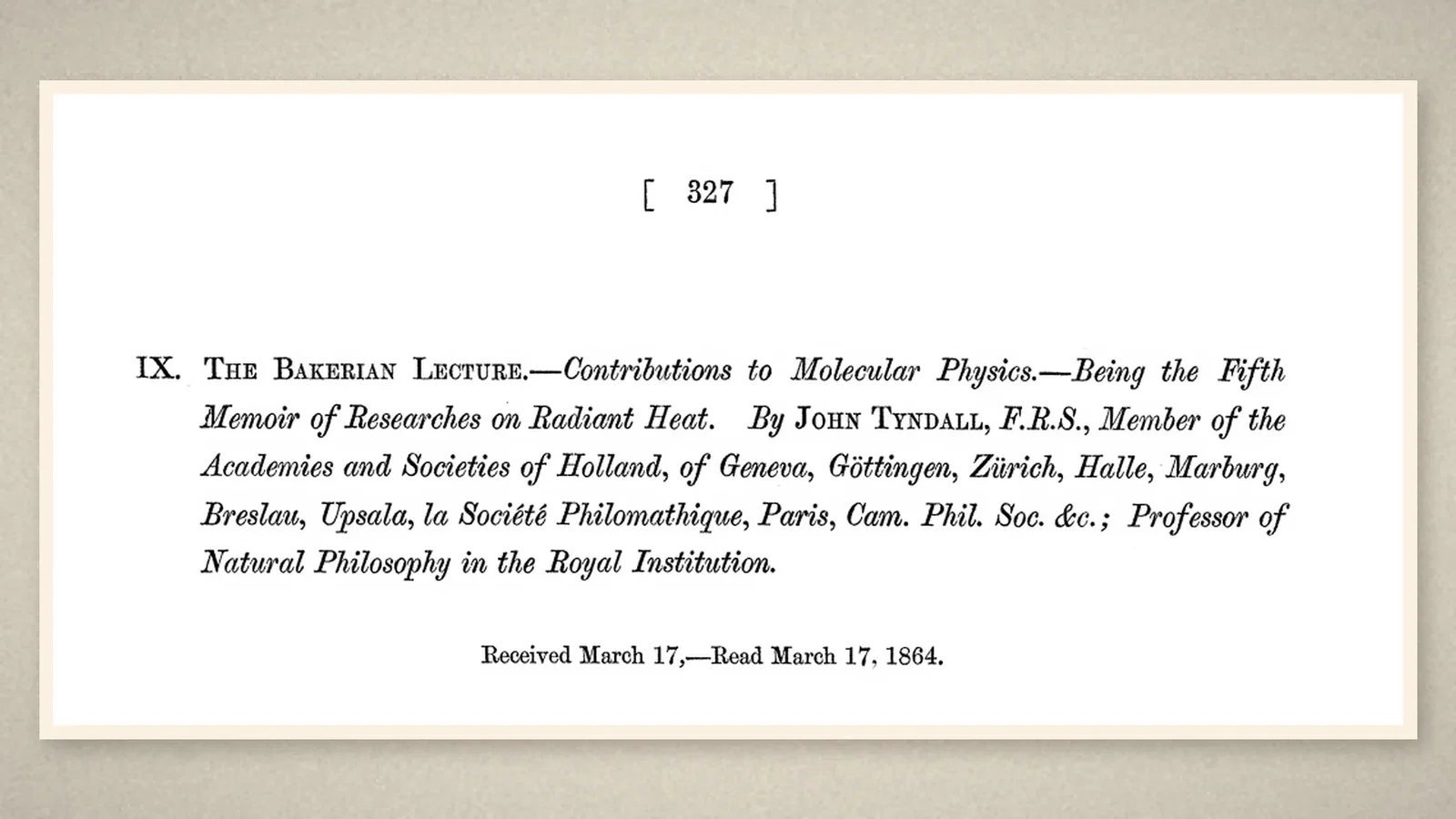
The memoir was the Bakerian Lecture of the Royal Society, "Contributions to Molecular Physics", the fifth of Tyndall's memoirs of researches on radiant heat, received and read on 17 March 1864 and printed in the Philosophical Transactions. Its subject was not breath at all. Tyndall wanted to use radiant heat "as an instrument for exploring molecular condition", and most of the memoir compares liquids with their vapours, measured in cells and tubes closed with plates of rock-salt, which lets heat rays through. [1]
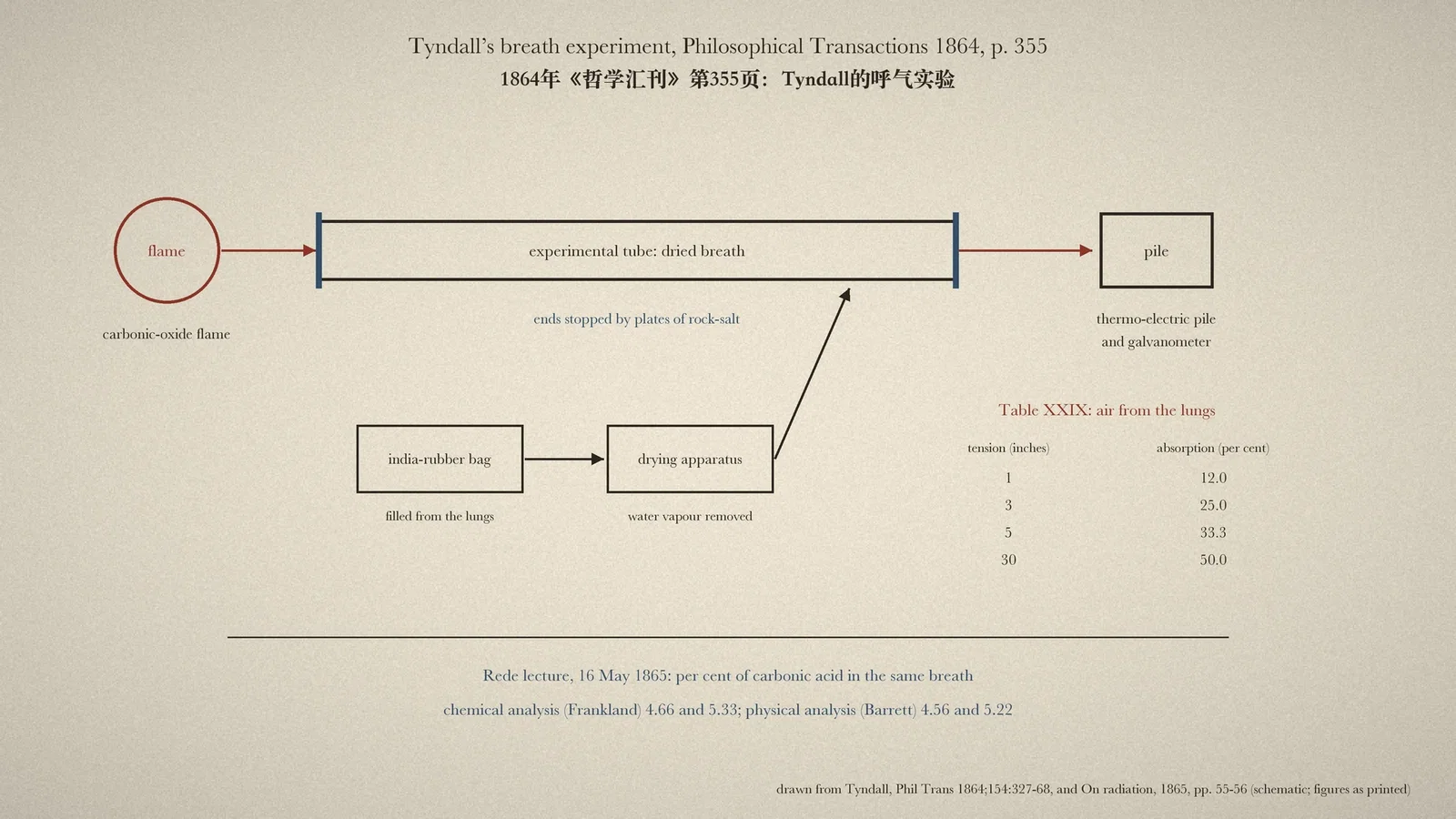
The apparatus was the one used in the earlier memoirs. For the vapours, the experimental tube "was of brass, 49.6 inches long, and 2.4 inches in diameter, its two ends being stopped by plates of rock-salt". The heat that passed through the tube fell on a thermo-electric pile; a compensating source on the other face of the pile balanced it, so that the galvanometer needle stood at zero until something in the tube absorbed part of the radiation. The deflection of the needle then gave the absorption. [1]
The flame of carbonic oxide
The breath appears in section X, on radiation from the flames of hydrogen and of carbonic oxide through air. A flame of carbonic oxide gives off heat radiated by hot carbonic acid, the substance it burns into, and the memoir shows that carbonic acid is "highly opaque" to that radiation: dry carbonic acid at a tension of one inch already absorbed 53 per cent of it. Even the ordinary air of the laboratory absorbed 16 per cent of the heat from this flame; after the water vapour had been removed with sulphuric acid, leaving the carbonic acid, the figure was 13.8 per cent. [1]
Then came the experiment with breath. "An india-rubber bag was filled from the lungs; it contained therefore both the aqueous vapour and the carbonic acid of the breath." The air was passed through a drying apparatus, so that only air and carbonic acid entered the experimental tube. Table XXIX, "Air from the lungs containing CO2", gives the result at four tensions: 12, 25, 33.3 and 50 per cent absorption at 1, 3, 5 and 30 inches. [1]
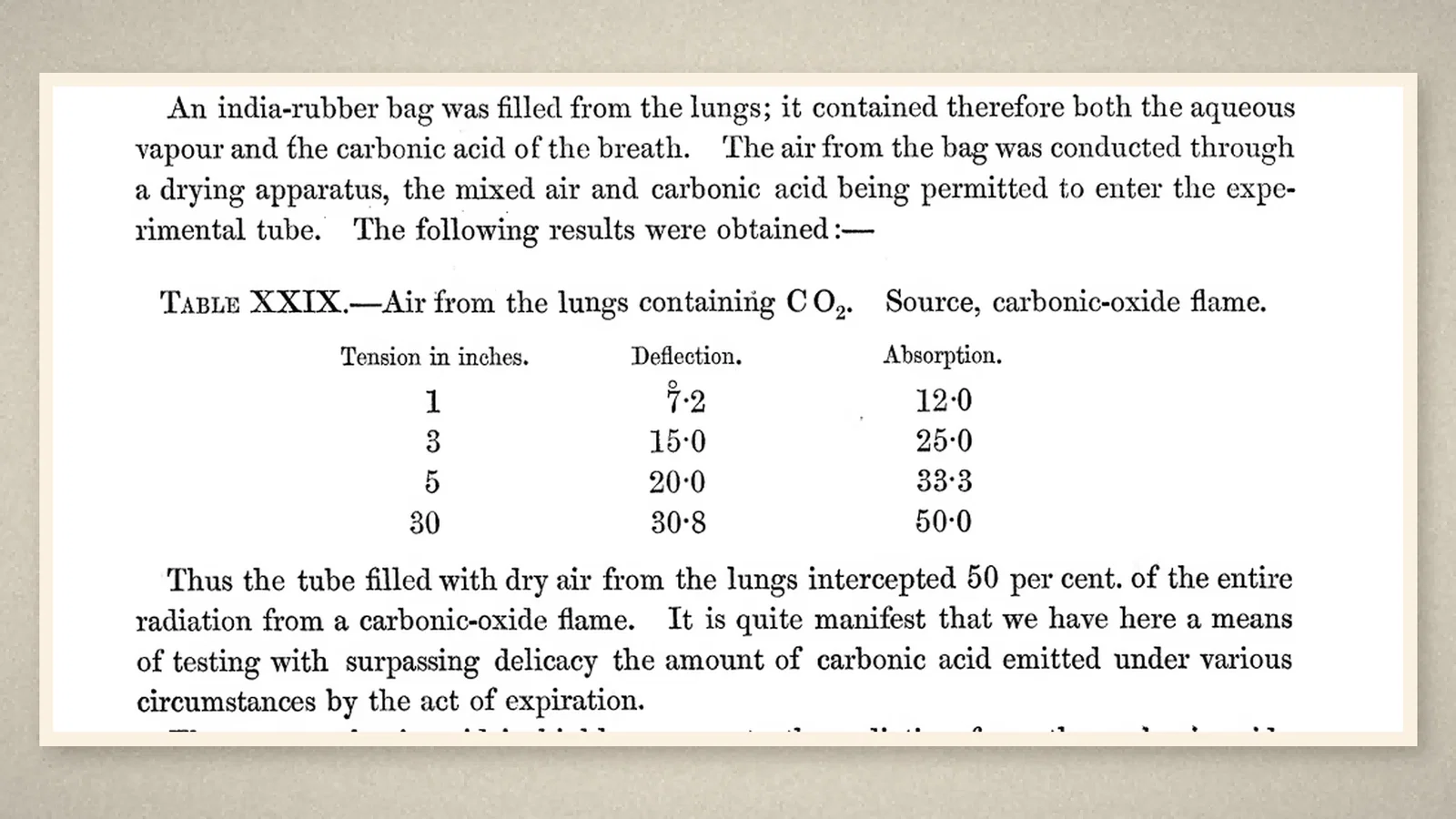
"Thus the tube filled with dry air from the lungs intercepted 50 per cent. of the entire radiation from a carbonic-oxide flame. It is quite manifest that we have here a means of testing with surpassing delicacy the amount of carbonic acid emitted under various circumstances by the act of expiration." The memoir goes no further than this. It says what could be done, and then returns to physics. [1]
Checked against chemistry, 1865
The step from a possibility to a measurement was reported a year later. On 16 May 1865 Tyndall gave the Rede lecture before the University of Cambridge, published that year as On radiation. Under the heading "Physical analysis of the human breath", the lecture repeats that dried breath carried into a tube four feet long absorbed 50 per cent of the radiation, and adds that radiant heat "may indeed be employed as a means of determining practically the amount of carbonic acid expired from the lungs". [2]
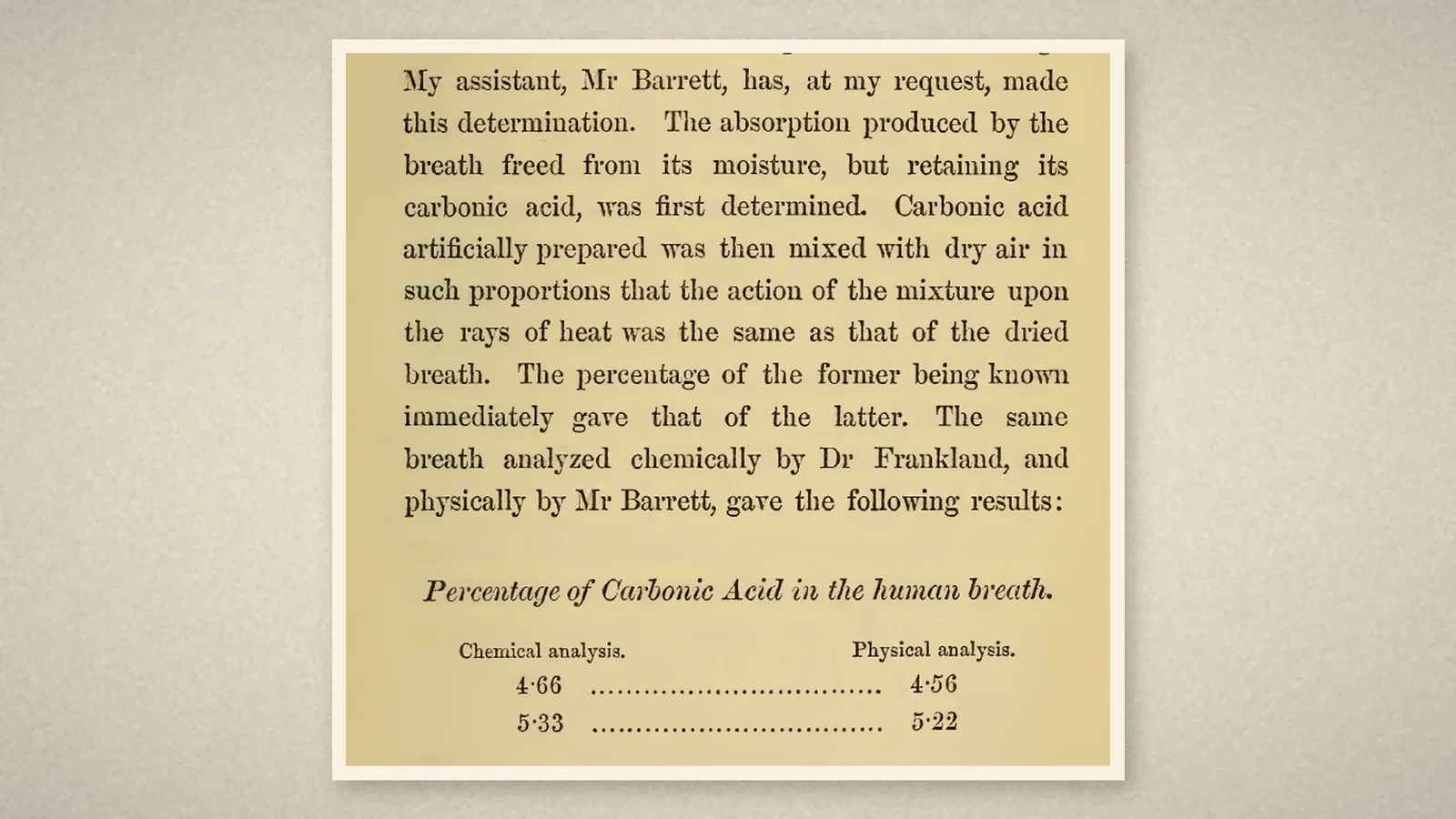
The determination had been made by Tyndall's assistant, Mr Barrett. The absorption produced by the dried breath was measured first; then carbonic acid prepared artificially was mixed with dry air until the mixture absorbed the heat to the same degree; the known percentage of the mixture gave the percentage in the breath. The same breath was analysed chemically by Dr Frankland. The lecture's small table, "Percentage of Carbonic Acid in the human breath", gives chemical 4.66 against physical 4.56, and chemical 5.33 against physical 5.22. Tyndall concluded that "we have a practical measure of the carbonic acid of the breath, and hence of the combustion going on in the human lungs". [2]
What the record shows
Two things in these pages survive in every capnometer. One is the principle: carbon dioxide absorbs a particular kind of invisible radiation strongly, so the fraction absorbed measures how much is present. The other is the method of calibration: the reading from breath was converted into a percentage by comparison with a gas mixture of known composition, and the result was checked against chemical analysis.
What these pages do not contain is a monitor. The measurement took a bagful of breath, dried it, and needed a laboratory bench, a flame and a galvanometer. Nothing in the memoir or the lecture follows breath from one exhalation to the next, or applies the method to a patient. The ASA timeline gives 1943 and Luft for the first modern infrared instrument; that paper was not read for this article. [3]
Sources and reading limits
Read: Tyndall's Bakerian Lecture, Philosophical Transactions 1864;154:327-368, especially p. 327 and pp. 355-356; Tyndall's Rede lecture On radiation (Cambridge, 16 May 1865), the title page and pp. 52-56; the 2024 ASA timeline entries for 1864 and 1943.
Not covered: Tyndall's earlier memoirs, where the apparatus is described in full; any separate record by Barrett or Frankland; Luft's paper of 1943 and later instruments; any clinical use of the method in the nineteenth century. The tube of 49.6 inches is the one described for the vapour experiments; the lecture speaks of a tube four feet long for the breath. Tyndall writes of radiant heat and invisible rays; "infra-red" is the timeline's word.
Three illustrations are crops of the 1864 memoir and the 1865 lecture; one is drawn from their descriptions and is not a picture of the actual apparatus.
- Tyndall J. The Bakerian Lecture: contributions to molecular physics. Being the fifth memoir of researches on radiant heat. Phil Trans R Soc Lond. 1864;154:327-68. Internet Archive
- Tyndall J. On radiation: the "Rede" lecture delivered in the Senate-House before the University of Cambridge, May 16, 1865. London: Longman, Green, Longman, Roberts & Green; 1865. pp. 52-56. Internet Archive
- Australian Society of Anaesthetists. Anaesthesia history timeline. 2024. ASA
Continue exploring
Related reading connects shared questions and contexts; it does not by itself establish historical influence.
- 1756: Black Weighs Fixed Air, an Invisible Component
- 2021: The WFSA Publishes Minimum Capnometer Specifications
Anesthesia Epochs · The Source Room · About & Editorial Method
Published November 2, 2026. Sources and reading limits are stated above. Illustrations are labelled as original source images or AI-made. Historical accounts are educational; they are not current treatment instructions.