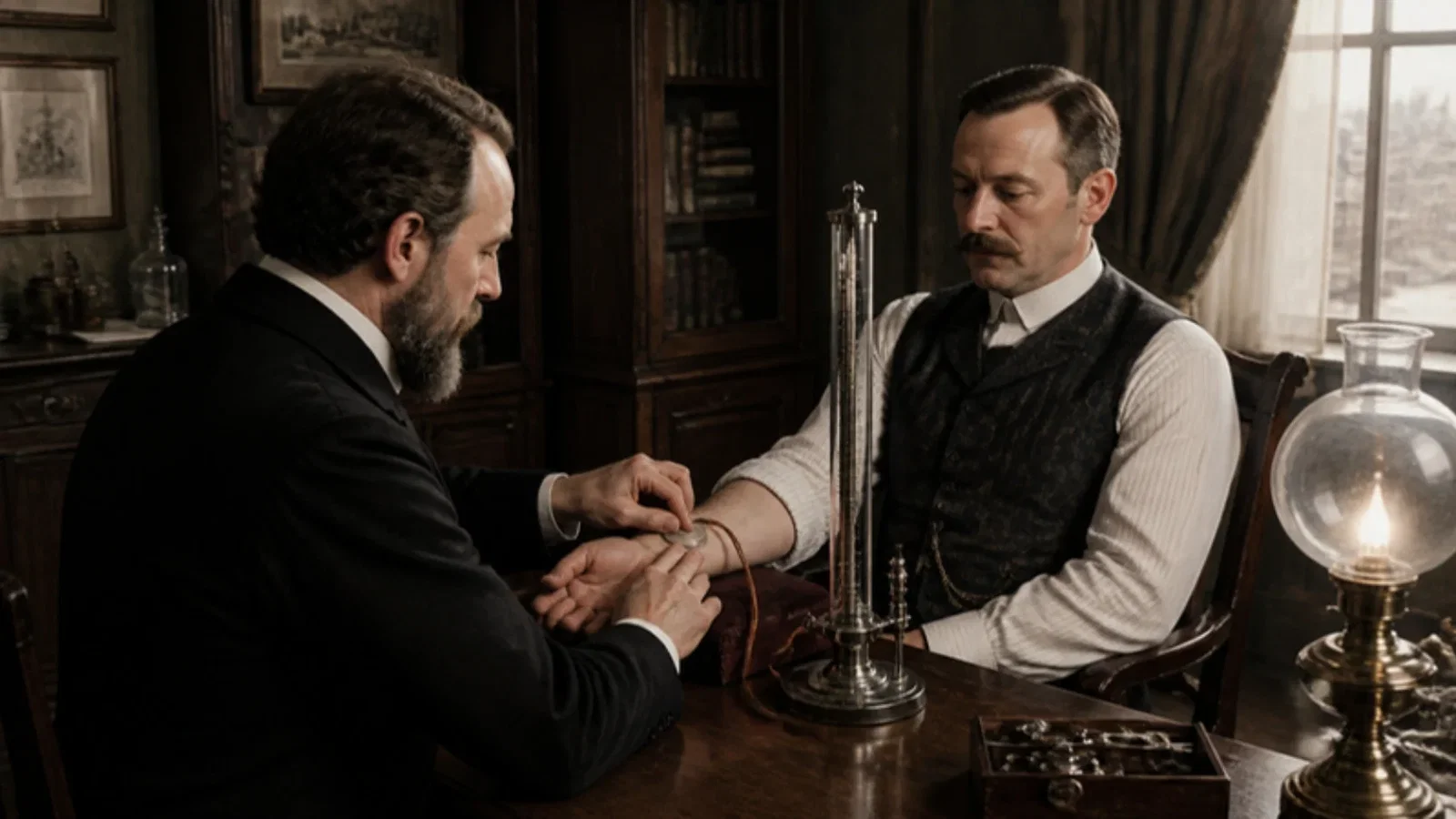
Von Basch's sphygmomanometer pressed a water-filled pad on the radial artery, joined to a mercury manometer read when the pulse disappeared.
Reading Library · Anesthesia Epochs · 中文版
Watch the education video (for clinicians)
1881: Von Basch's Sphygmomanometer — The Pressure That Stops the Pulse · Anesthesia Epochs Education Series
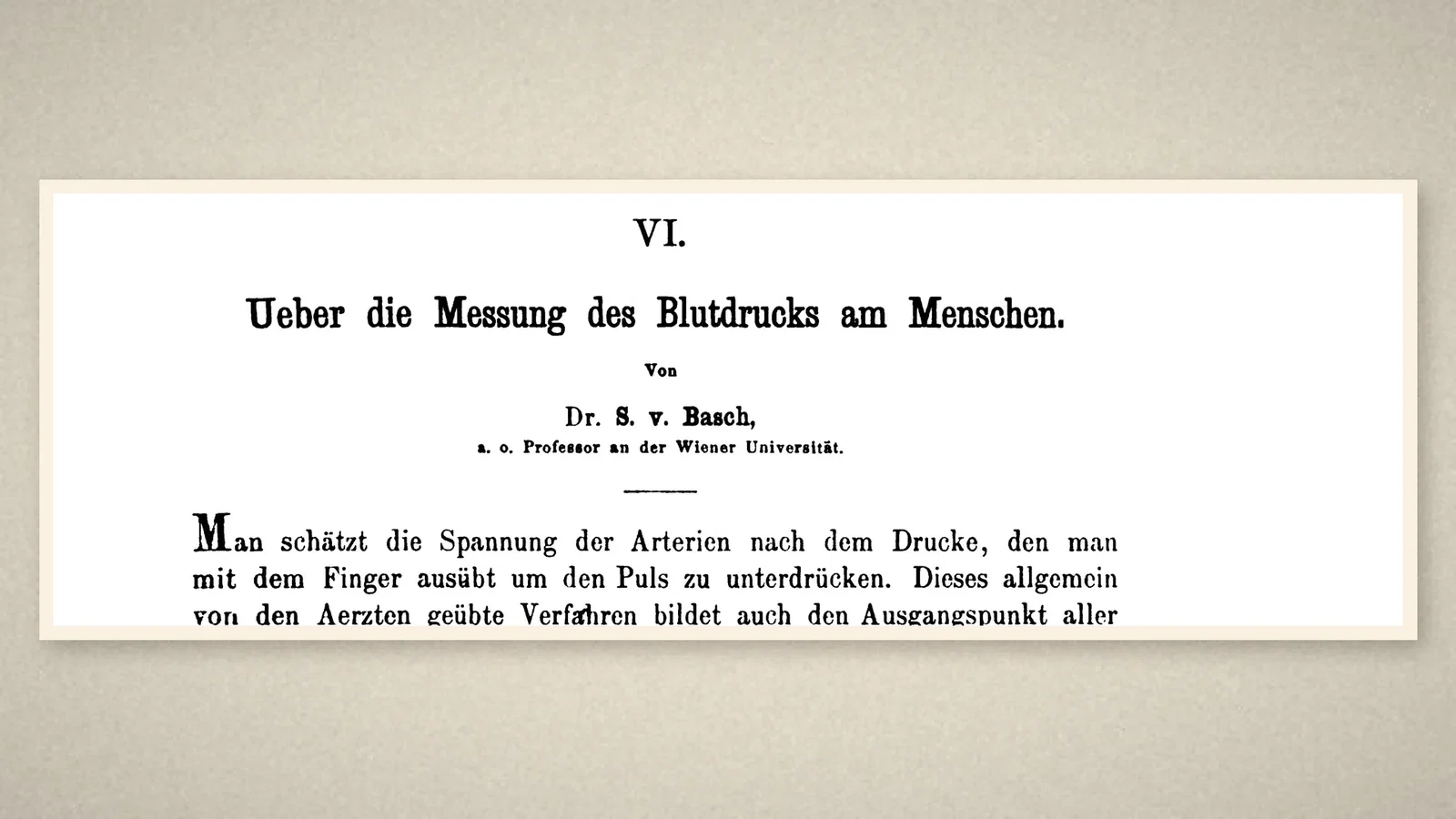
Every non-invasive blood pressure reading rests on one idea: squeeze the artery from outside, and the pressure needed to stop the pulse beyond the squeeze is the pressure inside it. The Australian Society of Anaesthetists' timeline credits the "first somewhat successful sphygmomanometer" to Samuel Siegfried Ritter von Basch of Vienna in 1881. This article reads von Basch's paper, "On the measurement of blood pressure in man", in the second volume of the Zeitschrift für klinische Medicin, whose title page reads Berlin, 1881. [1][2]
Starting from the finger
The paper begins with ordinary bedside practice. Doctors estimate the tension of the arteries "by the pressure exerted with the finger to suppress the pulse", and every method so far, von Basch says, starts from there. It then reviews the rivals: v. Kries, who loaded the skin with weights until it blanched; Marey, who sealed a forearm in a glass vessel of compressed air or water; Roy and Brown, who pressed transparent tissues against a membrane; and Waldenburg and Vierordt, who loaded the pad of a sphygmograph. A footnote adds that von Basch had begun the problem with Dr Breuer in 1874, using a method like Marey's, and had given it up as unreliable. [1]
Proving the principle in animals
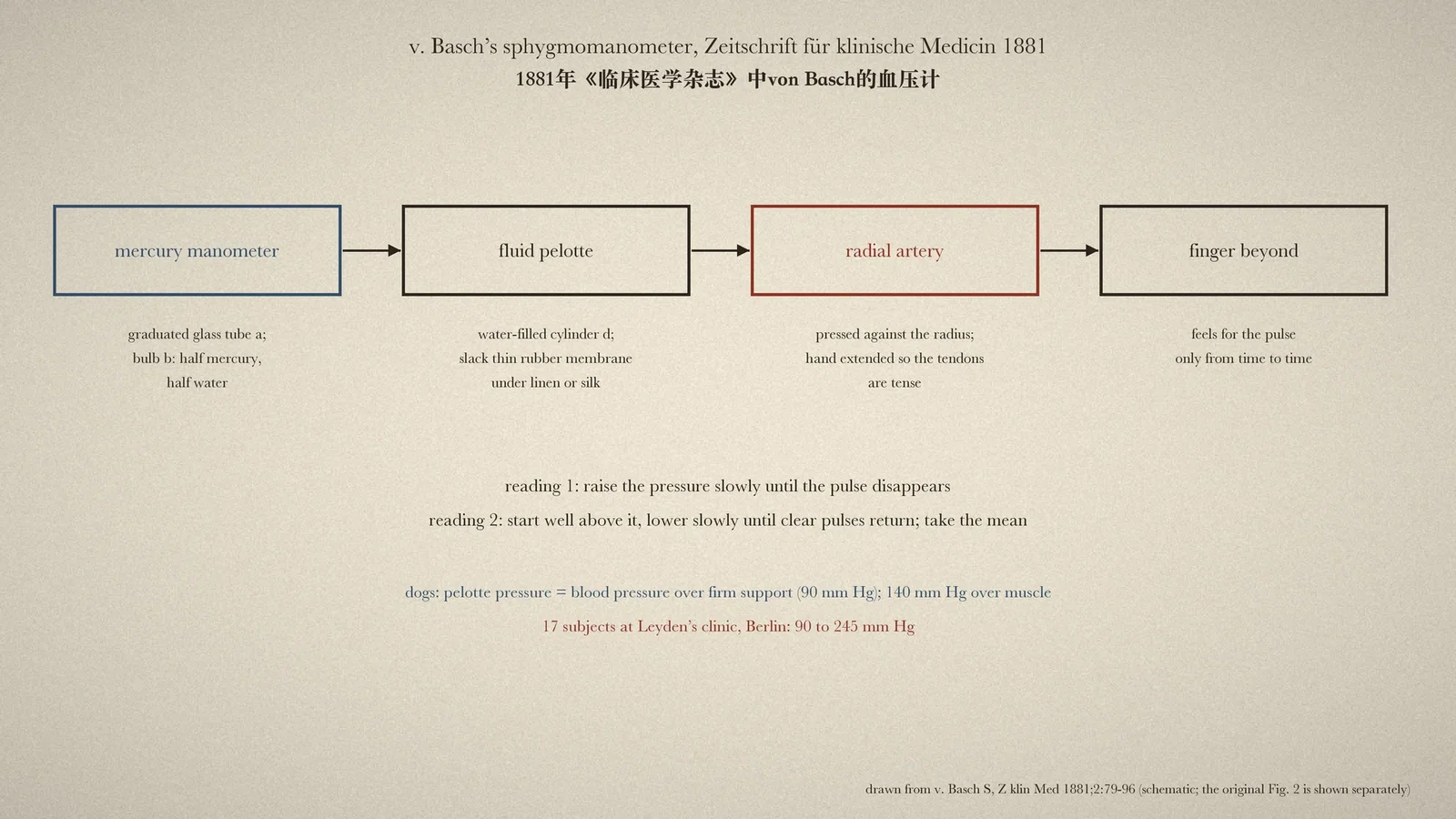
The difficulty with a weight or a rigid pad is that nobody knows the area it presses on. Von Basch's answer was a "fluid pelotte": a small glass funnel closed by a very thin rubber membrane, tied on loosely and covered with thin linen or silk, filled with water and connected to a mercury manometer. Pressed against a firm surface, the slack membrane flattens without stretching, so the surface feels the full pressure shown by the mercury, "as if the column of mercury were resting directly on it". [1]
Von Basch tested this on the carotid and femoral arteries of six dogs, with a mercury manometer on the opposite artery to give the true pressure, and judged closure by the disappearance of the pulse beyond the compressed point. When the exposed artery lay on firm support, the pelotte pressure needed to abolish the pulse equalled the actual blood pressure. When it lay on muscle, it did not: for one femoral artery at a blood pressure of 90 mm Hg, 90 mm Hg sufficed over a small board, 140 mm Hg without it, and over 200 mm Hg under the inguinal ligament. Covering the supported artery with skin made hardly any difference. [1]
The sphygmomanometer
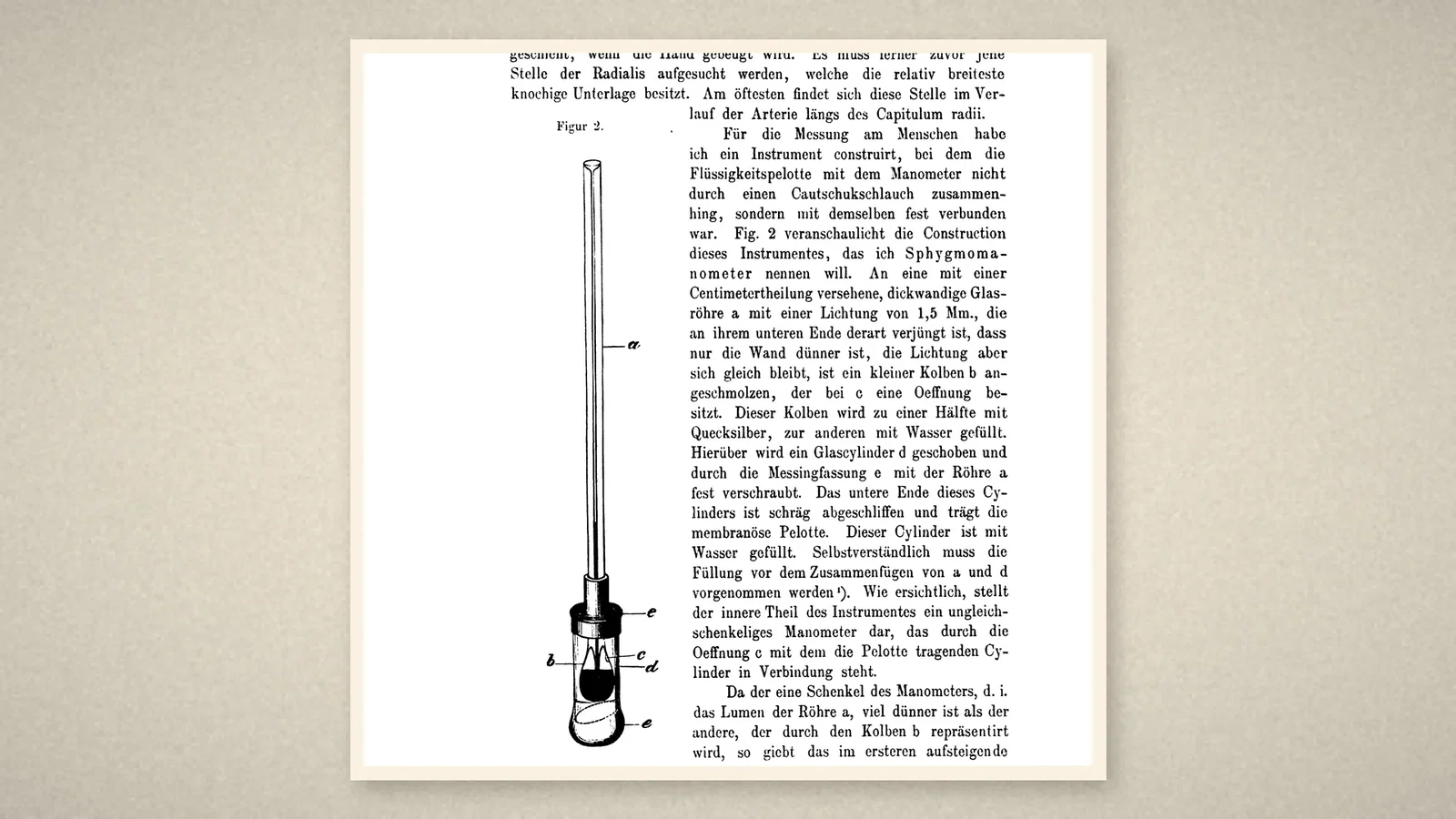
All the human measurements were made on the radial artery, where it can be pressed against the radius. For this von Basch built an instrument "which I will call a sphygmomanometer". A thick-walled glass tube with a centimetre scale and a bore of 1.5 mm carries a small bulb, half filled with mercury and half with water; over this slides a water-filled glass cylinder, screwed to the tube by a brass mount, its lower end obliquely ground and closed by the membrane pelotte. The bulb and the narrow tube form an unequal-limbed manometer, so that the mercury rising in the tube gives almost the whole pressure. [1]
The instructions are those of a careful clinician. Choose a radial artery that the exploring finger shows can be pressed against bone, usually along the head of the radius. Extend the hand until the tendons at the wrist are tense, so that the artery cannot slip under them. Put a finger on the artery beyond the pelotte, but feel only from time to time, because with continuous touch one easily mistakes the pulse in one's own fingertip for the patient's. Take two readings: press slowly until the pulse disappears; then start well above that value and release slowly until clear pulses return; the mean of the two is the result. For those who distrust their touch, a pulse lever can be made from an elastic ring round the wrist, a strip of whalebone with a piece of cork, and a needle lengthened with a straw. A second, fixed version of the apparatus, with an arm rest and screws, gave narrower limits but the same results. [1]
The first numbers
Most of the measurements were made at the Berlin propaedeutic clinic, with patients made available by Professor Leyden,, and only after von Basch had become fully familiar with the method. The table gives seventeen subjects, A to R. Healthy individuals of different ages read between 145 and 180 mm Hg; two patients with anaemia read 125 and 120; one with arteriosclerosis 168; two with cardiac hypertrophy 245 and 235; a convalescent from pneumonia 110; and a very cachectic patient with gastric cancer 90. Von Basch declined to draw diagnostic conclusions, offering the numbers only to show the method's worth, and noted their agreement with the human cases measured directly by Ludwig (120 mm Hg) and Vierordt (155 mm Hg). The instrument also showed that straining raised the pressure and that the Valsalva manoeuvre lowered it. [1]

What the record shows
The fluid pad pressed on one artery is gone; the cuff around the whole limb replaced it. But the paper's logic is still the logic of every blood pressure measurement: occlude from outside, detect the pulse beyond the occlusion, read the pressure in millimetres of mercury, approach the end point from both directions, and know where the method fails. Von Basch was explicit that it fails when the artery is not supported by bone, when the skin is thick, or when the arterial wall is rigid, and that the absolute value cannot be guaranteed, while changes in the same person can be followed reliably.
Sources and reading limits
Read: von Basch, "Ueber die Messung des Blutdrucks am Menschen", Zeitschrift für klinische Medicin vol. 2, pp. 79-96; the volume's title page and contents; the ASA timeline entry for 1881.
Not covered: von Basch's earlier volumetric paper, the Berlin Physiological Society reports of 1880, and the later metal sphygmomanometer; the date of the first number of the volume, which is why the paper is sometimes cited as 1880; later cuff methods. The ASA describes "a water-filled rubber ball"; the paper describes a water-filled glass cylinder closed by a slack rubber membrane. The table caption says the figures up to L are healthy individuals and also that L and M were anaemic; the article follows the diagnoses given. The paper speaks of the pressure at which the pulse disappears and returns, not of systolic pressure. Quotations are translated from the German for this article.
Three illustrations are crops of the 1881 volume, including its Fig. 2; one is drawn from the paper.
- v. Basch S. Ueber die Messung des Blutdrucks am Menschen. Z Klin Med. 1881;2:79-96. Internet Archive
- Australian Society of Anaesthetists. Anaesthesia history timeline. 2024. ASA
Continue exploring
Related reading connects shared questions and contexts; it does not by itself establish historical influence.
- 1733: Hales Measures Arterial Pressure in a Living Mare
- 1896: Riva-Rocci's Cuff Sphygmomanometer, Tested in a Munich Thesis
- 1897: Hill and Barnard Measure Blood Pressure with an Armlet and Dial
Anesthesia Epochs · The Source Room · About & Editorial Method
Published November 2, 2026. Sources and reading limits are stated above. Illustrations are labelled as original source images or AI-made. Historical accounts are educational; they are not current treatment instructions.