
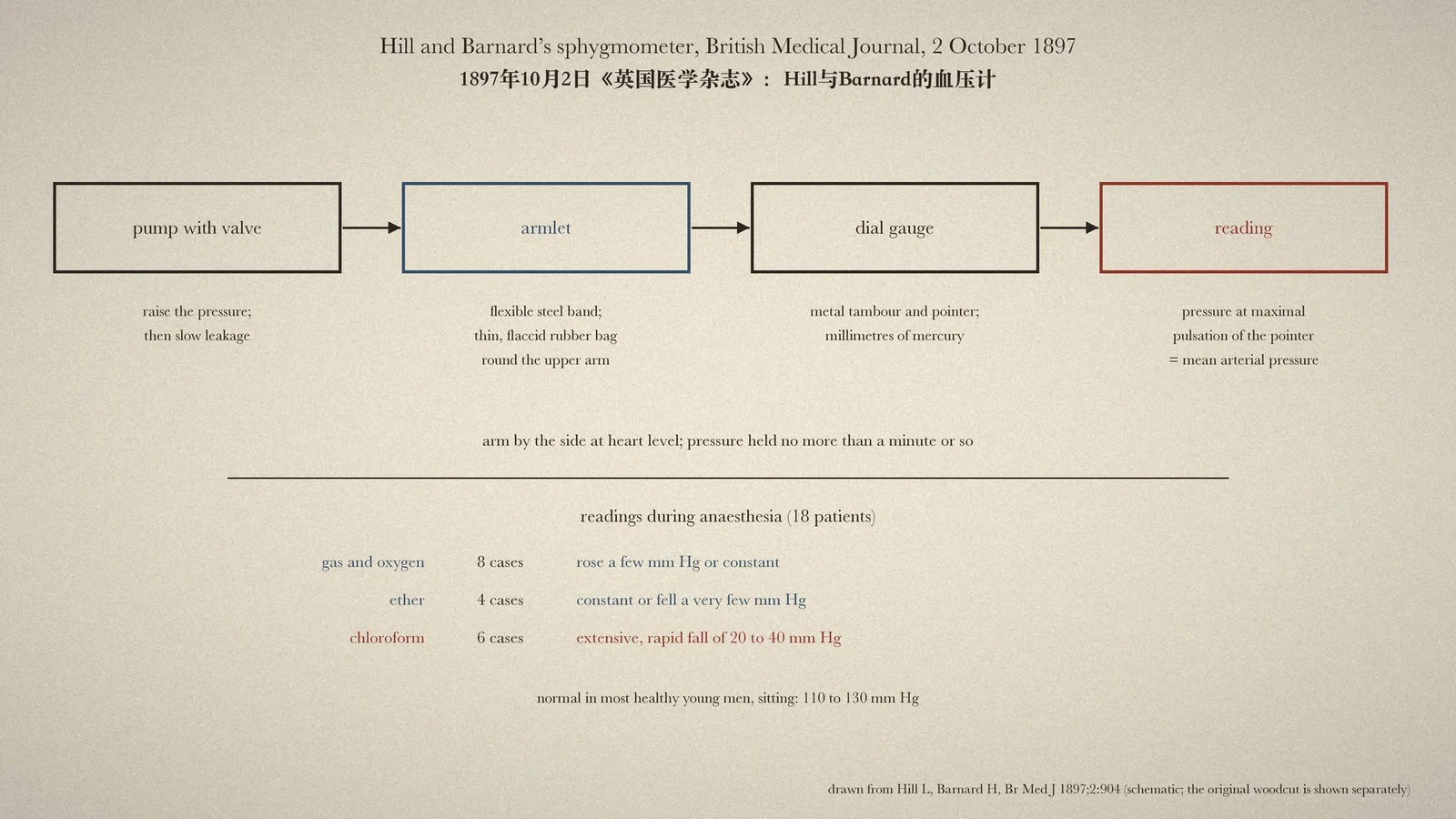
On 2 October 1897 Leonard Hill, lecturer on physiology, and Harold Barnard, surgical registrar, at the London Hospital described a clinical sphygmometer: a steel-band armlet lined with a thin rubber bag, a small pump and a dial gauge graduated in millimetres of mercury, read at the point of maximal pulsation as the mean arterial pressure; in eighteen anaesthetics, gas and oxygen and ether left the pressure nearly unchanged, while chloroform lowered it by 20 to 40 mm Hg.
Reading Library · Anesthesia Epochs · 中文版
Watch the education video (for clinicians)
1897: Hill and Barnard's Sphygmometer — An Armlet and a Dial · Anesthesia Epochs Education Series
Blood pressure is now recorded on every anaesthetic chart, usually every few minutes. The Australian Society of Anaesthetists' timeline gives the "first record of blood pressure monitoring in anaesthesia" to Leonard Hill and Harold Barnard of the London Hospital in 1897. This article reads the two places in the British Medical Journal where they reported it: a letter by Hill in July, written in the middle of the argument over how chloroform kills, and their short paper of 2 October describing the instrument. [1][2][3]
A letter about chloroform
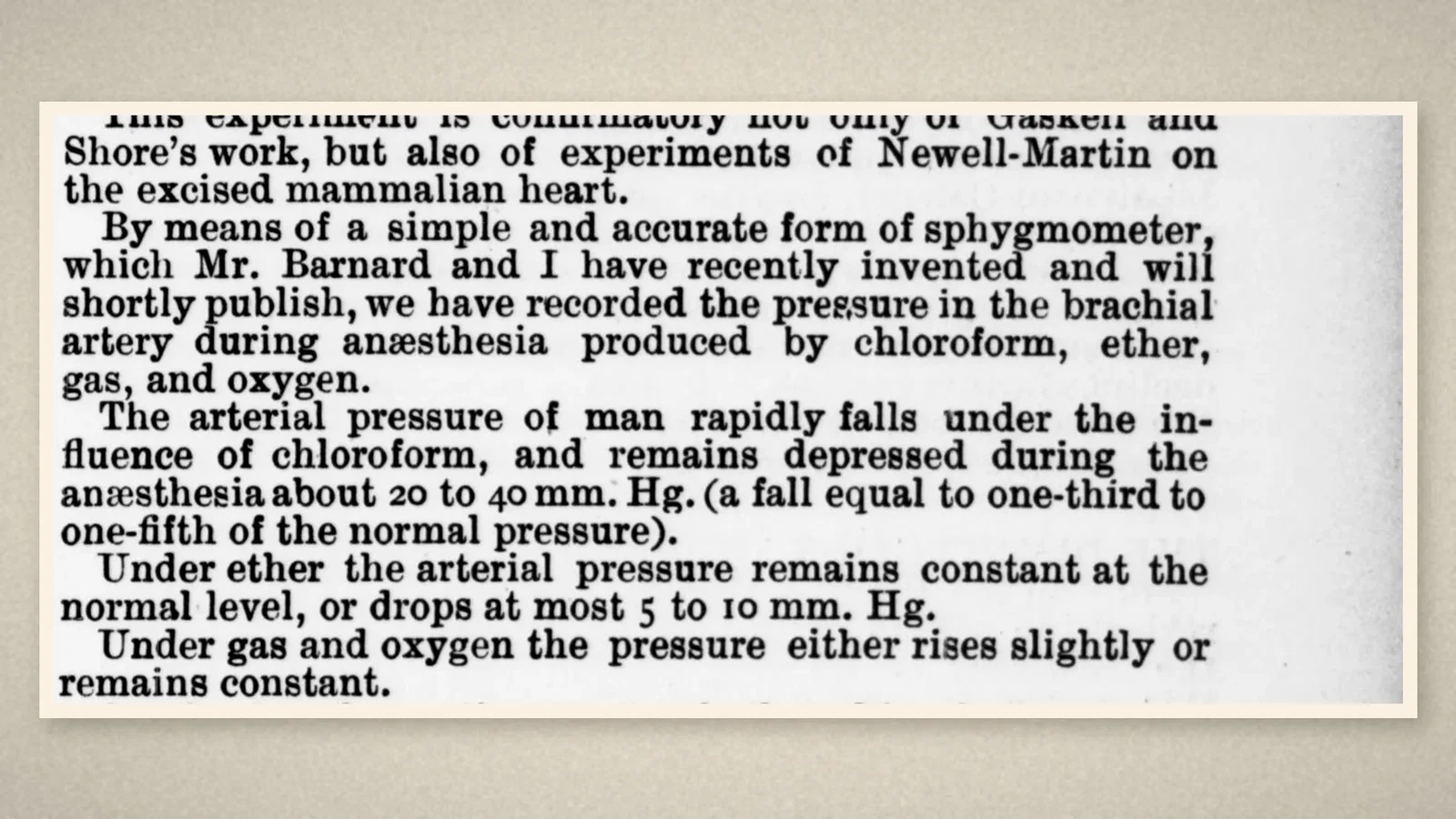
In 1897 British physiologists were arguing with the Hyderabad Chloroform Commission over whether chloroform deaths began with failure of breathing or of the circulation. Hill, lecturer on physiology at the London Hospital, wrote on 26 July that "the respiration fails because the arterial pressure falls". Near the end of the letter came new evidence from patients. "By means of a simple and accurate form of sphygmometer, which Mr. Barnard and I have recently invented and will shortly publish, we have recorded the pressure in the brachial artery during anaesthesia produced by chloroform, ether, gas, and oxygen." Under chloroform the pressure "rapidly falls" and stays some 20 to 40 mm Hg lower, "a fall equal to one-third to one-fifth of the normal pressure"; under ether it stayed level or dropped at most 5 to 10 mm; under gas and oxygen it rose slightly or stayed constant. [2]
The instrument
The promised paper appeared on 2 October 1897: "A simple and accurate form of sphygmometer or arterial pressure gauge contrived for clinical use", by Leonard Hill and Harold Barnard, surgical registrar. The instrument had three parts. A broad armlet of flexible steel band, strapped round the upper arm, carried on its inside "a bag of thin indiarubber"; a Y-tube connected the bag to "a small compressing air pump fitted with a valve" and to a pressure gauge. The gauge was a metal tambour whose expansion was magnified by a pointer travelling round a dial "graduated in millimetres of mercury". Armlet, pump and gauge fitted into a leather case. [1]
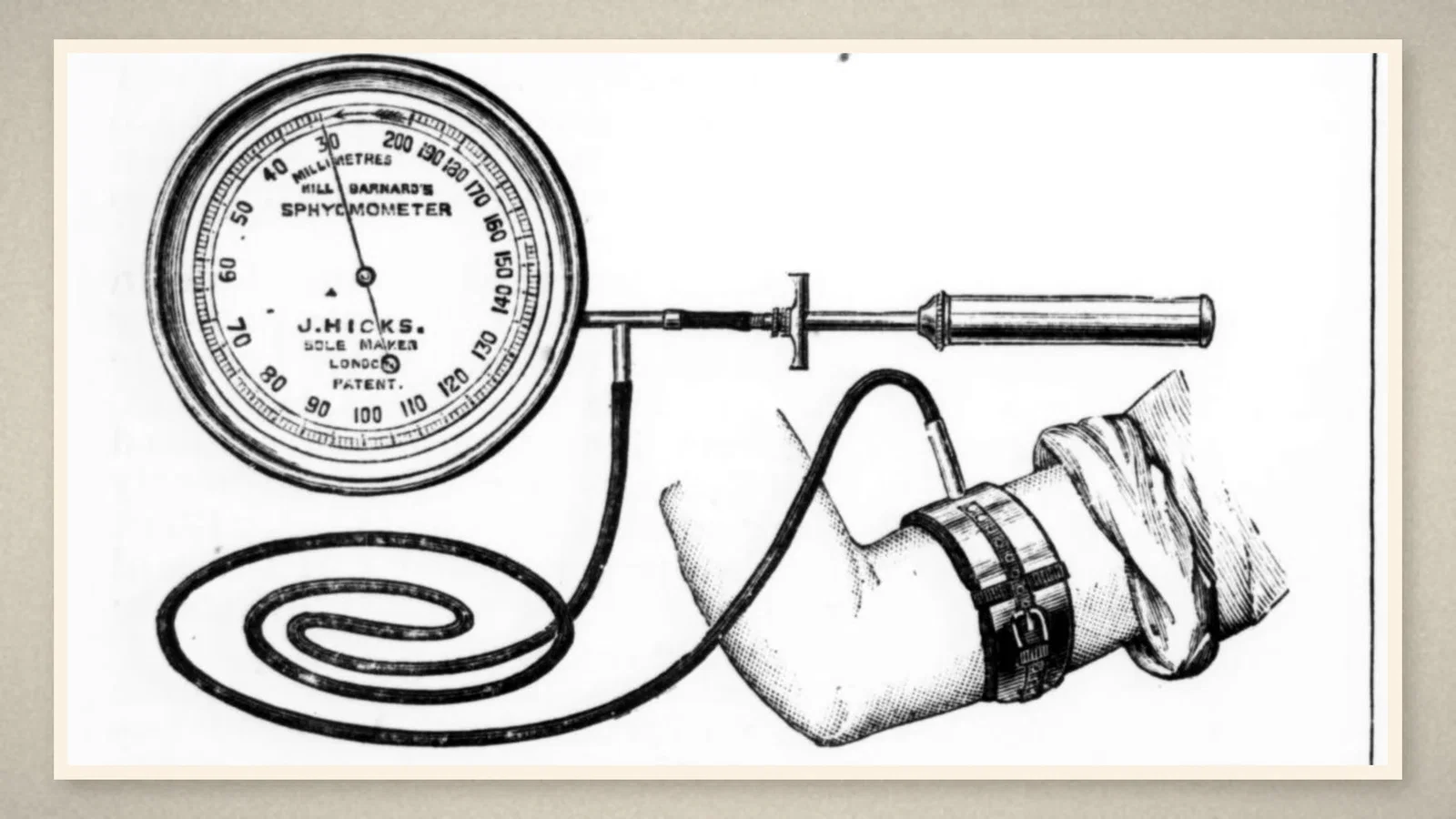
The reading rule differs from the one used today. The armlet was strapped closely round the arm, and the pressure in the bag was raised "until the pulsation indicated by the index of the pressure gauge becomes of maximal excursion. At this point the pressure indicated by the gauge is read, and this pressure is the mean arterial pressure." The steel band let the armlet fit any arm, and in children the thigh; the bag was "thin and flaccid" so that its own elasticity would not add an error. Because the inflated bag blocked the veins, readings had to be quick, never holding the pressure "for more than a minute or so": pump up past the point of disappearing pulsation, let the air leak slowly, note where the pulsation is greatest, let all the air out, empty the arm of venous blood, and repeat. The arm had to rest by the side at the level of the heart, with the muscles relaxed. [1]
The authors checked the principle in two ways. With the armlet round a dog's neck and a cannula in the femoral artery connected to a mercury manometer, maximal pulsation "was thus found to occur always at a pressure which exactly corresponded with the mean pressure in the femoral artery". With one arm raised and the other hanging, two sphygmometers differed by the height of the column of blood between them. [1]
Eighteen anaesthetics
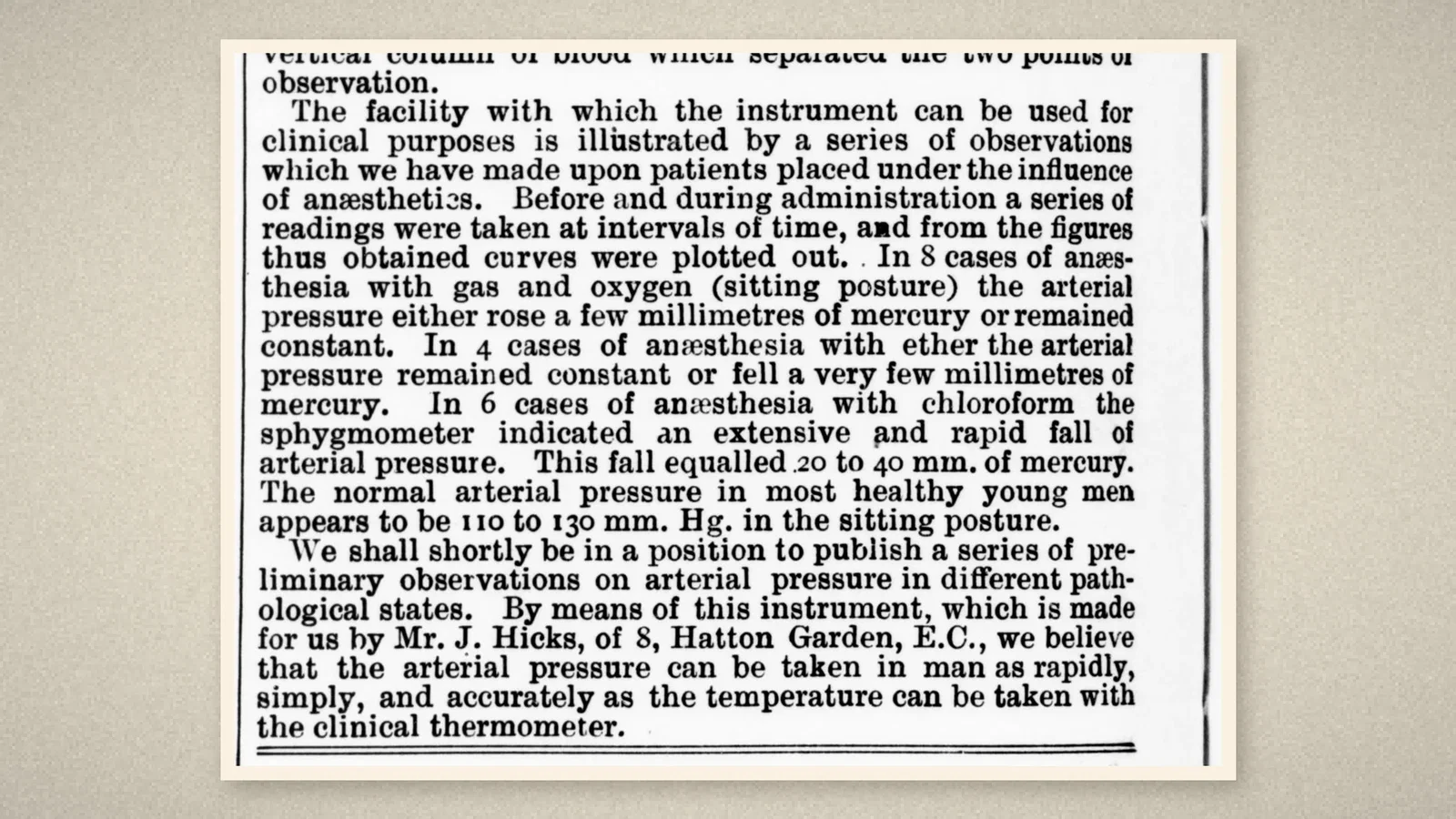
Before and during administration, readings were taken at intervals and plotted as curves. In 8 patients given gas and oxygen, sitting, the pressure rose a few millimetres of mercury or stayed constant. In 4 given ether it stayed constant or fell "a very few millimetres". In 6 given chloroform "the sphygmometer indicated an extensive and rapid fall of arterial pressure. This fall equalled 20 to 40 mm. of mercury." The normal pressure in most healthy young men, sitting, appeared to be 110 to 130 mm Hg. The instrument was made by J. Hicks of Hatton Garden, and the authors believed that with it the arterial pressure could be taken "as rapidly, simply, and accurately as the temperature can be taken with the clinical thermometer". [1]
What the record shows
Two things in these pages are now routine. One is an inflatable cuff with a dial gauge in mm Hg, small enough to carry in a case and quick enough to repeat. The other is the habit of measuring blood pressure repeatedly during an anaesthetic and plotting it against time, which showed, in a handful of patients, the circulatory depression of chloroform that the physiologists were arguing about. The method itself, reading the point of maximal oscillation as the mean pressure, is the principle of today's automated oscillometric monitors, though Hill and Barnard read it by eye.
Sources and reading limits
Read: Hill and Barnard’s paper in the British Medical Journal of 2 October 1897, p. 904, with its woodcut and page image; Hill’s letter “The causation of chloroform syncope”, BMJ 31 July 1897, pp. 312–313, with the page image of p. 313; the ASA timeline entry for 1897.
Not covered: the curves the authors plotted, which are not printed; their later series; Riva-Rocci’s paper of 1896. The ASA speaks of a drop in systolic pressure; the paper reads maximal pulsation as the mean arterial pressure, and this account follows the paper. Hill’s letter also reports animal experiments, which are not described here.
- Hill L, Barnard H. A simple and accurate form of sphygmometer or arterial pressure gauge contrived for clinical use. Br Med J. 1897;2:904. Internet Archive
- Hill L. The causation of chloroform syncope [letter]. Br Med J. 1897;2:312-3. Internet Archive
- Australian Society of Anaesthetists. Anaesthesia history timeline. 2024. ASA
Continue exploring
Related reading connects shared questions and contexts; it does not by itself establish historical influence.
- 1881: von Basch Reads Blood Pressure When the Pulse Stops
- 1896: Riva-Rocci's Cuff Sphygmomanometer, Tested in a Munich Thesis
- 1903: Cushing Brings Blood Pressure Charting into the Operating Room
Anesthesia Epochs · The Source Room · About & Editorial Method
Published November 2, 2026. Sources and reading limits are stated above. Illustrations are labelled as original source images or AI-made. Historical accounts are educational; they are not current treatment instructions.