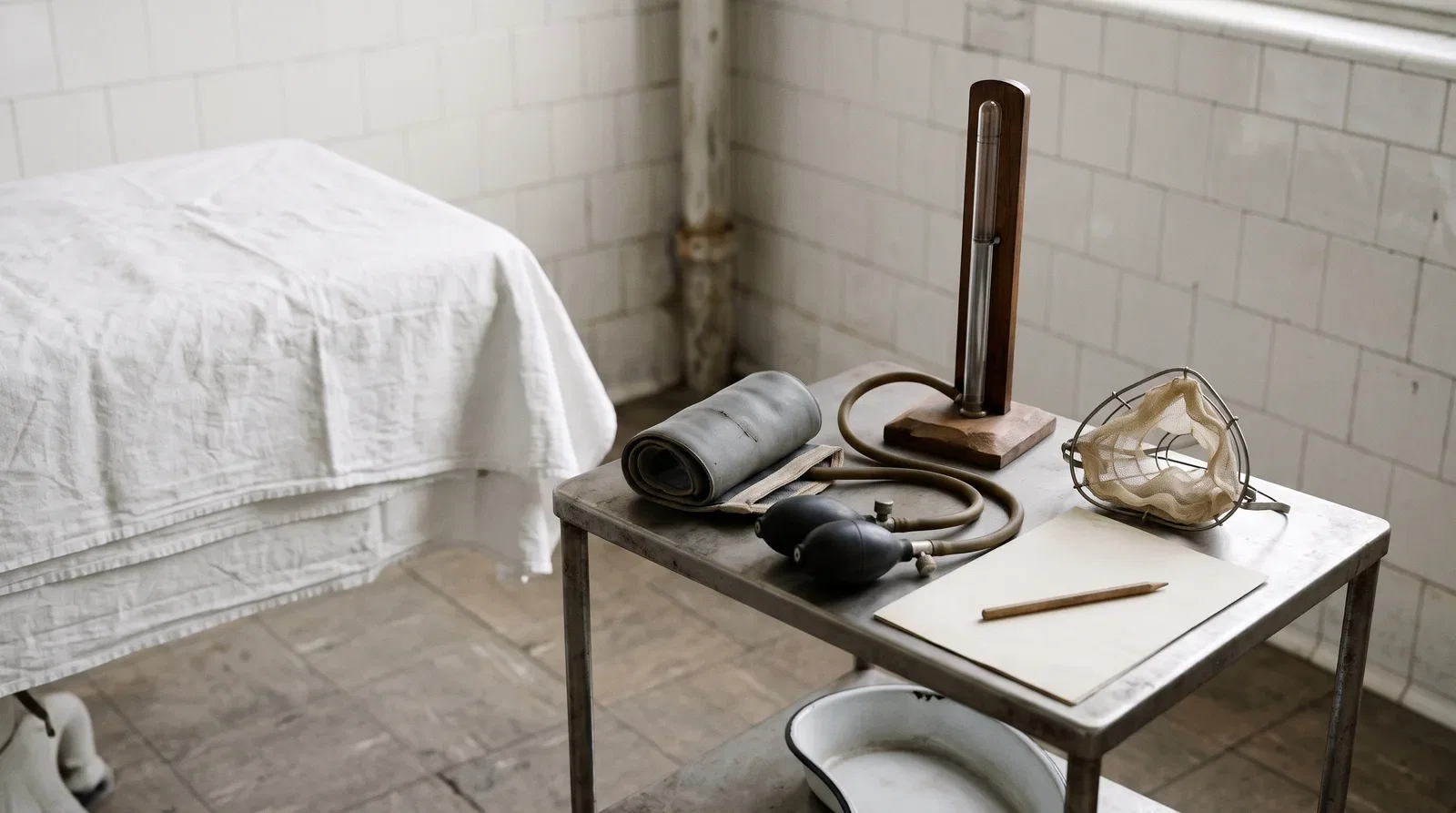
In January 1903 Harvey Cushing of Johns Hopkins described bringing the Riva-Rocci armlet, seen in routine use in Pavia, into the operating room, where charts of systolic pressure showed a rise under ether and a fall under chloroform.
Reading Library · Anesthesia Epochs · 中文版
Watch the education video (for clinicians)
1903: Blood Pressure in the Operating Room — Harvey Cushing · Anesthesia Epochs Education Series
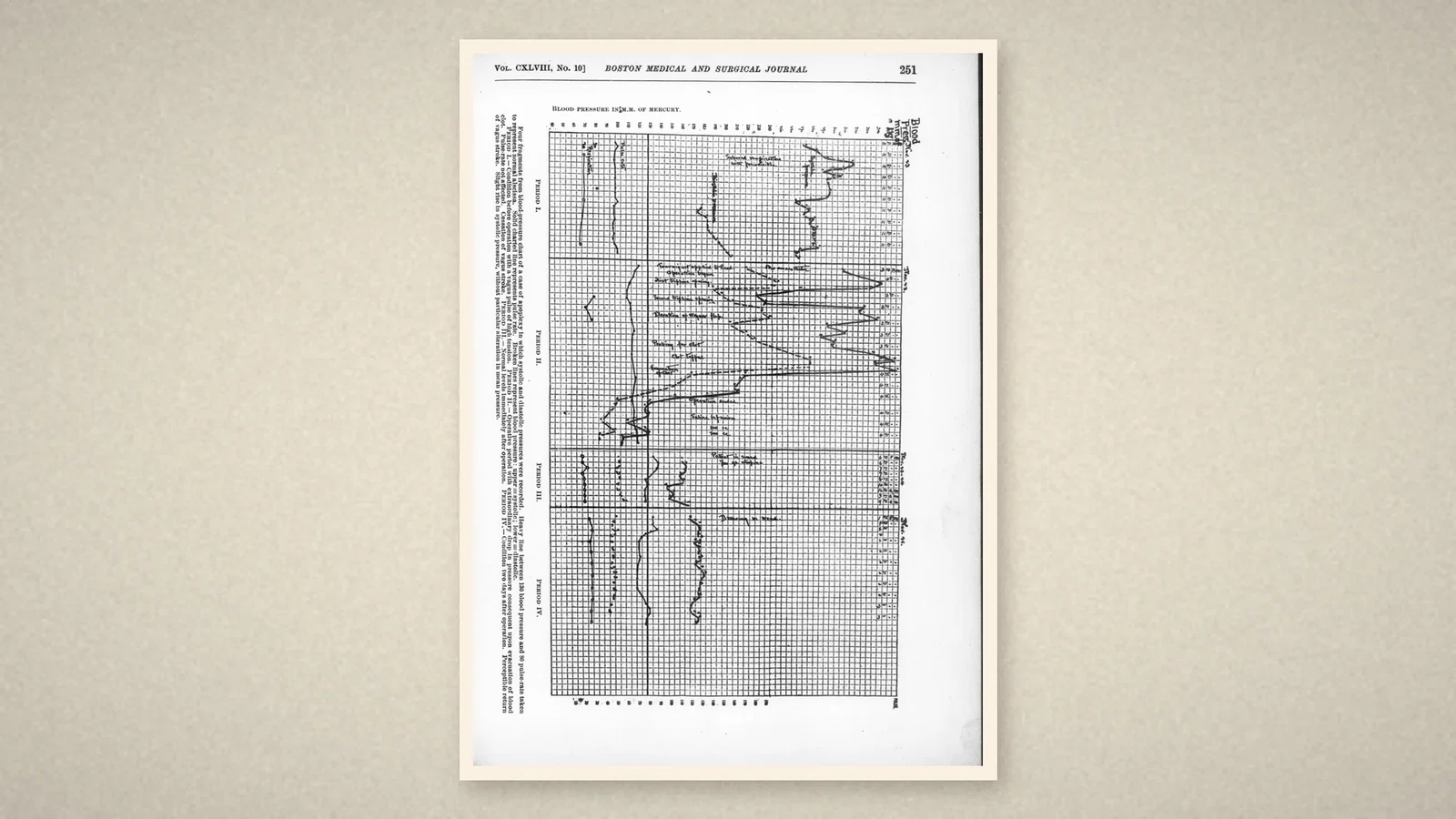
The anaesthetic chart that Harvey Cushing and E. A. Codman kept at the Massachusetts General Hospital in 1894-1895 recorded pulse and respiration, not blood pressure. The Australian Society of Anaesthetists' timeline says that "in 1902, Cushing added the recording of systolic blood pressure to the chart after visiting Riva-Rocci's clinic". Cushing's own account of that step is a lecture given at the Boston Medical Library on 19 January 1903 and printed in the Boston Medical and Surgical Journal on 5 March 1903. [1][2]
The surgeon and the anaesthetist's finger
Cushing, then associate in surgery at the Johns Hopkins Hospital, began with a want felt "in the surgical operating room, possibly even more than in the clinic": a practical apparatus that would give "numerical equivalents for variations in pulse tension", so that "consecutive observations on this quality of the pulse may be diagramatically charted". During a critical operation, the surgeon's "hearsay dependence ... on the palpating finger of the anesthetist" for knowledge of the patient's cardiac strength could be among the most trying of responsibilities. Figures, or a glance at a plotted chart, would lighten it, and the operation might be modified "with a consequent lessening of its risks". [1]
Cushing did not dismiss an educated touch, but argued that training with a sphygmomanometer taught the fingers faster: a "weak" or "compressible" pulse would become one "with a tension perhaps of 80", a "hard" or "bounding" one perhaps 260. The paper compares blood pressure with the thermometer and the watch, instruments the clinic had also once resisted, and predicts that "routine observations on blood pressure ... will be taken in our hospitals in correspondence with the present thermic and pulse-rate observations". [1]
Pavia
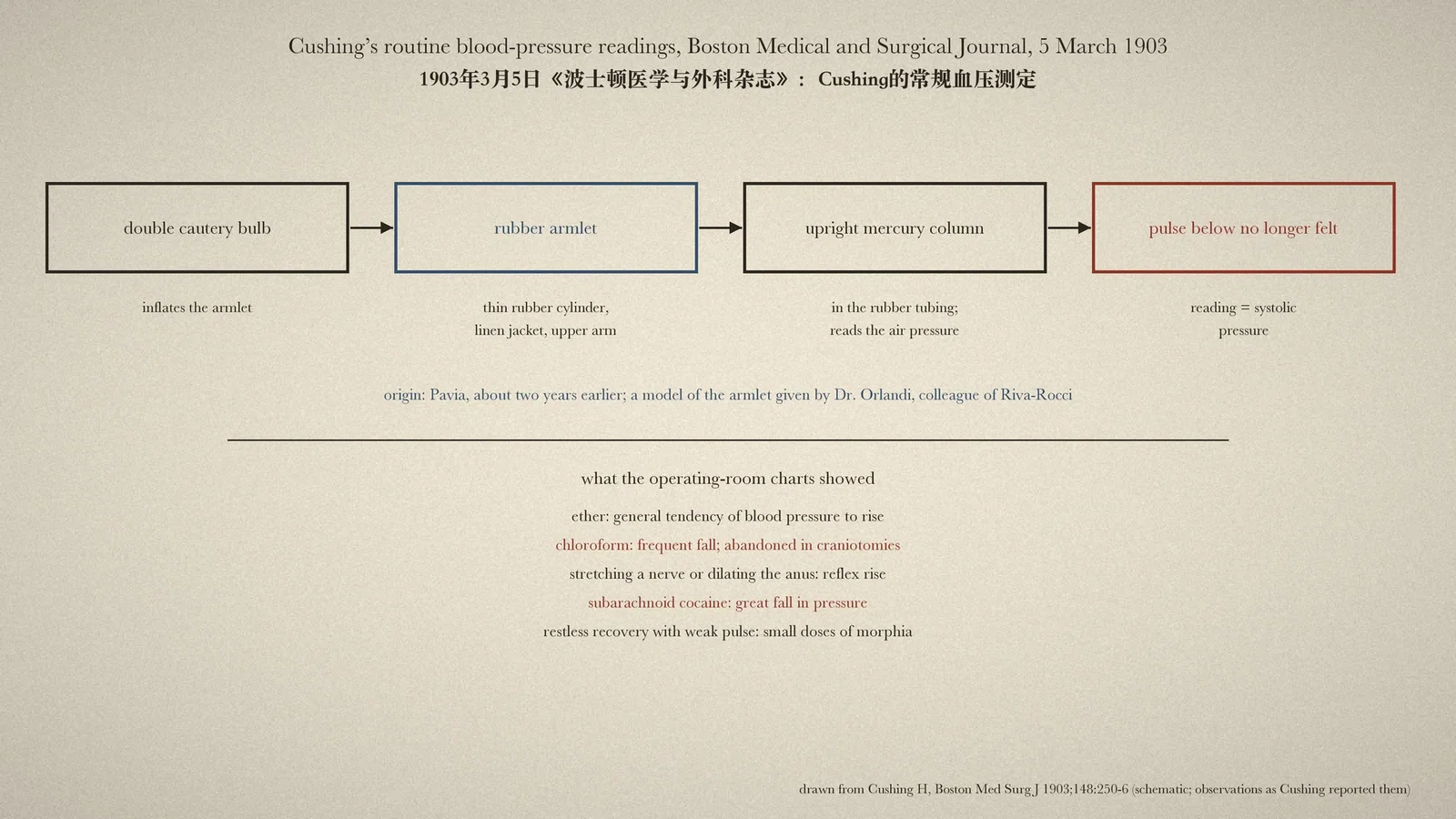
The instrument came from Italy. "Two years ago, while on a tour among the Italian University towns, I had the good fortune in Pavia to be shown through the medical wards of the old Ospidale de S. Matteo by Dr. Orlandi, a colleague of Riva-Rocci", and found that "a simple 'home-made' adaptation" of Riva-Rocci's blood-pressure apparatus "was in routine daily use at the bedside of every patient". Orlandi gave Cushing a model of the inflatable armlet, and "practically the same form of apparatus" had been used at Johns Hopkins "with increasing satisfaction ever since". [1]
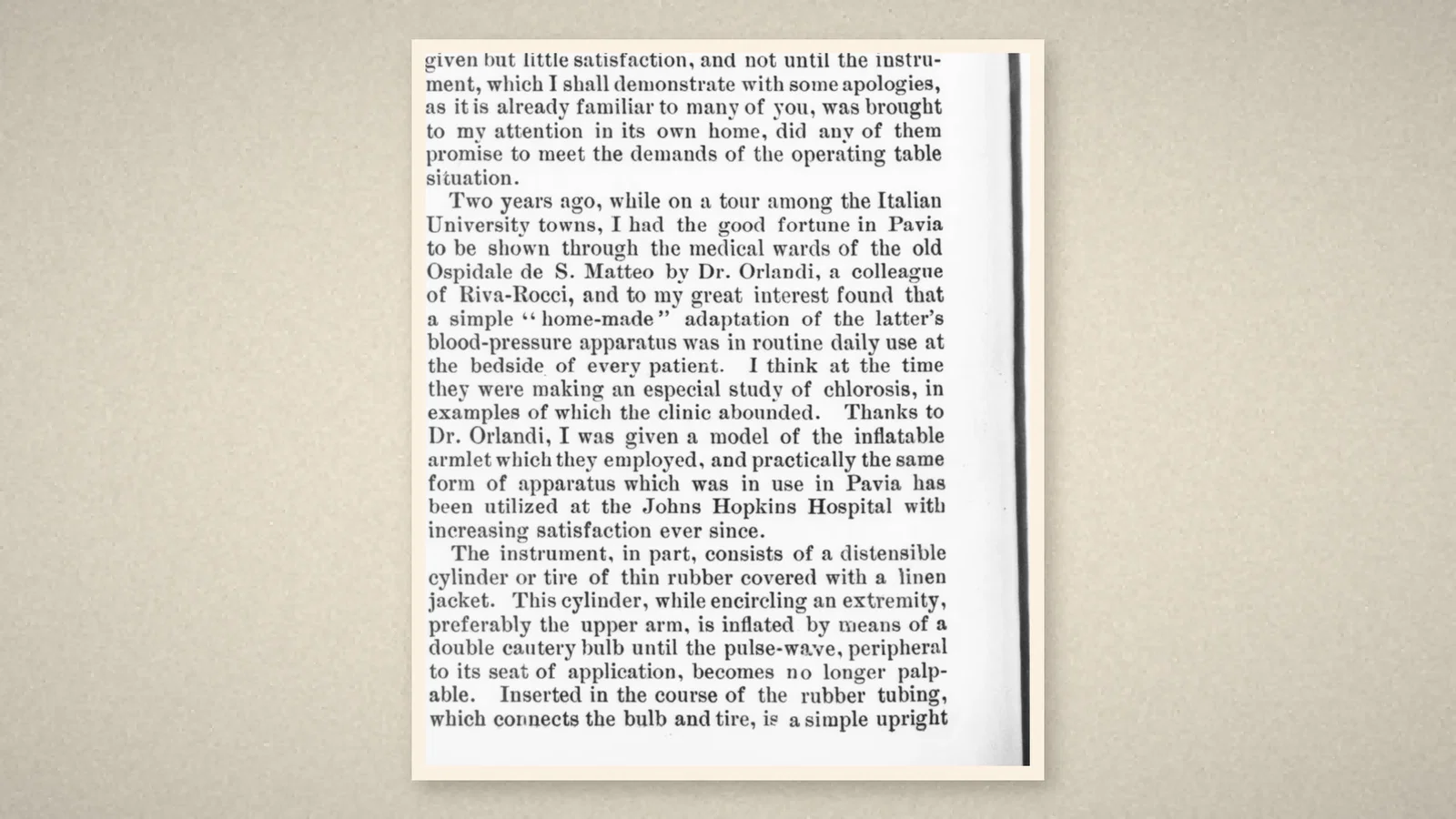
The apparatus was simple: "a distensible cylinder or tire of thin rubber covered with a linen jacket", wrapped round the upper arm and "inflated by means of a double cautery bulb until the pulse-wave, peripheral to its seat of application, becomes no longer palpable", with "a simple upright mercury manometer" in the tubing. Cushing noted that it differed "only in some important details from the appliance described by Hill and Barnard", that it recorded systolic pressure only, and that its readings depended on the tissue over the artery; but for following changes in one patient, its simplicity outweighed its errors. Eimer and Amend of New York had put a version on the market, and Crile had substituted a small aneroid gauge for the mercury. [1]
What the charts showed
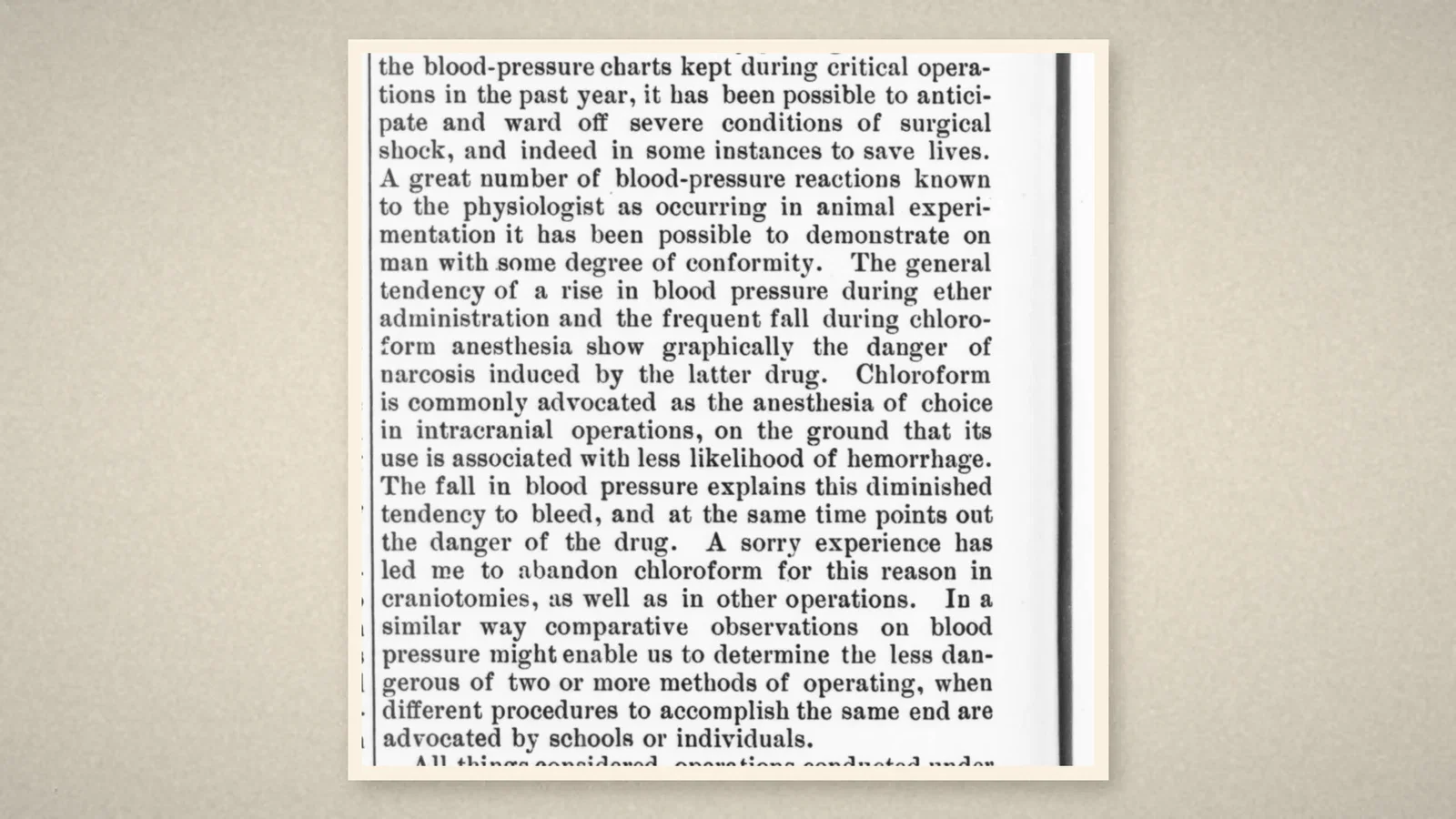
Cushing claimed that by relying on blood-pressure charts kept during critical operations in the past year, "it has been possible to anticipate and ward off severe conditions of surgical shock, and indeed in some instances to save lives". The charts showed "the general tendency of a rise in blood pressure during ether administration and the frequent fall during chloroform anesthesia". Chloroform was then favoured for intracranial operations because there was less bleeding; the fall in pressure explained the lesser bleeding and "at the same time points out the danger of the drug. A sorry experience" had led Cushing to abandon chloroform in craniotomies and other operations. [1]
Other observations followed. Handling large nerves, stretching a nerve or dilating the anus produced reflex rises; in exhausted patients the same stimulus could produce a fall. During restless recovery a weak pulse responded best to small doses of morphia. And "the great fall in pressure which often follows the subarachnoid injection of cocaine" seemed to Cushing reason enough to deter anyone from that method of anaesthesia, a fall Cushing attributed to paralysis of the splanchnic vasomotor nerves rather than to toxicity. [1]
What the record shows
This paper turns blood pressure into a routine number, measured by anyone with a cuff and recorded beside pulse and temperature, and into a line on the anaesthetic chart that changes the surgeon's decisions. Much of what Cushing reported has held: the pressure fall with chloroform, the reflex responses to surgical stimulation, the hypotension of spinal anaesthesia and its sympathetic cause. The judgement on spinal anaesthesia did not.
Sources and reading limits
Read: Cushing's paper in the Boston Medical and Surgical Journal of 5 March 1903, pp. 250–256; the note on p. 29 of the ASA timeline.
Not covered: Cushing's own ether charts with blood pressure; any paper by Cushing on the precordial stethoscope; Riva-Rocci's paper of 1896. The ASA places the visit in 1902 and in Padua; the paper, read in January 1903, says "two years ago" and Pavia, and the account follows the paper. Cushing's claims about saving lives are Cushing's own. The view of spinal anaesthesia is reported as a 1903 opinion.
- Cushing H. On routine determinations of arterial tension in operating room and clinic. Boston Med Surg J. 1903;148:250-6. Internet Archive
- Australian Society of Anaesthetists. Anaesthesia history timeline. 2024. ASA
Continue exploring
Related reading connects shared questions and contexts; it does not by itself establish historical influence.
- 1894: Cushing and Codman Put Anesthesia on the Record
- 1896: Riva-Rocci's Cuff Sphygmomanometer, Tested in a Munich Thesis
- 1897: Hill and Barnard Measure Blood Pressure with an Armlet and Dial
Anesthesia Epochs · The Source Room · About & Editorial Method
Published November 2, 2026. Sources and reading limits are stated above. Illustrations are labelled as original source images or AI-made. Historical accounts are educational; they are not current treatment instructions.