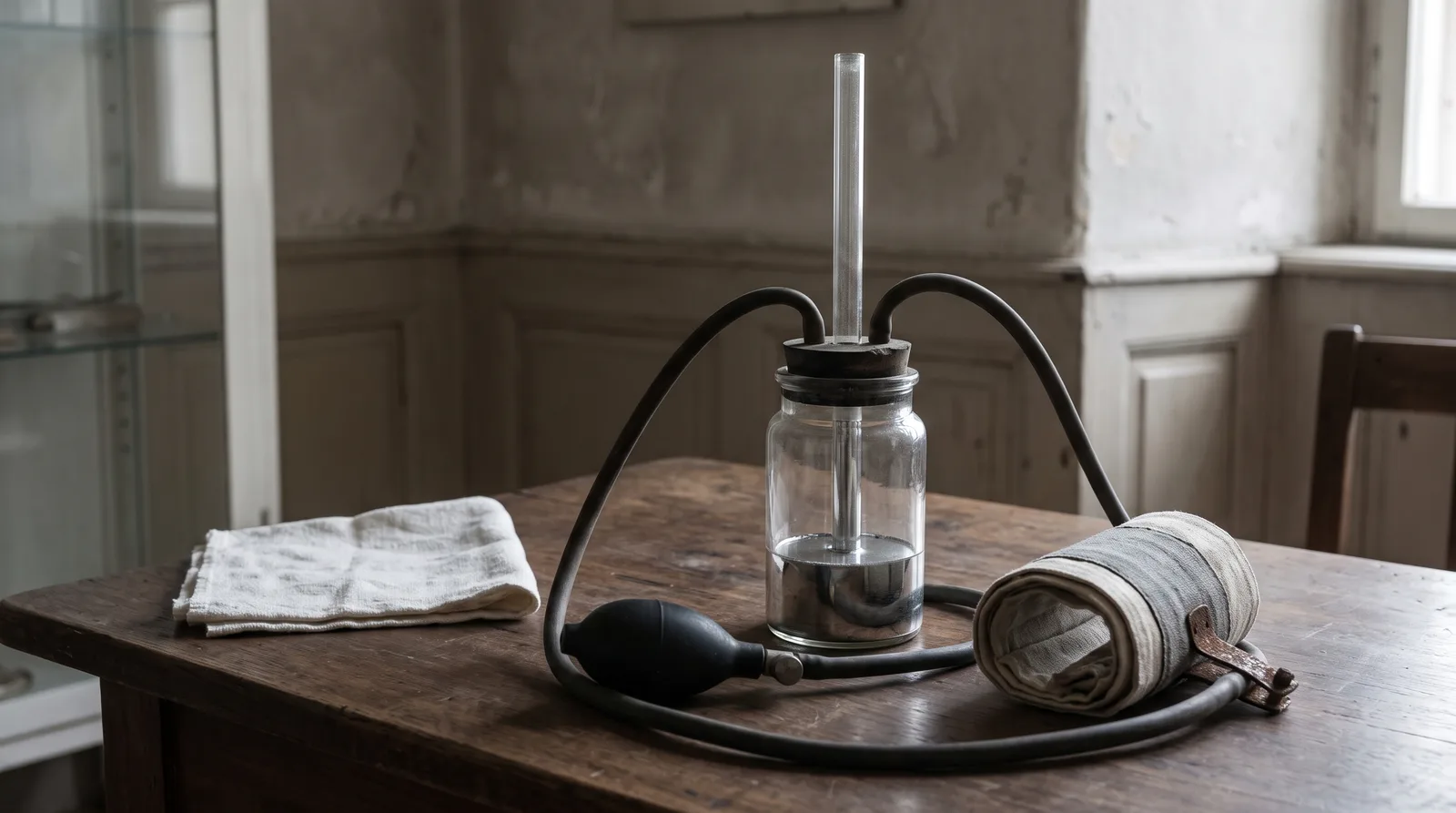
In 1898 a Munich doctoral thesis by H. H. Cushing of Philadelphia tested the cuff sphygmomanometer designed by Riva-Rocci, found the copy made in Turin unusable as built, rebuilt it and, after comparing it with von Basch’s instrument in some 400 cases, judged that its faults lay in construction, not in principle.
Reading Library · Anesthesia Epochs · 中文版
Watch the education video (for clinicians)
1896: Riva-Rocci's Cuff — Tested Case by Case in Munich · Anesthesia Epochs Education Series
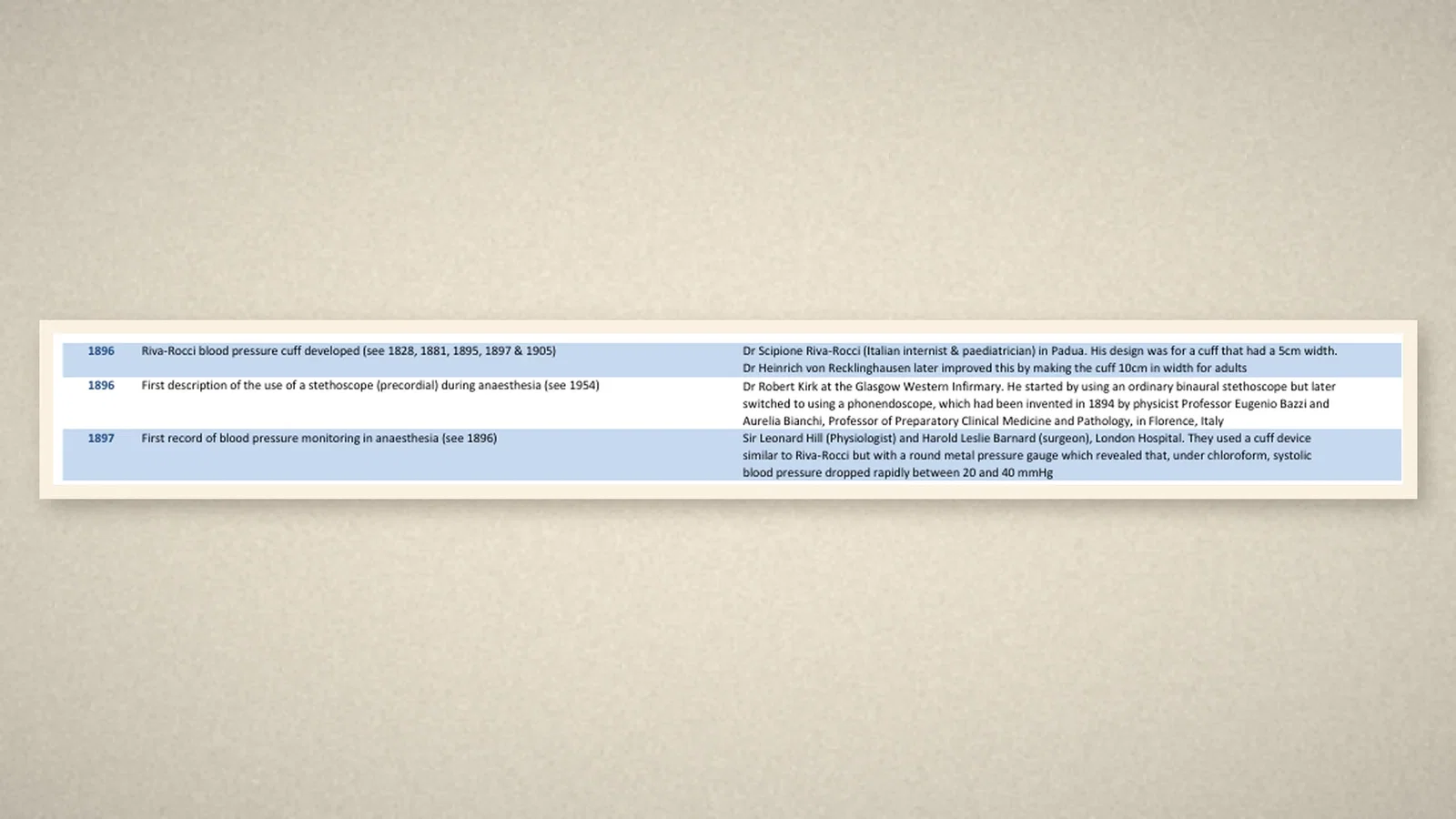
The inflatable cuff round the arm is so familiar in anaesthesia that its arrival is easy to overlook. The Australian Society of Anaesthetists (ASA) timeline dates that cuff to 1896: "Riva-Rocci blood pressure cuff developed", by Dr Scipione Riva-Rocci, Italian internist and paediatrician. It adds that the design used a cuff 5 cm wide, which Heinrich von Recklinghausen later widened to 10 cm for adults; that in 1897 Leonard Hill and Harold Barnard at the London Hospital used a similar cuff, in what the ASA calls the "First record of blood pressure monitoring in anaesthesia"; and that in 1905 Korotkov developed the auscultatory method with a Riva-Rocci cuff. [2, pp. 29, 33]
Riva-Rocci's own paper of 1896 is not quoted here. A working clinic met the instrument two years later, as described in an inaugural dissertation submitted to the medical faculty of the Ludwig-Maximilians-Universität in Munich in 1898: "Das neue Sphygmomanometer für klinische Zwecke von Riva Rocci" (The new sphygmomanometer for clinical purposes by Riva Rocci), presented by H. H. Cushing "aus Philadelphia", with Professor Hugo von Ziemssen as referee. [1, title page]

The instrument to beat
The thesis begins with the standard of the day. Of all the sphygmomanometers in general use, "von Basch's is certainly the best for clinical purposes": compact, and reasonably accurate when the same examiner used the same instrument. Its weakness was its handling. The examiner pressed a pad on an artery, usually the temporal, with one hand while feeling the pulse with the other, and the soft tissues, the skin and the examiner's own pressure all crept into the reading. What the clinic wanted was a pressure applied mechanically, always at the same site, read on a simple mercury column, and an instrument robust enough that its owner could repair it. [1, pp. 5-11]
What arrived from Turin
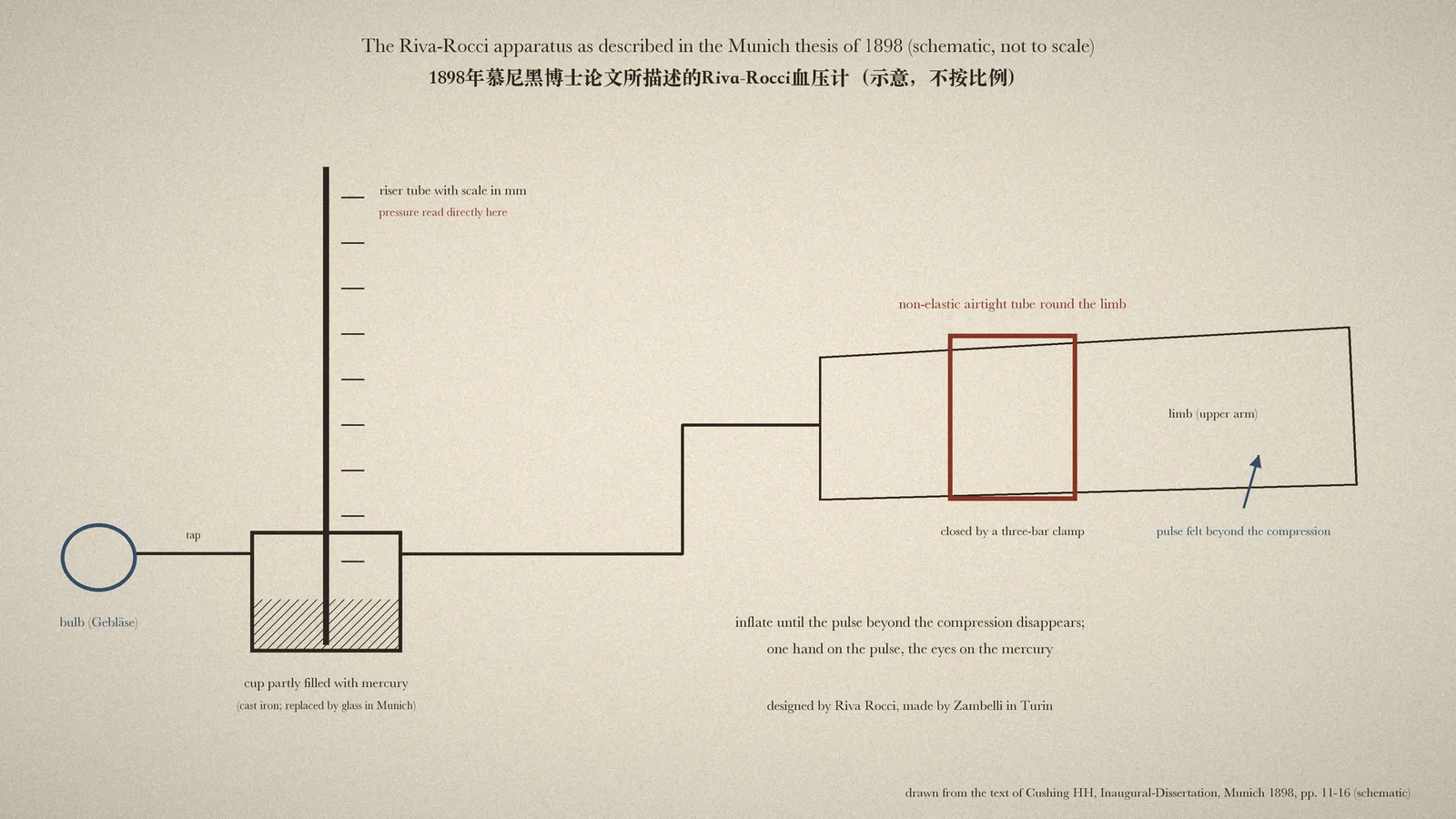
"Recently an apparatus has come onto the market," the author wrote, "that at first sight seemed to meet a large part of these demands." It had been "designed by Riva Rocci and made by Zambelli in Turin", and had two parts. The first was a manometer with a bulb: a cast-iron cup partly filled with mercury, sealed with a metal lid, with a riser tube dipping into the mercury and carrying a scale in millimetres. The second, the compression device, the author called "extraordinarily ingenious": an airtight, non-elastic tube laid round a limb, closed by a clamp and blown up with the bulb, so that the limb and its vessels were compressed from all sides. Pressure was raised until the pulse beyond the compression disappeared, and the pressure needed was read directly from the riser tube. Because the device was fixed mechanically at the same place, pressure was applied "in a way that requires no special attention", leaving the examiner free to read the column and feel the pulse. [1, pp. 11-12]

A good idea, badly built
The copy delivered to the Munich medical clinic, however, was "in its present state not usable at all". The mercury cup was too shallow, so the air from the bulb drove mercury into the tubing; the clamp did not seal; almost every patient found the application painful, because the screw heads pressed on the skin; after barely twelve examinations the fabric of the compression tube burst; and the price was high. The author drew a clear line: the faults "are not caused by the principle, but by the construction". The clinic rebuilt it with a deeper glass vessel, glass tubes and a rubber stopper, improved the clamp with a rubber sheet, and found that a slight, deliberate leak helped: after over-inflating, the examiner could simply wait for the mercury to fall to the point where the first returning pulse wave was felt. That needed only one hand, "the one feeling the pulse", while the examiner's whole attention stayed on the mercury. [1, pp. 13-16]
The comparison
The author then measured blood pressure with both instruments in healthy people and in patients with a range of diseases, in some 400 cases. The new apparatus, applied to the upper arm, read consistently higher than von Basch's at the temple, which the author explained by the greater mass of soft tissue at the arm; changes in disease moved both instruments in roughly the same direction and proportion. The conclusion was measured: the apparatus "is suited to render good service to the clinician, since it gives faultless figures with less effort", and by reducing "the influence of the individuality both of the examiner and of the examined", it might bring more consistency between the results of different authors. [1, pp. 26-29]
What the record shows
The thesis shows Riva-Rocci's idea at the moment of transfer: an instrument bought from Turin, found wanting in a German clinic, taken apart and rebuilt, and kept because the principle was right. The parts it praised, a pressure applied round the whole limb, a column of mercury read directly, and a procedure that freed one hand and the examiner's attention, are the parts that survived.
Sources and reading limits
Read: the 1898 Munich inaugural dissertation on Riva-Rocci’s sphygmomanometer, in full (German, about thirty printed pages), with the page images of the title page and pp. 11, 12 and 29; the ASA timeline entries for 1896, 1897 and 1905.
Not covered: Riva-Rocci’s original paper, “Un nuovo sfigmomanometro”, Gazzetta Medica di Torino, 1896, so Riva-Rocci’s own design, cuff width and reasoning appear here only as the ASA states them; von Recklinghausen’s work; Korotkov’s report (a separate article). The ASA places Riva-Rocci in Padua; the thesis names only the maker in Turin, and where Riva-Rocci worked is not settled here. The thesis gives no cuff width. The thesis author is identified only as on the title page. The thesis tables name patients with their occupations and ages; these are not repeated. The comparison is one clinic’s, against von Basch’s instrument, not against direct arterial measurement. Translations from German are made here.
- Cushing HH. Das neue Sphygmomanometer für klinische Zwecke von Riva Rocci [Inaugural-Dissertation]. München: K. Hofbuchdruckerei Kastner & Lossen; 1898. Internet Archive
- Australian Society of Anaesthetists. Anaesthesia history timeline. 2024. ASA
Continue exploring
Related reading connects shared questions and contexts; it does not by itself establish historical influence.
- 1881: von Basch Reads Blood Pressure When the Pulse Stops
- 1897: Hill and Barnard Measure Blood Pressure with an Armlet and Dial
- 1903: Cushing Brings Blood Pressure Charting into the Operating Room
Anesthesia Epochs · The Source Room · About & Editorial Method
Published November 2, 2026. Sources and reading limits are stated above. Illustrations are labelled as original source images or AI-made. Historical accounts are educational; they are not current treatment instructions.