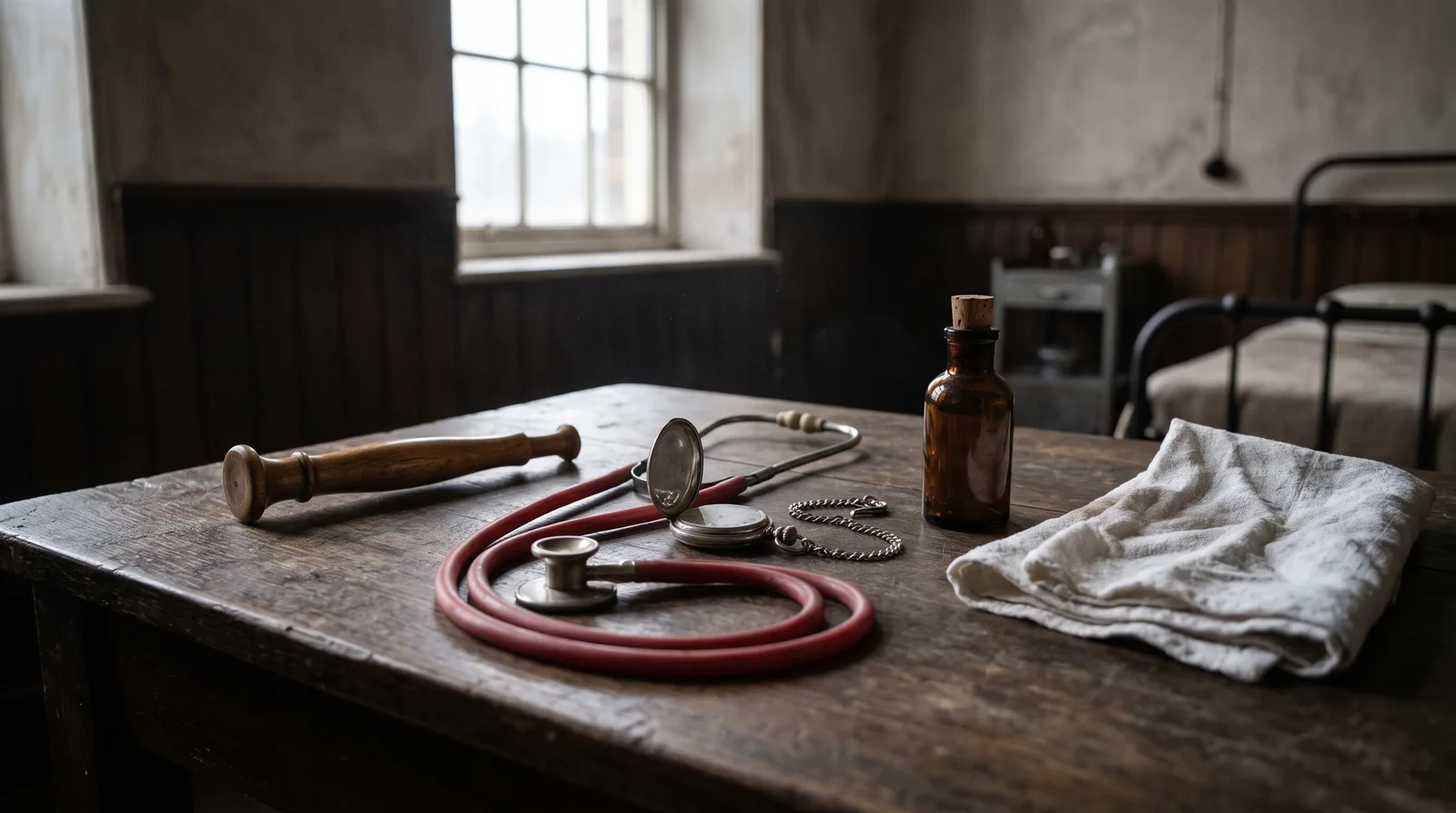
In 1896 Robert Kirk of the Glasgow Western Infirmary reported auscultating the heart in 200 chloroform anaesthetics, first with a binaural stethoscope lengthened by rubber tubing and then with a phonendoscope fitted with a watch, and heard nearly every irregularity in the textbooks, sometimes more than the pulse could show; eighty years earlier Laennec had heard a heart through a roll of paper.
Reading Library · Anesthesia Epochs · 中文版
Watch the education video (for clinicians)
1896: Kirk's Precordial Stethoscope — Listening Through Chloroform · Anesthesia Epochs Education Series
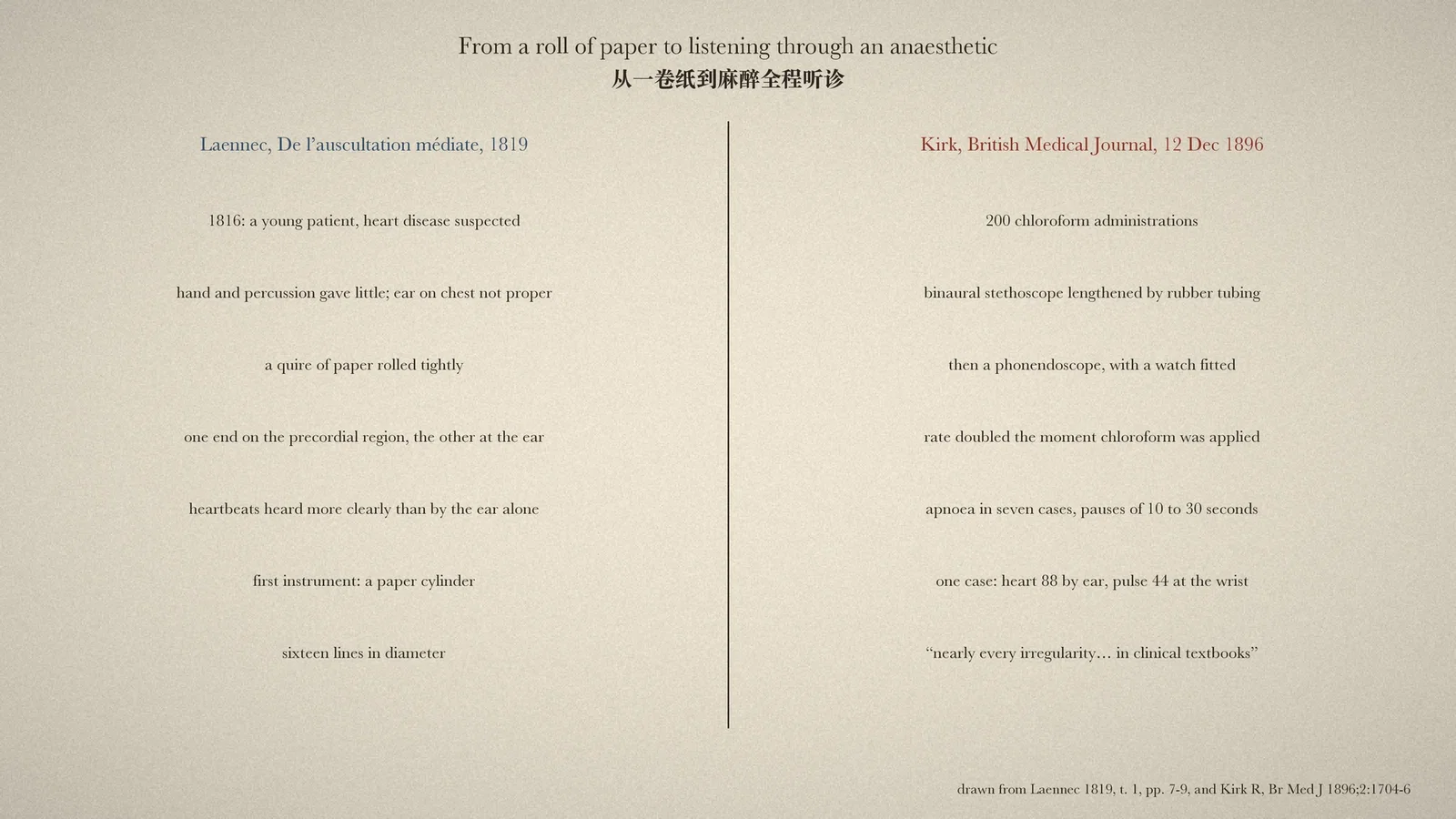
For a long time a stethoscope on the chest or in the oesophagus was one of the anaesthetist's most constant links with the patient's heart and lungs. This article reads two texts that bracket the beginning of that habit: Laennec's own account of how listening through an instrument began, and a Glasgow physician's report of 1896 on listening to the heart throughout chloroform anaesthesia. [1][2][3]
A roll of paper, 1816
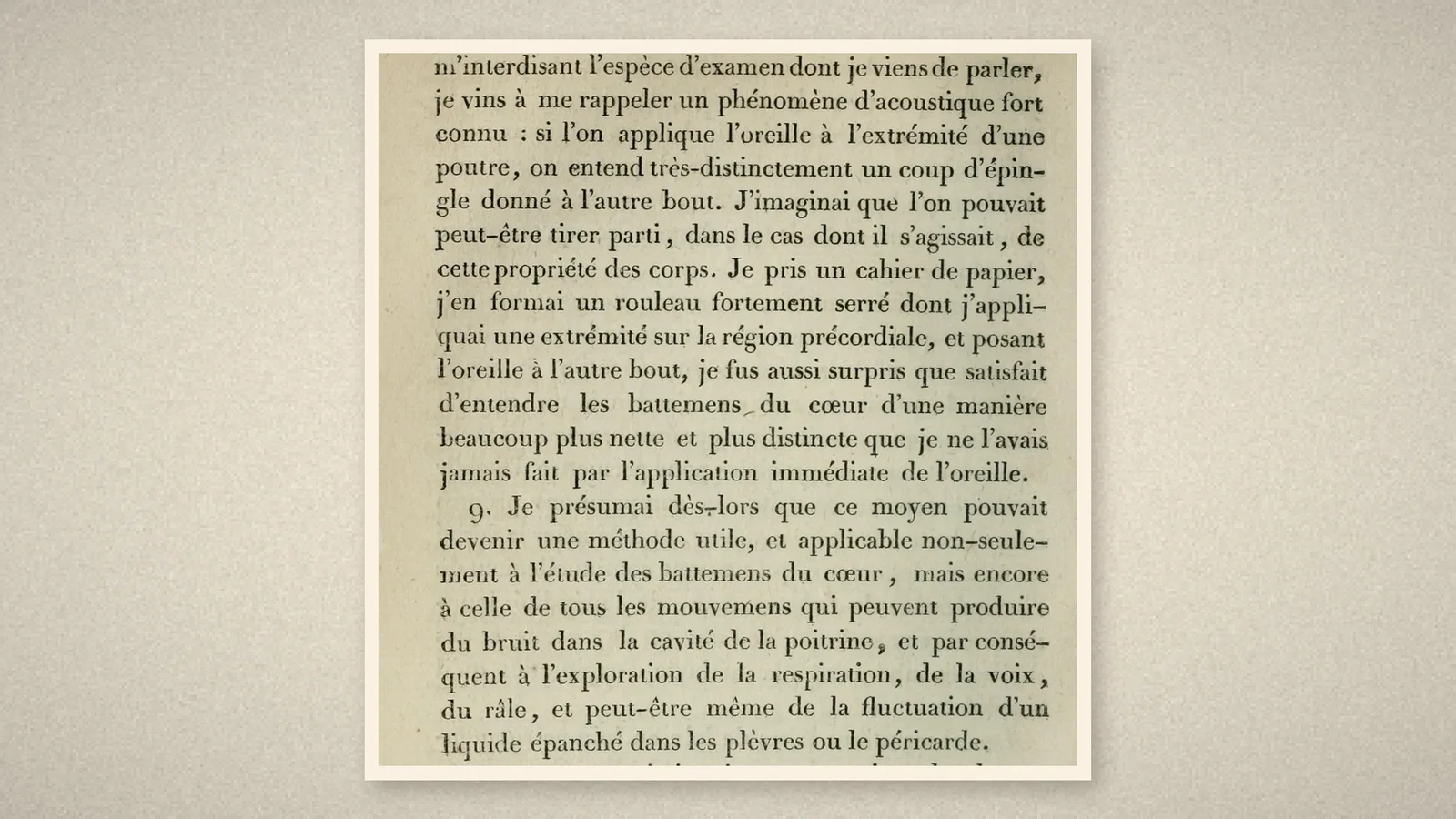
René-Théophile-Hyacinthe Laennec, physician to the Necker Hospital in Paris, told the story in the first volume of De l'auscultation médiate (Paris, 1819). "I was consulted, in 1816, for a young person who presented general symptoms of disease of the heart", and in whom laying on the hand and percussion gave little because of the patient's build; the patient's age and sex ruled out putting the ear directly on the chest. Laennec remembered a familiar fact of acoustics, that an ear at one end of a beam hears a pin scratched at the other. "I took a quire of paper, I formed it into a tightly rolled cylinder, one end of which I applied to the precordial region, and putting my ear to the other end, I was as surprised as pleased to hear the beating of the heart much more clearly and distinctly than I had ever done by the immediate application of the ear." The first instrument, Laennec adds, was exactly such a cylinder of paper, "sixteen lines in diameter". [2]
Two hundred chloroform anaesthetics, 1896
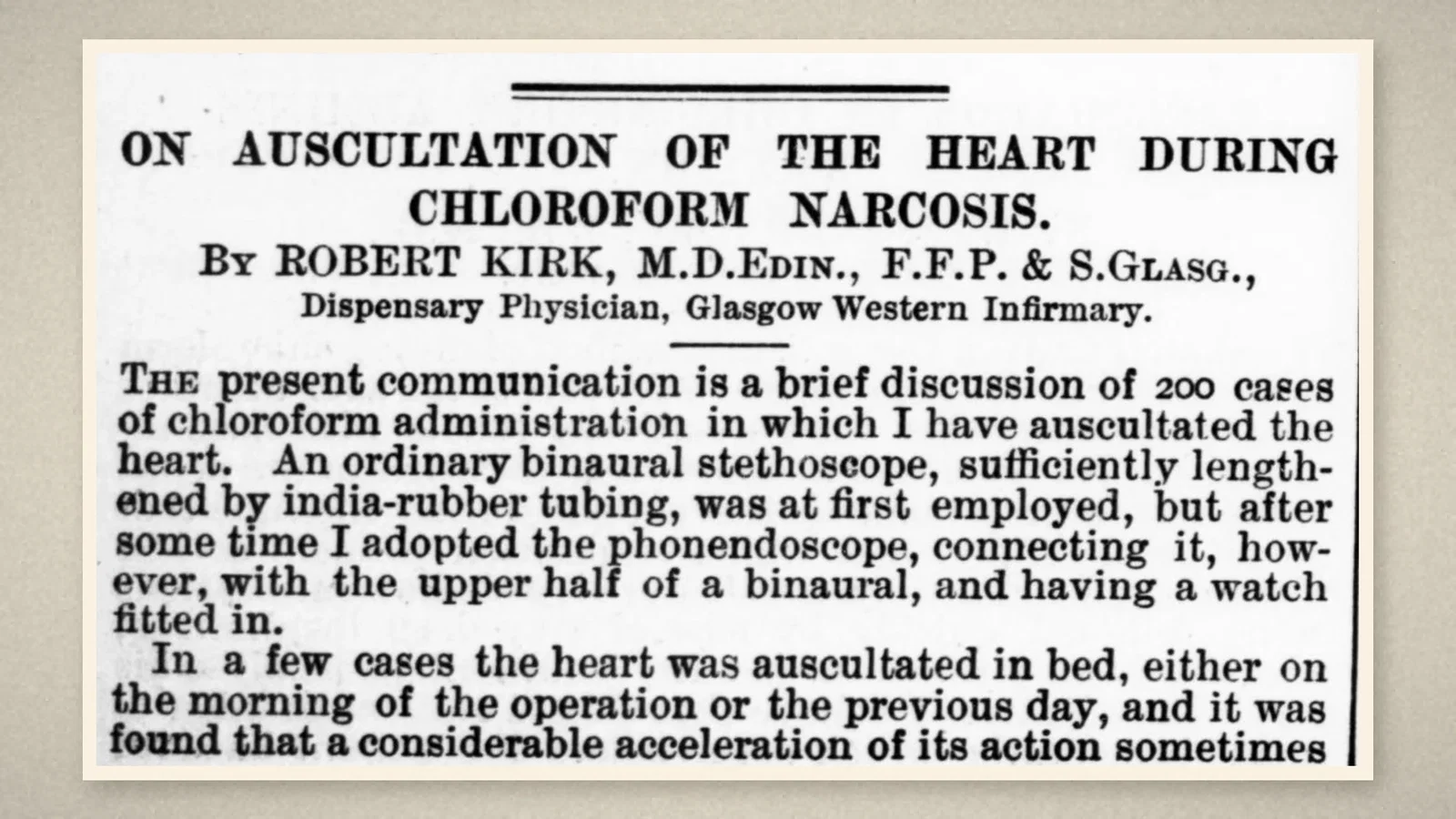
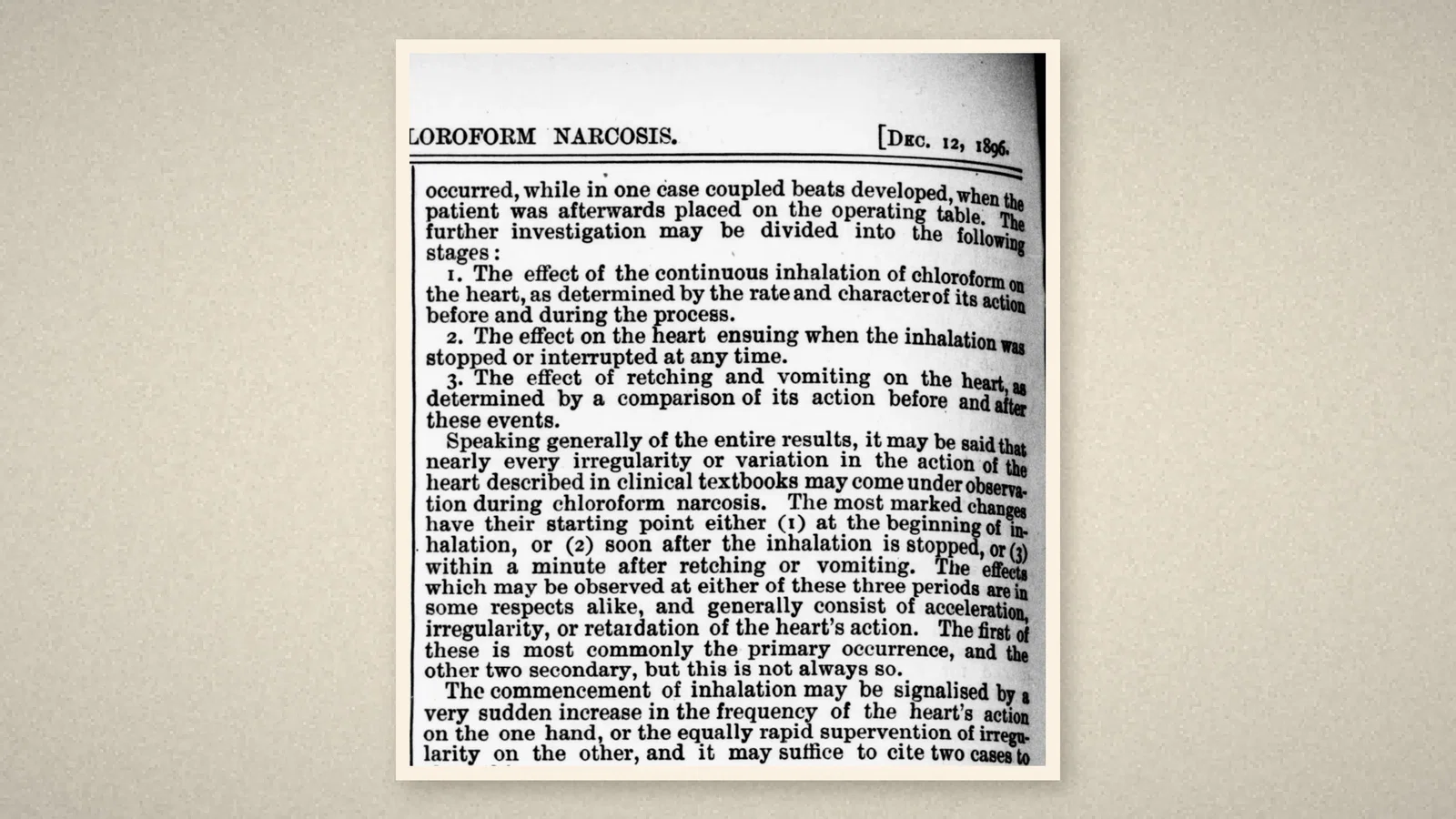
Eighty years later, Robert Kirk, dispensary physician at the Glasgow Western Infirmary, published "On Auscultation of the Heart during Chloroform Narcosis" in the British Medical Journal of 12 December 1896. "The present communication is a brief discussion of 200 cases of chloroform administration in which I have auscultated the heart. An ordinary binaural stethoscope, sufficiently lengthened by india-rubber tubing, was at first employed, but after some time I adopted the phonendoscope, connecting it, however, with the upper half of a binaural, and having a watch fitted in." [1]
Kirk divided the observations into the effect of continuing chloroform, the effect of stopping or interrupting it, and the effect of retching and vomiting. The headline finding was that "nearly every irregularity or variation in the action of the heart described in clinical textbooks may come under observation during chloroform narcosis", most often at the start of inhalation, soon after it was stopped, or within a minute of retching. In a man of 29, a heart rate of 68 doubled "the moment the chloroform was applied". In other patients Kirk heard coupled beats, volleys of rapid beats, and in one case a rate of 248. There were seven episodes of apnoea, pauses of ten to thirty seconds. [1]
What the ear heard that the finger missed
The stethoscope repeatedly gave more than the pulse. In one patient the operating surgeon felt a large and a small beat alternately at the wrist while Kirk was hearing coupled beats at the heart. In another, the heart was heard at 88 while the pulse was 44: every second beat was too weak to reach the wrist. In the case of a heart racing at 248, Kirk twice tried to count the pulse and could feel "only a vibration occasionally". [1]
Kirk drew strong conclusions from all this about chloroform itself: that the dangerous moments came when the vapour was interrupted, and that stopping the anaesthetic and starting artificial respiration for a brief apnoea was "a double blunder". Those were Kirk's opinions, set against the fatal cases the paper discusses, and this article reports them as such, not as advice. [1]
What the record shows
The lasting contribution was the method: to keep listening, beat by beat, through the whole anaesthetic, and to treat the heart as something to be monitored rather than checked once. Kirk's paper also shows why: the pulse at the wrist can mislead, and changes in rhythm cluster around moments the anaesthetist controls, such as induction and interruption of the agent.
Sources and reading limits
Read: Kirk’s paper in the British Medical Journal of 12 December 1896 (pp. 1704–1706), in full, with its page images; Laennec’s De l’auscultation médiate (Paris, 1819), tome 1, title page and pp. 7–9; the 2024 ASA timeline entries for 1816, 1893, 1896 and 1954.
Not covered: the oesophageal stethoscope described in 1893 and first recorded in anaesthesia in 1954, which the timeline lists with this topic; Kirk’s later work and the Glasgow committee report. Kirk’s clinical opinions are reported as Kirk’s. Translations from Laennec’s French are made here.
- Kirk R. On auscultation of the heart during chloroform narcosis. Br Med J. 1896;2:1704-6. Internet Archive
- Laennec RTH. De l'auscultation médiate, ou traité du diagnostic des maladies des poumons et du coeur. Tome 1. Paris: J.-A. Brosson et J.-S. Chaudé; 1819. pp. 7-9. Internet Archive
- Australian Society of Anaesthetists. Anaesthesia history timeline. 2024. ASA
Continue exploring
Related reading connects shared questions and contexts; it does not by itself establish historical influence.
- 1889: The Second Hyderabad Commission Says Chloroform Stops Breathing Before the Heart
- 1894: Cushing and Codman Put Anesthesia on the Record
- 1914: Goodman Levy Blames Ventricular Fibrillation for Light Chloroform Deaths
Anesthesia Epochs · The Source Room · About & Editorial Method
Published November 2, 2026. Sources and reading limits are stated above. Illustrations are labelled as original source images or AI-made. Historical accounts are educational; they are not current treatment instructions.