In 1900 Oskar Kreis of Basel reported six cases of spinal cocaine analgesia in labour; two later theses record that it relieved the pain of contractions for about two hours but abolished the reflex urge to bear down, which could still be made voluntarily.
Reading Library · Anesthesia Epochs · 中文版
Watch the education video (for clinicians)
1900: Kreis's Spinal Analgesia in Labour — The Lost Urge to Push · Anesthesia Epochs Education Series
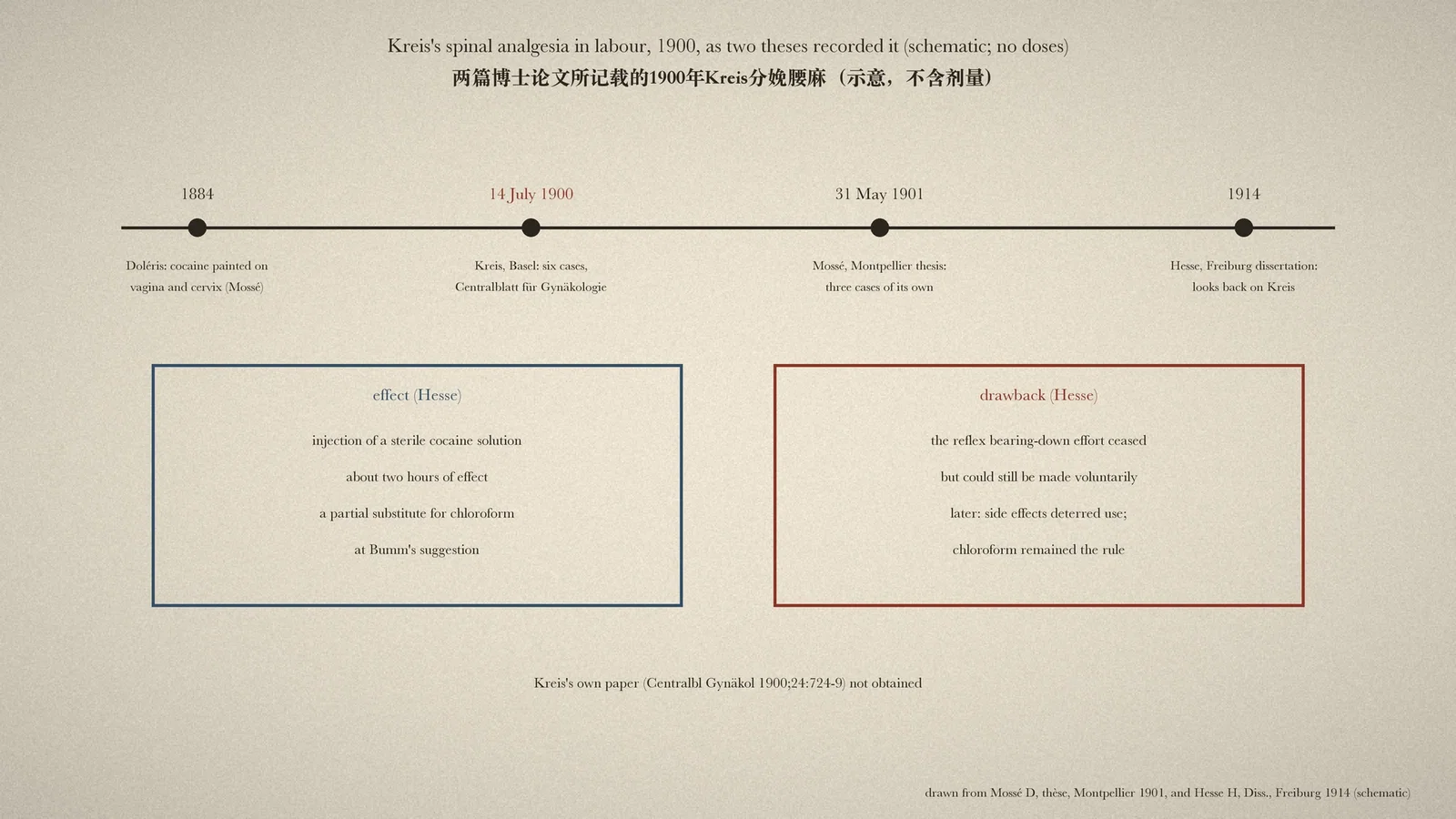
Spinal cocaine anaesthesia, "la méthode de Bier" as a Montpellier thesis called it, was soon tried wherever pain lay below the waist. The History of Anaesthesia Society (HAS) timeline records the obstetric step under July 1900: Oskar Kreis "publishes the first account of spinal analgesia for vaginal delivery". Kreis's paper, "Über Medullarnarkose bei Gebärenden" (On spinal anaesthesia in women in labour), appeared in the Centralblatt für Gynäkologie. [3]
Two theses that cite and summarise the paper survive: one written in France the following year, the other in Germany fourteen years later. [1][2]
A Montpellier thesis, 1901
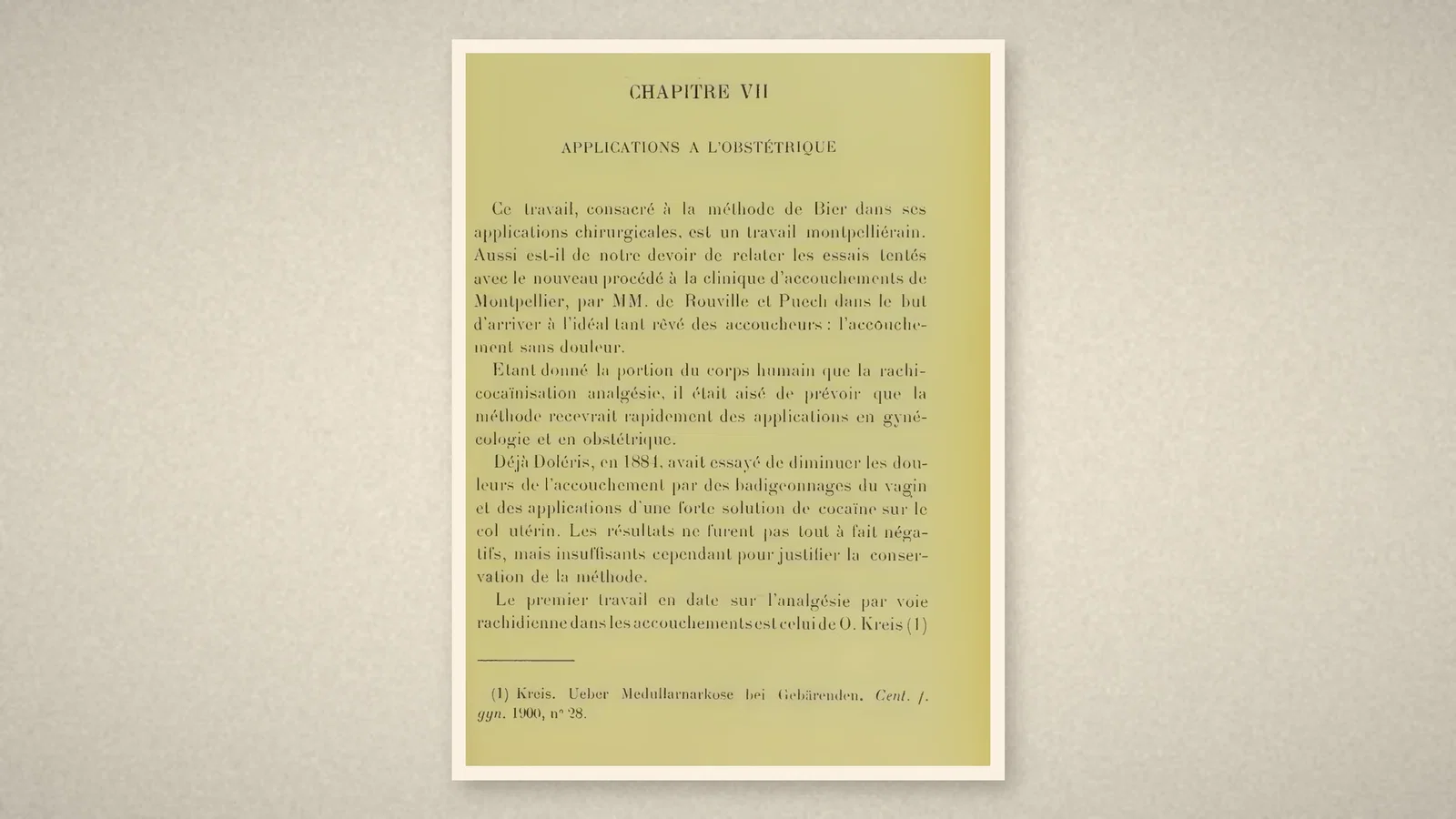
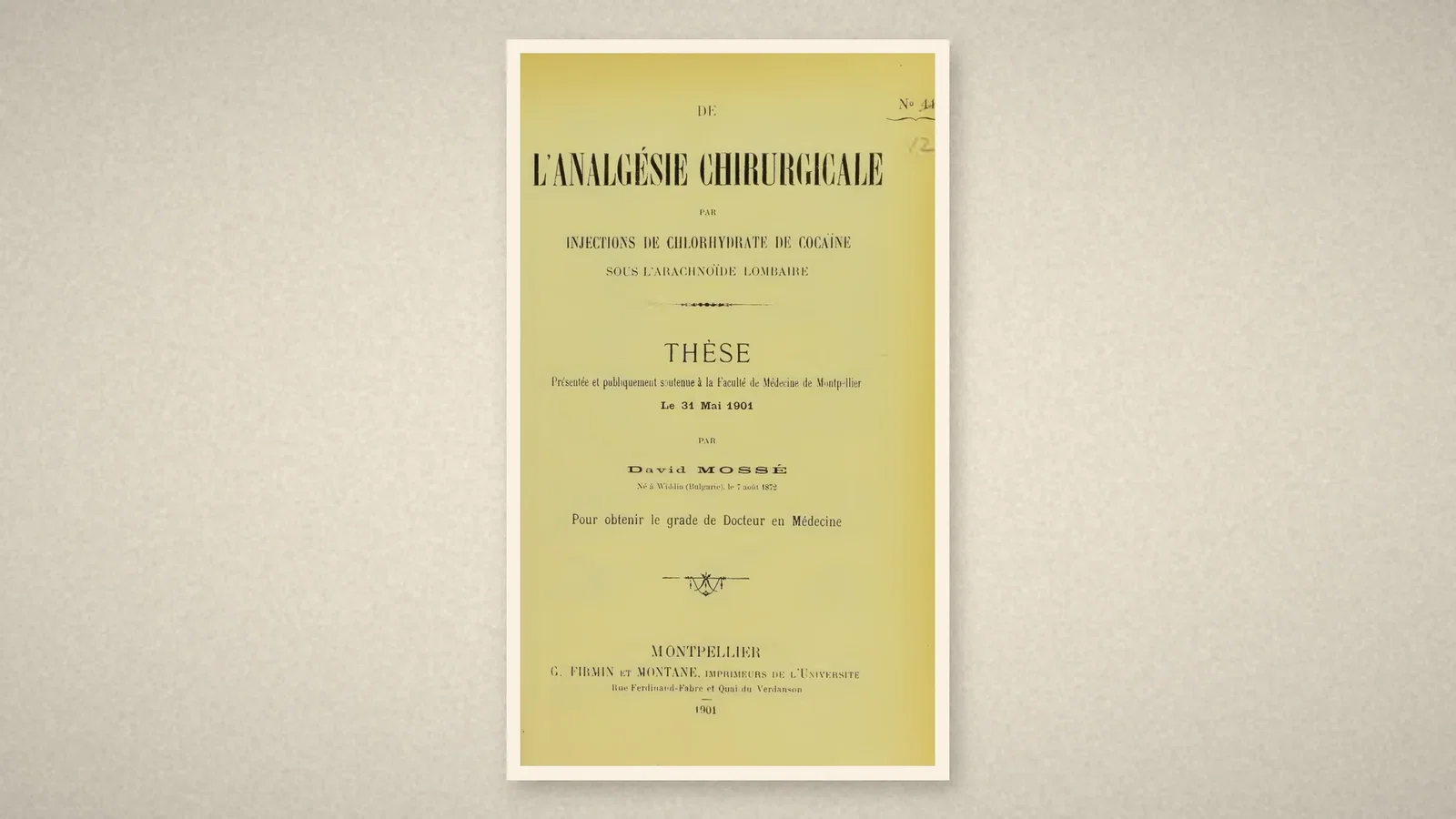
On 31 May 1901 David Mossé defended a thesis at the Faculty of Medicine of Montpellier on surgical analgesia by injecting cocaine under the lumbar arachnoid, "the method of Bier". Its seventh chapter, on obstetrics, begins with the obvious: given the part of the body that spinal cocaine anaesthetised, "il était aisé de prévoir que la méthode recevrait rapidement des applications en gynécologie et en obstétrique". Mossé recalled that Doléris, in 1884, had tried to reduce the pains of labour by painting the vagina and cervix with cocaine, with results "insuffisants cependant pour justifier la conservation de la méthode". [1, p. 77]
Then Mossé named Kreis. The earliest work on spinal analgesia in labour, Mossé wrote, was that of "O. Kreis de Bâle, qui rapporte six observations"; Goldan and others had followed in America, and the thesis added three cases from the Montpellier obstetric clinic. The bibliography gives the original as the Centralblatt für Gynäkologie of 14 July 1900, pages 724 to 729. [1, pp. 77-8]
A Freiburg dissertation, 1914
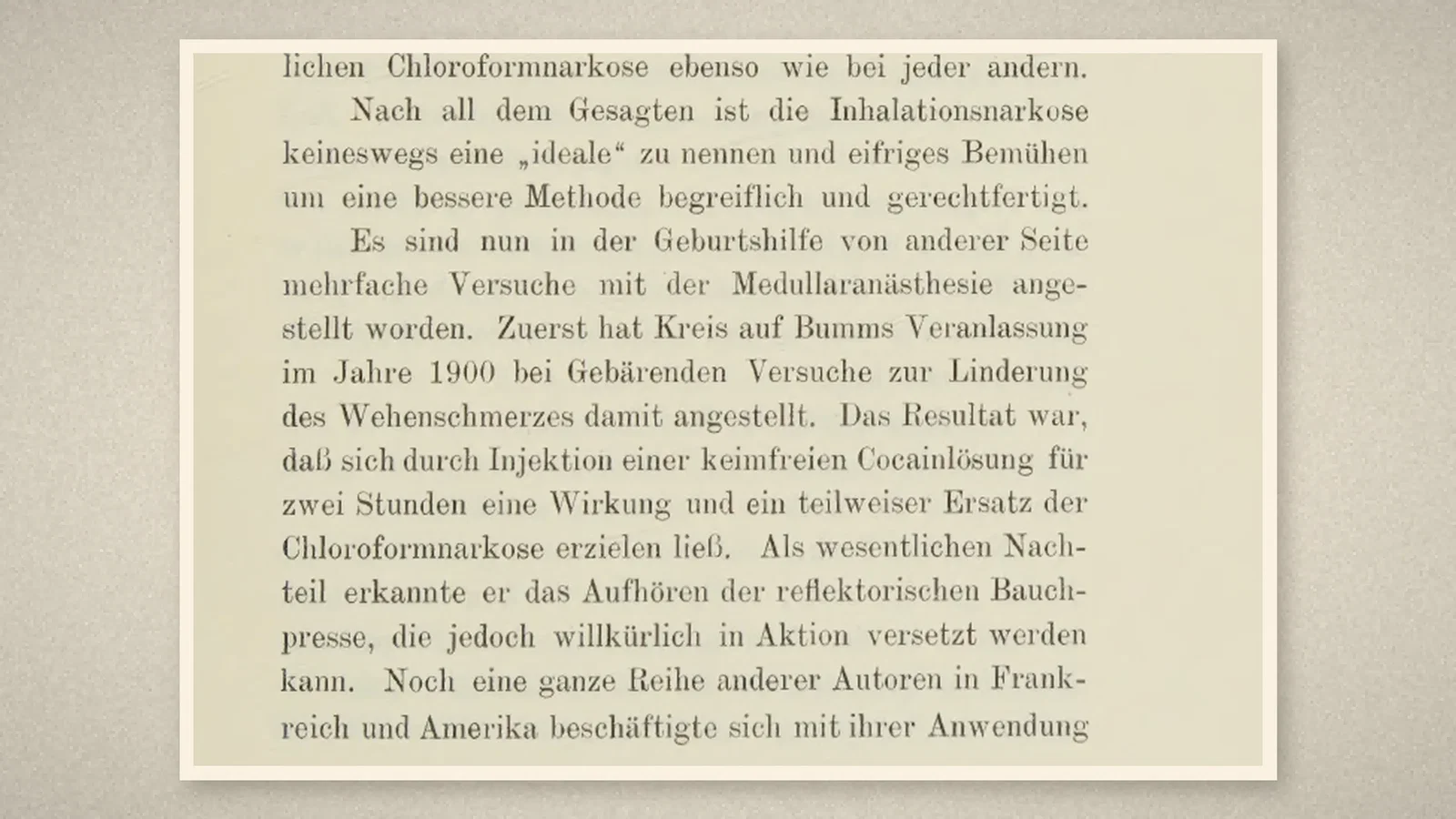
Hermann Hesse's inaugural dissertation at Freiburg im Breisgau, "Die Verwendung der Lumbalanästhesie in der Geburtshilfe" (The use of lumbar anaesthesia in obstetrics), looked back from 1914. Inhalation anaesthesia in labour, Hesse argued, was "keineswegs eine 'ideale'", and the search for something better was understandable. "Zuerst hat Kreis auf Bumms Veranlassung im Jahre 1900 bei Gebärenden Versuche zur Linderung des Wehenschmerzes damit angestellt": Kreis, at Bumm's suggestion, made the earliest trials in women in labour in 1900. [2, p. 5]
Hesse summarised the result in two sentences. An injection of a sterile cocaine solution gave an effect lasting about two hours and "ein teilweiser Ersatz der Chloroformnarkose", a partial substitute for chloroform. The main drawback Kreis recognised was "das Aufhören der reflektorischen Bauchpresse", the cessation of the reflex bearing-down effort, which could nevertheless be made voluntarily. Many authors in France and America then used the method in spontaneous labour and concluded that it was not dangerous to the woman; Weber, in 1902, recommended lumbar anaesthesia for operative deliveries in the countryside, where an assistant and an anaesthetist were rarely available. But unpleasant side effects deterred its use, and "nach wie vor machte man in der operativen Geburtshilfe Chloroformnarkosen". [2, p. 5]
What the record shows
The two theses record both halves of Kreis's finding. Spinal cocaine could take away the pain of contractions for a couple of hours, and in doing so it removed the reflex that helps a woman push. That second observation, about the mechanics of labour rather than its pain, is the one both theses took care to record.
Sources and reading limits
Read: Mossé’s 1901 Montpellier thesis, the obstetric chapter (pp. 77–78), the bibliography and the title page, with page images; Hesse’s 1914 Freiburg dissertation, the historical section (p. 5), with its page image; the HAS timeline entry for July 1900.
Not covered: Kreis’s original paper in the Centralblatt für Gynäkologie of 1900; Doléris and Malartic’s communication of 1900; Goldan’s American reports. Kreis’s method, cases and reasoning appear here only through Mossé’s and Hesse’s summaries, the second written fourteen years later; doses and the Montpellier case histories are not given.
- Mossé D. De l'analgésie chirurgicale par injections de chlorhydrate de cocaïne sous l'arachnoïde lombaire [thèse]. Montpellier: Firmin et Montane; 1901. Internet Archive
- Hesse H. Die Verwendung der Lumbalanästhesie in der Geburtshilfe [Inaugural-Dissertation]. Freiburg im Breisgau: C. A. Wagner; 1914. Internet Archive
- History of Anaesthesia Society. Timeline. HAS
Continue exploring
Related reading connects shared questions and contexts; it does not by itself establish historical influence.
- 1906: Dean Leaves the Spinal Cannula In
- 1907: Barker Makes the Spinal Solution Heavier Than Spinal Fluid
- 1931: Aburel Leaves a Fine Catheter in Place for Labour Analgesia
Anesthesia Epochs · The Source Room · About & Editorial Method
Published November 2, 2026. Sources and reading limits are stated above. Illustrations are labelled as original source images or AI-made. Historical accounts are educational; they are not current treatment instructions.