
The Australian Society of Anaesthetists dates the auscultatory method with a Riva-Rocci cuff to 1905 and to the Russian surgeon Nikolai S. Korotkov; Korotkov's original preliminary report could not be obtained, so this article reads two contemporary accounts: Witold Ettinger of Warsaw, in the Wiener klinische Wochenschrift of 1907, who described Korotkov's two demonstrations at the Military Medical Academy hospital, the dispute they raised and his own results in 235 examinations; and Frank W. Lynch of Chicago, who in 1913 summarised the method, its phases and the disagreement over which point marked diastolic pressure.
Reading Library · Anesthesia Epochs · 中文版
Watch the education video (for clinicians)
1905: Korotkov Sounds — Nikolai Korotkov · Anesthesia Epochs Education Series
A cuff and a column of mercury told the clinician when the pulse beyond the cuff vanished, but feeling for that pulse gave only one number. The Australian Society of Anaesthetists (ASA) timeline records the step that added a second: under 1905, "Auscultatory method of determining blood pressure using a Riva-Rocci cuff developed", by Dr Nikolai Sergeyevich Korotkov, Russian surgeon. [3, p. 33]
Korotkov's own report, a short preliminary communication in the bulletin of the Imperial Military Medical Academy in St Petersburg, could not be obtained for this article. What the article reads instead are two contemporary accounts by clinicians who used the method: Witold Ettinger of Warsaw, writing in the Wiener klinische Wochenschrift in 1907, and Frank W. Lynch of Chicago, writing in 1913. [1][2]
The demonstration, as Ettinger told it
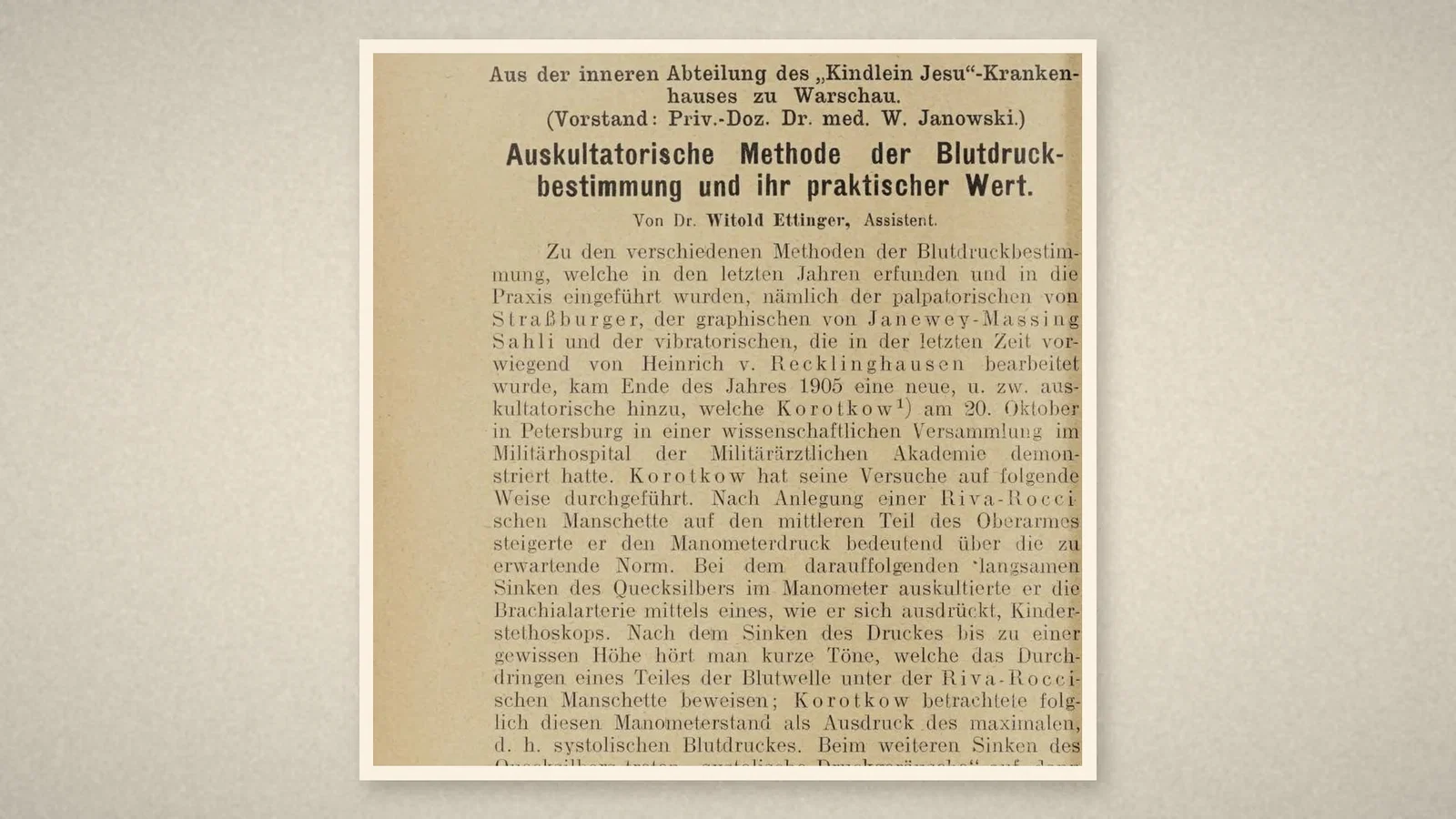
Ettinger was an assistant in the medical department of the Kindlein Jesu hospital in Warsaw. The article, "Auscultatory method of blood pressure determination and its practical value", opens by listing the indirect methods of recent years: the palpatory, the graphic and the vibratory. Then, "at the end of the year 1905", came a new, auscultatory one, which Korotkow had demonstrated on 20 October at a scientific meeting in the military hospital of the Military Medical Academy in St Petersburg. [1, p. 992]
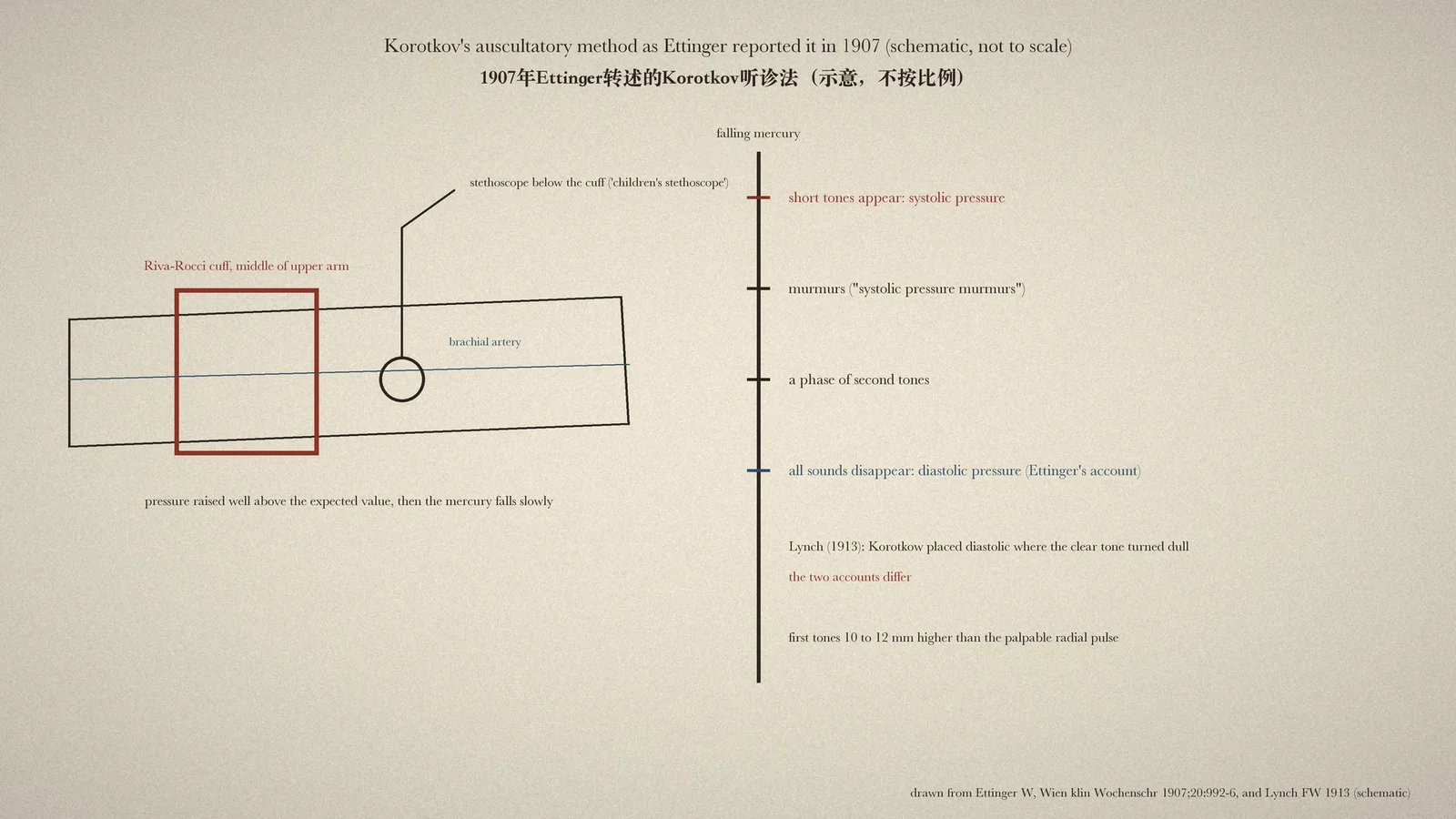
The procedure was simple. A Riva-Rocci cuff was put on the middle of the upper arm and the pressure raised well above the expected value. As the mercury then sank slowly, the brachial artery was auscultated with what Korotkow called "a children's stethoscope". At a certain height "one hears short tones", showing that part of the pulse wave was passing under the cuff, and Korotkow took that reading as the maximal, systolic pressure. As the mercury fell further, "systolic pressure murmurs" appeared, then a phase of second tones, after which all sounds disappeared; that moment, when blood flowed freely through the artery, gave the minimal or diastolic pressure. The first tones appeared at a pressure 10 to 12 mm of mercury higher than that at which the radial pulse could be felt. [1, p. 992]
The explanation was contested from the start. Korotkow attributed the first tones to the vessel walls being torn apart by the first drops of blood forcing through; at the same session another speaker argued that the sounds came from the heart and were merely conducted. A month later, on 26 December 1905, Korotkow returned with experiments on an exposed femoral artery and maintained that the sounds arose locally. In the discussion, Professor Yanowsky accepted that the sounds were local but not Korotkow's mechanism, and in Yanowsky's clinic Krylow went on to describe typical and atypical patterns of the phases. [1, p. 992]
Testing it in Warsaw
Ettinger then reported 235 examinations of healthy people and of patients with heart disease, nephritis, arteriosclerosis, tuberculosis, pneumonia and fevers. In 200 of them all the phases could be heard. In 232 systolic determinations, the auscultatory value was higher than the palpatory and graphic values 207 times, on average by 16 mm, which Ettinger explained simply: "the sense of hearing is more perfect than the sense of touch". The diastolic comparisons were less tidy, and some differences Ettinger declared impossible to explain for the present. [1, pp. 995-6]
Eight years on, in Chicago
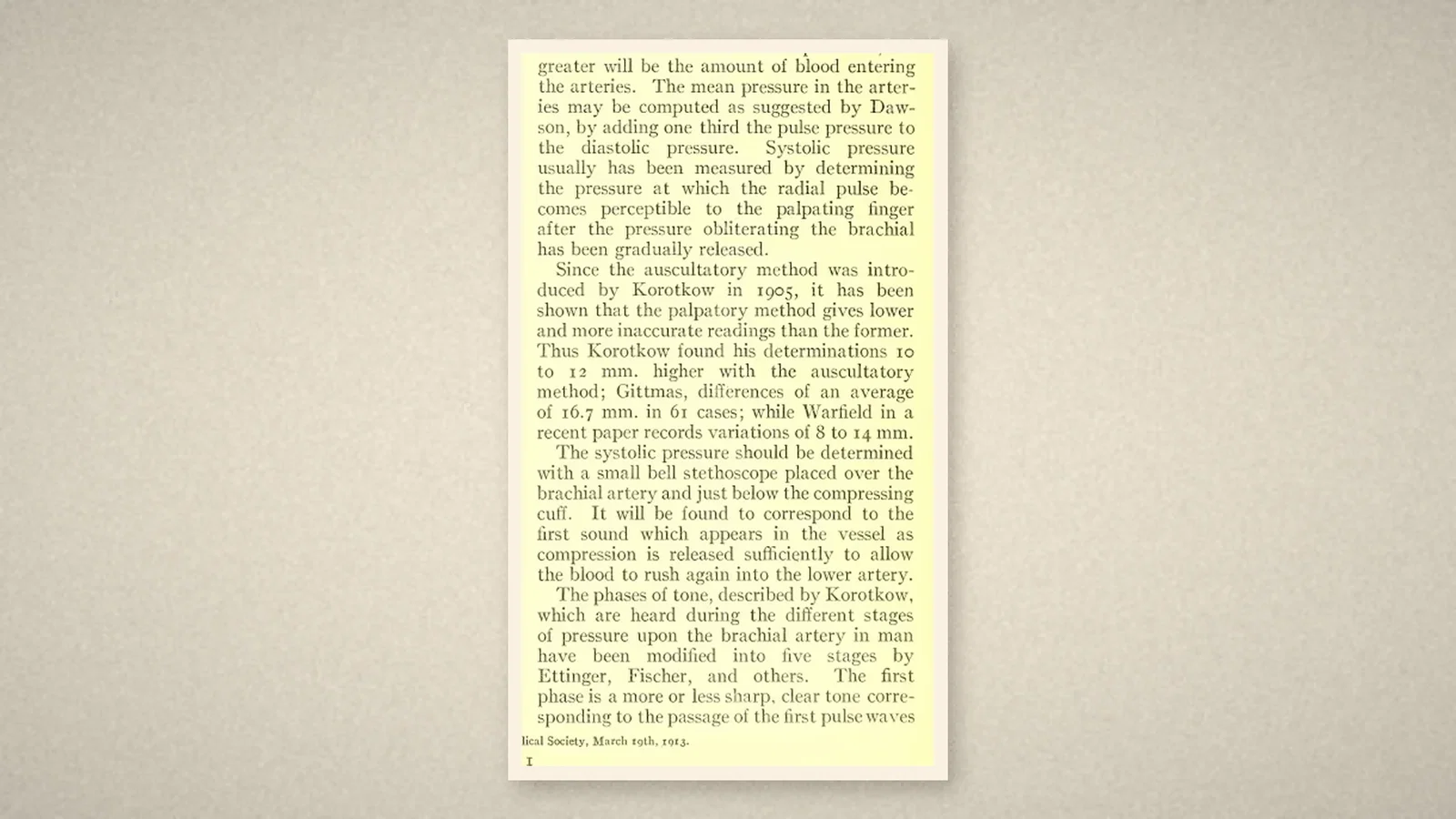
By 1913 the method had reached obstetric practice in the United States. Lynch, of Rush Medical College, opened a paper on blood pressure in pregnancy with its history: "Since the auscultatory method was introduced by Korotkow in 1905, it has been shown that the palpatory method gives lower and more inaccurate readings." The systolic pressure was to be taken "with a small bell stethoscope placed over the brachial artery and just below the compressing cuff". Korotkow's phases had been "modified into five stages by Ettinger, Fischer, and others". [2, p. 1]
Lynch also recorded a disagreement that matters to anyone reading old blood pressures. Diastolic pressure was often read in the United States at the disappearance of all sound; Korotkow, Lynch wrote, "from theoretical considerations placed the diastolic pressure at the point where the clear, loud tone was replaced by a dull tone". Ettinger's account of the 1905 demonstration says the opposite: that Korotkow took the disappearance of all sounds as diastolic. The two contemporary reports do not agree. [1, p. 992][2, p. 2]

What the record shows
The method needed nothing new: a cuff that already existed and a stethoscope any doctor owned. What changed was the sense used. Listening below the cuff gave a systolic reading earlier than the finger could, and a point to read for diastolic pressure as well, even if clinicians could not yet agree which point it was.
Sources and reading limits
Read: Ettinger, Wien klin Wochenschr 1907;20:992-6, in full; Lynch's 1913 reprint from Surgery, Gynecology and Obstetrics, in full; the ASA timeline entry for 1905.
Not covered: Korotkov's preliminary reports in the bulletin of the Imperial Military Medical Academy, St Petersburg (cited by Ettinger as December 1905, vol. 12, no. 4, p. 395, and by Lynch as 1905, vol. xi, p. 365; the citations differ); Krylov's studies of 1906; later translations and commentaries. Korotkov's own words therefore do not appear here; the method is described as Ettinger and Lynch report it. Ettinger does not say which calendar the dates follow. The two accounts differ on Korotkov's diastolic point, and this article does not decide between them. Patient readings are not repeated. Translations from German are the article's.
Three illustrations are crops of Ettinger (p. 992), Lynch (p. 1) and the ASA timeline (p. 33); one is drawn from the two accounts.
- Ettinger W. Auskultatorische Methode der Blutdruckbestimmung und ihr praktischer Wert. Wien Klin Wochenschr. 1907;20(33):992-6. Internet Archive
- Lynch FW. Blood pressure during pregnancy. Surg Gynecol Obstet. 1913 Oct:472-9 (reprint). Internet Archive
- Australian Society of Anaesthetists. Anaesthesia history timeline. 2024. ASA
Continue exploring
Related reading connects shared questions and contexts; it does not by itself establish historical influence.
- 1896: Riva-Rocci's Cuff Sphygmomanometer, Tested in a Munich Thesis
- 1897: Hill and Barnard Measure Blood Pressure with an Armlet and Dial
- 1903: Cushing Brings Blood Pressure Charting into the Operating Room
Anesthesia Epochs · The Source Room · About & Editorial Method
Published November 2, 2026. Sources and reading limits are stated above. Illustrations are labelled as original source images or AI-made. Historical accounts are educational; they are not current treatment instructions.