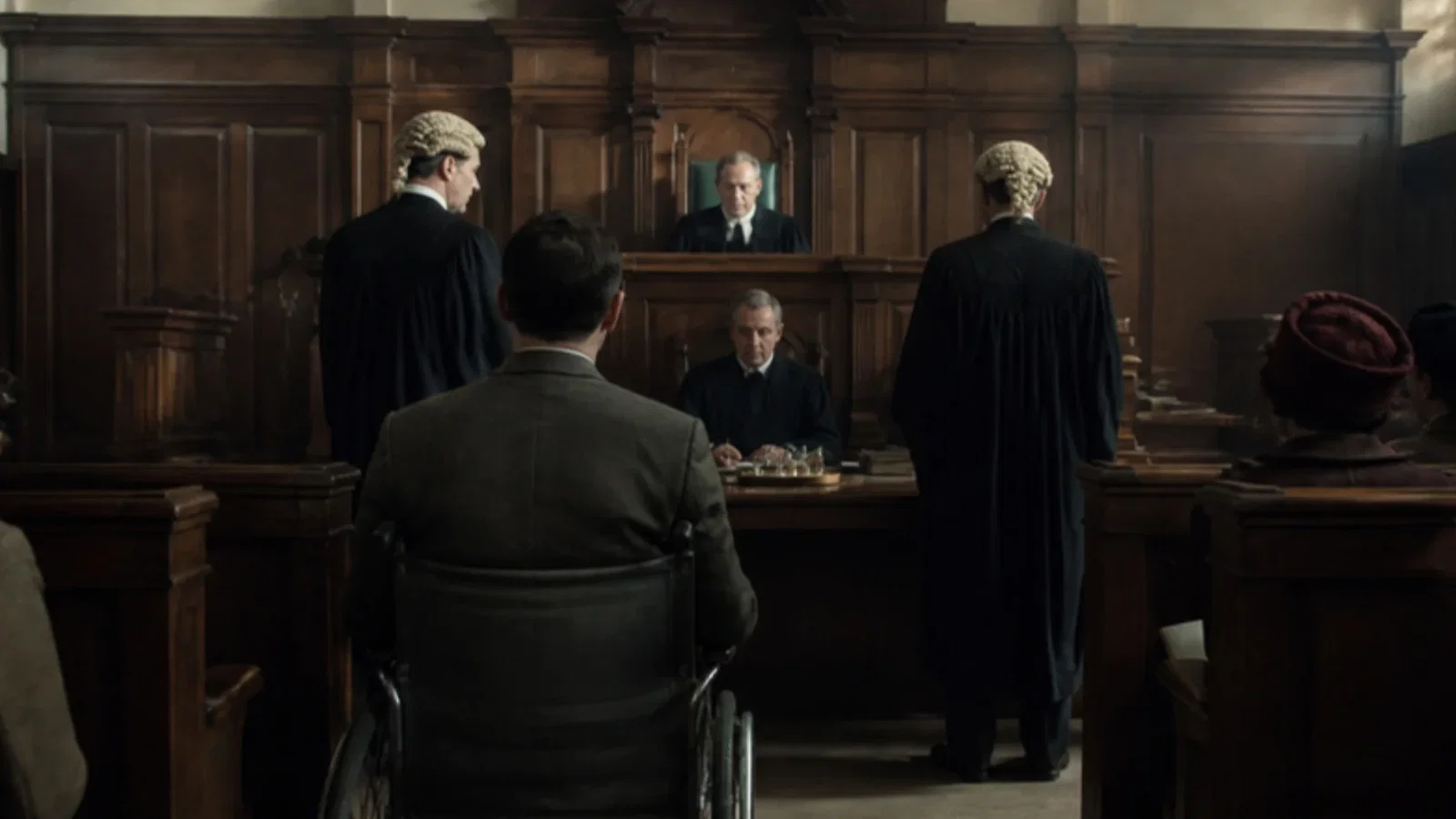
Two labourers given nupercaine spinals at Chesterfield on 13 October 1947 were left paraplegic; the courts found phenol had seeped through invisible cracks in the ampoules, held that no one was negligent by the standards of 1947, and the case became a long shadow over spinal anaesthesia in Britain.
Reading Library · Anesthesia Epochs · 中文版
Watch the education video (for clinicians)
1947: Woolley and Roe — Paralysis After Spinal Anaesthesia · Anesthesia Epochs Education Series
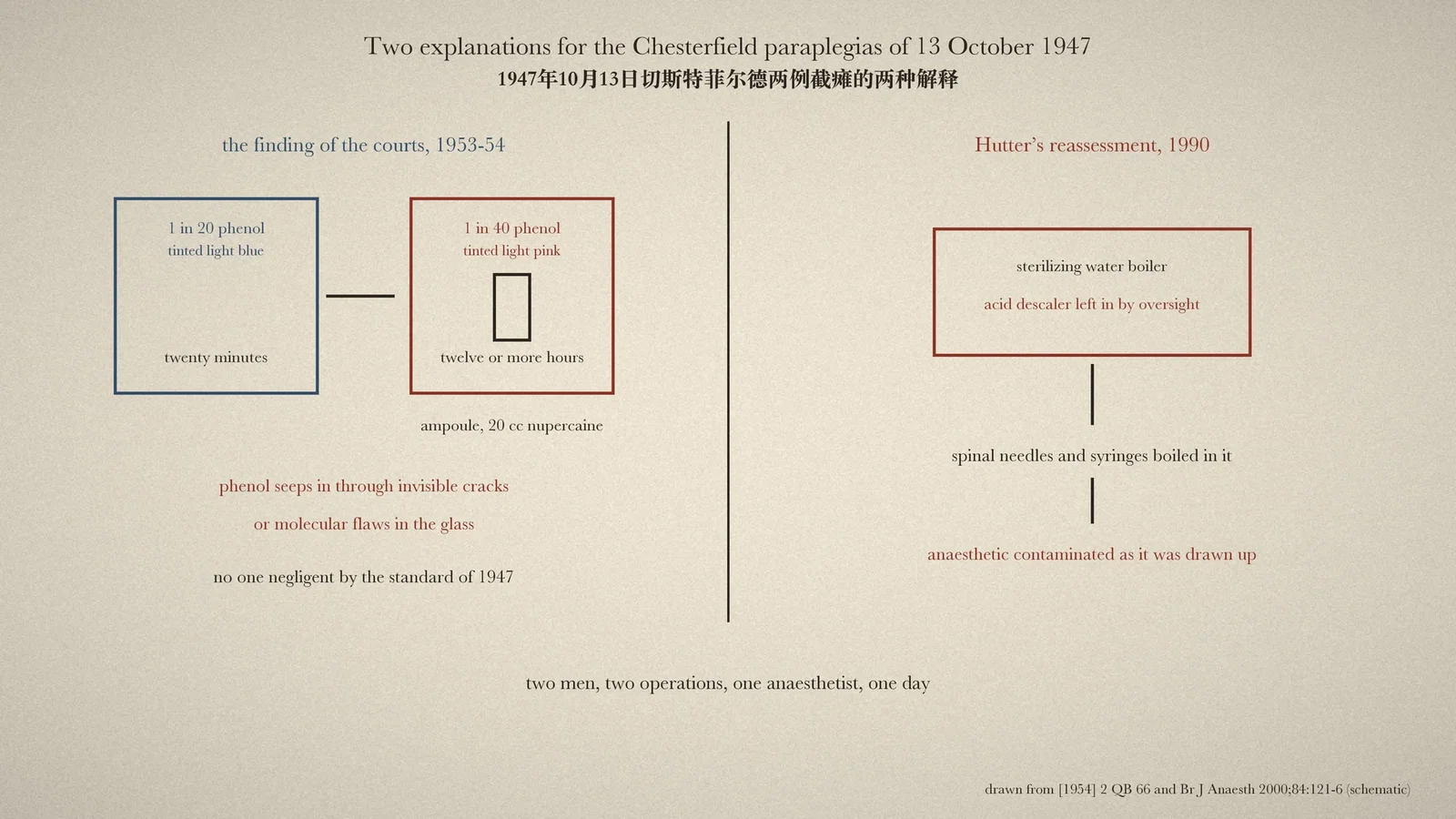
On Monday 13 October 1947, at the Chesterfield and North Derbyshire Royal Hospital, two labourers each had a minor operation, one on a knee cartilage and one for a hydrocele. The same visiting anaesthetist, Dr J. Malcolm Graham, gave each a spinal anaesthetic of nupercaine. Both men, Albert Woolley and Cecil Henry Roe, were left permanently paralysed from the waist down. Their claims against the Minister of Health and Dr Graham failed at trial in 1953 and on appeal in 1954. This article reads the case as the Law Reports printed it, with the medical press of the time and a review published in 2000. [1][2][3][4][5]
What happened in the theatre
The nupercaine came in glass ampoules, each holding 20 cc. The makers' box warned that the outside of an ampoule should be treated as "frankly septic", and anaesthetists worried that the needle might touch it while drawing up the drug. To guard against this, the senior anaesthetist, Dr Pooler, had begun soaking the ampoules in phenol, "a 1 in 20 solution of phenol for twenty minutes and then in a 1 in 40 solution for twelve or more hours", and Graham adopted the method. The two phenol solutions were tinted, light blue and light pink, but only to tell them apart. Each man received 10 cc. [1]
Graham told the court of about 500 spinal anaesthetics given before October 1947. Roe's operation was in the morning and Woolley's in the afternoon; Roe complained of a headache during the operation, and it was three days before Graham knew that something was seriously wrong. Some weeks earlier Graham had found a cracked ampoule in the phenol and rejected it. Of these two ampoules, Graham said: "I did not believe for one moment that I could have missed a crack." [1][2]
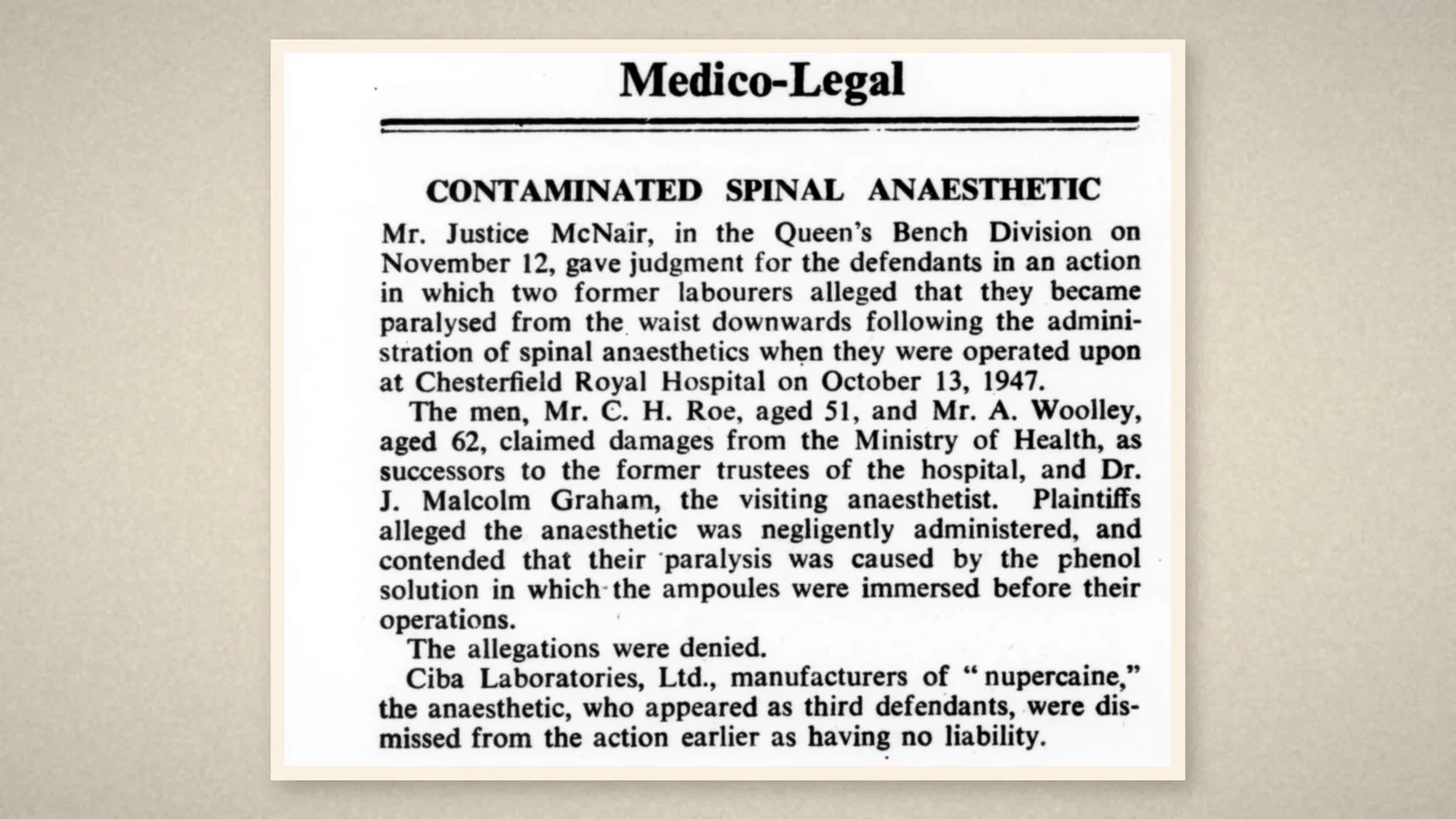
The trial
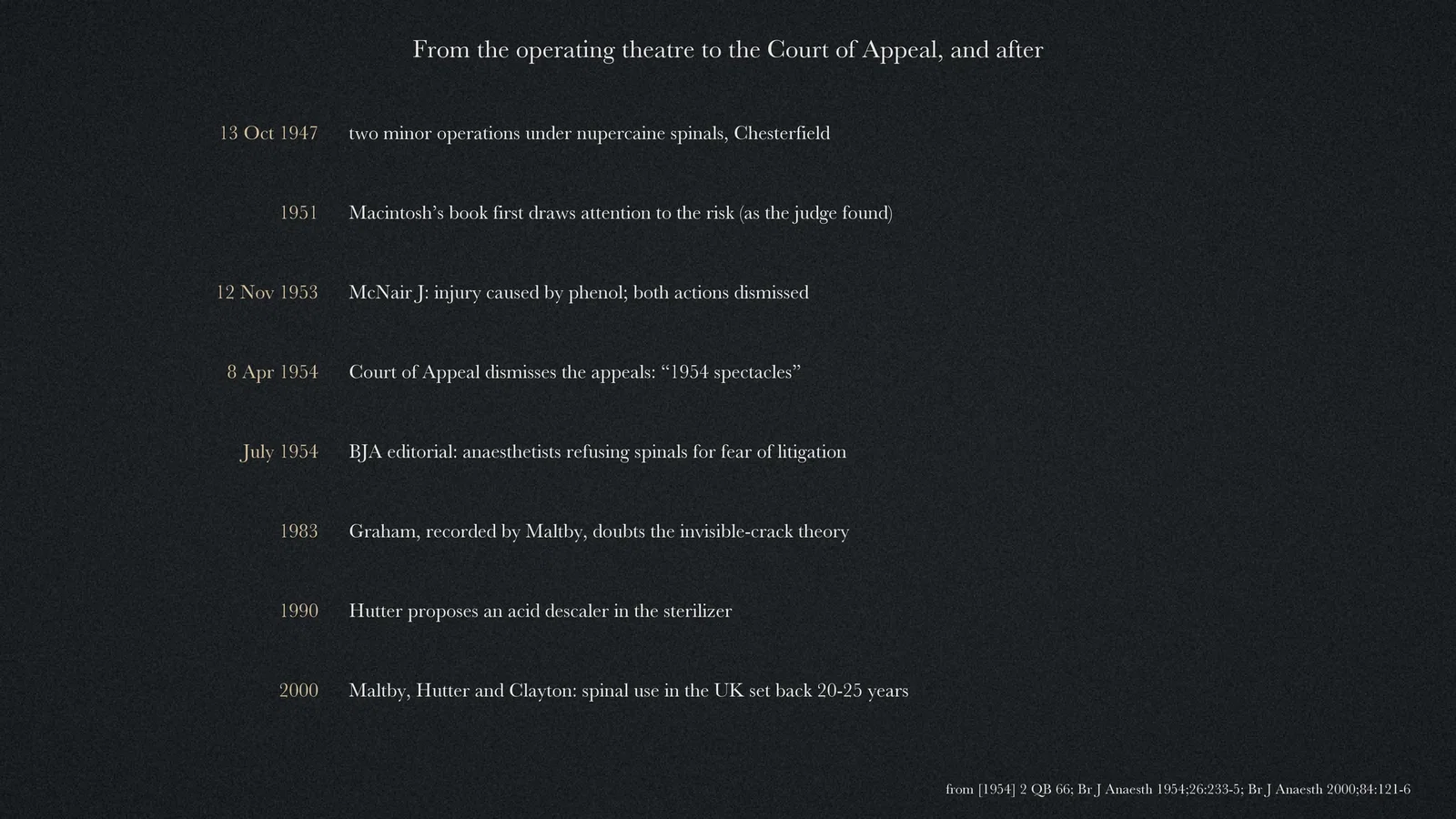
The hearing before McNair J lasted eleven days. Neurologists and anaesthetists disagreed sharply. For the Ministry, Sir Francis Walshe said the case histories were "inconsistent with a corrosive poison such as phenol"; for the plaintiffs, Professor R. R. Macintosh thought phenol the cause. "None of the medical witnesses had consciously ever seen" phenol injected into the human theca, the judge noted, but concluded that "the phenol theory is sufficiently established": phenol had seeped into both ampoules through "invisible cracks" or molecular flaws in the glass. The judge then held that the risk had first been drawn to the profession's attention by Macintosh's book on lumbar puncture and spinal analgesia in 1951, and that by the standard of 1947 Graham was not negligent. On 12 November 1953 both actions were dismissed. The judge put the rate of such injuries at "about 1 in 10,000". [1][2]
The appeal
The Court of Appeal gave judgment on 8 April 1954. All three judges dismissed the appeals, though their reasoning differed. Somervell LJ regarded the hospital as answerable for the visiting anaesthetists but found no negligence. The plaintiffs argued that the phenol should have been dyed deep blue, as some hospitals did; counsel for Graham conceded that deep tinting would probably have shown the contamination. Somervell LJ observed that such a precaution "imposes no burden on the doctor except the speaking of a sentence", and that Graham would have had every motive to give it if the risk had been known. [1]
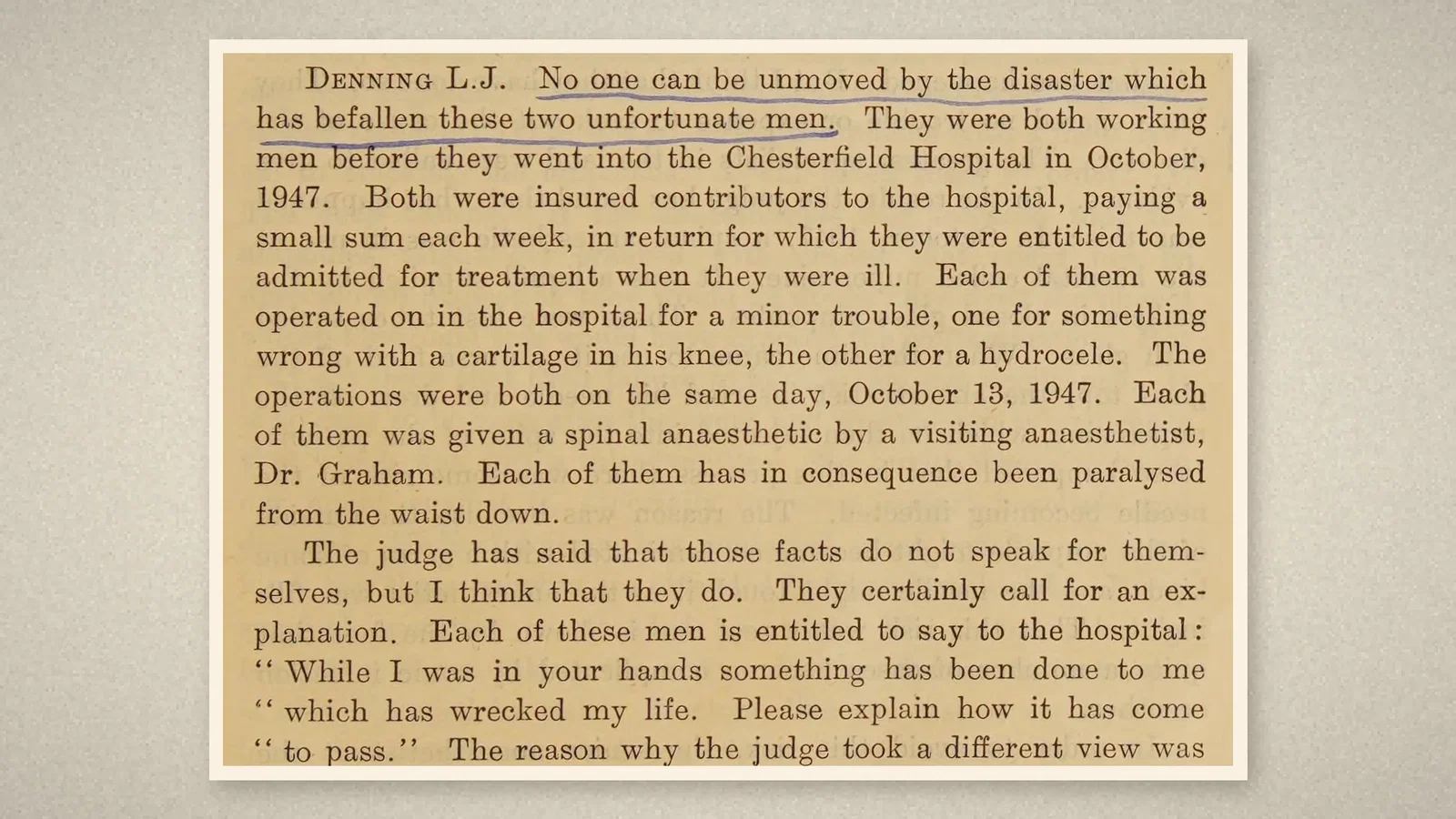
Denning LJ began: "No one can be unmoved by the disaster which has befallen these two unfortunate men." Unlike the trial judge, Denning held that the facts did speak for themselves: each man was entitled to say to the hospital, "While I was in your hands something has been done to me which has wrecked my life. Please explain how it has come to pass." But the hospital had explained it, and the explanation was a misadventure, not negligence: "We must not look at the 1947 accident with 1954 spectacles." Denning ended with a warning that has been quoted ever since: "we must not condemn as negligence that which is only a misadventure." The men received nothing. [1]
Reactions
The Lancet thought the decision might "not only mystify the layman but also leave the lawyers in some uncertainty". The British Journal of Anaesthesia doubted the science: given the contradictory evidence, "it is by no means certain that the truth finally emerged". The editorial also recorded the cost to practice: "Anaesthetists are refusing to give spinal anaesthesia for fear of litigation." [3][4]
Another explanation
Graham never accepted the invisible-crack theory. In 1983, in a conversation recorded by J. R. Maltby, Graham recalled that the cracks shown in court looked like thermal cracks, and that experiments "banging them about" in Chesterfield could not produce one. Graham also knew, though the court did not, of a third patient given a spinal that day who probably suffered neurological damage too. In 1990 C. D. D. Hutter proposed that an acidic descaler had been left in the sterilizing water boiler by oversight, so that the spinal needles and syringes were boiled in acid and contaminated the anaesthetic as it was drawn up; the theatre sister responsible for the sterilizer had been ill that day and went off duty at lunchtime. Maltby, Hutter and Clayton, writing in 2000, judged that the case "retarded the use of spinal anaesthesia in the UK by 20-25 yr". They also quoted Denning's own later account, from a book of 1979, of why the court had found for the doctors: "we sought to relieve the anxieties of the medical men." [5]
What the record shows
Two men lost the use of their legs on one day, in one theatre, at the hands of one competent anaesthetist. The court found the cause in a disinfecting routine meant to make spinal anaesthesia safer, judged it by what was known in 1947, and left the men uncompensated. Whether phenol or acid was to blame was never settled in court. Denning added that, now the 1951 warning against keeping ampoules in spirit had been printed, a hospital that kept up the practice could expect to be found negligent; and by the 2000 review's account, British anaesthesia turned away from the spinal for a generation.
Sources and reading limits
Read: the Law Reports text of the case, [1954] 2 QB 66, in full (headnote, the first-instance judgment as reported, argument and the three appeal judgments); the BMJ report of the trial; the BJA editorial of July 1954; the Lancet note of April 1954; Maltby, Hutter and Clayton 2000, in full.
Not covered: R. W. Cope's 1954 account of the trial in Anaesthesia; Hutter's 1990 reassessment; the trial transcript; Macintosh's 1951 book. The ages of the men differ between the Law Reports, the BMJ and the 2000 review, so none are given here; the BMJ crop above shows the BMJ's figures. The acid-descaler explanation, Graham's 1983 recollections, the third patient and Denning's 1979 remark are reported from Maltby, Hutter and Clayton, not from their originals.
Two illustrations are page crops from the 1954 Law Reports and the 1953 BMJ; two are drawn from the sources.
- Roe v Minister of Health and another; Woolley v Same. [1954] 2 QB 66 (CA). Internet Archive
- Medico-legal: contaminated spinal anaesthetic. Br Med J. 1953;2(4846):1165-6. Internet Archive
- Editorial. Br J Anaesth. 1954;26(4):233-5. Internet Archive
- Medicine and the law: spinal anaesthesia. Lancet. 1954 Apr 24:872-3. Internet Archive
- Maltby JR, Hutter CDD, Clayton KC. The Woolley and Roe case. Br J Anaesth. 2000;84(1):121-6. Internet Archive
Continue exploring
Related reading connects shared questions and contexts; it does not by itself establish historical influence.
- 1944: Tuohy Threads a Ureteral Catheter into the Spinal Space
- 1906: Dean Leaves the Spinal Cannula In
- 1907: Barker Makes the Spinal Solution Heavier Than Spinal Fluid
Anesthesia Epochs · The Source Room · About & Editorial Method
Published November 2, 2026. Sources and reading limits are stated above. Illustrations are labelled as original source images or AI-made. Historical accounts are educational; they are not current treatment instructions.