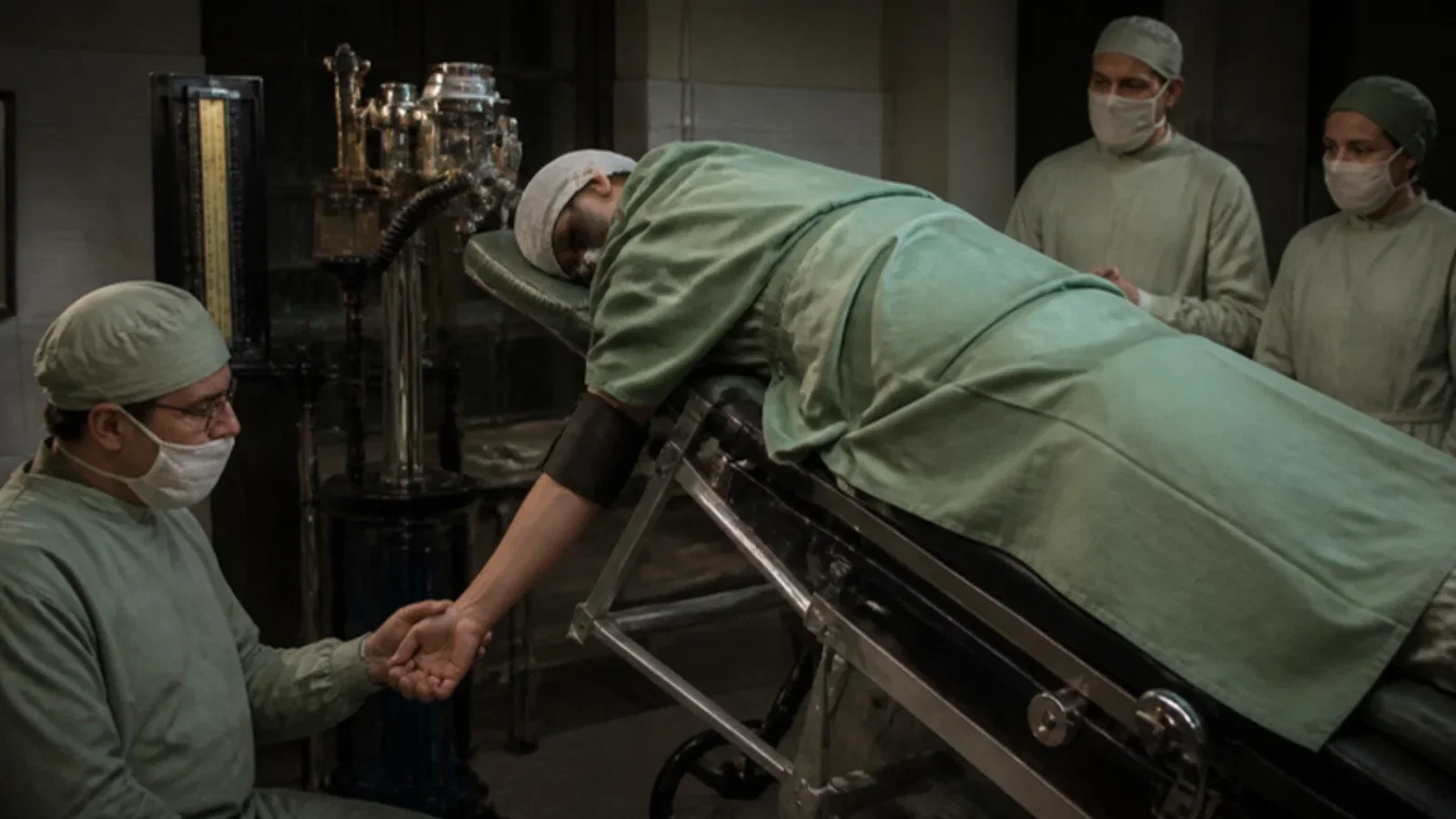
In 1948 Anaesthesia (vol. 3, no. 4) printed 'Thoraco-lumbar splanchnicectomy and sympathectomy: anaesthetic procedure' by H. W. C. Griffiths and John Gillies of the Department of Anaesthetics, University of Edinburgh. The operation for essential hypertension needed a long incision, rib resection, possible opening of the pleura and an ischaemic field, in patients particularly prone to bleed. Modern anaesthesia, the authors wrote, dealt with everything except bleeding, and 'the only certain way to reduce haemorrhage is to lower the blood pressure'. Thiopentone's fall was not sustained, whereas spinal block could be graded by the segments involved. After reviewing high and total spinal anaesthesia from Bier onwards and Vehrs's dog experiments, they combined a deliberate 'total sympathetic block' by lumbar injection with light narcosis, oxygen and a head-down lateral jack-knife position. In 84 operations on 44 patients, pressure became unrecordable and the radial pulse impalpable within ten to twenty minutes, giving an almost ischaemic field; one patient died on the table from failure of oxygenation. Drawing on Dale and Laidlaw, they argued that neurogenic hypotension from arteriolar dilatation is relatively innocuous, and admitted the hypotension had often been extreme, possibly unnecessarily so.
Reading Library · Anesthesia Epochs · 中文版
Watch the education video (for clinicians)
1948: Griffiths and Gillies — Total Spinal Block for Sympathectomy · Anesthesia Epochs Education Series
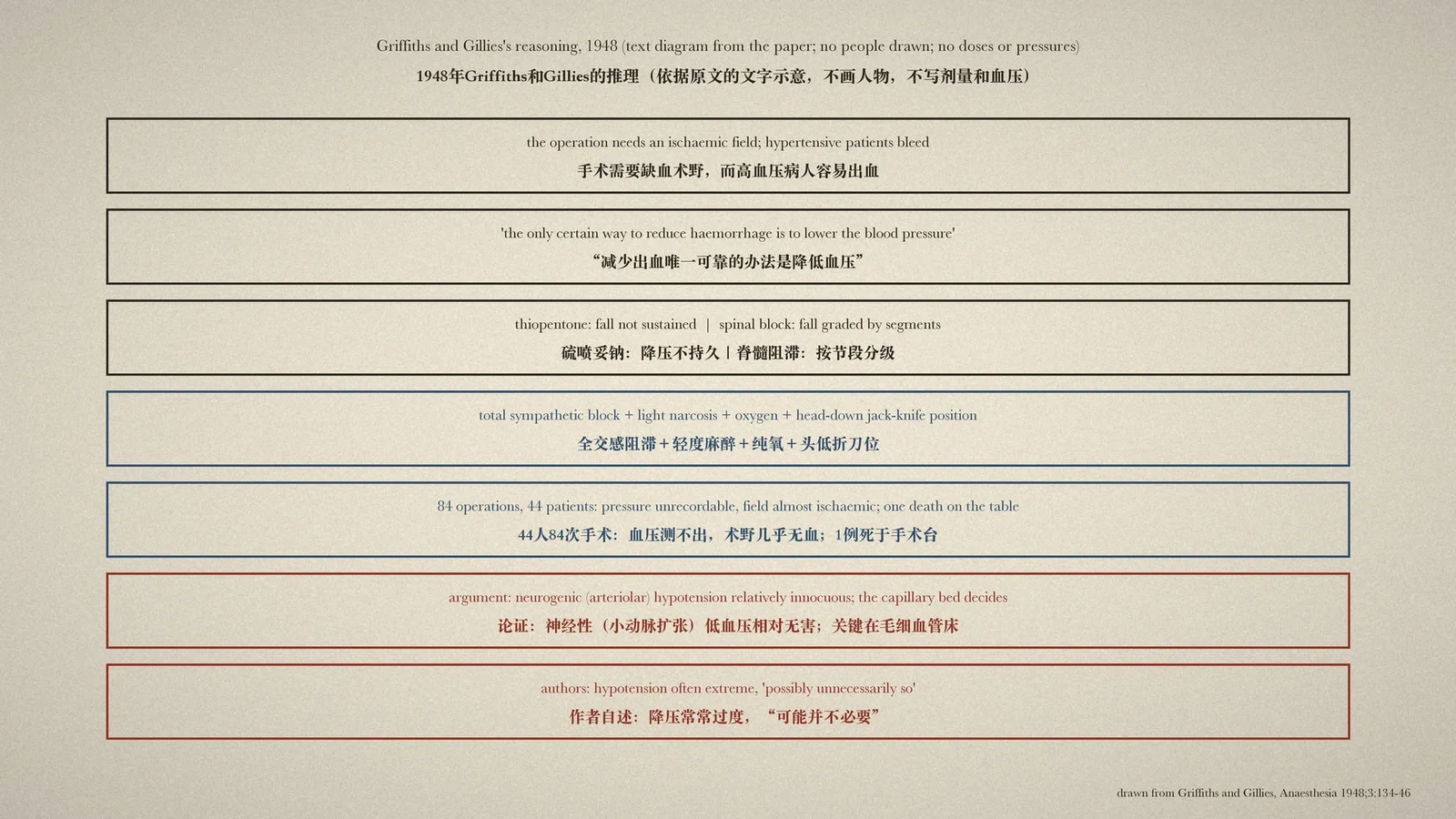
Low blood pressure is usually something anaesthetists try to prevent. In 1948 two anaesthetists in Edinburgh did the opposite: they set out to lower their patients' pressure until it could no longer be measured, for an operation that bled freely and needed a clear view of small nerves. In Anaesthesia they set out their reasons, their method and its cost. [1, p. 134]
A difficult operation
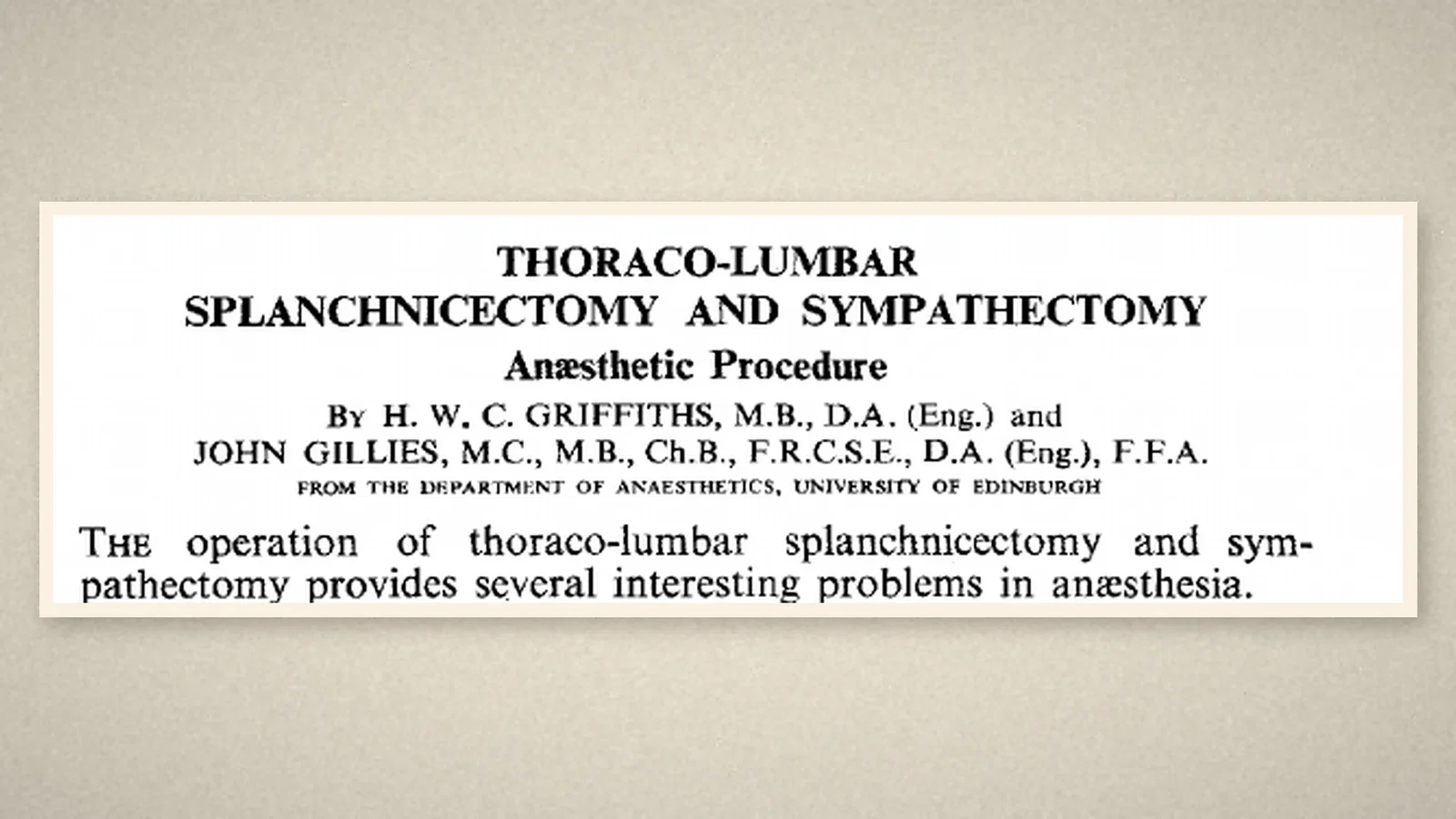
In 1948 Anaesthesia (vol. 3, no. 4) printed "Thoraco-lumbar splanchnicectomy and sympathectomy: anaesthetic procedure" by H. W. C. Griffiths and John Gillies of the Department of Anaesthetics, University of Edinburgh. The operation was then used to treat essential hypertension, and the authors listed its problems for the anaesthetist. The patients were usually middle-aged, often with past cardiac or cerebral episodes, and "generally fair or poor risk". Exposure of the splanchnic nerves and sympathetic chain needed a long oblique incision, resection of a rib and partial detachment of the diaphragm, with the patient on the side and acutely flexed. The wide dissection "demands an ischaemic field", yet hypertensive patients bleed readily. Diathermy in the chest ruled out inflammable agents, the pleura might be opened, and the patient should be fit for the other side within about two weeks. [1, p. 134]
Modern anaesthetic methods, the authors wrote, dealt with all of this except bleeding, and "the only certain way to reduce haemorrhage is to lower the blood pressure". Thiopentone lowered pressure considerably in hypertensives, but the fall was not sustained; spinal block gave a fall that could be "graded according to the number of vasomotor units affected", maximal when the block reached the first thoracic segment and no better above it. [1, p. 134][1, p. 135]
From total spinal analgesia to total sympathetic block
They reviewed the history of high and total spinal anaesthesia. On their account Bier gave the first spinal injection, after which surgeons pushed the level ever higher, as reported by Tait and Caglieri, Morton, Jonnesco and Le Filliâtre; Koster did not fear extreme hypotension and considered the patient safe while head-down; and Vehrs, after experiments in dogs, concluded that lumbar injection in proper dosage was the safest and most efficient way of producing total spinal analgesia. [1, p. 135][1, p. 136]
Their own "total spinal block" meant a total sympathetic block, with lesser sensory and motor paralysis, designed for the maximal fall in pressure while leaving the respiratory muscles and medullary centres alone. With "confidence in the resuscitative measures now available", they combined it with light general narcosis and efficient oxygenation for this operation, stressing that the method was safe only when the patient could be kept head-down. [1, p. 137]
The head-down jack-knife
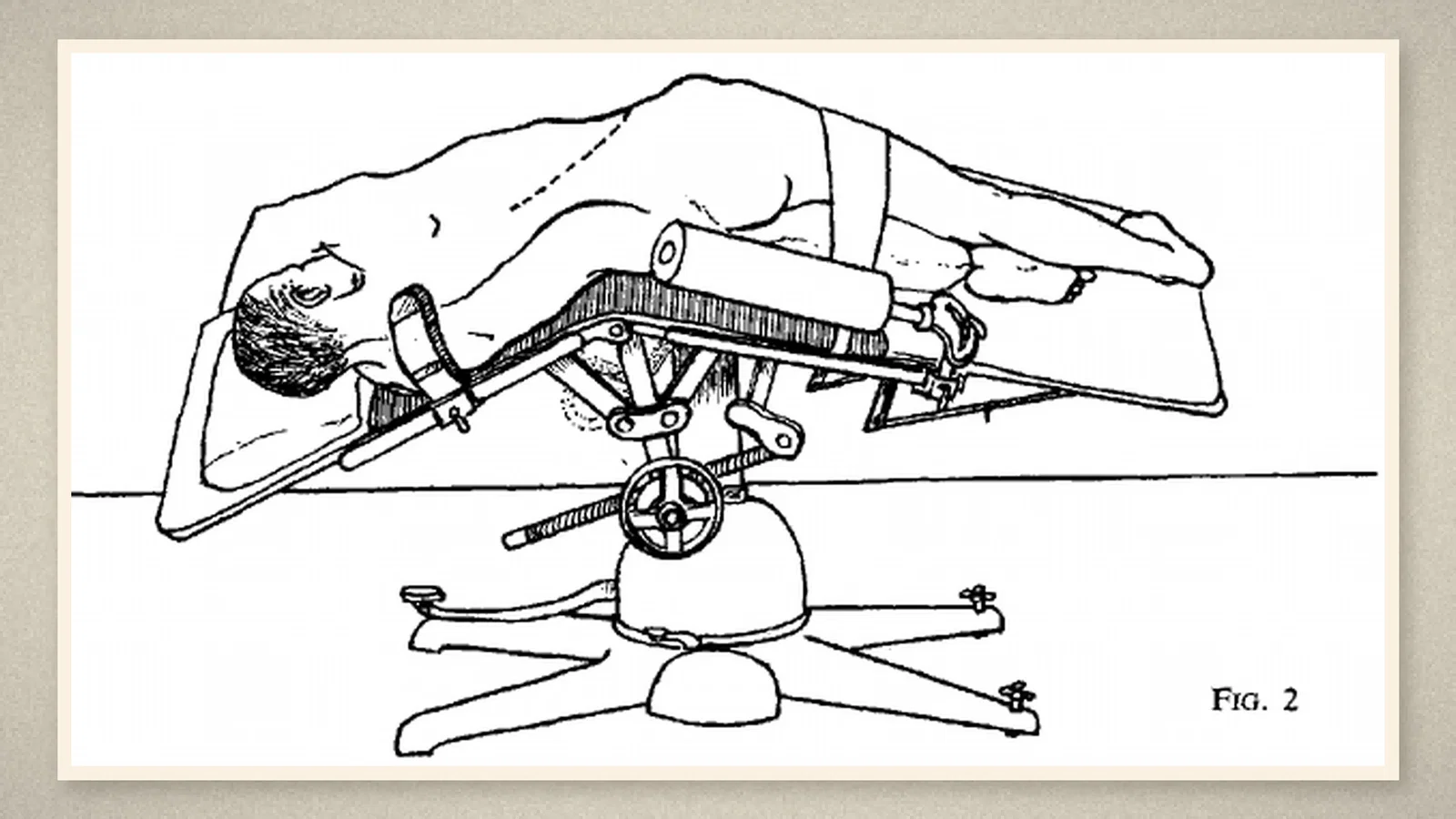
Thiopentone was given first, with no vasopressor beforehand. Local anaesthetic was injected at the second lumbar space, the patient laid flat and the table tipped steeply head-down until the pressure fell; an airway was inserted and oxygen given. The patient was then turned into a lateral "jack knife" position with the pelvis at the highest point of the table, so that gravity kept the heart filled while the pressure was often unrecordable. Oxygen was given throughout, more thiopentone as needed, and cyclopropane, "more readily controllable", if laryngeal spasm made further thiopentone undesirable; an opened pleura called for controlled inflation. Afterwards the head-down tilt was kept during transfer and for at least eight hours on the ward. [1, p. 138][1, p. 139]
Eighty-four operations
The series comprised 84 operations on 44 patients. One patient died on the table, from failure to maintain oxygenation: a large pleural effusion on the side operated on thirteen days earlier, together with retractors restricting the lung on the open side. Because thiopentone had been given before the lumbar puncture, the level reached by the injection could not be ascertained. [1, p. 139]
The pressure fell quickly. Within ten to twenty minutes on average no reading could be obtained at the brachial artery and no pulse felt at the wrist, and most cases gave "an almost ischaemic operative field". The apex beat was slow but forceful, skin capillary filling remained brisk and colour was usually good. Four patients became cyanosed, probably from inadequate oxygenation; respiratory arrest twice required passive ventilation, which the authors attributed to thiopentone; relaxation was satisfactory and there was no nausea or vomiting. The state lasted twenty to thirty minutes on average. [1, p. 140]
Why the authors thought such hypotension acceptable
The commentary admitted that the planned production of hypotension to obtain an ischaemic field "needs further investigation", and noted the widespread belief that spinal hypotension was as dangerous as that from haemorrhage or trauma, so that spinal block was considered contraindicated above the diaphragm. Citing Seevers, the authors argued that respiratory failure always preceded circulatory failure in high spinal block, and that early deaths were probably due to anoxia combined with hypotension. [1, p. 141]
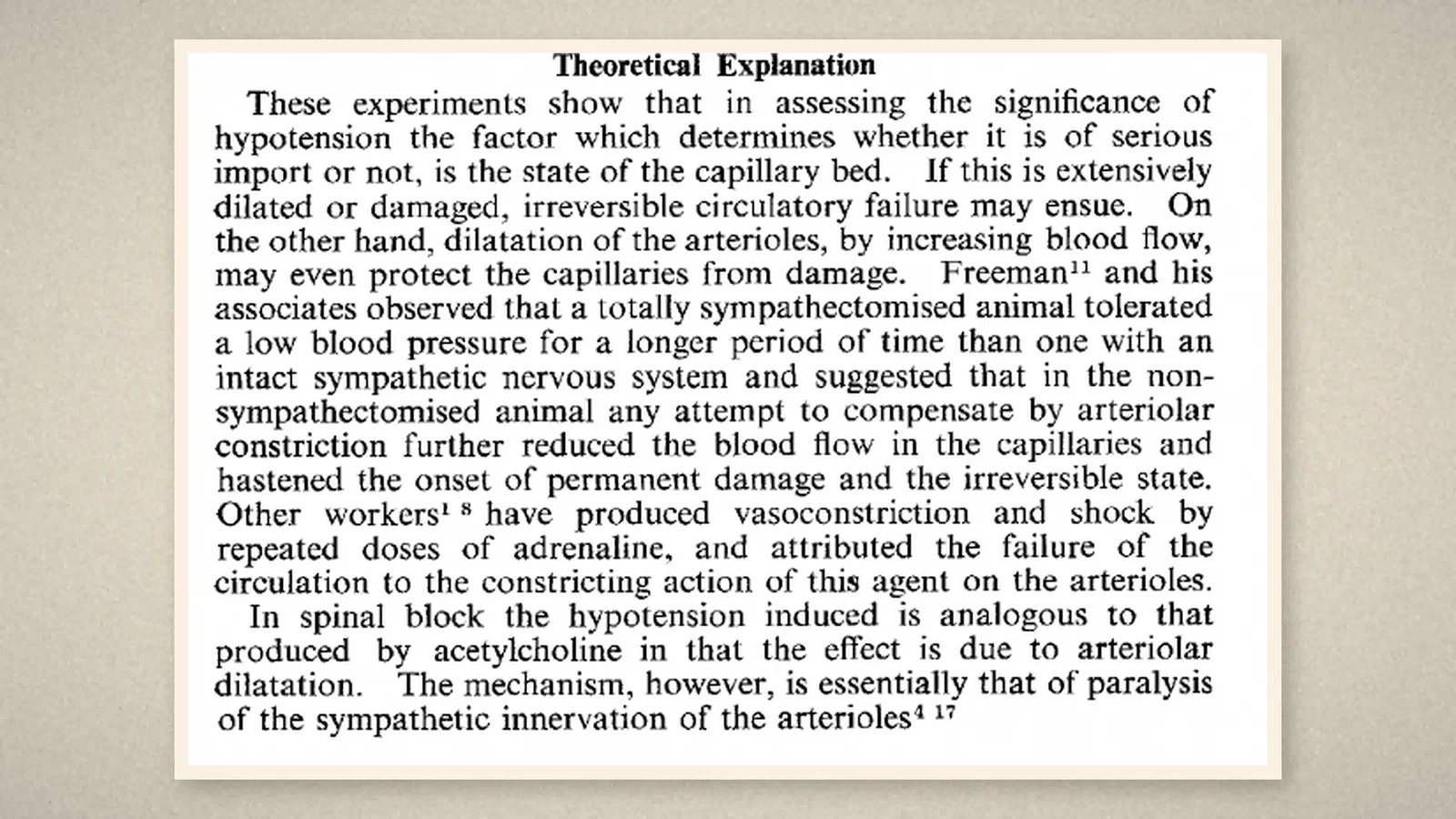
Under "Controlled Hypotension" they proposed that hypotension is serious when its mechanism is haematogenic and damages the capillaries, and relatively innocuous when it is neurogenic. Their evidence came from Dale and Laidlaw's experiments in cats: histamine lowered the pressure while the veins emptied, blood pooled in the capillary bed and circulatory failure followed; acetylcholine produced the same degree of hypotension by arteriolar dilatation, with venous return preserved and pressure recovering as soon as the infusion stopped. The deciding factor, they concluded, was "the state of the capillary bed", and spinal hypotension resembled the acetylcholine kind. [1, p. 142]
No permanent dysfunction of the nervous system was seen; despite several patients with anginal histories or electrocardiographic changes, no anginal attacks followed in the immediate postoperative period; and none of the four with serious cerebral histories had a thrombosis. The summary described a method of combined analgesia, vasoconstrictor paralysis and narcosis giving an ischaemic field and good relaxation, with shorter operations and negligible blood loss, but conceded that the hypotension had often been extreme, "possibly unnecessarily so", and that results as the series went on had been equally good at more moderate levels. The authors thanked Professor J. R. Learmonth, the surgeon, for cooperation and encouragement. [1, p. 145][1, p. 146]
What the record shows
The paper stands for a bold and direct idea: if bleeding comes from blood pressure, lower the pressure, and use physiological experiment to argue why that kind of hypotension can be tolerated. It also records the authors' own reservations: the pressure was often lowered too far, and one patient died on the table.
Sources and reading limits
Read: Griffiths and Gillies, "Thoraco-lumbar splanchnicectomy and sympathectomy: anaesthetic procedure", Anaesthesia 1948;3:134-46 (the whole paper: problems of the operation, prevention of haemorrhage, earlier experimental and clinical work, total sympathetic block, technique with Figs 1 and 2, clinical observations with Fig. 3, commentary, controlled hypotension, theoretical explanation, case notes and summary). Obtained through institutional access.
Not covered: Enderby's 1950 Lancet paper on controlled circulation with hypotensive drugs and posture; the original works of Bier, Koster, Vehrs, Seevers, Dale and Laidlaw, and Freeman cited by the authors. A Royal College of Anaesthetists timeline entry was used only as a lead.
Limits: the series was uncontrolled and the level of block was not established; the authors concede that the hypotension was often extreme, possibly unnecessarily so, and one patient died on the table. The account of earlier workers, including who gave the first spinal injection, is the authors'. Crossref dates the issue to December 1948; this article gives only the year. All drug doses, concentrations, blood pressures, heart rates and case-note figures are omitted, and page crops stop before them; Fig. 2 is a drawing of the position, not a photograph of a patient. Patients are not identified.
Three illustrations are crops of Anaesthesia 1948 pp. 134, 139 and 142 (the title, Fig. 2, the "Theoretical Explanation" section). One is a text diagram drawn from the paper, with no people and no doses or pressures.
- Griffiths HWC, Gillies J. Thoraco-lumbar splanchnicectomy and sympathectomy: anaesthetic procedure. Anaesthesia. 1948;3:134-46. DOI
Continue exploring
Related reading connects shared questions and contexts; it does not by itself establish historical influence.
- 1953: Magill Reports Trimetaphan by Drip for Controlled Hypotension
- 1946: The First Number of Anaesthesia
Anesthesia Epochs · The Source Room · About & Editorial Method
Published November 3, 2026. Sources and reading limits are stated above. Illustrations are labelled as original source images or AI-made. Historical accounts are educational; they are not current treatment instructions.