The Foreword, the Editorial, the first President's account of how the Association began, and a centenary review.
Reading Library · Anesthesia Epochs · 中文版
Watch the education video (for clinicians)
1946: Anaesthesia — The Journal's First Number · Anesthesia Epochs Education Series
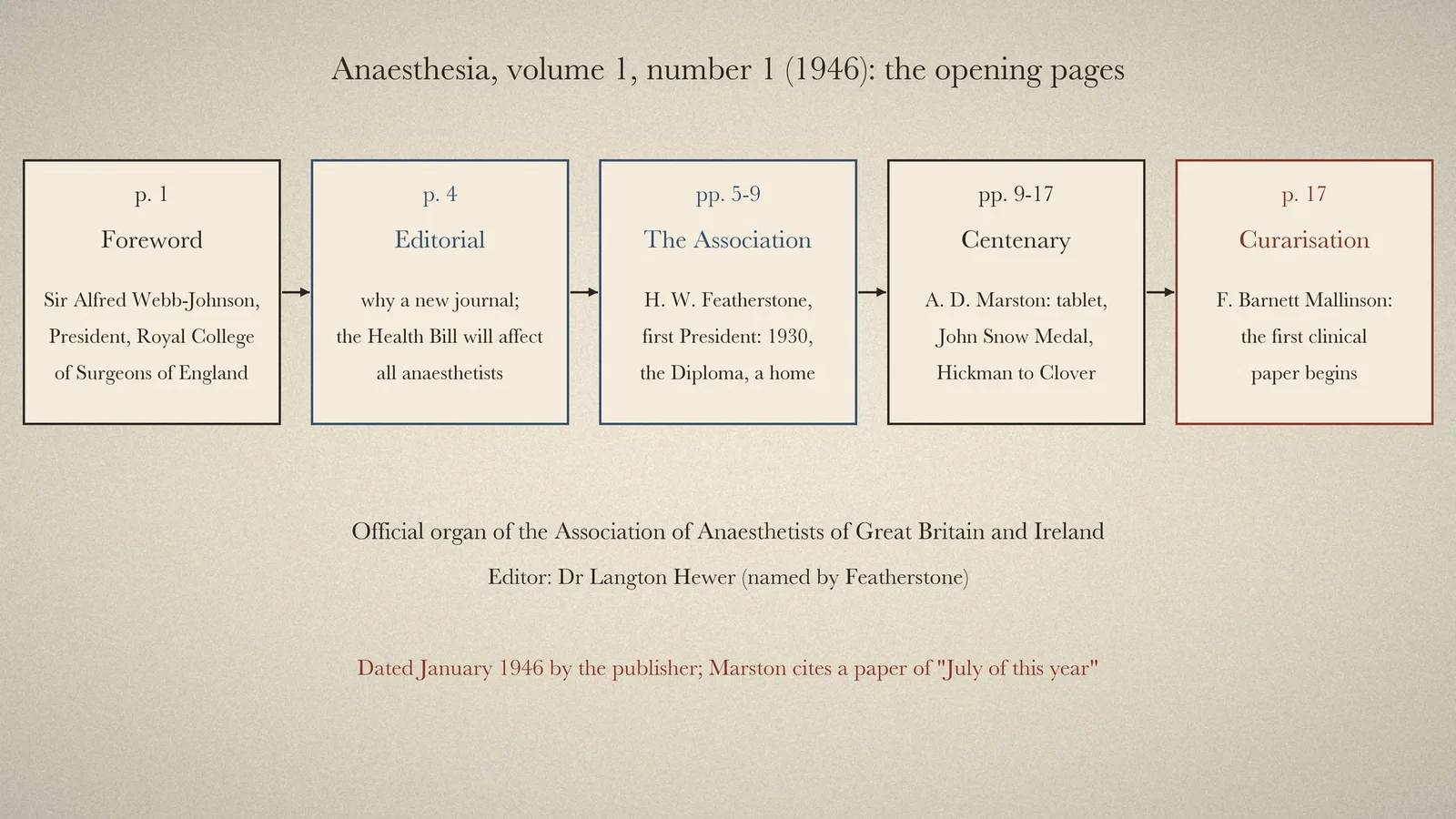
Anaesthesia is the journal of the Association of Anaesthetists of Great Britain and Ireland. Its first number appeared in 1946, the centenary of the first anaesthetics in Britain. This article reads the four pieces that open that number: a Foreword by the President of the Royal College of Surgeons of England, an unsigned Editorial, the first President's account of how the Association began, and the Association's President on the centenary.
A foreword from the surgeons
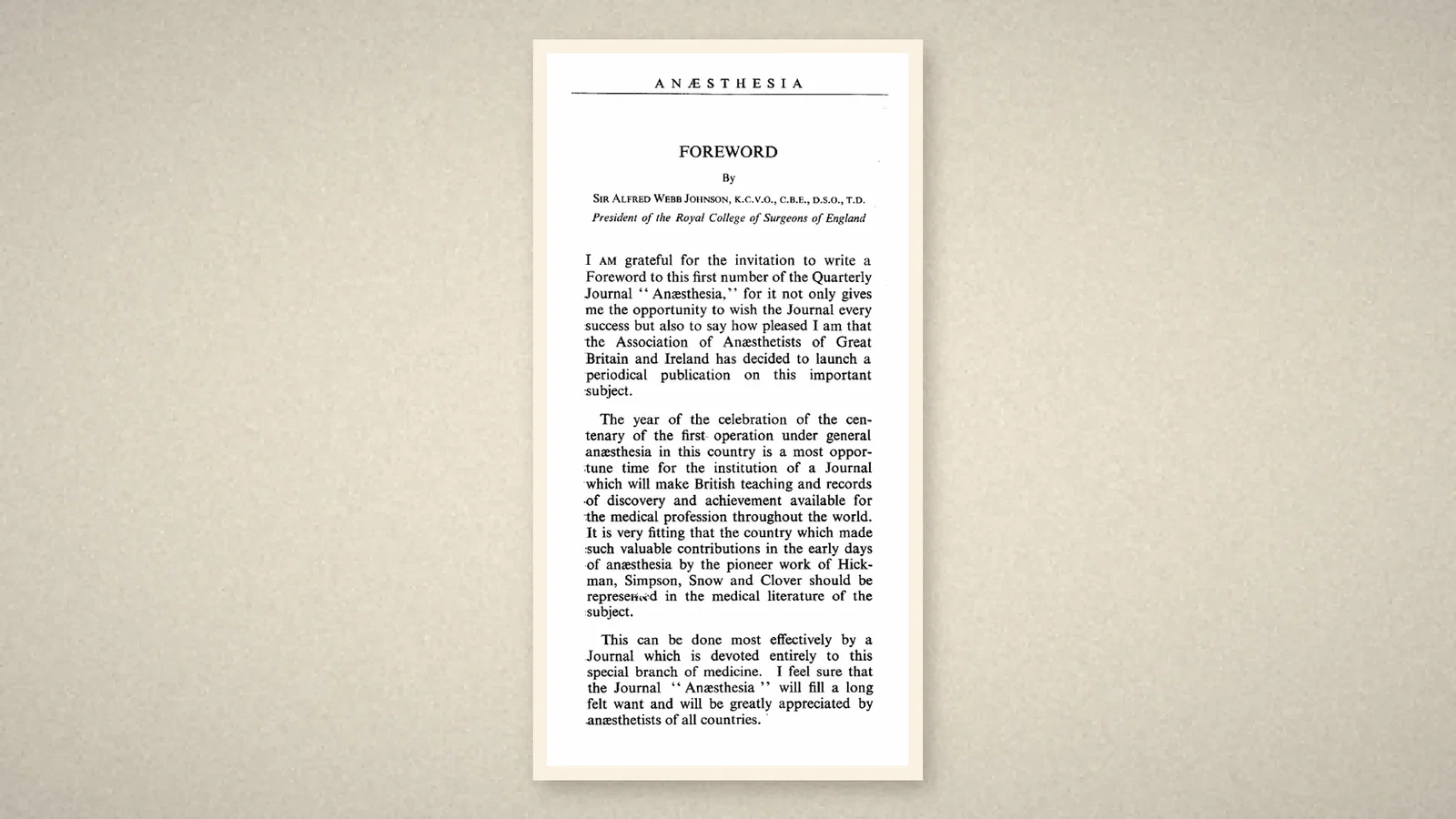
Sir Alfred Webb-Johnson, President of the Royal College of Surgeons of England, thanked the Association for the invitation to write a Foreword "to this first number of the Quarterly Journal". [1, p. 1] The year of the centenary of the first operation under general anaesthesia in this country was, in Webb-Johnson's words, "a most opportune time" for a journal which would make British teaching and records of discovery available to the profession throughout the world, in the country of Hickman, Simpson, Snow and Clover. A journal devoted entirely to this special branch of medicine would "fill a long felt want". [1, p. 1]
Why another journal
The Editorial opened with an ancient sage's complaint that "of making many books there is no end", so a new journal needed a good and definite purpose. The first was that the rapid advance in anaesthetic and analgesic technique needed fuller and quicker expression than could be given in "the overloaded columns of the general medical press". [2, p. 4] The journal would be primarily a scientific one, open to contributions from colleagues abroad, but it was also the official organ of the Association, able to carry news that the Annual Report could only mention briefly. [2, p. 4]
The second reason was the future. Whatever view one took of a National Medical Service, "the implementation of the Health Bill will profoundly affect all anaesthetists", and the latest information on the specialist service, and on the negotiations then going on between the Association and official bodies, would be published as soon as it was available. [2, p. 4] The Editorial ended by quoting a leading article in The Times: "One of the greatest contributions to human well-being in the last hundred years has been the great advance in the field of anaesthesia." [2, p. 4]
How the Association began
H. W. Featherstone, the Association's first President, described its beginnings. The scientific side of anaesthesia had been carried by the Society of Anaesthetists and then the Section of Anaesthetics of the Royal Society of Medicine, whose rules confined it to science. "The position in the year 1930 was this": anaesthetic practice had grown enormously, but its practitioners had no means of organising their departments or representing the needs of the anaesthetic service. "No standard of training had been laid down", and there was little means of telling trained workers from "unskilled but optimistic novices". [3, p. 5] Skilled anaesthetists felt exposed to an unstable career, with no official body to which medical or lay authorities could turn. [3, p. 5]
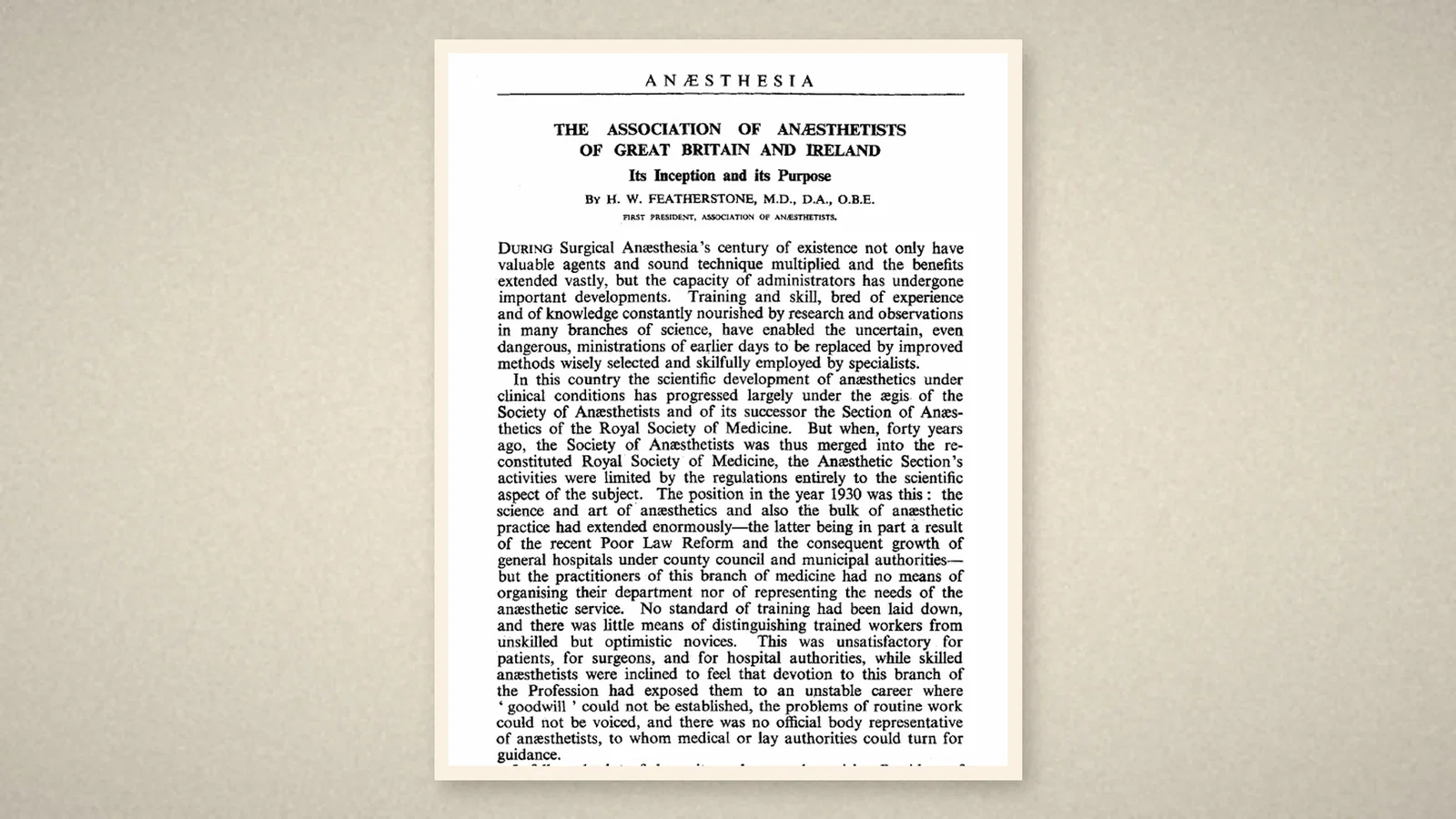
As retiring President of the Section, Featherstone invited a hundred anaesthetists on the staffs of the main teaching hospitals to a meeting; a provisional Council drew up objectives and rules. [3, p. 5–6] Featherstone had liked the title "Guild", for the technical skill it implied, but it seemed too stylistic; colleagues in Eire were to be able to join. [3, p. 6] The Association's first undertaking, and in Featherstone's view its most far-reaching achievement, was the Diploma: a non-competitive test of practical knowledge and skill, a single diploma rather than several, and one held from the outset by the senior teachers, a lesson drawn from the fifty years the Diploma in Public Health of 1885 had taken to win recognition. [3, p. 6–7] During the war the Diploma was of special value in selecting specialist and graded anaesthetists in the Services. [3, p. 7]
Featherstone also recorded evidence on deaths under anaesthesia given to the departmental committee on coroners appointed in 1935 under Lord Wright, and admitted the limits of the prewar Association: hospitals and medical schools had not been willing to pay serious attention to its advice on salary, fees, status or conditions of service. [3, p. 7–8] The membership limit of one hundred and fifty had been lifted and fellows added, and the Royal College of Surgeons had offered accommodation in Lincoln's Inn Fields. [3, p. 8] With its own journal under the editorship of Dr Langton Hewer, Featherstone concluded, anaesthetists had a means of discussion and representation, a diploma and a home for the new circumstances of the National Health Service. [3, p. 9]
The centenary
The President of the Association, A. D. Marston, wrote the centenary review. Credit for anaesthesia, in Marston's view, "cannot fairly be given to any one man". [4, p. 9] Marston recalled Crawford Long's use of ether from 30 March 1842, Morton's demonstration on 16 October 1846, the extraction of teeth under ether by Robinson at Dr Boot's house in Gower Street on 19 December 1846, and Liston's amputation two days later at University College Hospital, "the ether being administered by Mr. Squire". [4, p. 10] The Association was erecting a memorial tablet at the Royal College of Surgeons, to be unveiled by the Princess Royal, naming Hickman, Simpson, Snow and Clover. [4, p. 11]
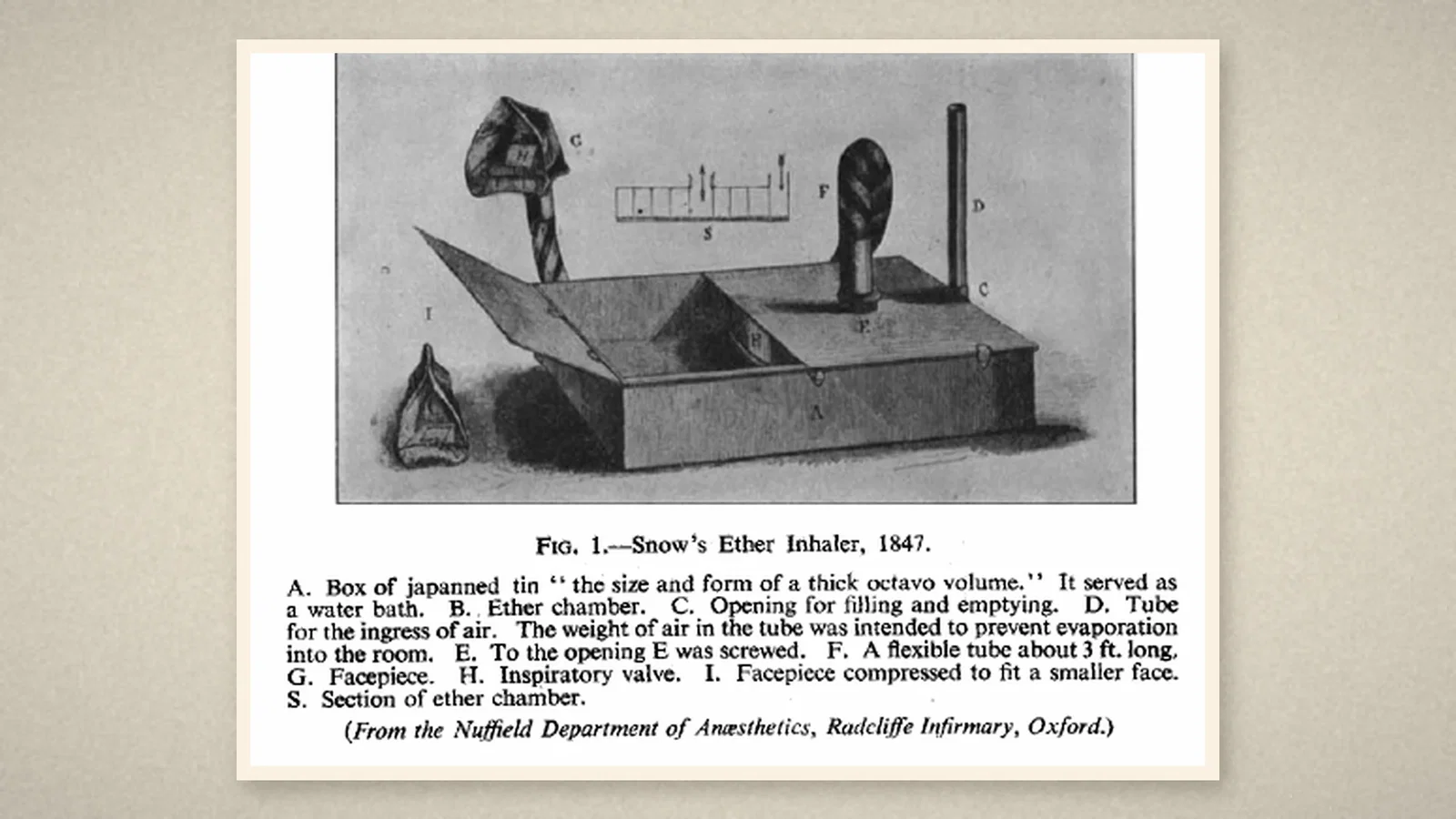
Marston's sketches of the four end with an announcement: in the centenary year the Association had instituted an award for signal service to the specialty, to be known as the "John Snow Medal". [4, p. 15] Clover's ether apparatus, described in 1877, had been used in Britain until 1914. [4, p. 16] On the last page of Marston's article the first clinical paper begins: F. Barnett Mallinson on curarisation compared with other methods of securing relaxation. [4, p. 17]
A question of date
The publisher's site and Crossref date the issue January 1946. Marston, however, mentions a paper on Trilene published in the British Medical Journal "in July of this year". [4, p. 16] The number cannot therefore have gone to press before July 1946; the pages read give no exact date.
What the record shows
In its first number Anaesthesia presented itself as a scientific journal, the voice of an Association, and a celebration of a centenary. Its founders looked back to 1930, when anaesthetists had no organisation and no standard of training, and forward to a health service that would change their position. The prospect of that change, the Editorial wrote, gave the journal's news "some urgency". [2, p. 4]
Sources and reading limits
Read: the Foreword (p. 1), the Editorial (p. 4), Featherstone (pp. 5–9) and Marston (pp. 9–17) from Anaesthesia volume 1, number 1, in the PDFs from the publisher. Only the first page of Mallinson's paper was seen.
Not covered: the rest of the issue, its cover and any dated imprint. Featherstone gives no founding date for the Association, and none is supplied here. Marston's account of the first years of anaesthesia is a summary written in 1946 from secondary works, and is reported only as what the first number said. The issue date is discussed above; no month of publication is asserted.
One illustration is drawn from the four articles; three are crops of the 1946 pages.
- Webb-Johnson A. Foreword. Anaesthesia. 1946;1(1):1. doi:10.1111/j.1365-2044.1946.tb02044.x
- Editorial. Anaesthesia. 1946;1(1):4. doi:10.1111/j.1365-2044.1946.tb02045.x
- Featherstone HW. The Association of Anaesthetists of Great Britain and Ireland: its inception and its purpose. Anaesthesia. 1946;1(1):5–9. doi:10.1111/j.1365-2044.1946.tb02046.x
- Marston AD. Centenary of anaesthesia in Great Britain. Anaesthesia. 1946;1(1):9–17. doi:10.1111/j.1365-2044.1946.tb02047.x
Continue exploring
Related reading connects shared questions and contexts; it does not by itself establish historical influence.
- 1932: The Association of Anaesthetists of Great Britain and Ireland Forms
- 1935: London Holds the Diploma in Anaesthetics Examination
- 1923: The First Number of the British Journal of Anaesthesia
- 1940: The First Number of Anesthesiology
Anesthesia Epochs · The Source Room · About & Editorial Method
Published November 2, 2026. Sources and reading limits are stated above. Illustrations are labelled as original source images or AI-made. Historical accounts are educational; they are not current treatment instructions.