
The Lancet of 31 January 1953 printed 'Controlled Hypotension by a Thiophanium Derivative' by I. W. Magill, C. F. Scurr and J. B. Wyman of Westminster Hospital, London. Deliberate hypotension with pentamethonium or hexamethonium had been used there for four years, but it needed one large dose, repeated doses worked less and less, the young and the thyrotoxic resisted it, and sensitive patients could stay too low too long. Arfonad (trimetaphan) acted briefly; by drip the pressure followed the drip rate and recovered quickly when it stopped. With a small supply that Magill had brought back from the United States, they treated five patients, all with highly satisfactory results, and thought it might supplant the other agents. The same day in the British Medical Journal, A. A. Mason and John F. Pelmore of the Queen Victoria Hospital, East Grinstead, reported that hexamethonium still failed in some patients, mostly young ones with a fast pulse, and tried adding procaine amide.
Reading Library · Anesthesia Epochs · 中文版
Watch the education video (for clinicians)
1953: Trimetaphan — Controlled Hypotension · Anesthesia Epochs Education Series
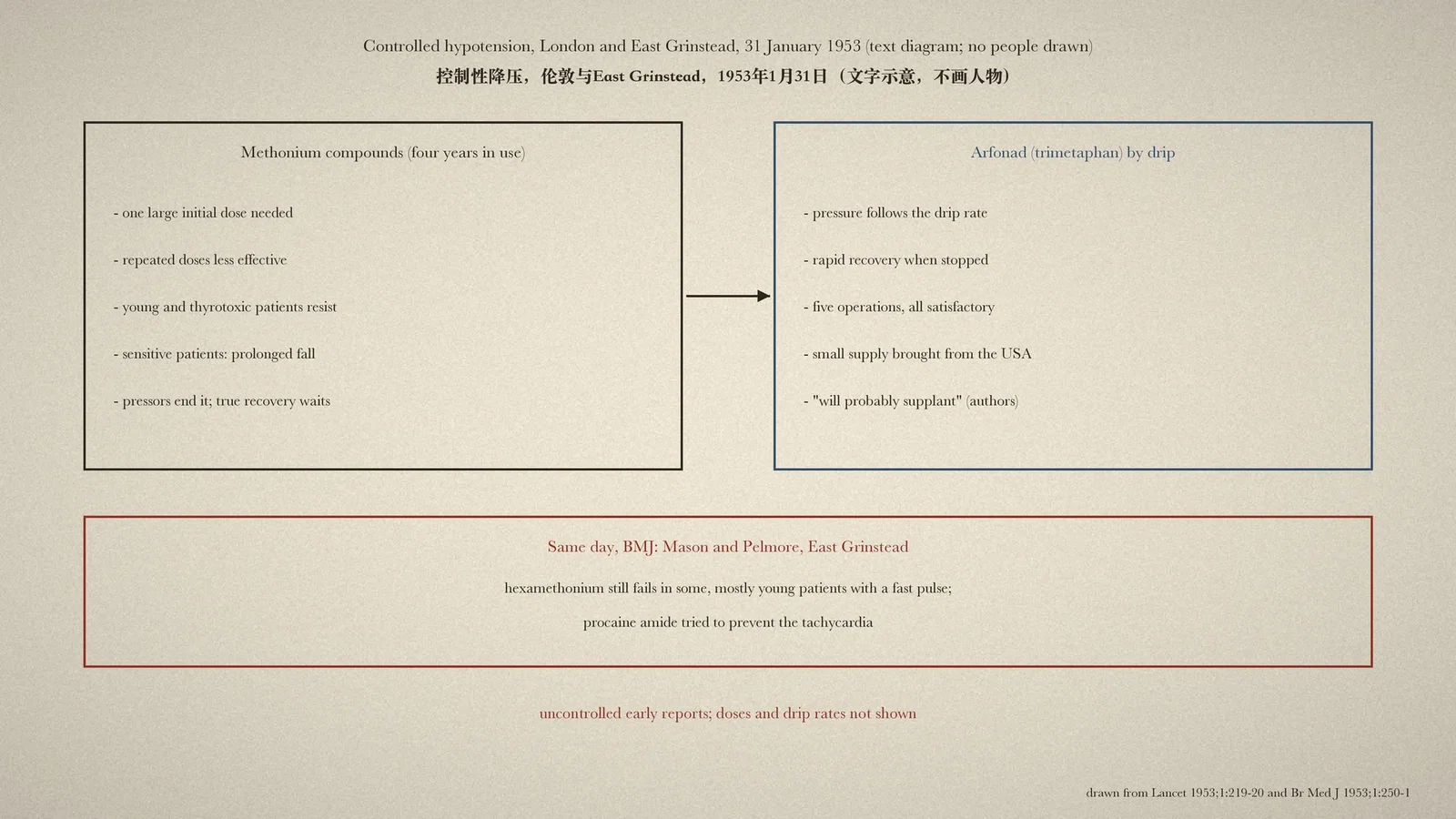
Lowering the blood pressure on purpose during an operation, to get a drier field, was already routine in some British hospitals by the start of 1953. On one day, 31 January 1953, two journals printed two reports on how the drugs behaved. One came from anaesthetists who had found a better drug, the other from anaesthetists still trying to make the old one work. [1, p. 219][2, p. 250]
Four years of the methonium drugs
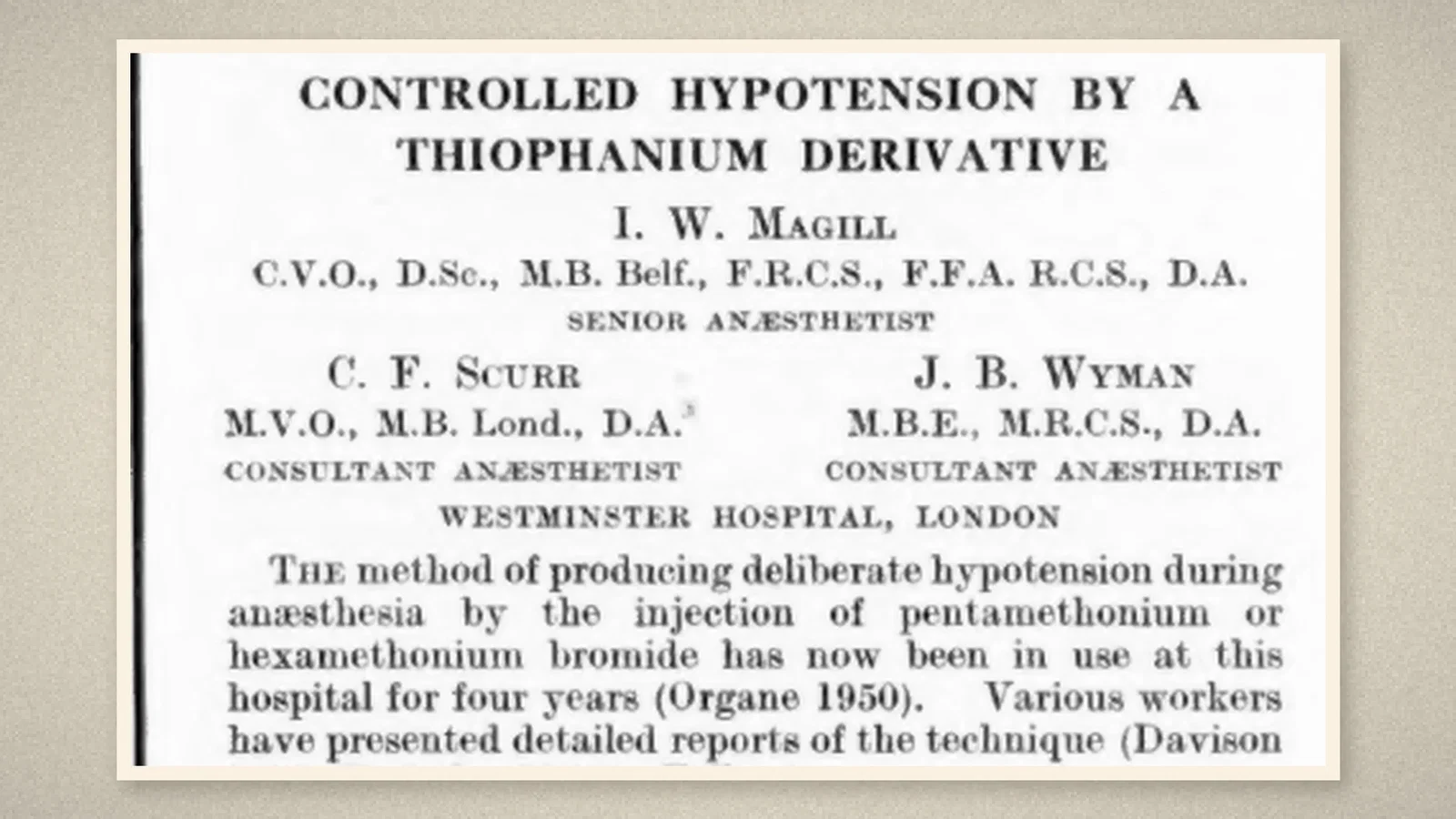
"Controlled Hypotension by a Thiophanium Derivative" was by I. W. Magill, senior anaesthetist, and C. F. Scurr and J. B. Wyman, consultant anaesthetists, of Westminster Hospital, London. Deliberate hypotension with pentamethonium or hexamethonium had "now been in use at this hospital for four years". [1, p. 219]
Experience had shown its limits. A good fall in pressure and a dry field needed one large initial dose; repeated smaller doses worked less and less. Sensitive patients could stay too low for too long. "Very young subjects and thyrotoxic" patients resisted the drugs, and larger doses did not help. Pressor drugs could end the hypotension, but true recovery came only when the drug was gone. [1, p. 219]
A drug that followed the drip
The new agent was a ganglion blocker with the code number Ro 2-2222, sold as Arfonad (trimetaphan). In the United States, Sarnoff and colleagues had used it for "graded reduction of arterial pressure in the treatment of" acute pulmonary oedema: it acted briefly, did not lose its effect with repeated doses, and could therefore be given by continuous drip, the fall in pressure following the rate. [1, p. 219]
"Recently we obtained a small supply of arfonad", the Westminster authors wrote, and they used it by drip "in 5 cases": a stellectomy, a radical mastectomy, a laminectomy, a thyroidectomy and a mastoidectomy. The pressure could be controlled by "varying the rate of drip"; when the drip stopped, "recovery was rapid", and the pressure stayed stable for hours afterwards. They saw no undesirable side-effects or complications. [1, p. 219]
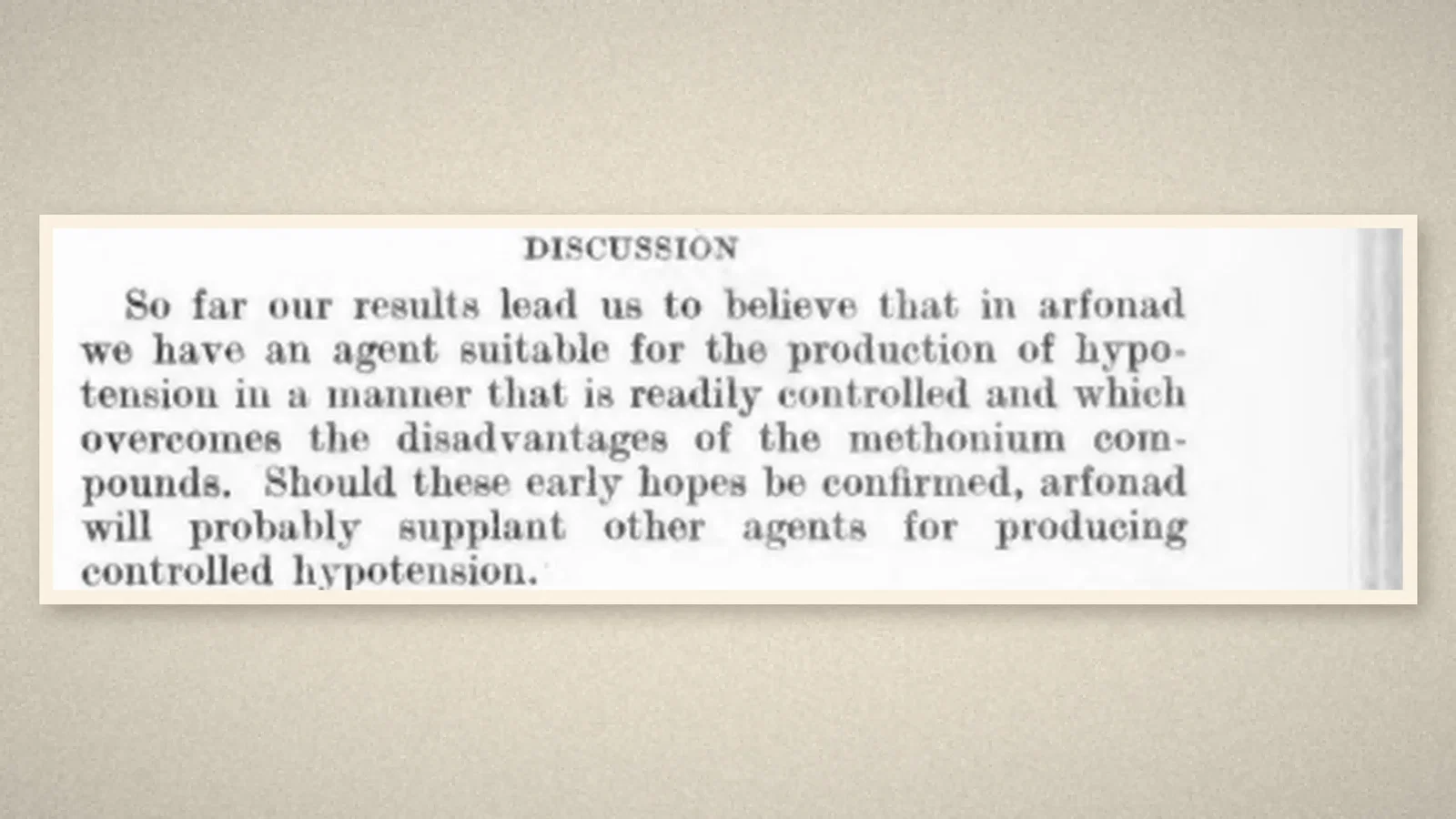
Their discussion was hopeful. Here was an agent that produced hypotension "in a manner that is readily controlled" and "overcomes the disadvantages of the methonium compounds"; if early hopes were confirmed, it "will probably supplant other agents". The authors also explained why there were only five cases: the drug "was brought back from the U.S.A. by one of us (I. W. M.)", and a larger trial would have to wait for more. [1, p. 219][1, p. 220]
The same day, in East Grinstead
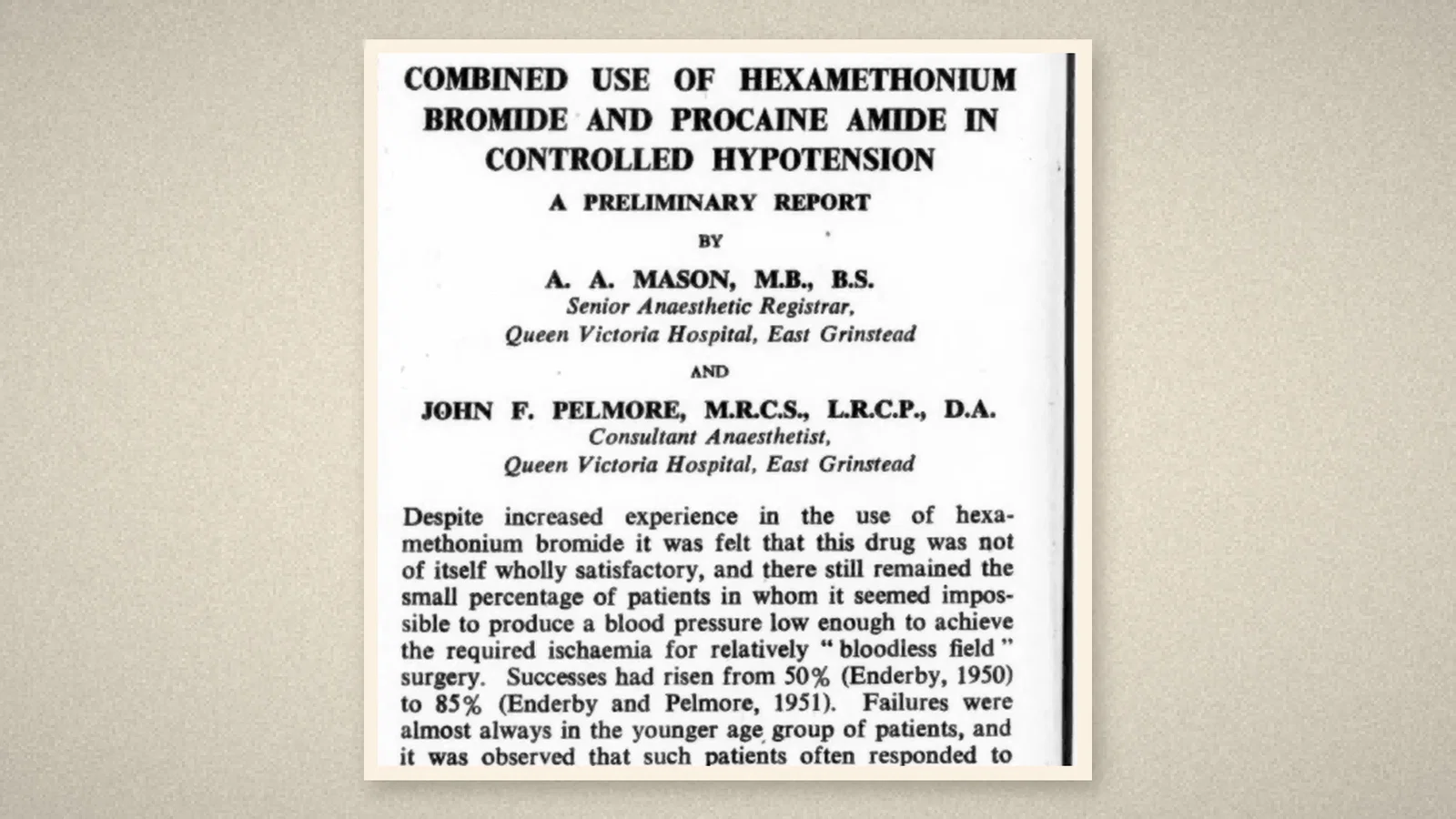
The British Medical Journal of the same date carried "Combined Use of Hexamethonium Bromide and Procaine Amide in Controlled Hypotension" by A. A. Mason and John F. Pelmore of the Queen Victoria Hospital, East Grinstead. Hexamethonium still failed in "a small percentage of patients", though "Successes had risen from 50% (Enderby, 1950)" to more than four in five. The failures were "almost always in the younger age group of patients", whose pulse often rose instead. "A constant search has been maintained for a drug" to replace or strengthen hexamethonium; they hoped procaine amide "might prevent the tachycardia". [2, p. 250][2, p. 251]
What the record shows
Two answers to the same problem, printed on the same day. The East Grinstead paper tried to fix the old drug by adding another. The Westminster paper changed the drug, and what it valued was control: a pressure that followed the drip and came back when the drip stopped. Both were early, small, uncontrolled reports. Whether deliberate hypotension was safe enough to justify its use is a later question that these pages do not settle.
Sources and reading limits
Read: I. W. Magill, C. F. Scurr and J. B. Wyman, "Controlled Hypotension by a Thiophanium Derivative", The Lancet 31 January 1953, pp. 219-220, in full; A. A. Mason and John F. Pelmore, "Combined Use of Hexamethonium Bromide and Procaine Amide in Controlled Hypotension: A Preliminary Report", British Medical Journal 31 January 1953, from p. 250, the opening and pharmacology section, the case material skimmed.
Not covered: the earlier methonium papers by Enderby and Organe; the American papers by Sarnoff and colleagues and by Nicholson and colleagues; later trimetaphan series; later events of 1955, 1974 and 1981, which concern later agents; the later debate on the risks of deliberate hypotension.
Limits: the history of pharmacological controlled hypotension spans several events; this article covers only the two papers of 31 January 1953. Magill's report covers five uncontrolled cases, and the judgement "highly satisfactory" is the authors' own. Doses, drip strengths and rates, and blood-pressure values are not repeated, and the page crops leave them out. Patients are not identified. Some first names were not printed in full in the pages read.
Three illustrations are crops of The Lancet (p. 219) and the British Medical Journal (p. 250) of 31 January 1953; one is a text diagram drawn from both, with no people drawn and no doses shown.
- Magill IW, Scurr CF, Wyman JB. Controlled hypotension by a thiophanium derivative. Lancet. 1953;1(6753):219-20. Internet Archive
- Mason AA, Pelmore JF. Combined use of hexamethonium bromide and procaine amide in controlled hypotension: a preliminary report. Br Med J. 1953;1(4804):250-6. Internet Archive
Continue exploring
Related reading connects shared questions and contexts; it does not by itself establish historical influence.
- 1951: Thesleff Brings Succinylcholine into the Operating Room
- 1951: Suckling Designs Halothane at ICI
- 1931: Roche Picks Prostigmin from 44 Physostigmine Analogues
Anesthesia Epochs · The Source Room · About & Editorial Method
Published November 3, 2026. Sources and reading limits are stated above. Illustrations are labelled as original source images or AI-made. Historical accounts are educational; they are not current treatment instructions.