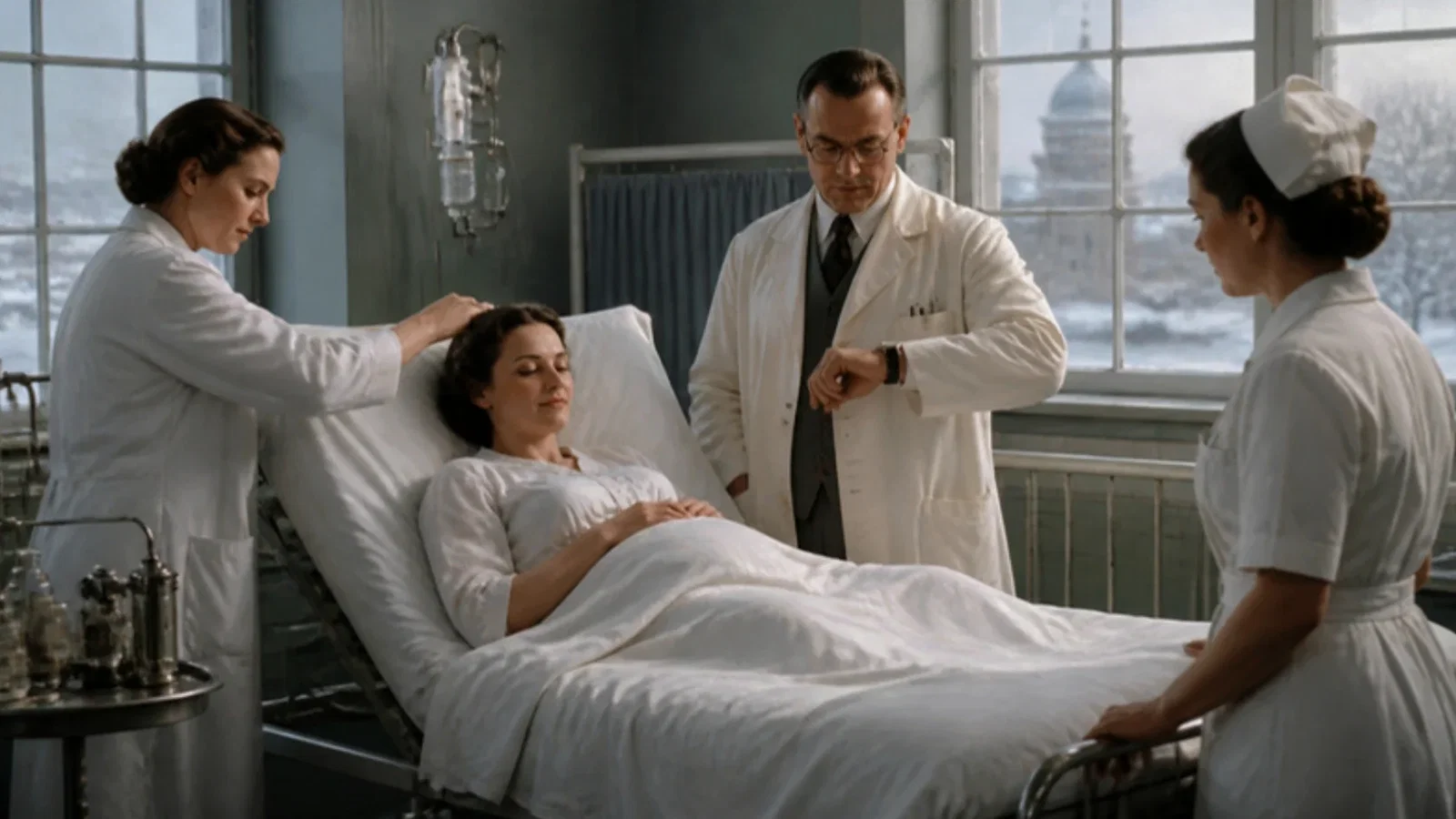
At the Montreal General Hospital the anaesthetist Jean T. Hugill and the obstetrician Clark Gillespie gave heavy nupercaine spinals to women in bed, raised the head of the bed to hold the level between D11 and D9, and relieved pain for an average of more than two hours before delivery; against 100 deliveries under nitrous oxide, oxygen and ether, the spinal group had more headaches and catheterizations but far less post-partum haemorrhage and neonatal resuscitation; the authors insisted on a trained anaesthetist.
Reading Library · Anesthesia Epochs · 中文版
Watch the education video (for clinicians)
1948: Hugill and Gillespie — Nupercaine Spinal in 100 Labours · Anesthesia Epochs Education Series
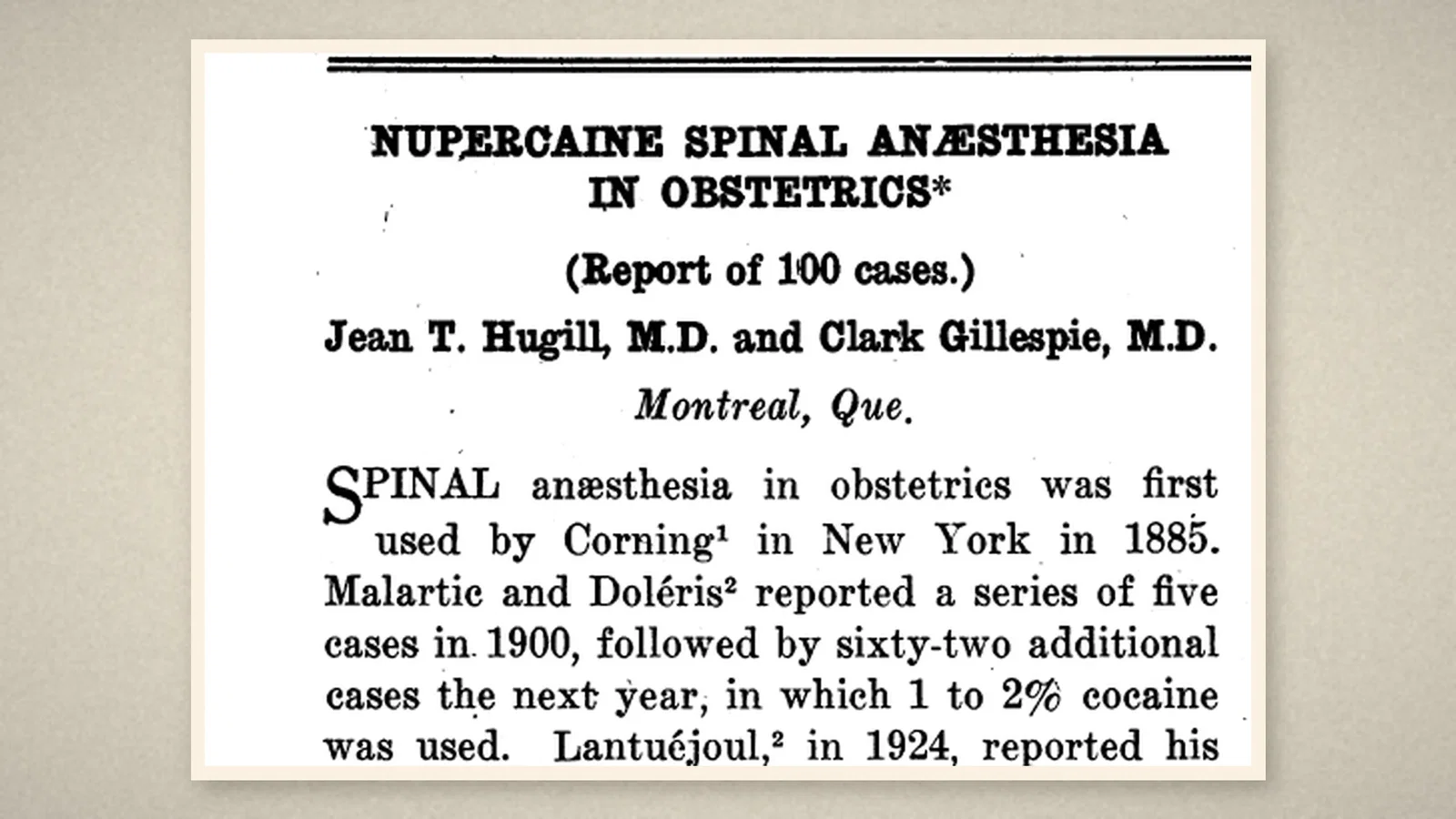
Neuraxial analgesia in labour is now routine. Around 1948, an obstetric unit had to decide between a general anaesthetic for the delivery and a spinal given hours earlier, and the evidence came from hospital series. The Canadian Anesthesiologists' Society (CAS) remembers Dr Jean Templeton Hugill as "a pioneer in the development of obstetric anesthesia in Canada". This article reads the paper behind that reputation: Jean T. Hugill and Clark Gillespie, "Nupercaine spinal anaesthesia in obstetrics (report of 100 cases)", in the Canadian Medical Association Journal of February 1948, from the departments of anaesthesia and obstetrics of the Montreal General Hospital. [1][2]
A long-acting spinal for labour
The authors began with history: spinal anaesthesia in obstetrics had been used by Corning in New York in 1885; Pitkin in 1928 used weighted solution for a saddle block; a series of 2,789 cases had been reported from the Margaret Hague Maternity Hospital; heavy nupercaine had been used by Burton in England in 1943; and Weaver and colleagues had reported 1,547 obstetric spinals at the Hamilton General Hospital. Their own aim was to describe a "relatively new spinal agent", heavy nupercaine, and to compare 100 cases with 100 deliveries in the same hospital under nitrous oxide, oxygen and ether, the commonest anaesthetic there for vaginal delivery "until this year". Having used pontocaine and novocaine before, they preferred nupercaine because of its longer action. [1]
The technique was built round the bed, not the delivery table. Most spinals were given in bed with the patient on the right side; the patient was then turned on the back and the head of the bed raised. "Trendelenberg position was never used." If pain persisted with the level low, the bed was briefly lowered and raised again; "by this method the level of anaesthesia was kept between D 11 and D 9". The patient was not allowed to push, nor to be moved, for at least half an hour. "All the anaesthetics were given by a member of the anaesthetic staff of the hospital." [1]
What happened
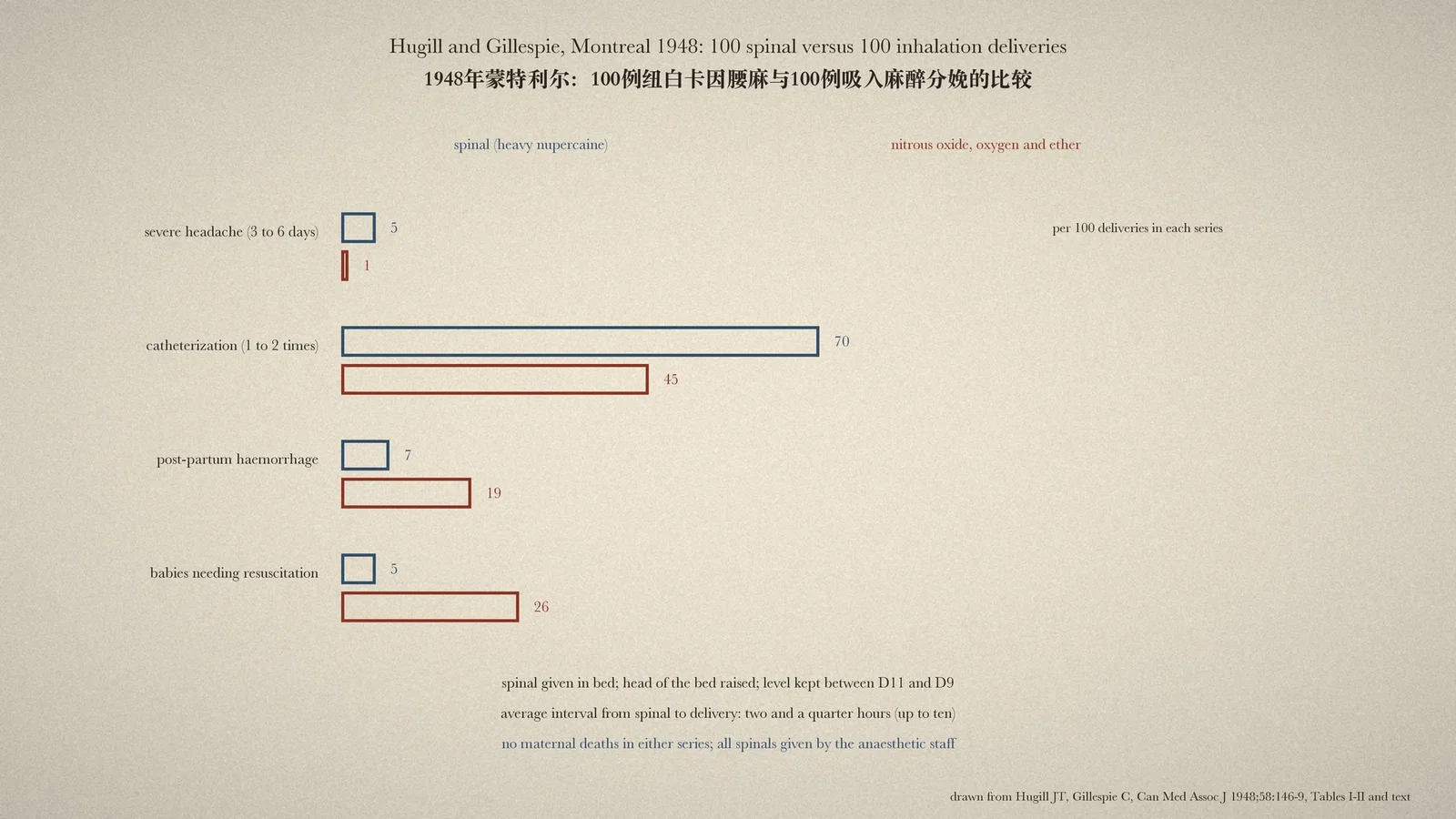
Relief was usually immediate. The interval from spinal to delivery ranged from fifteen minutes to ten hours, "with an average of two and one-quarter hours", and many women went three or four hours without pain before delivery. Nineteen needed a supplement of cyclopropane or nitrous oxide for forceps traction; one spinal was counted a failure. The authors also recorded a difficulty of being awake: when one baby was born with spina bifida and hydrocephalus, the mother was given cyclopropane before seeing the baby. There was no clinical evidence of marked fall in blood pressure, and "there were no maternal deaths in either series". [1]
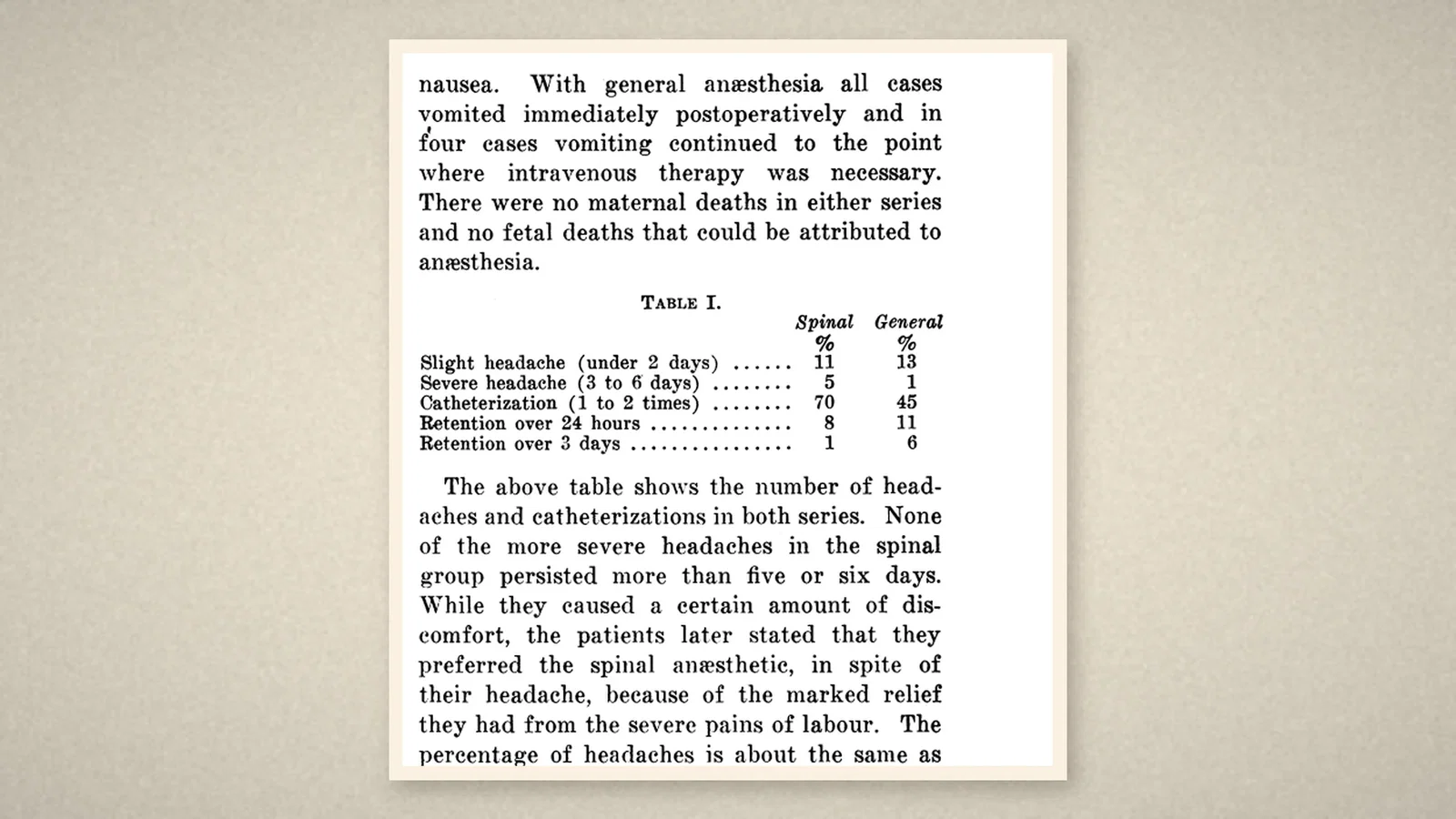
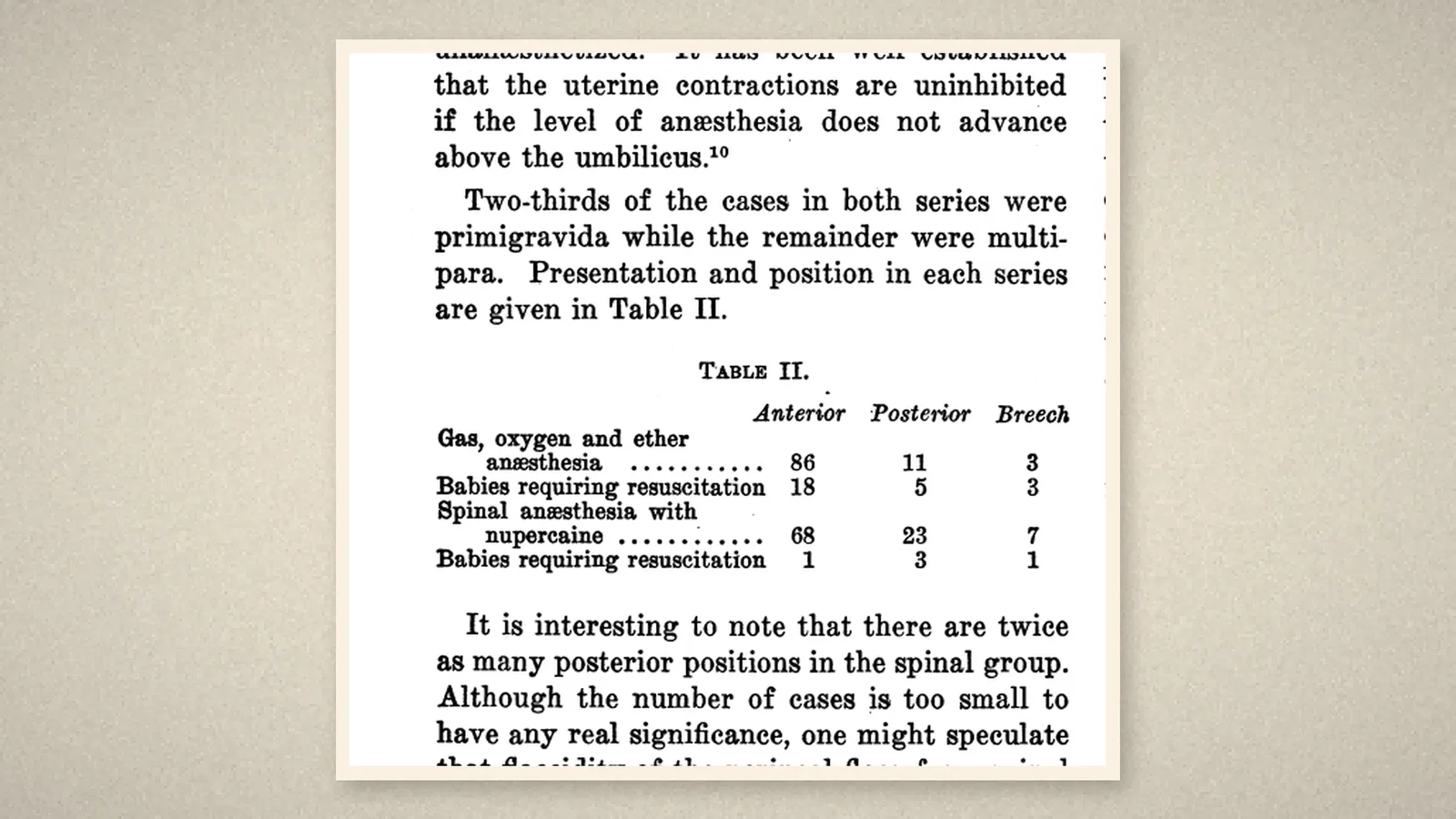
The comparison was not one-sided. Table I shows more severe headaches (5 against 1) and more catheterizations (70 against 45) after spinal; yet "the patients later stated that they preferred the spinal anaesthetic, in spite of their headache". No nerve damage, weakness or sphincter change occurred, and "no patient was given a spinal who did not want one". The obstetric findings favoured the spinal: post-partum haemorrhage occurred 7 times against 19, and only five spinal babies needed any resuscitation, against 26 per cent after inhalation anaesthesia. There were no fetal deaths in the spinal series. [1]
The condition attached
The conclusion was strong: "The advantages are overwhelming", and nupercaine spinal had "the considerable advantage of being an anaesthetic for labour and not for delivery alone". But the authors attached a condition. "In the hands of those inexperienced in the technique of its administration, spinal is dangerous and unpredictable", and an obstetrician without an experienced anaesthetist would continue to use inhalation with excellent results. They expected spinal anaesthesia to spread in "those hospitals possessing a trained anaesthetist". [1]
According to the CAS, Hugill later founded the anaesthesia department of the West Coast General Hospital in Port Alberni and worked at Vancouver General as a lead anesthesiologist until 1985; research chairs at the University of British Columbia carry Hugill's name. [2]
What the record shows
The 1948 paper shows obstetric anaesthesia moving from the moment of delivery to the course of labour. Position controlled the spread of a heavy solution; a specialist stayed responsible; and the cost in headaches and catheterizations was set openly against less bleeding and fewer depressed babies. It also shows the authors' honest limit: a small, non-randomised series in one hospital, judged by the people who gave the anaesthetics.
Sources and reading limits
Read: Hugill JT and Gillespie C, Can Med Assoc J 1948;58:146-9, in full; the CAS biography of Dr Jean Templeton Hugill.
Not covered: the earlier obstetric spinal series the authors cite; any record of the dates of the 100 cases; other sources on Hugill's career. The CAS's descriptions ("pioneer", "one of the first female specialist physicians on the West Coast", "first Anesthesia department" in Port Alberni) are quoted as its own; this article does not call Hugill Canada's first woman anaesthetist. The comparison and conclusions are the authors'. Spinal, sedative, vasopressor and oxytocic doses are not repeated. Patients are not identified. Quotations are from the English original.
Three illustrations are crops of pp. 146-8, including Tables I and II; one is drawn from the tables.
- Hugill JT, Gillespie C. Nupercaine spinal anaesthesia in obstetrics: report of 100 cases. Can Med Assoc J. 1948;58(2):146-9. PMC
- Canadian Anesthesiologists' Society. Important contributors: Dr Jean Templeton Hugill. CAS
Continue exploring
Related reading connects shared questions and contexts; it does not by itself establish historical influence.
- 1907: Barker Makes the Spinal Solution Heavier Than Spinal Fluid
- 1949: Flowers, Hellman and Hingson Run a Tube into the Epidural Space
Anesthesia Epochs · The Source Room · About & Editorial Method
Published November 2, 2026. Sources and reading limits are stated above. Illustrations are labelled as original source images or AI-made. Historical accounts are educational; they are not current treatment instructions.