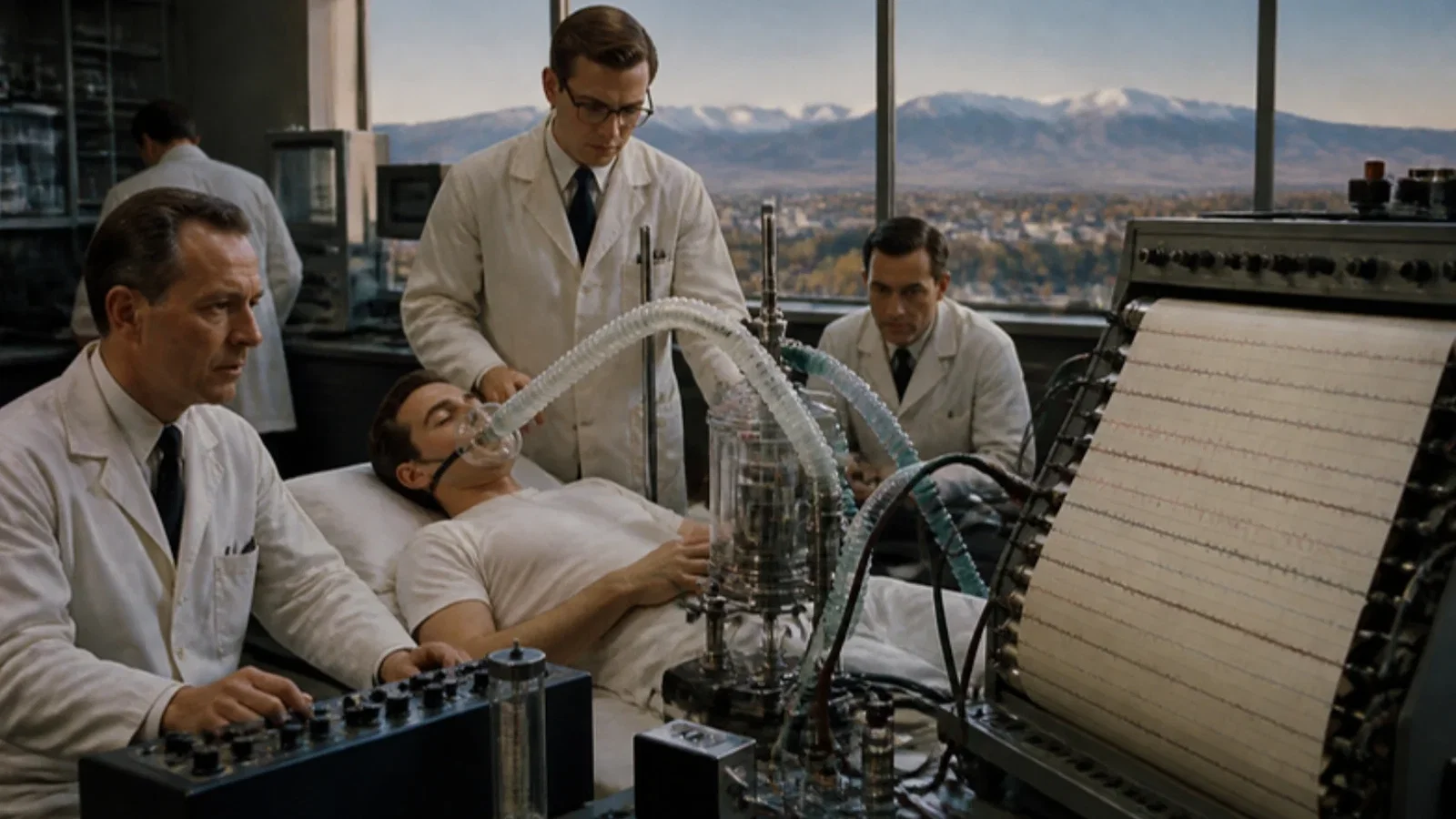
The Canadian Anaesthetists' Society Journal for May 1966 (vol. 13, p. 233) printed a paper by Robert W. Virtue and five colleagues at the University of Colorado Medical Center, Denver, supported by the Air Reduction Company. A new halogenated ether, difluoromethyl 1,1,2-trifluoro-2-chloroethyl ether (DFMTFCE), had been offered to them for further study. They gave it to dogs, then to eight healthy volunteers aged 22 to 29 for cardiovascular and respiratory measurements, and then to eleven surgical patients. Induction was pleasant and the course resembled the early use of halothane; but three dogs fibrillated after epinephrine, a patient carried to burst suppression on the EEG twitched at a loud noise, and spontaneous movements appeared in the deeper planes. Two years later Dobkin and colleagues in Syracuse gave this 'Compound 347' to 100 abdominal surgical patients and judged that it deserved clinical evaluation, while Botty and colleagues in Dallas saw tonic-clonic movements in 4 of 142 patients in deep anaesthesia with hyperventilation and could not yet assess the hazard.
Reading Library · Anesthesia Epochs · 中文版
Watch the education video (for clinicians)
1966: Compound 347 (Enflurane) — A Twitch in Deep Anesthesia · Anesthesia Epochs Education Series
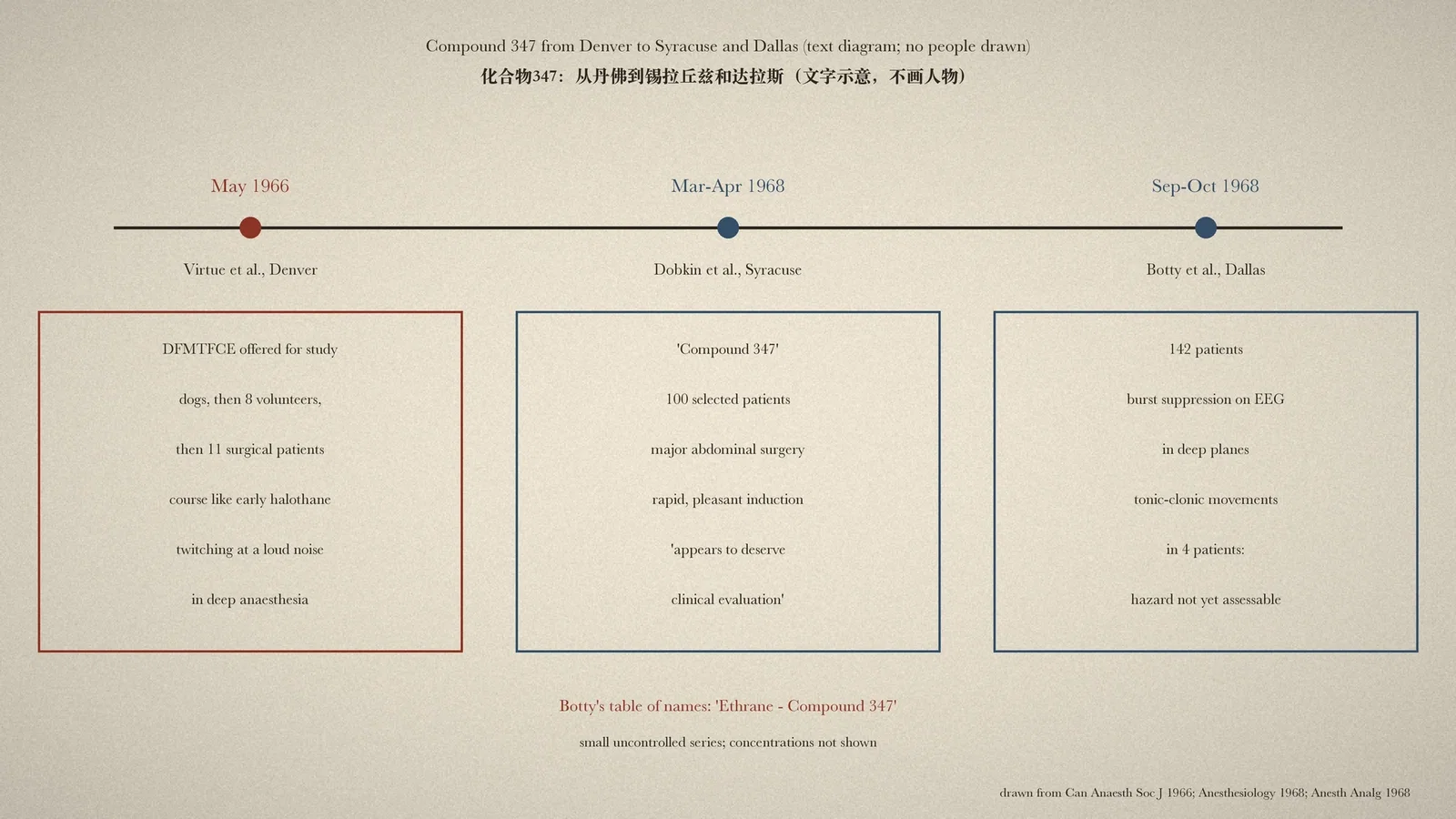
A new inhaled anaesthetic reaches patients by a set path: first dogs, then volunteers who are not having surgery, and only then patients on the operating table. A paper from Denver in May 1966 records the early steps of that path in full. Its awkward chemical name would appear two years later in a table of drug names as "Ethrane - Compound 347". [1, p. 233][3, p. 505]
A new compound offered for study
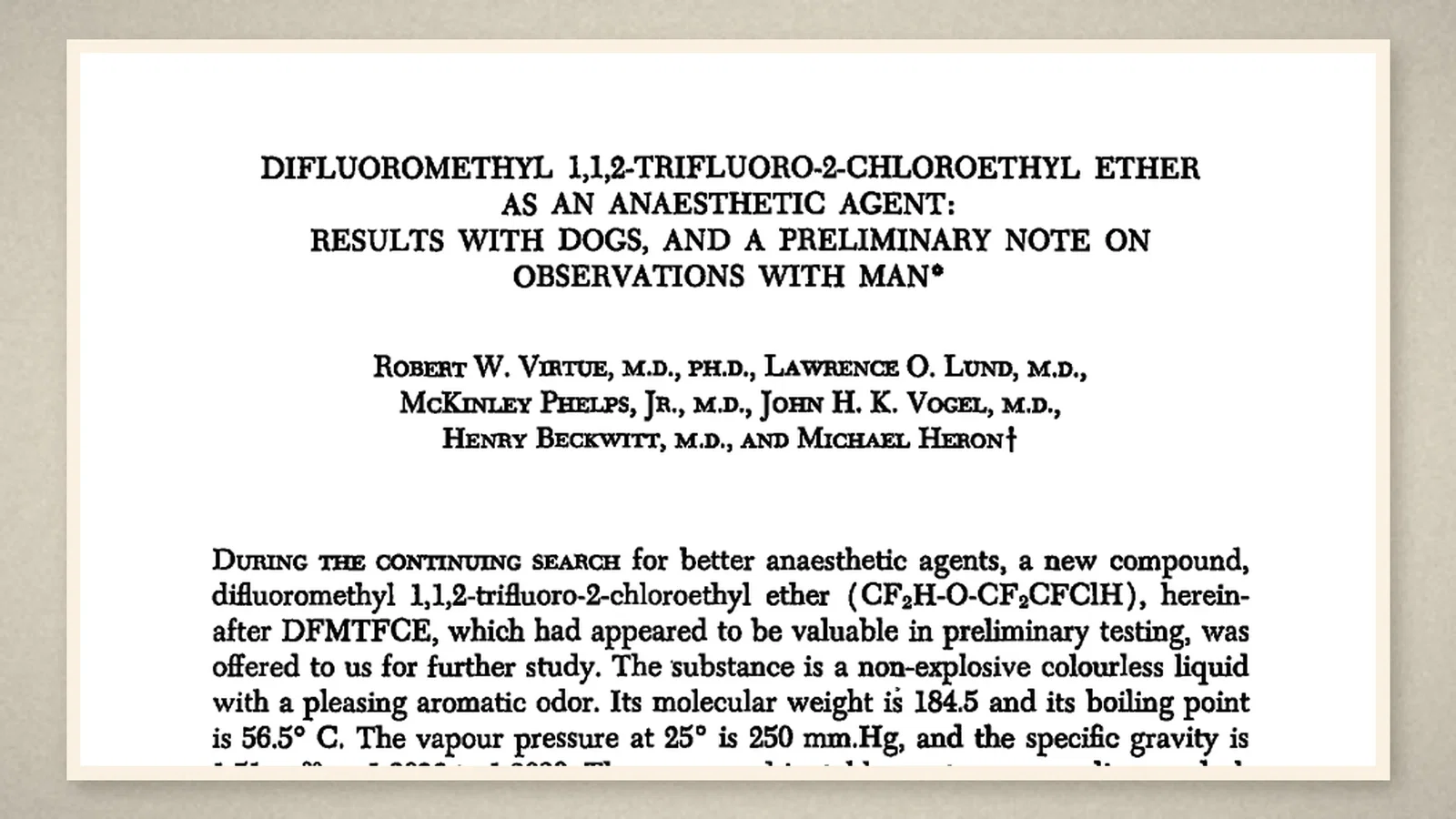
The paper was written by Robert W. Virtue, Lawrence O. Lund and four colleagues in the Division of Anesthesiology and the Cardiovascular Laboratory of the University of Colorado Medical Center, with a grant from the Air Reduction Company. It begins with the "continuing search for better anaesthetic agents". A new compound, difluoromethyl 1,1,2-trifluoro-2-chloroethyl ether, shortened in the paper to DFMTFCE, had appeared valuable in preliminary testing and "was offered to us for further study". It was a non-explosive colourless liquid "with a pleasing aromatic odor", stable on storage and needing no dark bottles or stabilizers. [1, p. 233]
The authors first anaesthetized dogs by open drop, and induction was smooth and rapid. They then carried out cardiovascular and respiratory studies on volunteers who were not having surgery. Only when those results looked satisfactory did they give the agent to a few surgical patients. [1, p. 233] There were eight volunteers, all healthy and aged 22 to 29, and eleven surgical patients. [1, p. 234][1, p. 235]
Results, and an odd sign
The summary reports smooth anaesthesia in dogs without salivation, irritation or nausea. But when epinephrine was given intravenously to 16 dogs, three went into ventricular fibrillation. In the volunteers induction was "pleasant" and waking was rapid; three of the eight were briefly nauseated during recovery. In the eleven patients the course was similar to that with halothane. The authors wrote that it was "quite similar to what we had experienced during the early use of halothane". [1, p. 240]
One sign set the new agent apart from halothane. A patient carried to burst suppression on the EEG twitched in response to a loud noise. With this agent, the authors wrote, spontaneous movements appear in the deeper planes. They might mean that anaesthesia is deepening rather than lightening, so they should not prompt more anaesthetic. The paper's last sentence on the point is: "This may be a valuable feature." [1, p. 238][1, p. 240]
One hundred patients in Syracuse
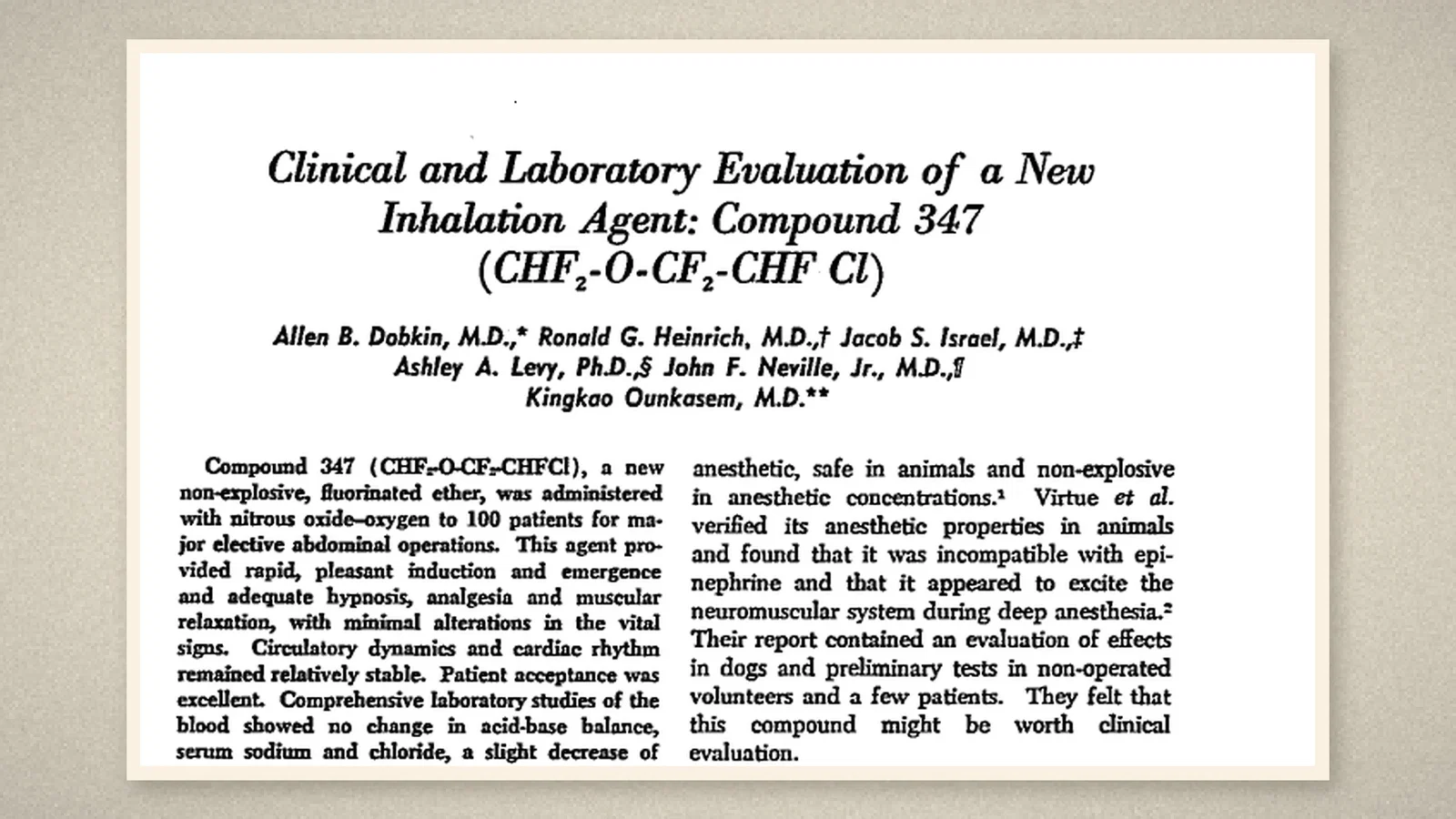
Two years later Allen B. Dobkin and five colleagues at the State University of New York Upstate Medical Center in Syracuse published a larger series in Anesthesiology. The paper was accepted on 22 September 1967 and presented at the American Society of Anesthesiologists' meeting in Las Vegas on 1 October 1967, with support from Ohio Medical Products. One hundred patients for major elective abdominal operations received "Compound 347". Induction and emergence were rapid and pleasant, circulation and rhythm were relatively stable, and patient acceptance was excellent. The abstract ends: "This anesthetic appears to deserve clinical evaluation." [2, p. 275]
The paper also repeated Virtue's findings that the agent was incompatible with epinephrine and appeared to excite the neuromuscular system during deep anaesthesia. [2, p. 275]
Twitching in Dallas
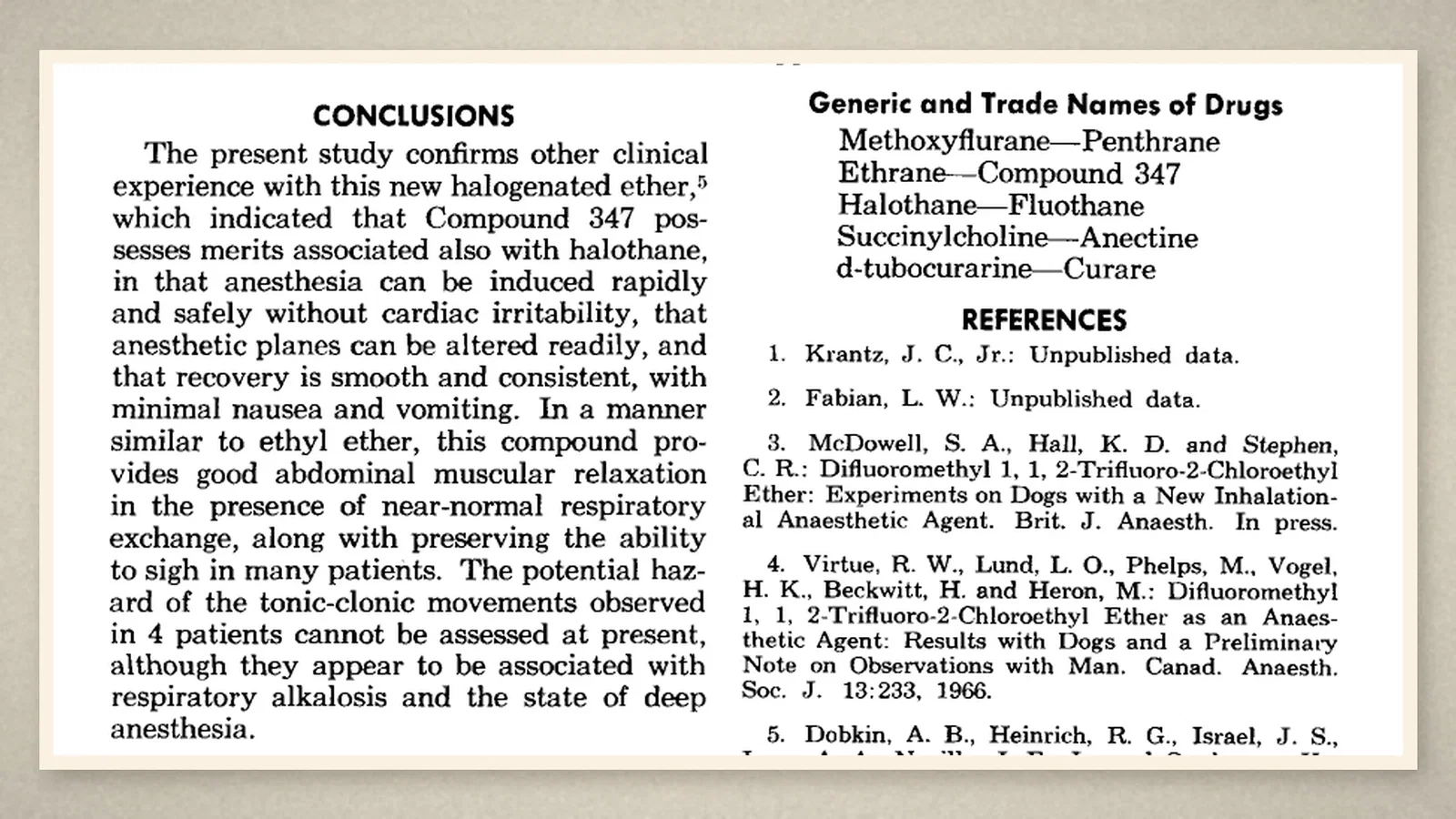
In September-October 1968 Anesthesia and Analgesia printed a report by Carlos Botty, Burnell Brown, Vayden Stanley and C. R. Stephen of the University of Texas Southwestern Medical School in Dallas. The four authors had anaesthetized 142 patients aged 2 to 80. They cited Virtue's observation in dogs that, in deep anaesthesia, striking the table or a loud noise produced twitching of the muscles of the face, limbs and tail. [3, p. 499][3, p. 501]
In this series the EEG showed fast activity in light planes and burst suppression in deep ones. Four patients had paroxysms of tonic-clonic movements lasting 10 to 15 seconds; three of them were being actively hyperventilated and were in a deep plane at the time. The episodes stopped on their own. [3, p. 503] The conclusions say that the agent shared some of the merits of halothane and ether, but that "the potential hazard of the tonic-clonic movements observed in 4 patients cannot be assessed at present", though they seemed linked to respiratory alkalosis and deep anaesthesia. [3, p. 505]
What the record shows
The twitch that Virtue saw in Denver was written down as a possibly "valuable feature". Two years later in Dallas it had become a hazard that could not yet be weighed. The same sign was a clue in the smallest series and a warning in the larger one. By 1968 Botty's table of names already called the agent Ethrane, and its twitching in deep anaesthesia with hyperventilation had been on paper from the start.
Sources and reading limits
Read: Virtue, Lund, Phelps, Vogel, Beckwitt and Heron, Can Anaesth Soc J May 1966;13:233-41 (the whole paper except the tables, with page images of pp. 233 and 240 checked); Dobkin, Heinrich, Israel, Levy, Neville and Ounkasem, Anesthesiology 1968;29:275-87 (abstract, introduction, methods and the results on recovery and nausea); Botty, Brown, Stanley and Stephen, Anesth Analg 1968;47:499-505 (the whole paper, tables skimmed). All three are publisher PDFs of the published articles, obtained through institutional access.
Not covered: Terrell's synthesis of the compound and the earlier screening by Ohio Medical Products; McDowell, Hall and Stephen's dog study (cited by Botty as in press); Dobkin and colleagues' 700-case review; later EEG studies; the approval record. The Wood Library-Museum timeline entry was not used as evidence.
Limits: the generic name enflurane does not appear in the sources read, which use DFMTFCE, Compound 347 and, in Botty's table of names, Ethrane. Virtue's paper does not date the volunteer and patient studies. The series are small and uncontrolled, and Dobkin's and Botty's patients were selected. Concentrations, doses and physiological figures are not repeated, and page crops stop before them. Volunteers and patients are not identified.
Three illustrations are crops of Can Anaesth Soc J 1966 p. 233, Anesthesiology 1968 p. 275 and Anesth Analg 1968 p. 505. One is a text timeline drawn from these sources, with no people drawn and no concentrations shown.
- Virtue RW, Lund LO, Phelps M Jr, Vogel JHK, Beckwitt H, Heron M. Difluoromethyl 1,1,2-trifluoro-2-chloroethyl ether as an anaesthetic agent: results with dogs, and a preliminary note on observations with man. Can Anaesth Soc J. 1966;13:233-41. DOI
- Dobkin AB, Heinrich RG, Israel JS, Levy AA, Neville JF Jr, Ounkasem K. Clinical and laboratory evaluation of a new inhalation agent: Compound 347 (CHF2-O-CF2-CHFCl). Anesthesiology. 1968;29:275-87. DOI
- Botty C, Brown B, Stanley V, Stephen CR. Clinical experiences with Compound 347, a halogenated anesthetic agent. Anesth Analg. 1968;47:499-505. DOI
Continue exploring
Related reading connects shared questions and contexts; it does not by itself establish historical influence.
- 1960: The Cleveland Clinic Reports Methoxyflurane in 206 Patients
- 1951: Suckling Designs Halothane at ICI
- 1990: Jones Reports Desflurane in Ten Volunteers
- 1972: Enflurane's FDA Approval and an Unfinished Clinical Story
Anesthesia Epochs · The Source Room · About & Editorial Method
Published November 3, 2026. Sources and reading limits are stated above. Illustrations are labelled as original source images or AI-made. Historical accounts are educational; they are not current treatment instructions.