In January 1973 the British Journal of Anaesthesia (vol. 45, no. 1) printed 'Anaesthesia for liver transplantation in primates' by K. B. Vetten, J. A. Myburgh, C. J. Mieny, I. Bersohn and the technical staff F. Isaacs and A. Nermudzhivadi of the Department of Anaesthesia and Surgery, University of the Witwatersrand, Johannesburg. Part of a larger liver transplantation programme, it sought a simple, safe technique that technical staff could use. Earlier primate anaesthesia had been done at or near sea level with nitrous oxide and oxygen, but Johannesburg lies high and hypoxia had to be avoided in liver transplantation, so an agent usable with oxygen was needed. In 58 Chacma baboons (17 donors, 41 recipients), animals were first sedated by intramuscular injection in a 'crush' cage, then given halothane or fluroxene by inhalation, breathing spontaneously without relaxants. Donors showed no difference; among recipients only 1 of 12 given halothane lived beyond 48 hours against 15 of 26 given fluroxene, some for up to ten months, though the authors warned that ischaemic times varied and the comparison was circumstantial. A tranquilliser with fluroxene then became standard, with no operative or immediate postoperative deaths in over 200 cases.
Reading Library · Anesthesia Epochs · 中文版
Watch the education video (for clinicians)
1973: Vetten's Baboons — Anaesthesia for Liver Transplantation · Anesthesia Epochs Education Series
Before liver transplantation reached the clinic, much of the work was done in animals, and anaesthetising those animals was a problem in itself. In 1973 a surgical and anaesthetic team in Johannesburg reported in the British Journal of Anaesthesia what they had learned anaesthetising baboons for liver transplantation research: they had to avoid hypoxia at altitude, anaesthetise a dangerous animal safely, and do it in a way that technical staff could manage. [1, p. 10]
Why earlier methods would not do
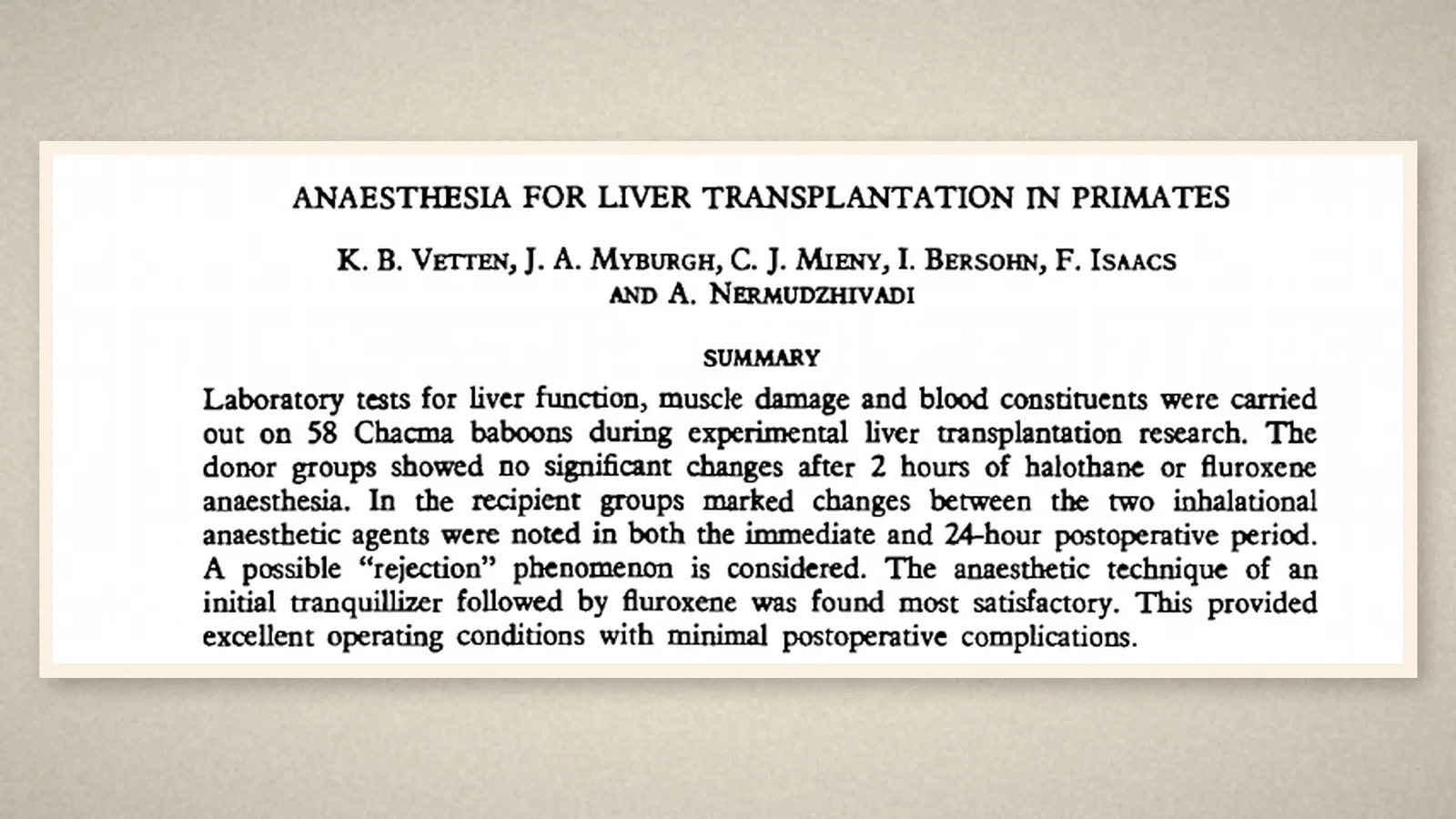
In January 1973 the British Journal of Anaesthesia (vol. 45, no. 1) printed "Anaesthesia for liver transplantation in primates" by K. B. Vetten, J. A. Myburgh, C. J. Mieny, I. Bersohn, F. Isaacs and A. Nermudzhivadi, all of the Department of Anaesthesia and Surgery at the University of the Witwatersrand, the last two being technical staff. The summary described laboratory tests of liver function, muscle damage and blood constituents in 58 Chacma baboons, and reported that "an initial tranquillizer followed by fluroxene" was the most satisfactory technique. [1, p. 10]
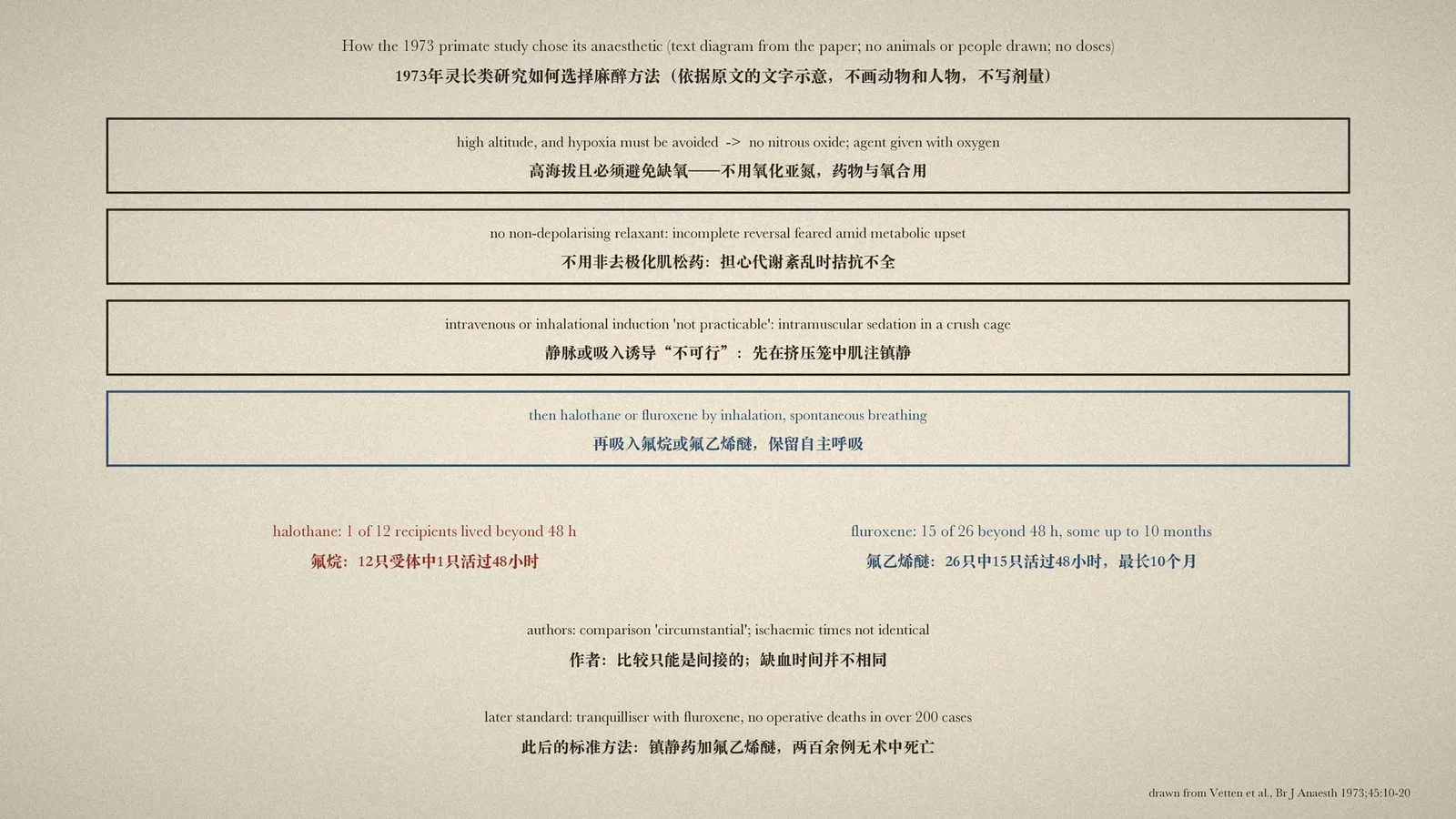
The introduction explained why earlier methods would not serve. Primate anaesthesia had been done at sea level or low altitude, where nitrous oxide and oxygen could be used without hypoxia, the prevention of which "is mandatory in liver transplantation"; Johannesburg is high, so an agent that could be given with oxygen was needed. Foster and colleagues' phencyclidine-diazepam method caused prolonged respiratory depression and slow recovery and made analgesia hard to judge, and "these methods have not been acceptable to other workers in this field". [1, p. 10]
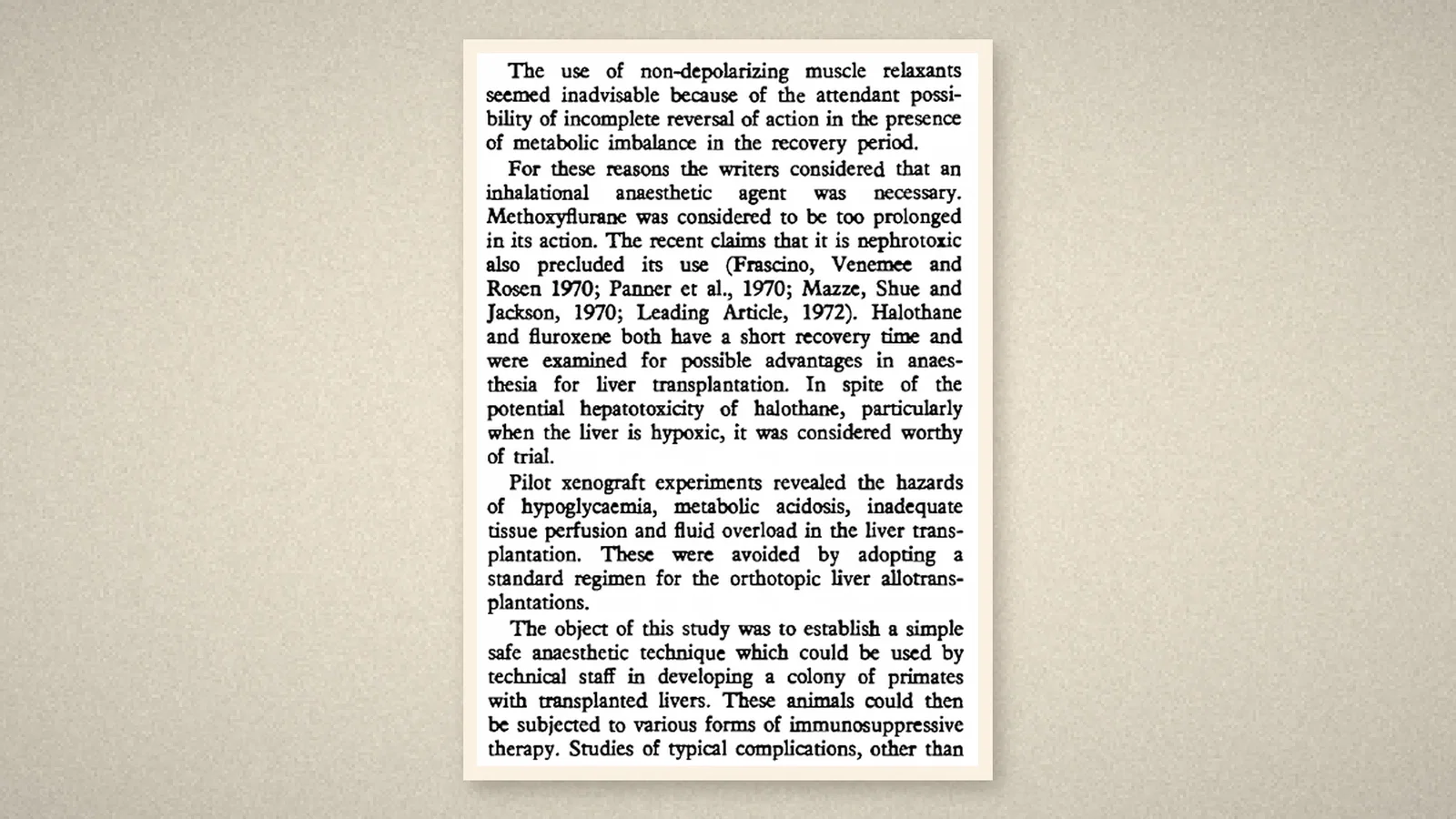
Non-depolarising relaxants were avoided too, for fear of incomplete reversal amid metabolic upset; methoxyflurane acted too long and had been reported to be nephrotoxic; halothane and fluroxene both recovered quickly, and halothane, despite its potential hepatotoxicity in a hypoxic liver, was "considered worthy of trial". The aim was a simple, safe technique that technical staff could use in building a colony of baboons with transplanted livers for studies of immunosuppression. [1, p. 10]
A crush cage and spontaneous breathing
There were 17 donors and 41 recipients, with no xenografts. Intravenous or inhalational induction, the authors wrote, "is not practicable in primates", so the animals were placed in a "crush" or "squeeze" cage and sedated by intramuscular injection before they could be handled; they were vicious, and the sedation suppressed the bite reflex. Contact with monkeys carried a considerable risk of serious or fatal virus infection, and care was needed; there had been no serious mishaps among staff in three years. [1, p. 11][1, p. 12]
Anaesthesia was then deepened with the inhalational agent for intubation and maintained in oxygen through a Magill circuit. No muscle relaxant was needed and the animals breathed spontaneously, with periodic hyperinflation against atelectasis, continuous arterial and central venous pressure and regular blood gases. [1, p. 12]
Two agents, two outcomes
In donors, two hours of either agent produced no significant changes. Recipients differed: in one group pretreated with antilymphocyte globulin, every animal given halothane died within 24 hours with fatty change and necrosis of the liver. "The discouraging results obtained using halothane precluded its further use." [1, p. 11][1, p. 15]
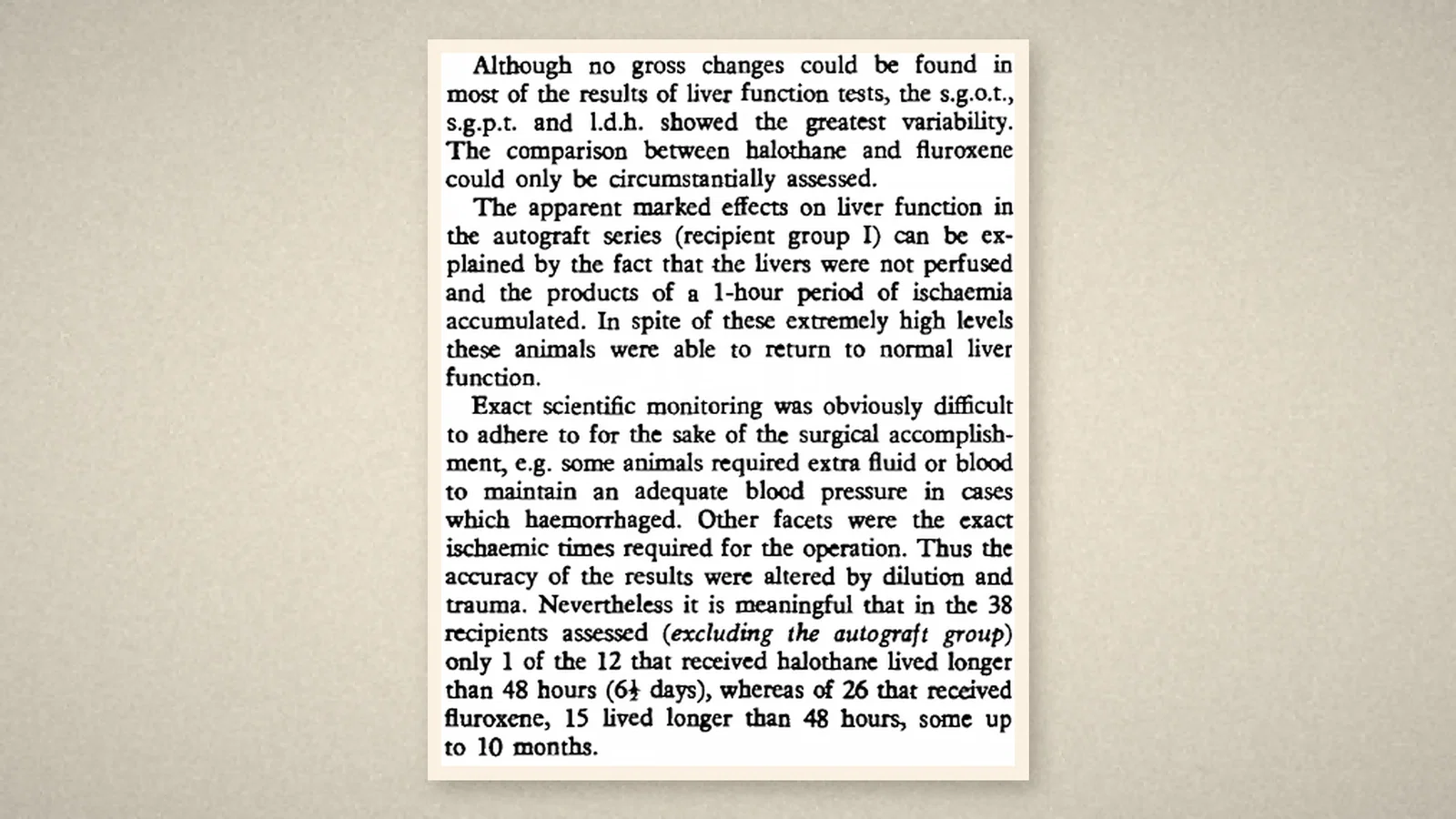
In the discussion the authors stressed that this small group was part of a larger programme and that the comparison between halothane and fluroxene "could only be circumstantially assessed": some animals bled and needed extra fluid or blood, ischaemic times varied, and dilution and trauma affected the results. Still, they found it meaningful that of 38 recipients, excluding the autografts, only 1 of 12 given halothane lived longer than 48 hours, whereas 15 of 26 given fluroxene did, some for up to ten months. They urged caution because ischaemic times were not identical, and suggested that hepatic hypoxia might have acted as a "triggering mechanism" in the presence of halothane. [1, p. 18]
Since the survey, a tranquilliser with fluroxene and oxygen had become the standard technique, with no deaths during operation or immediately afterwards in over 200 cases; the animals were "awake and vigorous" at once. The authors noted that fluroxene had earlier been found the safest inhalational agent for renal transplant surgery (Vetten, 1970), and counted among the combination's greatest advantages the safety with which technical staff could use it. [1, p. 19]
What the record shows
The paper records a rarely mentioned part of transplant research: finding a simple, safe anaesthetic for a dangerous animal at altitude, through long ischaemia and heavy fluid replacement. It reports a striking difference between the two agents, and says plainly that the comparison could only be circumstantial.
Sources and reading limits
Read: Vetten, Myburgh, Mieny, Bersohn, Isaacs and Nermudzhivadi, "Anaesthesia for liver transplantation in primates", Br J Anaesth 1973;45:10-20 (the whole paper: summary, introduction, materials and methods, anaesthetic technique, results with tables and figures, discussion and acknowledgements; page images checked). Obtained through institutional access.
Not covered: the 2020 South African Medical Journal history article on Vetten; Vetten's 1970 paper on renal transplantation and the work on cardiac surgery and conjoined twins; Foster and colleagues' baboon method and the other works cited.
Limits: some accounts frame Vetten's work up to 1967 and list cardiac surgery, transplantation and conjoined twins; this article covers only the 1973 primate study, which lies outside that range. The authors call the halothane-fluroxene comparison circumstantial and note that ischaemic times differed; the later 200-case series is reported only in outline. The paper prints the name as K. B. Vetten, and that form is used here. All doses, concentrations, laboratory values and the altitude figure are omitted, and page crops stop before them. These were animal experiments; no patient is involved.
Three illustrations are crops of Br J Anaesth 1973 pp. 10 and 18 (title and summary, the choice of agents, a discussion paragraph). One is a text diagram drawn from the paper, with no animals or people and no doses.
- Vetten KB, Myburgh JA, Mieny CJ, Bersohn I, Isaacs F, Nermudzhivadi A. Anaesthesia for liver transplantation in primates. Br J Anaesth. 1973;45:10-20. DOI
Continue exploring
Related reading connects shared questions and contexts; it does not by itself establish historical influence.
- 1964: Mushin and Colleagues Find No Excess Liver Damage After Halothane
- 1960: The Cleveland Clinic Reports Methoxyflurane in 206 Patients
Anesthesia Epochs · The Source Room · About & Editorial Method
Published November 3, 2026. Sources and reading limits are stated above. Illustrations are labelled as original source images or AI-made. Historical accounts are educational; they are not current treatment instructions.