In January-February 1963 Anesthesiology printed four cases from Brody and Sweet of the University of Michigan, Ann Arbor, three of them fatal: massive hepatic necrosis after surgery under halothane, in two patients whose liver biopsies at operation had been normal, three of them after biliary surgery. On 3 January 1964 Sheila Sherlock of the Royal Free Hospital told the Section of Anaesthetics of the Royal Society of Medicine that reports had multiplied since Brody and Sweet, 39 patients in 19 papers, 17 fatal; the relationship was still uncertain, research on a very wide scale should be assessed by a central group, the association was too rare to abandon the agent, but more than one exposure should be avoided. On 8 August 1964 the BMJ printed Mushin, Rosen, Bowen and Campbell's retrospective study from the United Cardiff Hospitals, 1960 to 1962: no statistical difference between halothane and non-halothane anaesthesia in liver-function tests, hospital stay or mortality, and no susceptible patient among 15,747 halothane anaesthetics. They noted that a prospective study proposed on a large scale in the USA had been abandoned over ethical objections, and argued that one could now proceed. The 1966 summary of the US National Halothane Study itself was not read.
Reading Library · Anesthesia Epochs · 中文版
Watch the education video (for clinicians)
1964: Halothane — What a Negative Study Leaves Open · Anesthesia Epochs Education Series
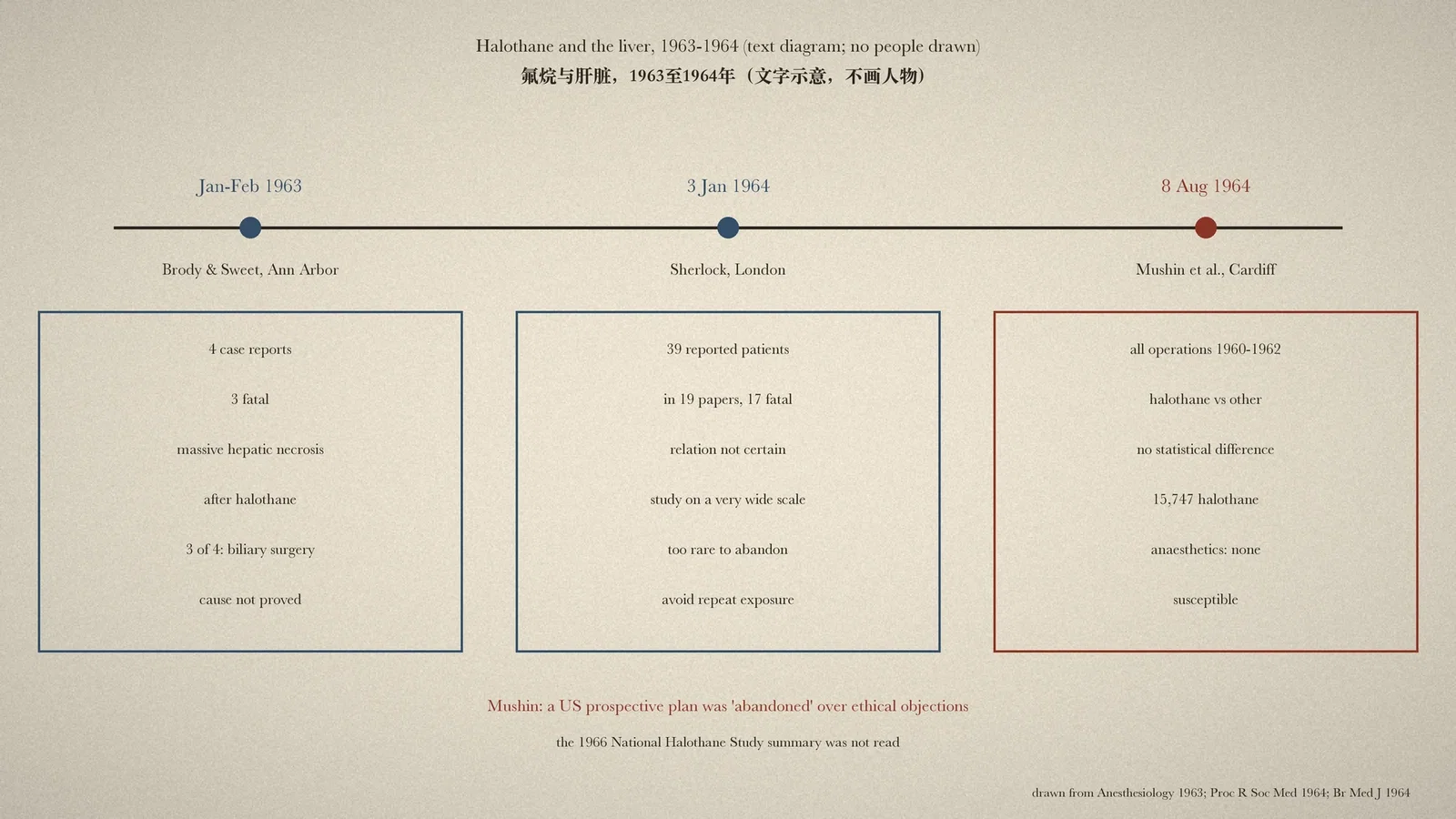
Once a drug is in wide use, scattered serious cases begin to appear, and doctors face a hard question. Did the drug cause them, or would they have happened anyway? Should it be withdrawn? In 1963 and 1964 a handful of papers on halothane and liver necrosis set out that question step by step: first case reports, then a review by a liver specialist, then a large retrospective study. [1, p. 29][2, p. 305][3, p. 329]
Four cases from Ann Arbor
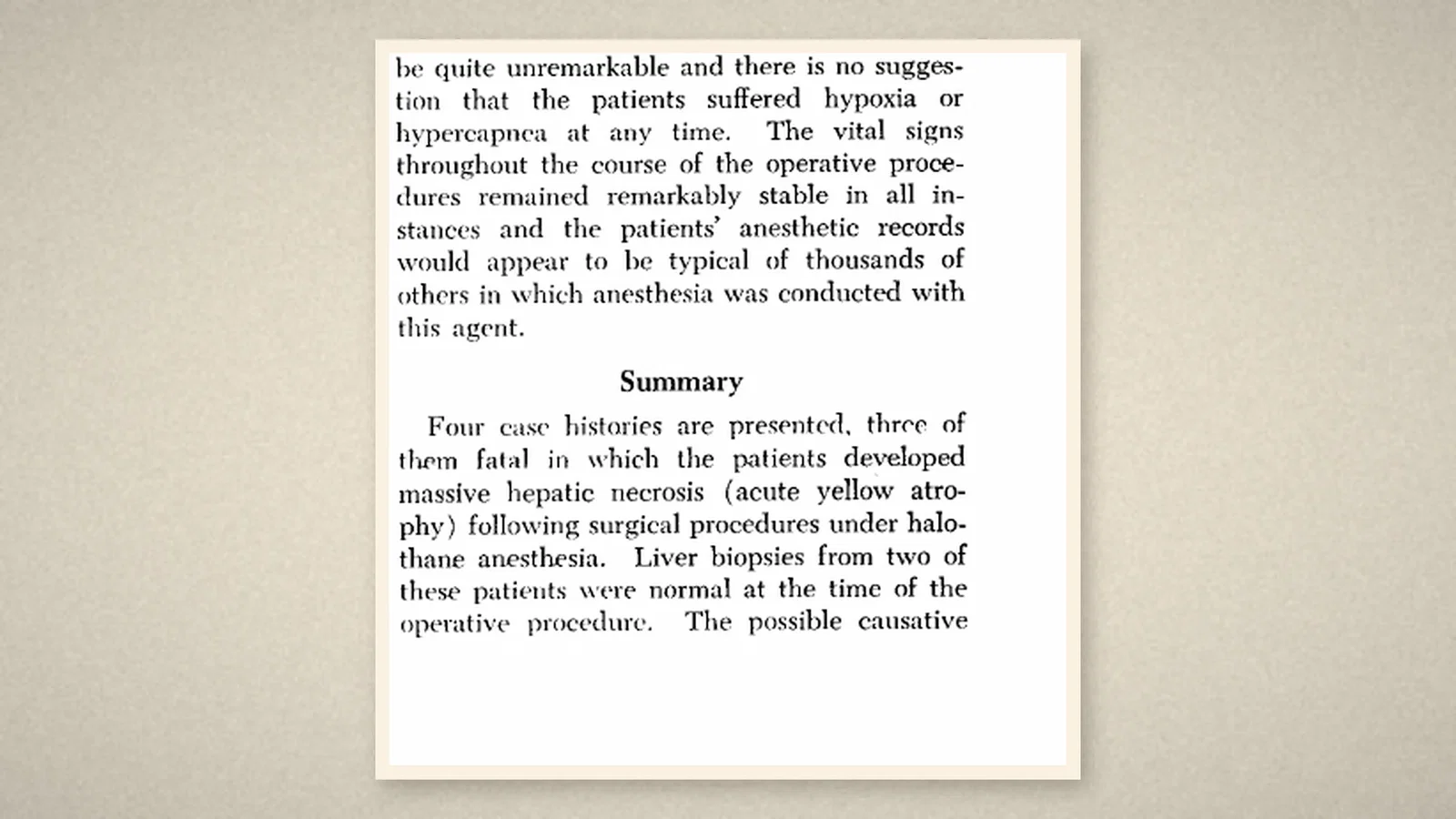
In January-February 1963 Anesthesiology printed "Halothane anesthesia as a possible cause of massive hepatic necrosis" by Gerald L. Brody and Robert B. Sweet of the Departments of Pathology and Anesthesiology, University of Michigan. Halothane, they began, was becoming widely used for a great variety of operations; its low toxicity was recognized and reports of adverse effects were few. Yet "the following four cases, three of them fatal", implicated halothane as the cause of massive hepatic necrosis (acute yellow atrophy). [1, p. 29]
In the discussion the two authors noted that liver biopsies taken at operation in two patients had been normal. Two patients had had more than one halothane anaesthetic, and what effect the repeated anaesthetics had on the liver, "we cannot say". The anaesthetic course itself gave no hint of hypoxia or hypercapnia. The summary closes by noting that three of the four patients had operations on the biliary tract, which the authors believed to be significant. [1, pp. 36-37]
A liver specialist's review
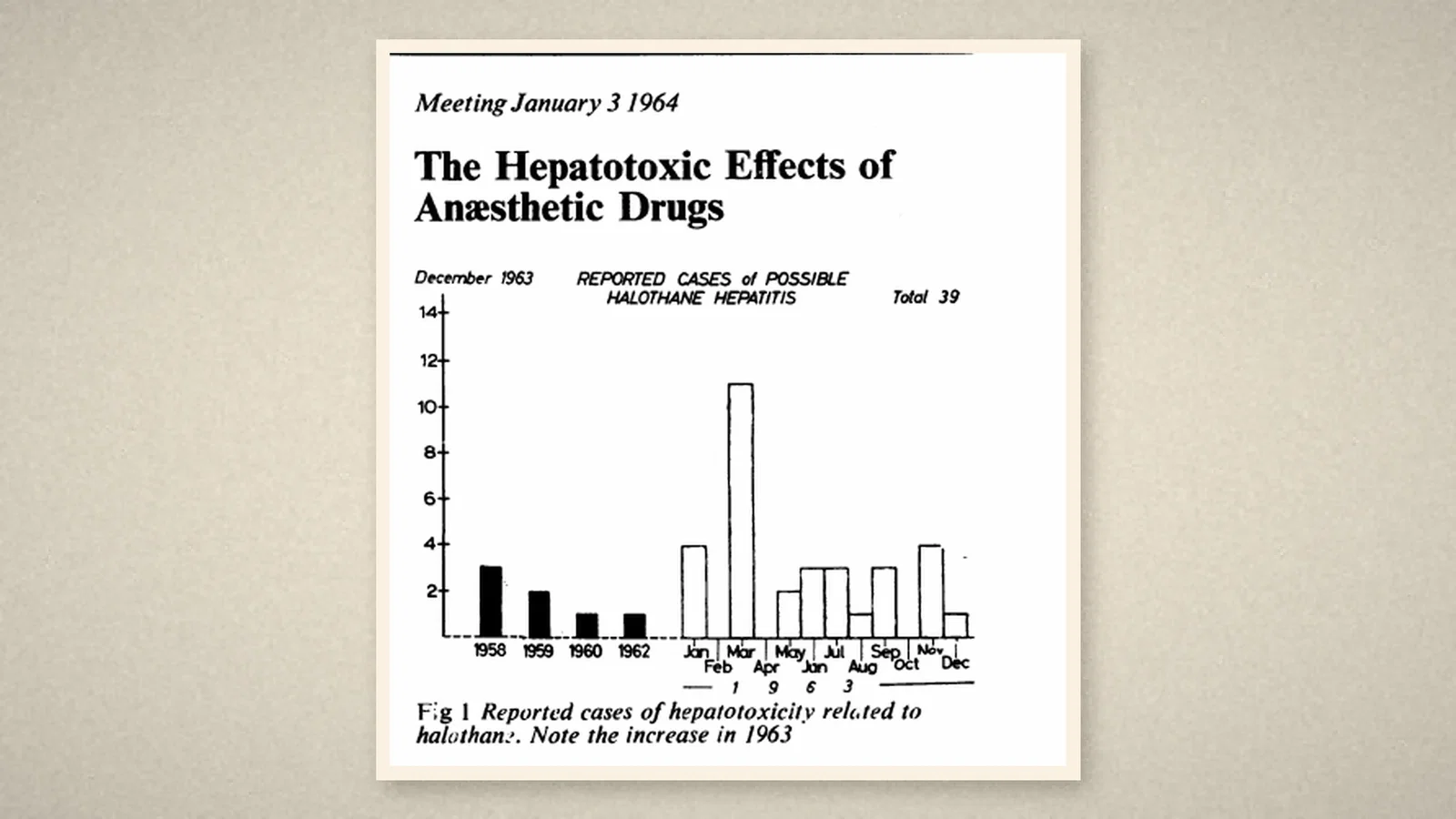
On 3 January 1964 the Section of Anaesthetics of the Royal Society of Medicine met to discuss the hepatotoxic effects of anaesthetic drugs. Professor Sheila Sherlock of the Royal Free Hospital, London, said that the real spate of publications had come in 1963, "following the paper of Brody & Sweet in January" and two papers in the New England Journal of Medicine in March. So far nineteen papers had reported hepatotoxic effects in 39 patients, 17 of them fatal, and 28 of the reported cases had received the drug more than once. Sherlock's Fig 1 plotted the reports by month, with the bars rising sharply in 1963. [2, p. 305]
It was not, Sherlock said, solely an "American disease": cases had been noted in Canada, France, Germany, South Africa and Britain. Perhaps the Americans were simply more alert in recognizing the association. [2, p. 306]
The conclusion was cautious. The relation between halothane and hepatic toxicity was "still not certain". Research should be undertaken "on a very wide scale" on the effect of all anaesthetics on the liver, assessed by a central group of surgeons, anaesthetists, physicians and pathologists trained in liver disease. The association must be extremely rare, "certainly not frequent enough to merit abandoning the anesthetic at the present time". But more than one exposure should be avoided, particularly if the earlier one was followed by otherwise unexplained fever or jaundice. [2, p. 307]
A retrospective study in Cardiff
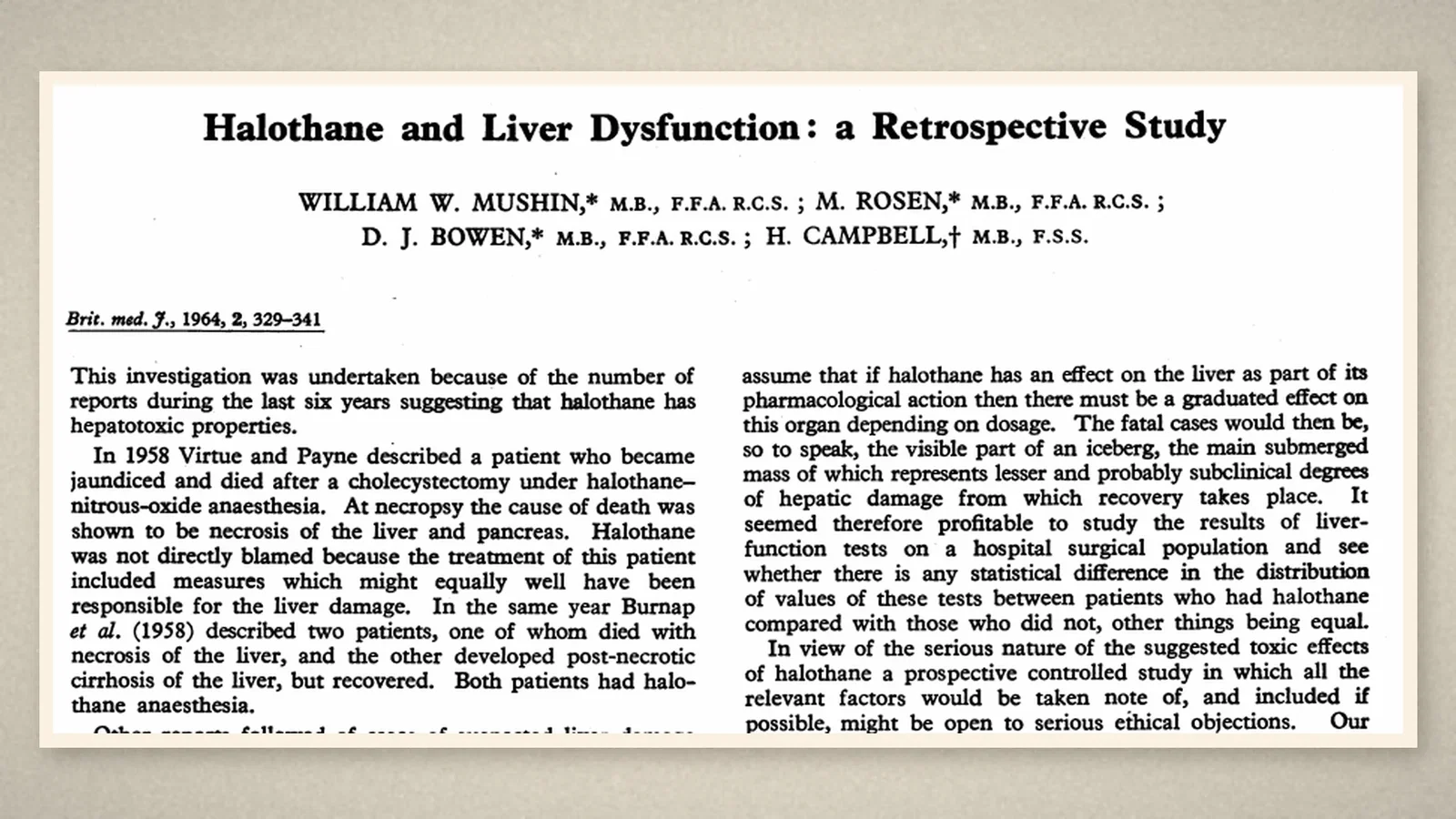
On 8 August 1964 the British Medical Journal printed a long paper by William W. Mushin, M. Rosen and D. J. Bowen of the Department of Anaesthetics, Cardiff, and H. Campbell, a lecturer in medical statistics at the Welsh National School of Medicine. The study, they wrote, had been undertaken because of reports over six years suggesting that halothane was hepatotoxic, 40 cases in the world literature. The manufacturers, ICI, had also sent an inquiry to 1,700 anaesthetists in Great Britain. [3, p. 329]
The authors judged that a prospective controlled study might meet serious ethical objections, so they used their own records instead. They took every operation under general anaesthesia in the United Cardiff Hospitals from 1 January 1960 to 31 December 1962 and compared anaesthetics with and without halothane. [3, p. 329]
There was no statistical difference between the groups in postoperative stay or mortality, or in liver-function tests within 28 days of operation. Patients with unexplained abnormal tests were spread across the anaesthetics in proportion to their use. "We found no examples of patients with this susceptibility in the 15,747 halothane anaesthetics we studied", the authors wrote, adding that if such a defect existed its incidence might be too low to show in that number. [3, p. 340][3, p. 341]
One passage of the discussion shows the bind of the time. A prospective approach had been proposed on a large scale in the USA. But so long as some clinicians felt the link between halothane and liver damage was proved, serious ethical objections were raised, and that study was abandoned. Since their own study had found no specific hepatotoxic or sensitizing effect, the authors felt that a prospective study "could be carried out without serious ethical objection". [3, p. 340]
What the record shows
From four cases to 15,747 anaesthetics, this thread shows an old problem of drug safety. Case reports can raise the alarm but cannot prove cause, while large studies are bound by ethics and by what the records hold. Sherlock's central group and Mushin's prospective study both pointed towards something larger. Some timelines place this topic at the US National Halothane Study of 1966, but its summary was not read for this article.
Sources and reading limits
Read: Brody and Sweet, Anesthesiology 1963;24:29-37 (introduction, the opening of case 1, discussion and summary); Mushin, Rosen, Bowen and Campbell, Br Med J 1964;2:329-41 (introduction, plan of investigation, discussion, conclusions and summary; tables and case analyses skimmed); Sherlock, Proc R Soc Med 1964;57:305-7 (Sherlock's whole contribution; Rollason's paper that follows skimmed). The PubMed Central scans and the Anesthesiology PDF were obtained for this article.
Not covered: the Summary of the National Halothane Study (JAMA 1966;197:775-88); the full NIH report; the case reports of Lindenbaum and Leifer, Bunker and Blumenfeld, Tygstrup and others; Green and Mungavin's report of the ICI inquiry. A Countway Library finding aid for Charles S. Davidson's papers lists a copy of the JAMA summary in that collection; it is a catalogue entry only and was not used as evidence.
Limits: the wider topic is the national study of 1966, but because its summary was not read, this article stops at the debate of 1963 and 1964 and does not describe that study's design or findings. Mushin and colleagues mention a large prospective study proposed and abandoned in the USA; this article does not identify it with the later National Halothane Study. Case reports cannot establish cause, and Mushin's study is retrospective and from one hospital group. Doses, concentrations and laboratory values are not repeated, and page crops stop before them. Patients are not identified.
Three illustrations are crops of Anesthesiology 1963 p. 36, Proc R Soc Med 1964 p. 305 and Br Med J 1964 p. 329. One is a text timeline drawn from these sources, with no people drawn and no doses shown.
- Brody GL, Sweet RB. Halothane anesthesia as a possible cause of massive hepatic necrosis. Anesthesiology. 1963;24:29-37. DOI
- Sherlock S. Halothane and the liver (The hepatotoxic effects of anaesthetic drugs). Proc R Soc Med. 1964;57(4):305-7. PMC
- Mushin WW, Rosen M, Bowen DJ, Campbell H. Halothane and liver dysfunction: a retrospective study. Br Med J. 1964;2(5405):329-41. PMC
Continue exploring
Related reading connects shared questions and contexts; it does not by itself establish historical influence.
- 1966: Virtue and Colleagues Report Compound 347, Later Ethrane, in Patients
- 1951: Suckling Designs Halothane at ICI
- 1960: The Cleveland Clinic Reports Methoxyflurane in 206 Patients
- 1956: Johnstone's Halothane, a Nonflammable Agent Still Needing Measurement
Anesthesia Epochs · The Source Room · About & Editorial Method
Published November 3, 2026. Sources and reading limits are stated above. Illustrations are labelled as original source images or AI-made. Historical accounts are educational; they are not current treatment instructions.